Explosive Livestream Clash Over Muhammad’s Prophecies Sparks U.S. Faith-Media Firestorm
Explosive Livestream Clash Over Muhammad’s Prophecies Sparks U.S. Faith-Media Firestorm
Dallas, Texas — A combative livestream debate over Islam, prophecy, and the reliability of Islamic texts has erupted across American religious media, after a Christian polemicist challenged Muslim callers to produce a clear prophecy from Muhammad — and then turned the discussion into a heated interrogation of Quranic wording, Hadith traditions, and Islamic apologetics.
The confrontation, which unfolded in a raw online call-in format, was not a calm academic exchange. It was aggressive, emotional, mocking, and relentless. But beneath the insults and theatrical style was a serious question that has long haunted Christian–Muslim debate:
What makes someone a true prophet?
The host’s central challenge was simple. If Muslims call Muhammad a prophet, then, he argued, they should be able to show a prophecy that Muhammad gave and that came true in a clear, verifiable way. The Muslim caller tried to respond by pointing first to the Quranic opening of Muhammad’s revelation — the command traditionally rendered as “Read” or “Recite.” But the host immediately attacked the answer, arguing that the command itself creates a problem because Islamic tradition often describes Muhammad as unable to read.
That moment set the tone for the entire exchange.
The host pressed the caller again and again: if Muhammad could not read, why would the first command be “read”? The caller responded that Allah was teaching him, that divine command does not work like ordinary human instruction, and that Muslims understand the verse within a broader religious context. But the host refused to accept that explanation. He framed it as evidence of confusion at the very origin of Islam’s revelation story.
From there, the debate escalated.
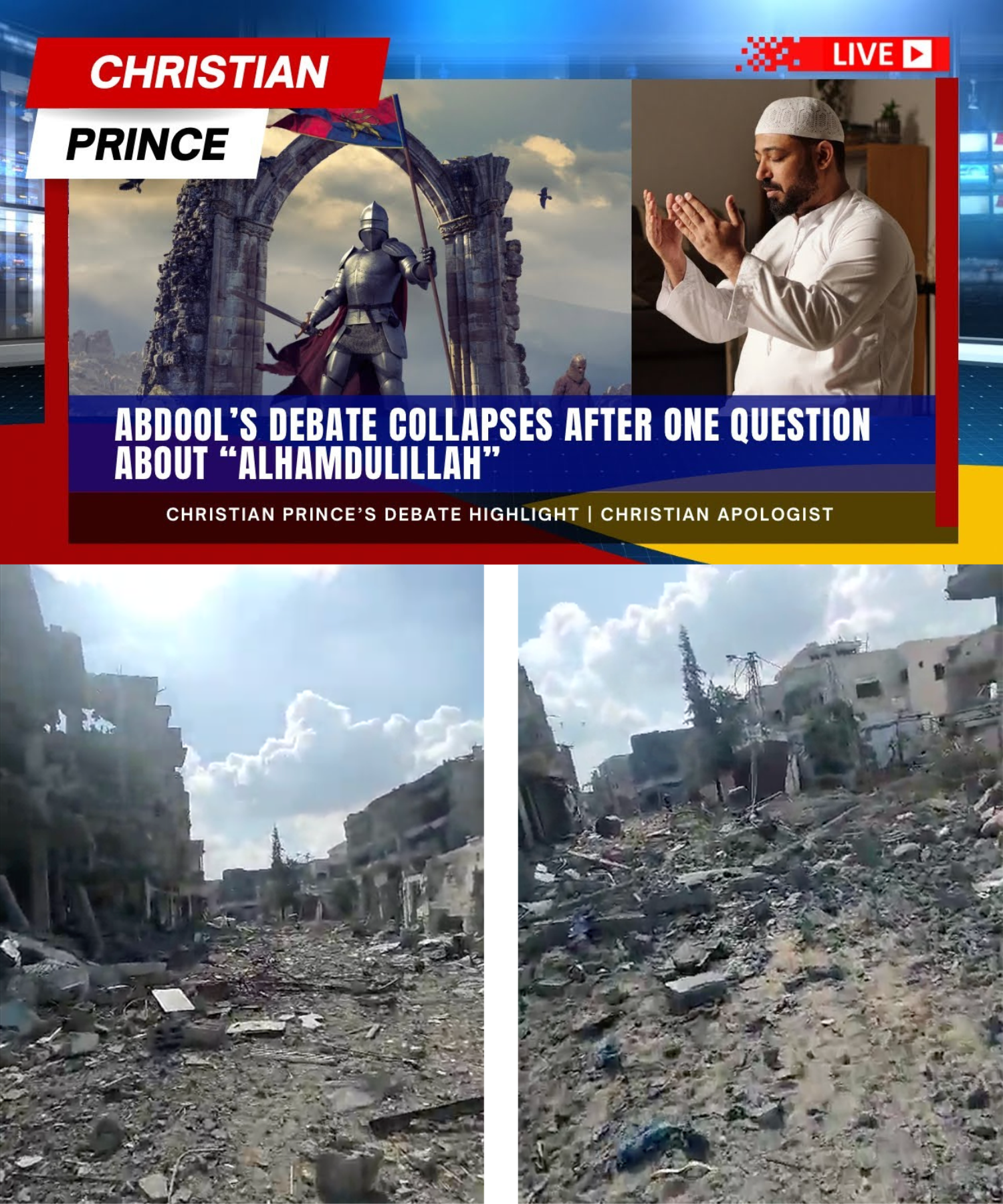
The conversation turned to Surah al-Fatiha, the first chapter of the Quran. The host questioned why Allah would say “in the name of Allah” and “praise be to Allah,” arguing that the wording sounds like a prayer recited by a worshipper rather than direct divine speech. The Muslim caller answered that Allah is teaching believers how to praise Him. But the host demanded explicit wording showing that Allah was “teaching” rather than speaking directly.
This is a classic apologetics dispute: whether prayer-like passages in scripture are divine instruction or evidence against divine authorship. Muslim scholars have long read al-Fatiha as a revealed prayer taught by God. Critics, however, often frame the chapter as rhetorically strange if the entire Quran is direct divine speech.
The call then moved to Jesus.
The host argued that Islamic tradition gives Jesus a role on Judgment Day that, in his view, belongs only to God. He pointed to Islamic beliefs about Jesus returning, judging, and defeating evil, then claimed this makes Jesus “absolute judge” in a way that undermines Islamic rejection of Jesus’ divinity. The caller rejected that framing, insisting that Jesus remains a prophet and servant of Allah, not God.
The host then shifted into Christian scripture, citing passages where Jesus discusses the Messiah and the title “Lord.” He argued that Jesus identified himself with divine authority. The caller pushed back, saying Christians must show where Jesus explicitly says, “I am God, worship me.” This became another familiar battlefield: Christians often argue Jesus claims divinity through titles, actions, worship, authority, and Old Testament references; Muslims often demand an explicit formula.
Neither side yielded.
But the sharpest part of the livestream came when the host returned to Muhammad’s prophethood.
The Muslim caller eventually cited a Hadith warning that, near the end of time, liars and charlatans would come with narrations that people and their fathers had never heard before. He presented this as a prophecy that fits modern anti-Islam critics who, in his view, bring strange claims and interpretations against Islam.
The host immediately reversed the argument. He claimed the Hadith actually indicts Muhammad or later Muslim narrators, because Islamic tradition itself contains reports that, in his view, introduced strange explanations unknown before. The caller rejected that reading, arguing the Hadith warns against false narrators, not authentic Islamic tradition.
The dispute quickly became a fight over Hadith authority.
The host brought up controversial Hadith reports involving embryology, conception, resemblance between children and parents, and claims about male and female fluid. He argued that such reports reflect scientifically false ideas and therefore damage Muhammad’s prophetic credibility. The Muslim caller attempted to explain them through modern biological concepts, including chromosomes, but the host accused him of importing modern science into ancient wording that never mentions such ideas.
This portion of the exchange is now one of the most debated sections online.
Christian critics argue that some Hadith reports contain medically inaccurate claims and that Muslim apologists often reinterpret them after the fact. Muslim defenders answer that translations are often misleading, that classical terminology does not always map neatly onto modern biology, and that polemicists frequently quote texts without proper context.
The debate then turned to another controversial Hadith: Muhammad allegedly instructing sick men to drink camel milk and urine. The host used it to accuse Muhammad of promoting primitive or unsafe medicine. The caller responded that it was a specific case involving illness, not a universal religious command. He also argued that not every action or instruction in a Hadith automatically becomes a general obligation for all Muslims.
That distinction is important. In Islamic jurisprudence, not every narrated act is treated the same way. Some reports are legal, some situational, some descriptive, and some disputed in interpretation. But the host used the report as a rhetorical weapon, repeatedly asking whether Muslims today would follow that medical advice.
The caller struggled to regain control.
Then came Paul.
The host challenged the Muslim claim that Paul corrupted Christianity. He asked why Muhammad never clearly identified Paul as the corrupter if Paul was truly responsible for distorting Jesus’ message. The caller answered that Paul was not important enough to mention. The host then cited Islamic exegetical material that, according to him, identifies Paul as one of the messengers connected with Jesus’ disciples. The caller disputed the authority of those sources, saying he wanted Quranic evidence rather than any random commentary.
That exchange revealed another weakness in online religious debate: participants often shift between scripture, Hadith, tafsir, history, and later commentary, but do not always agree on which sources are binding.
For Christian viewers, the host appeared to land repeated blows by forcing the caller to confront uncomfortable Islamic texts. For Muslim viewers, the host’s style was seen as abusive, selective, and unserious, relying on ridicule rather than scholarship.
That divide explains why the clip is spreading so fast in the United States.
America has become the world’s largest digital arena for religious confrontation. Former Muslims, Christian apologists, Muslim debaters, atheist critics, Jewish scholars, and secular commentators all compete for attention in the same online marketplace. Arguments that once belonged in seminaries or mosque study circles now explode in livestreams filled with donations, clips, memes, and instant reaction videos.
The danger is that truth can become entertainment.
The host’s supporters say his aggressive style is necessary because polite interfaith dialogue often hides contradictions. They believe Islam must be challenged directly, especially on Muhammad, Hadith, women, science, prophecy, and violence.
His critics say the opposite. They argue that mocking Muslims, insulting sacred figures, and using humiliating language only hardens people, fuels resentment, and turns serious theology into spectacle.
Both responses are shaping the American debate.
At its core, the livestream raises a real and difficult question: can Islamic claims about Muhammad survive scrutiny from Quran, Hadith, history, and science? Muslim scholars say yes, but only when texts are read correctly and not ripped from context. Christian critics say the pattern of defensive reinterpretation reveals deeper problems.
The debate ended without resolution. No caller conceded. No side changed position. But the episode did what viral religious media does best: it exposed the pressure points.
Muhammad’s prophethood.
Jesus’ identity.
Hadith reliability.
Scientific claims.
Paul’s role.
And the fragile line between apologetics and public humiliation.
The livestream may not settle the argument.
But it proves one thing clearly: in America’s digital faith wars, no sacred claim is safe from the microphone.