Muslim Prayer Outside UK Defense Ministry Sparks U.S. Firestorm Over Islam, Secularism, and Public Power
Muslim Prayer Outside UK Defense Ministry Sparks U.S. Firestorm Over Islam, Secularism, and Public Power
Washington, D.C. — A photograph of Muslim worshippers praying outside Britain’s Ministry of Defence has detonated into a transatlantic political controversy, with American commentators seizing on the image as a warning about religion, public space, national identity, and the limits of tolerance in Western democracies.
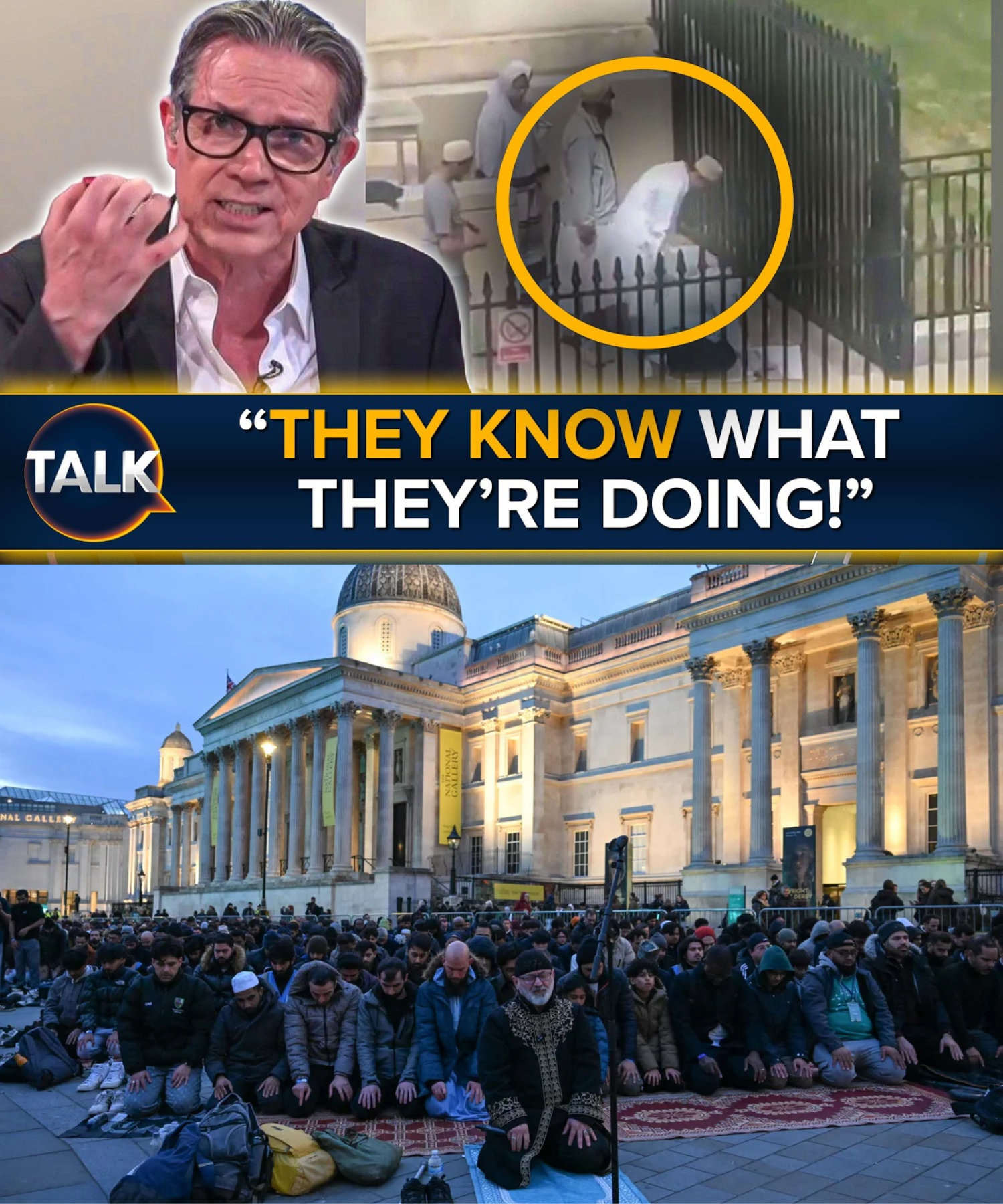
The image, discussed on a British political broadcast and now spreading through U.S. conservative media circles, shows a group of Muslim men laying down prayer mats and praying in a highly symbolic location: outside the Ministry of Defence, the heart of Britain’s military establishment.
For critics, the scene was not simply private worship. It was a message.
For defenders, it was an exercise of religious freedom being inflated into a culture-war panic.
And for Americans watching from across the Atlantic, the controversy feels disturbingly familiar.
The debate began after British commentator Nick Timothy reportedly described the public prayer as a “deliberate political act of domination.” His argument, echoed by others in the broadcast, was that there was no clear religious necessity for praying at that particular site, especially when mosques exist for worship and when prayer could be performed privately or in less symbolic spaces.
The question now raging online is simple but explosive: when does public religious expression become political theater?
Journalist Khadija Khan, who appeared in the discussion, took a sharply critical position. She argued that the issue was not Muslims as individuals, nor their right to believe, worship, or practice their faith. Rather, she said the concern was about performing highly visible religious rituals in shared civic and political spaces, especially when those spaces carry national symbolism.
In her view, the location matters.
A prayer gathering outside a mosque is one thing. A prayer gathering outside a defense ministry, Parliament, a school, a war memorial, or a national monument is something else entirely. It shifts the act from private devotion into public messaging, whether the participants intend that or not.
That argument has struck a nerve in America.
The United States has its own long-running battles over religion in public life: school prayer, Ten Commandments displays, public nativity scenes, Satanic Temple counter-displays, prayer at city council meetings, Islamic calls to prayer, and religious exemptions in public institutions. But the British controversy adds a sharper edge because it involves Islam, national defense, and growing anxiety over public Islamism in Europe.
Conservative American outlets are framing the image as proof that Western governments are afraid to defend secular civic space when the religion involved is Islam. They argue that if Christians, Jews, or nationalist protesters performed similar symbolic rituals outside sensitive government sites, the reaction from authorities and media would be far harsher.
Progressive and civil liberties voices strongly reject that framing. They warn that treating Muslim prayer as inherently threatening risks turning ordinary religious practice into suspicion. They argue that Western democracies must protect the right to worship publicly unless there is obstruction, intimidation, violence, or direct security risk.
That distinction is now the heart of the fight.
Public prayer alone is not extremism. Millions of Muslims pray peacefully every day. Most do not seek political domination, Sharia rule, or public confrontation. Many British and American Muslims see themselves as loyal citizens who simply want the same religious liberty others enjoy.
But critics say the problem is not ordinary prayer. The problem is strategic visibility.
Khan argued that mass or symbolic Islamic rituals in civic spaces can become political when used to assert presence, pressure authorities, or normalize religious power in secular settings. She pointed to large public prayer gatherings and Ramadan events in major British locations as examples of how religious expression can take on political meaning in a society already anxious about integration, blasphemy norms, and free speech.
Her broader warning was that Britain is losing the courage to criticize anything associated with Islam without immediately being accused of bigotry.
That warning resonates powerfully in the United States, where debates over “Islamophobia” have become politically loaded. Some activists say the term is necessary to name real anti-Muslim prejudice, harassment, discrimination, and violence. Others argue that it is sometimes used to shut down legitimate criticism of Islamist ideology, gender segregation, religious coercion, or efforts to introduce religious norms into public life.
The photograph outside the Ministry of Defence has become a flashpoint because it contains both fears at once.
To one audience, it shows Muslims being unfairly demonized for praying.
To another, it shows a secular state being tested in plain sight.
The location intensifies everything. The Ministry of Defence is not a random sidewalk. It is tied to Britain’s armed forces, wars in Iraq and Afghanistan, terrorism debates, national memory, and the country’s military identity. The broadcast’s host pointed out that memorials connected to those conflicts were nearby, adding further symbolic weight to the moment.
That is why critics say the act could not be politically innocent.
But here is where the debate becomes dangerous: symbolism is not proof of intent.
A group of Muslims praying in a public area may be making a statement. They may also simply be fulfilling prayer at a given time while gathered in London. Without evidence of organization, messaging, or explicit political purpose, sweeping claims can quickly become collective accusation.
That is the line responsible journalism must hold.
The real story is not that Muslims prayed.
The real story is that Britain no longer agrees on what public religious expression means.
And America is heading in the same direction.
In a confident society, the boundaries would be clearer. Private prayer would be protected. Public obstruction would be regulated. Political religious demonstrations would be debated honestly. Criticism of religious symbolism would not automatically be smeared as hatred. And no peaceful religious minority would be treated as guilty by association with extremists.
But Western societies are no longer confident.
In Britain, fears over Islamist extremism, grooming scandals, campus radicalism, pro-Palestinian protests, and free-speech controversies have created a climate where even a prayer mat can become a political weapon. In America, debates over immigration, antisemitism, religious liberty, Christian nationalism, and Muslim civil rights are pushing the same unresolved questions into the open.
Who owns the public square?
Is the state neutral, secular, Christian-rooted, multicultural, or post-religious?
Can a democracy protect religious freedom while resisting religious politics?
Can it criticize Islamism without targeting Muslims?
Can it preserve national identity without punishing minority expression?
Those questions are no longer theoretical.
They are appearing on sidewalks, campuses, airports, city halls, protest marches, and now outside defense ministries.
The viral UK image has become powerful because it forces Americans to confront a truth many would rather avoid: pluralism does not run on slogans. It requires boundaries, confidence, and honesty.
A society that cannot distinguish prayer from political pressure will eventually fear all prayer.
A society that cannot criticize political religion will eventually surrender public space.
The challenge is to avoid both failures at once.
That is why this controversy matters far beyond London.
It is not only about a group of men praying outside a government building.
It is about whether the West still knows how to defend freedom without losing itself.