Footage From a Texas Feral Hog Massacre Reveals an Aftermath Nobody Expected
Texas Declares War on 3 Million Feral Hogs as Trail Camera Footage Reveals a Sudden Ecological “Rebirth”
In the vast farmlands and brush country of Texas, a silent war has been raging for decades — one that most Americans never see, but many farmers live with every day.
It is not a war between armies.
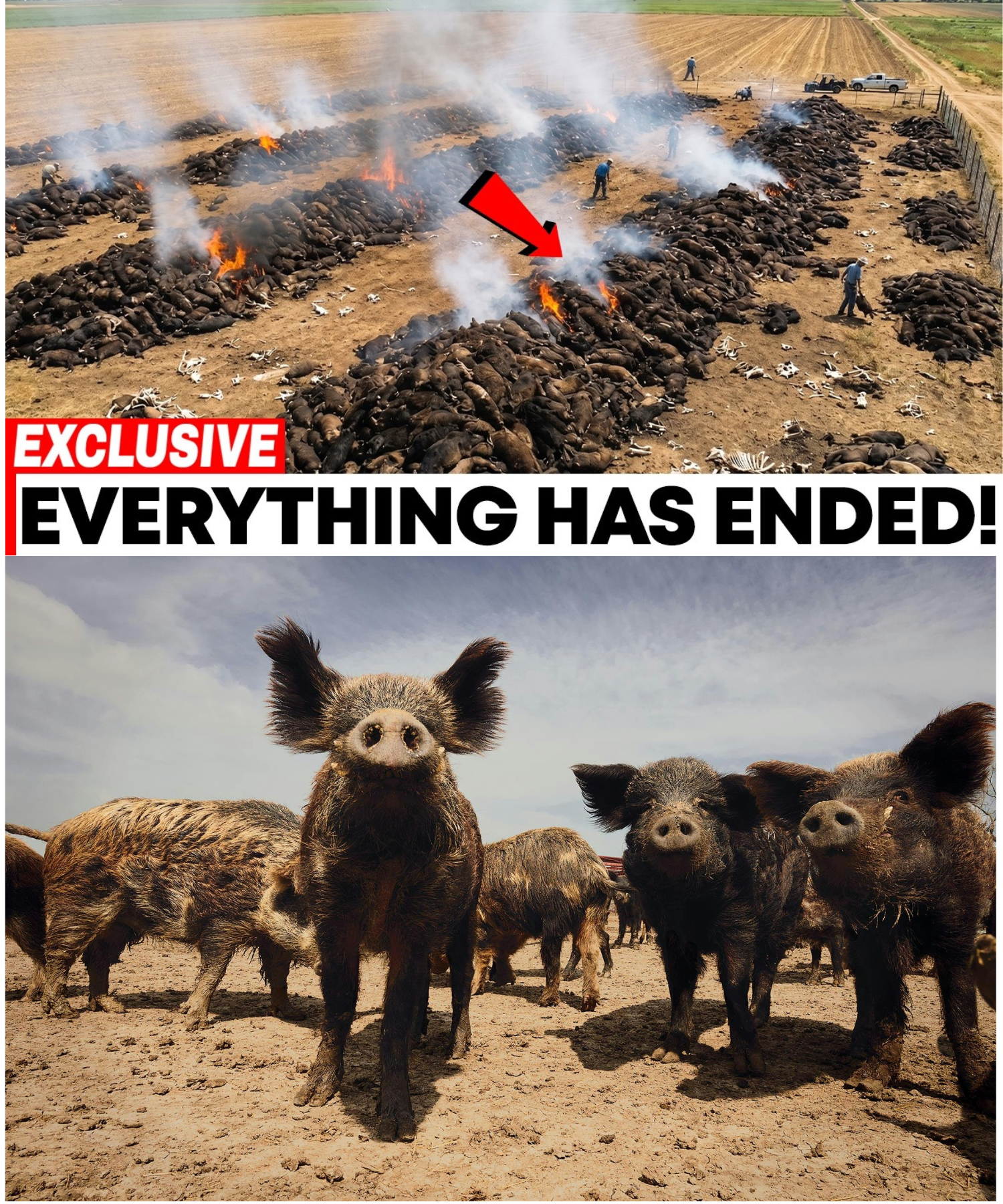
It is a war between humans and nearly 3 million feral hogs.
And now, new trail camera footage is revealing something that has stunned wildlife managers across the state: when pressure on hog populations drops, the land begins to recover almost immediately.
Grass returns. Water clears. Deer reappear.
But the bigger question is whether Texas is winning — or simply holding the line in a battle that never ends.
From 13 Pigs to a Continental Problem
The origins of the crisis stretch back nearly 500 years.
In 1539, Spanish explorer Hernando de Soto brought 13 pigs to what would become the southeastern United States. Those animals escaped, were released, and began multiplying in the wild.
For centuries, the population grew slowly and unnoticed. But in the 20th century, human decisions accelerated everything. Domestic pigs interbred with Eurasian wild boar introduced for hunting purposes, creating a hybrid animal perfectly adapted for survival.
The result is what Texas faces today: a highly intelligent, extremely resilient, fast-breeding invasive species capable of thriving in deserts, forests, wetlands, and suburban neighborhoods.
A single female can reproduce twice a year, producing up to a dozen piglets per litter. In ideal conditions, populations can increase by as much as 20% annually.
In Texas alone, estimates place the population between 2.5 and 3 million animals spread across 250 of the state’s 254 counties.
And they are not slowing down.
The Cost of an Expanding Invasion
The economic damage is staggering.
In 2024 alone, feral hogs caused more than $670 million in crop destruction in Texas. Another $130 million was spent on control efforts, including fencing, trapping, and monitoring.
But the real cost goes beyond agriculture.
Hogs destroy ecosystems as they feed. They root through soil, uproot crops, devastate native vegetation, and contaminate water sources. They carry diseases such as swine brucellosis, pseudorabies, and potentially African swine fever — a disease that could devastate livestock industries if it ever reaches North America’s domestic herds.
Officials estimate that a widespread outbreak could cost the U.S. economy up to $21 billion.
And yet, despite decades of effort, the population continues to grow.
The Failure of Traditional Control
Texas has adopted one of the most aggressive wildlife control programs in the United States.
Hunting is legal year-round with no bag limits. Suppressors are allowed. Night hunting is legal. Helicopter culling — known as “pork chopper” operations — permits shooters to target hogs from the air.
Super-sized corral traps are deployed across ranches, sometimes capturing entire sounders in a single night. Remote cameras alert trappers in real time.
And yet the results are underwhelming.
Wildlife biologists estimate that to stabilize the population, 60–80% of hogs must be removed annually. Even aggressive hunting and trapping efforts typically achieve only around 25%.
The math does not work in favor of eradication.
Enter Kaput: The Controversial Poison
In recent years, Texas has added a more controversial tool: Kaput feral hog bait.
The poison uses warfarin-based compounds that interfere with blood clotting, causing internal hemorrhaging in hogs after ingestion. It is designed with specialized feeders that restrict access to larger animals, reducing risk to non-target species.
One unusual detail has become symbolic of the program: hog fat turns bright blue after consumption, making contaminated carcasses identifiable in the field.
The Environmental Protection Agency approved the product, and Texas regulators allowed controlled use in 2024 after extended field trials.
Researchers reported up to 95% effectiveness in controlled environments.
But controversy remains strong. Hunting groups argue that chemical control methods could impact ecosystems if not perfectly contained, while others warn about ethical concerns and accidental exposure.
The debate reflects a deeper divide in Texas wildlife management: whether technology and toxicology should replace traditional hunting methods.
The Trail Camera Discovery
While officials tested helicopters, traps, and bait systems, researchers deployed trail cameras across heavily infested regions like Blanco County to measure results.
What they expected was simple: fewer hogs, reduced activity, gradual stabilization.
What they saw instead was faster and more dramatic than anticipated.
Within weeks of hog pressure decreasing, the land began to change.
Native grasses reappeared in areas long dominated by rooting damage. Soil that had been compacted for years began to loosen. Seedlings that had been suppressed for seasons began to emerge.
The ecosystem was responding almost immediately.
Water Systems Begin to Heal
The most dramatic changes were seen in waterways.
Feral hogs rely heavily on wallowing to regulate body temperature. These mud baths damage stream banks, increase sediment levels, and introduce bacteria into water systems.
When hog populations were reduced in test zones, water quality improved noticeably. Turbidity dropped. Vegetation along stream edges returned. Bacterial contamination levels decreased in monitored watersheds.
The Plum Creek watershed study had already shown similar improvements when hundreds of hogs were removed over a two-year period.
Now, trail camera footage was showing those effects replicated across multiple regions simultaneously.
Wildlife Returns to Empty Zones
Perhaps the most striking footage came from Blanco County.
In areas previously dominated by hog activity, white-tailed deer began returning within weeks of population reduction.
For years, hogs had outcompeted deer for food resources like acorns, corn, and vegetation. GPS studies had already shown that deer actively avoid areas heavily occupied by hogs.
When hog pressure disappeared, deer returned almost immediately.
In one clip, a deer is seen calmly grazing in a clearing that had been heavily rooted and destroyed just weeks earlier.
It was not just survival.
It was reoccupation.
A Hidden Ecological Collapse Revealed
What the trail cameras ultimately revealed was not just a reduction in a pest population — but the restoration of an entire suppressed ecosystem.
For years, hog activity had masked the natural regenerative capacity of the land. Seeds had remained dormant. Water systems had been degraded. Wildlife had been displaced.
Once that pressure was removed, recovery began almost instantly.
The land, it seemed, had been waiting.
The Uncomfortable Reality: The War Isn’t Being Won
Despite localized success, Texas remains far from controlling the broader problem.
Across the United States, an estimated 7 million feral hogs now exist in at least 35 states, with sightings in nearly all 48 contiguous states.
Annual national damage is estimated at $2 billion.
And the population continues to expand.
Human activity — including illegal relocation and historical introductions — has contributed significantly to the spread.
Even sport hunting, intended as a control measure, has sometimes unintentionally aided expansion by moving animals into new territories.
Conclusion: A Battle Without a Final Line
The Texas feral hog crisis is not simply a wildlife issue.
It is an ecological, economic, and political struggle shaped by centuries of human decisions.
The recent trail camera footage offers something rare: proof that the land can recover quickly when pressure is removed.
But it also exposes a harder truth.
The problem is not just removal.
It is scale.
With millions of animals spread across millions of acres, every victory is local — and every loss can be replaced in a single breeding cycle.
For now, Texas continues its war.
But the enemy keeps multiplying.
And the land keeps waiting — for pressure to lift long enough to breathe again.