“Why We Don’t Know What Jesus Really Looked Like”: Ancient Catacombs, Hidden Symbols, and the Evolution of the World’s Most Recognized Face
“Why We Don’t Know What Jesus Really Looked Like”: Ancient Catacombs, Hidden Symbols, and the Evolution of the World’s Most Recognized Face
A new documentary-style narration exploring the evolution of Jesus’ image across two millennia has gone viral online, sparking global debate over how religious identity is shaped through art, politics, and cultural transformation.
The video traces the visual representation of Jesus from early Christian secrecy under Roman persecution to modern depictions found in churches around the world — arguing that there is no single historically “correct” image of Christ, but rather a continuous evolution shaped by fear, power, and cultural interpretation.
At the center of the discussion is a striking question:
If Jesus is one of the most depicted figures in human history, why do we still not know what he actually looked like?
Stage One: When Jesus Was Not Shown at All
The narration begins in the first two centuries after the death of Jesus, a period when Christians lived under Roman suspicion and periodic persecution.
During this time, early followers of Christianity avoided depicting Jesus directly. Instead, they relied on symbolic imagery that could be safely hidden or misunderstood by outsiders.
Symbols such as the fish (ichthys), the anchor, and the Chi-Rho became coded markers of identity among believers. These symbols allowed Christians to recognize each other without openly revealing their faith.
The reluctance to depict Jesus was not only due to fear of persecution, but also theological concerns inherited from Jewish traditions that warned against creating images of divine beings.
As a result, Jesus remained visually invisible for nearly 200 years.
The First Image: Mockery in Roman Graffiti
One of the earliest known visual references to Jesus appears not in Christian art, but in Roman mockery.
A piece of graffiti discovered on the Palatine Hill in Rome, dated around 200 CE, depicts a man worshiping a crucified figure with the head of a donkey.
The inscription reads: “Alexamenos worships his god.”
Historians interpret this as an insult aimed at early Christians, reflecting how Roman society viewed the idea of worshipping a crucified figure as absurd and humiliating.
Ironically, this crude drawing may represent one of the earliest surviving visual references to Jesus on the cross — not as reverence, but as ridicule.
Stage Two: The Good Shepherd Era
By the third century, Christianity had begun to spread more widely, despite ongoing persecution.
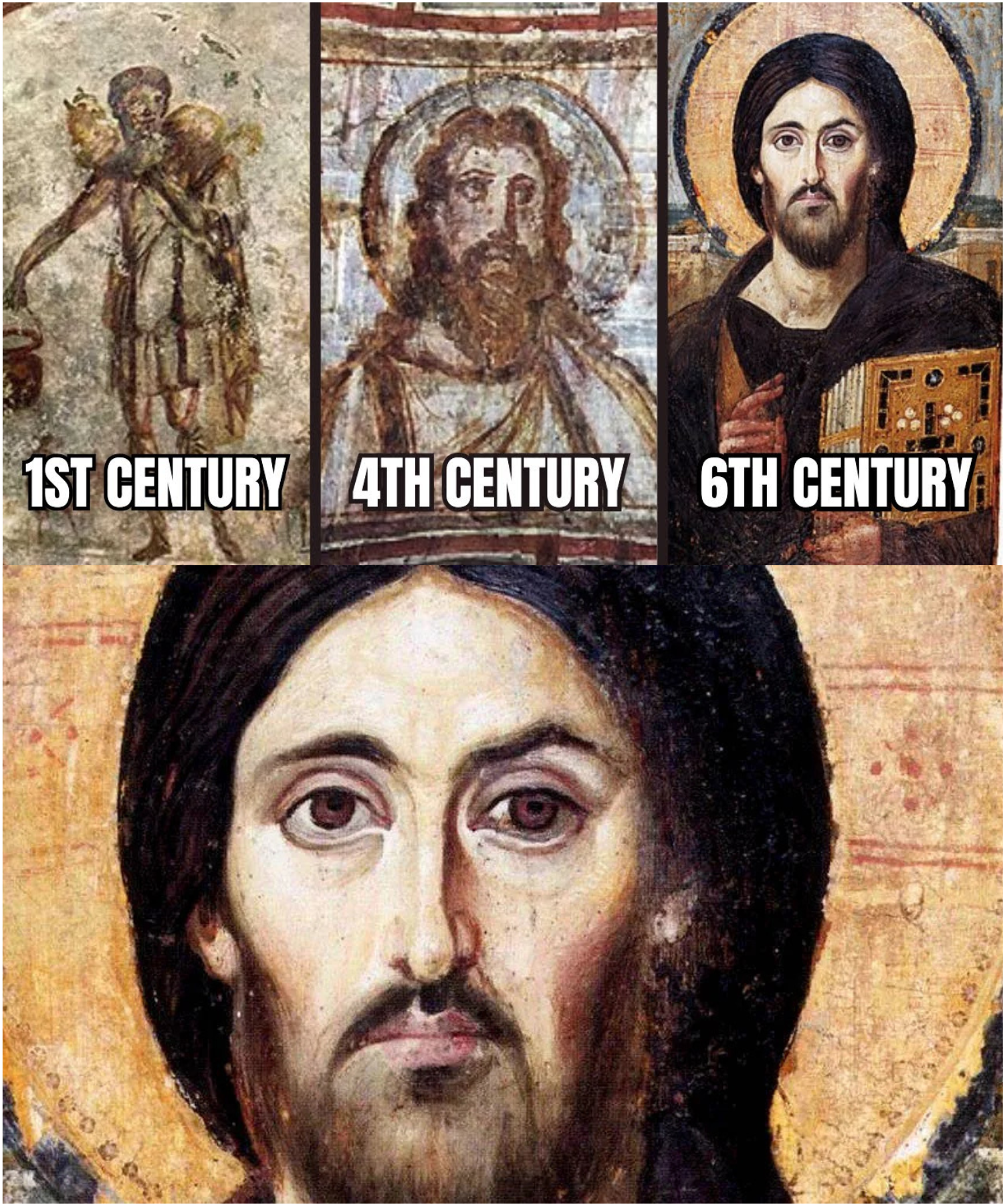
In underground burial sites known as catacombs, early Christians began producing the first respectful images of Jesus.
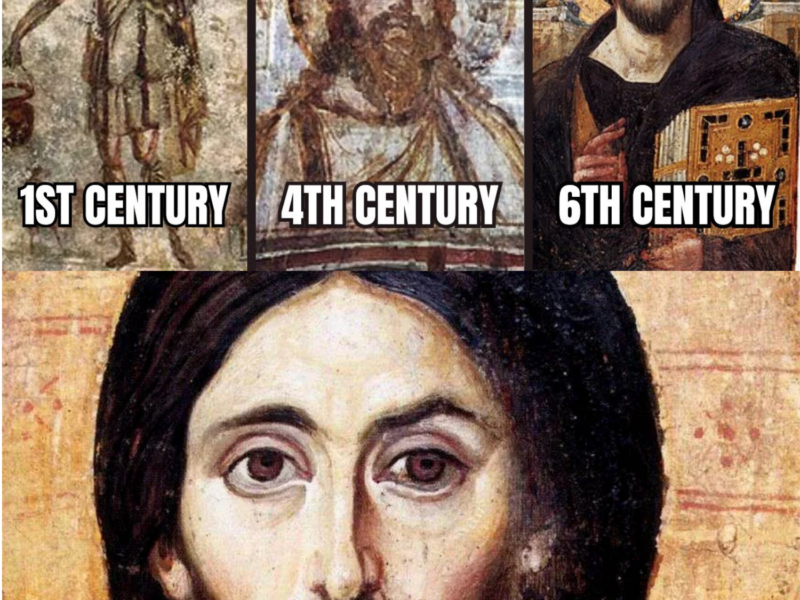
However, these depictions look very different from modern expectations. Jesus appears as a young, beardless man dressed in Roman-style clothing, often carrying a sheep on his shoulders.
This image, known as the “Good Shepherd,” reflects biblical passages in which Jesus describes himself as a protector of his followers.
The visual style was heavily influenced by Greco-Roman art, borrowing familiar imagery of shepherd gods and mythological figures.
In some depictions, Jesus is even shown holding a wand-like object, symbolizing healing and miraculous power in a visual language that Romans could understand.
Stage Three: The Emergence of the Bearded Christ
A major transformation occurred after 313 CE, when Emperor Constantine legalized Christianity through the Edict of Milan.
Once Christianity became publicly accepted, artistic representations of Jesus shifted dramatically.
He began to appear as a mature, bearded figure — a visual symbol of authority, wisdom, and divine power.
This new image aligned Jesus with Roman philosophers and imperial rulers, reinforcing his status not only as a spiritual teacher but as a cosmic authority.
However, earlier beardless depictions did not disappear immediately. For centuries, both versions coexisted across different regions of the Christian world.
Stage Four: The Byzantine Christ Pantocrator
By the sixth century, the image of Christ Pantocrator — “Christ the Almighty Ruler” — became dominant in the Eastern Roman Empire.
This depiction shows Jesus with long hair, a beard, and a solemn expression, often holding a Gospel book and raising one hand in blessing.
One of the most famous surviving examples, located at St. Catherine’s Monastery in Egypt, shows an intentionally asymmetrical face — one side appearing stern and judgmental, the other compassionate.
Scholars interpret this as a visual representation of Christ’s dual nature: divine judgment and divine mercy.
This iconographic style remains central to Eastern Orthodox Christianity to this day.
Stage Five: Medieval Transformation — Suffering and Majesty
During the medieval period, Western Christian art developed two contrasting visions of Jesus.
One emphasized Christ as a majestic ruler seated on a throne, surrounded by symbolic representations of the Gospel writers.
The other focused increasingly on his humanity and suffering.
Influenced by Franciscan spirituality, artists began portraying Jesus as a vulnerable figure — a baby in the nativity scene or a suffering man on the cross.
By the Gothic period, crucifixion imagery became emotionally intense, with detailed depictions of pain, blood, and human suffering.
Art was no longer just theological instruction — it became emotional experience.
Stage Six: The Renaissance Jesus
The Renaissance marked a turning point in artistic realism.
Artists like Leonardo da Vinci and Michelangelo reimagined Jesus using human anatomy, perspective, and classical techniques.
In The Last Supper, Jesus is portrayed as a deeply human figure reacting emotionally to betrayal.
In Michelangelo’s Pietà, Mary holds the lifeless body of Jesus with heartbreaking realism.
At the same time, controversy emerged over artistic freedom, especially when religious imagery became more anatomically detailed or influenced by classical pagan aesthetics.
Church authorities eventually imposed restrictions on how Jesus could be depicted.
Stage Seven: Reformation and Iconoclasm
The Protestant Reformation introduced a major rupture in Christian visual culture.
Some reformers argued that religious images could lead to idolatry and should be removed entirely from churches.
This led to waves of iconoclasm across Europe, where statues and paintings were destroyed in large numbers.
In contrast, Catholic regions continued developing religious art, leading to a long-lasting split in Christian visual traditions.
Some churches became visually minimal, while others became highly decorative and symbolic.
Stage Eight: Baroque and Rococo Emotion
The Catholic Counter-Reformation responded with dramatic Baroque art designed to evoke emotional intensity.
Artists like Caravaggio used light and shadow to highlight moments of suffering and divine revelation.
Later Rococo art softened these themes, presenting Jesus with elegance, serenity, and idealized beauty.
Together, these styles reflected shifting attitudes toward faith — from fear and awe to intimacy and emotional reflection.
Stage Nine: Modern and Global Interpretations
In modern times, depictions of Jesus have become increasingly diverse.
Artists around the world portray him with local ethnic features — African, Asian, Indigenous, and Latin American interpretations reflecting cultural identity and lived experience.
These images emphasize that Jesus belongs not to a single culture, but to global Christianity.
However, this diversity has also sparked debate over historical accuracy versus spiritual inclusivity.
Stage Ten: The Modern Question — What Did Jesus Really Look Like?
Modern forensic reconstructions suggest Jesus likely had Middle Eastern features — olive skin, short dark hair, and typical Semitic facial structure.
This contrasts sharply with the widely recognized European-style images popularized during the Renaissance and later Western religious art.
Today, scholars and religious leaders debate whether artistic tradition has distorted historical reality or simply expanded spiritual symbolism.
Conclusion: A Face That Belongs to Everyone — and No One
The documentary concludes that there is no single definitive image of Jesus.
Instead, every era has reshaped his appearance based on its own cultural, political, and spiritual needs.
From hidden symbols in Roman catacombs to global modern reinterpretations, Jesus’ image has never been fixed — only reimagined.
Ultimately, the debate is not just about history or art.
It is about identity, belief, and the human desire to see the divine in a familiar form.
And after two thousand years of evolution, one truth remains:
We may never know exactly what Jesus looked like — but every generation continues to recognize something of itself in him.