Black Voters Don’t Owe Democrats Anything: Viral Debate Exposes a Political Crisis Shaking America
Black Voters Don’t Owe Democrats Anything: Viral Debate Exposes a Political Crisis Shaking America
A furious online debate over Black voters, the Democratic Party, patriotism, and the growing “leave America” movement has exploded across American social media, exposing a political fracture that Democrats can no longer ignore.
The viral discussion began with a blunt message aimed directly at white Democrats.
Black people, the speaker declared, do not owe the Democratic Party their votes, their campaign labor, their silence, or their loyalty. They have fought for the country, bled for civil rights, defended democratic ideals, and carried political coalitions for generations. But that, she argued, does not mean they are obligated to show up every election cycle on command.
The comment hit hard because it came at a moment when Democrats are already facing deep tensions inside their own coalition. The transcript references the Texas Senate race, Jasmine Crockett, James Talarico, and Ken Paxton — a political battlefield where questions of race, party loyalty, electability, and ideological direction are colliding in real time.
The speaker’s point was simple: if party insiders dismissed Crockett as too loud, too ghetto, or too unelectable, they should not suddenly expect her to campaign enthusiastically for the nominee who defeated her. She still argued that Democrats should vote against Paxton, but she refused to frame that support as something Black voters owed anyone.
That distinction sparked the backlash.
A conservative commentator reacting to the clip said the problem is not that some Black voters are angry with Democrats. The problem, he argued, is that they keep returning to the same party no matter how badly they feel used. In his view, the Democratic Party has learned that it can insult, ignore, and pressure Black voters because too many will still vote Democrat out of fear.
That fear was summarized in one phrase: “We are in danger.”
The commentator challenged that idea directly. Danger from what? Republicans? Conservatives? America itself? To him, this is the political spell Democrats keep casting — convince Black voters that the other side is so dangerous that they must remain loyal, even when they feel disrespected by their own party.
Then the debate widened far beyond Texas.
Another viral voice entered the conversation with a raw message about America, race, crime, freedom, and gratitude. His argument was aggressive: many Americans, including many Black Americans, spend so much time condemning the United States that they forget how rare American rights are in the rest of the world. He pointed out that in America, people can criticize the president, attack the government online, insult the country, protest, complain, and still expect due process if arrested.
That, he argued, is not normal everywhere.
In many countries, speaking too loudly against the government can lead to jail. In some places, disrespecting authority can destroy a person’s life. In America, even a defendant who hates the system may still receive a lawyer, a hearing, a judge, and constitutional protections.
To the commentators in the transcript, that is the contradiction: people who say America is unbearable often refuse to give up the citizenship, legal protections, and social freedom that America provides.
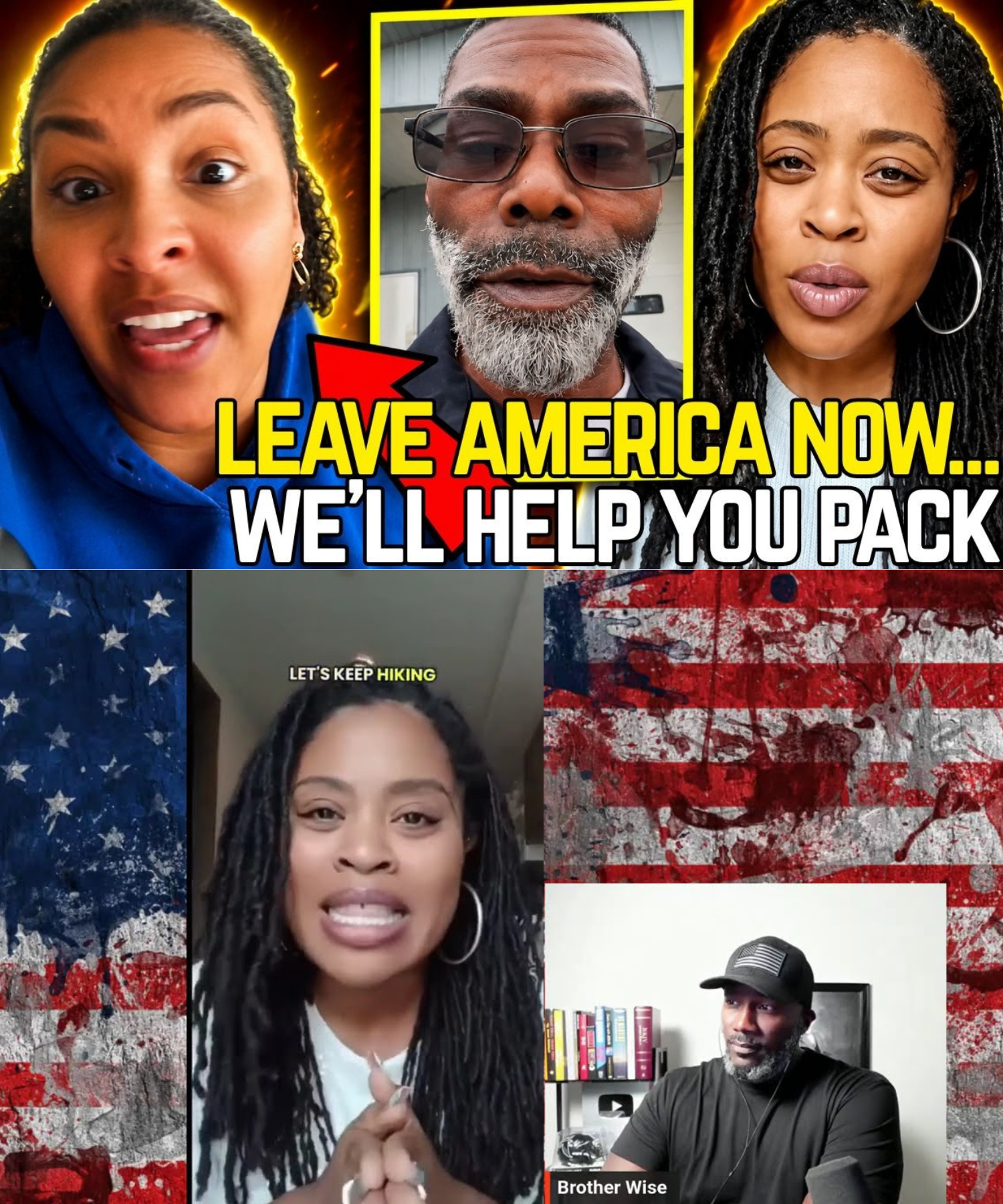
That led to one of the most explosive parts of the debate: the growing online trend of telling dissatisfied Black Americans to leave the country.
One woman in the transcript urged people who feel trapped in America to quit their jobs, max out their credit cards, take whatever money they have, and relocate to countries such as Thailand, Bali, the Philippines, Vietnam, or China. Her message was emotional and sweeping: if America feels wrong in your soul, go.
The reaction was immediate and brutal.
Conservative commentators mocked the idea as dangerously naive. Leaving America, they warned, does not mean escaping consequences. Other countries have their own laws, prejudices, economic systems, cultural barriers, and immigration rules. Americans who are used to free speech, due process, consumer convenience, and constitutional protections may be shocked to discover how quickly those assumptions disappear abroad.
The argument was not simply “America is perfect.” It was that America is still uniquely protective of personal liberty, even for people who spend their days condemning it.
That tension has become one of the defining battles in modern Black political discourse.
One side says America remains structurally hostile and psychologically exhausting for Black people. It points to police encounters, economic gaps, generational trauma, racial profiling, and the emotional burden of living in a country built partly on slavery and segregation. To this side, wanting to leave is not betrayal. It is survival.
The other side says that mindset has become self-destructive. It argues that constantly describing America as a prison teaches people to hate the very country where they have the most opportunity. It warns that victimhood, racial resentment, and anti-American rhetoric can become a trap — one that convinces people to abandon personal responsibility and practical gratitude.
The debate then turned inward.
Several speakers in the transcript voiced what they described as “Black fatigue” — exhaustion not with being Black, but with what they see as destructive behavior, public embarrassment, political manipulation, and cultural decline inside parts of Black America. The language was emotional and at times harsh, but the underlying message was clear: some Black conservatives and moderates are tired of being told that loyalty to the race requires loyalty to grievance politics.
They are tired of being told that America is only oppression.
They are tired of being told that every failure is someone else’s fault.
They are tired of leaders who speak in racial outrage but offer no path to discipline, family stability, economic growth, faith, education, or safety.
That is why this clip is spreading.
It is not only about Democrats. It is not only about Black voters. It is about a deeper identity crisis inside America. What does it mean to love a country that has wounded your people? What does it mean to criticize America without despising it? What does it mean to honor ancestors without living permanently in the pain they endured? What does it mean to demand justice while still admitting that the United States gives freedoms many nations do not?
The debate is uncomfortable because both sides touch something real.
Black voters have legitimate reasons to question whether the Democratic Party takes them for granted. The party depends heavily on Black turnout, especially Black women, but internal fights over leadership, tone, race, and electability continue to create resentment. When Black candidates are labeled too aggressive or too controversial, then later asked to unify behind someone else, anger is inevitable.
At the same time, the conservative response taps into a different frustration: if Black voters know they are being used, why keep rewarding the same party? Why keep accepting fear as a campaign strategy? Why not demand policy, respect, accountability, and results instead of emotional appeals every election season?
That is the political earthquake beneath the viral clips.
The Democratic Party is facing a warning. Black voters are not a permanent possession. They are not campaign machinery. They are not obligated to forgive every slight because Republicans are framed as worse. Loyalty can crack when respect disappears.
But Black America is facing a warning too. Rage cannot be a life plan. Leaving the country is not a strategy if it is built on fantasy. Hating America will not build wealth, restore families, improve schools, lower crime, or create dignity.
The viral debate ends with a hard truth many people do not want to hear:
America may be flawed, divided, and painful — but it is still a place where people can argue, vote, build, leave, return, criticize, worship, fight, fail, and rise again.
That freedom is not nothing.
And in 2026, as Democrats fight for Black voters and conservatives fight for their attention, one thing is becoming clear: Black Americans are no longer willing to be spoken to as if their vote is already owned.