“Queers for Palestine” Protest Clip Sparks Fierce Debate Over LGBTQ Politics, Free Speech, and Middle East Conflict Narratives
“Queers for Palestine” Protest Clip Sparks Fierce Debate Over LGBTQ Politics, Free Speech, and Middle East Conflict Narratives
New York — A viral video showing a heated exchange between a “Queers for Palestine” protester and a counter-commentator has ignited a fierce online debate across the United States about LGBTQ activism, the Israel–Palestine conflict, and whether identity-based solidarity movements are consistent in their political messaging.
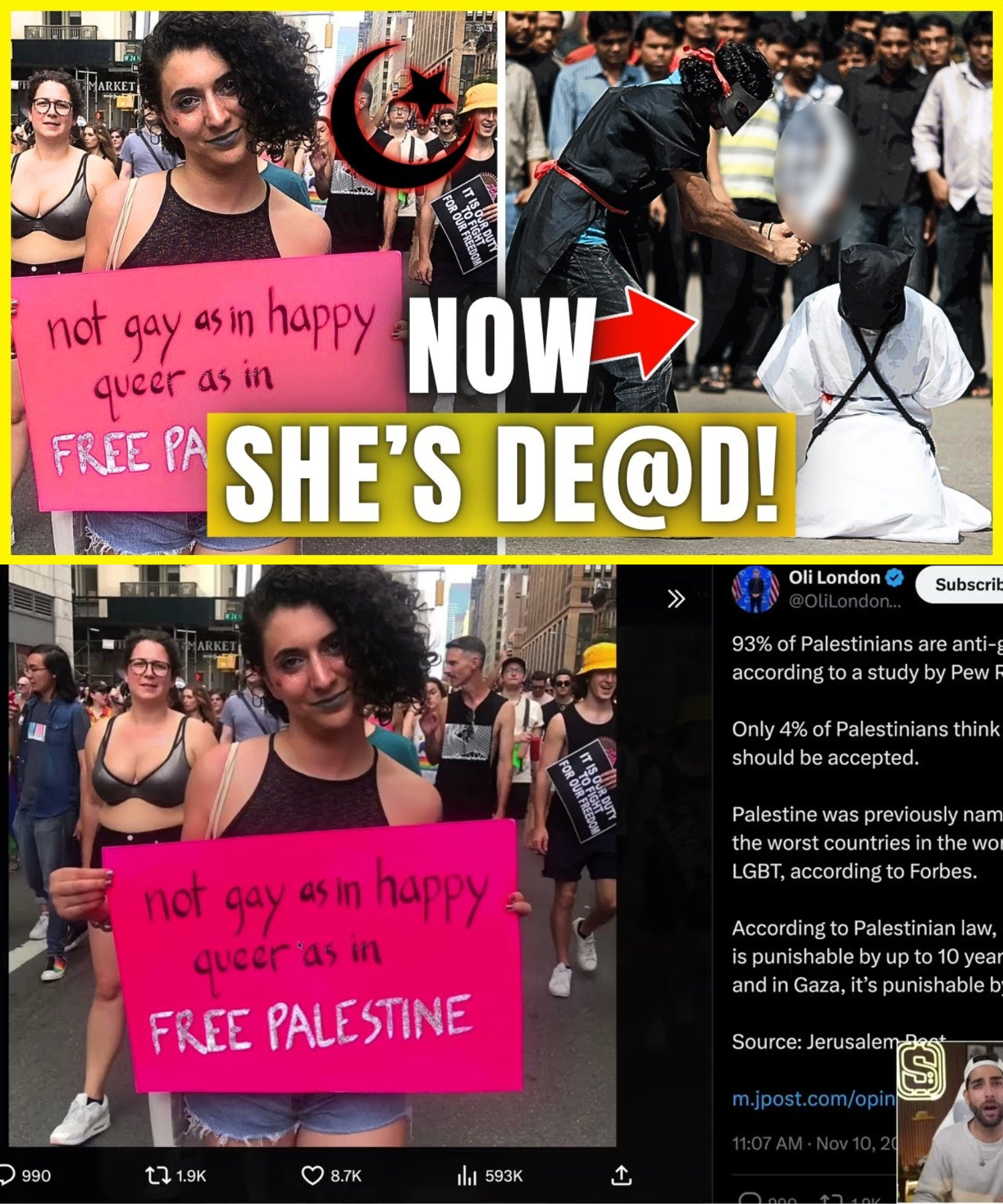
The footage, filmed at a public demonstration, features a trans non-binary activist explaining why they joined a pro-Palestinian protest under the banner of “Queers for Palestine,” arguing that queer liberation is inseparable from broader struggles for human rights.
The activist states that “queer liberation is not complete unless everyone is free,” and describes solidarity with Palestinians as part of a wider global justice movement. They also accuse critics of “pinkwashing” — a term used by some activists to describe accusations that Israel highlights LGBTQ rights to deflect from its treatment of Palestinians.
The clip quickly went viral after a counter-commentator responds in a sharply critical tone, arguing that LGBTQ individuals would face persecution under Hamas or other Islamist governance structures in Gaza and the West Bank. The speaker claims that queer people in those regions are not free and references reports of violence, legal restrictions, and social stigma toward LGBTQ individuals in parts of the Middle East.
The exchange has since become a flashpoint in a much larger cultural and political argument: whether solidarity movements are consistent in applying human rights principles across different geopolitical contexts.
Competing Narratives Over LGBTQ Safety
Supporters of the protester argue that the video reflects a broader truth about intersectional activism — that LGBTQ rights movements often align with anti-colonial and pro-human rights causes globally. They say the Palestinian cause represents a struggle against occupation, displacement, and systemic inequality, and that queer individuals have a right to participate in solidarity movements regardless of geopolitical complexities.
The activist in the video emphasizes that “queer Palestinians exist,” pushing back against the idea that LGBTQ identity and Palestinian identity are incompatible. This argument has become central to “Queers for Palestine” organizing efforts in cities across North America and Europe.
Critics of this position, however, argue that such alliances overlook the lived realities of LGBTQ individuals in parts of the Middle East where same-sex relationships may be socially taboo, criminalized, or dangerous. The counter-commentator in the video claims that LGBTQ people would not be safe in territories governed by militant groups or conservative legal systems, and therefore views the protest as politically contradictory.
The result is a deeply polarized debate over whether solidarity should prioritize political liberation, personal safety, or both.
Claims of “Pinkwashing” and Counter-Accusations
One of the most contested issues raised in the video is the accusation of “pinkwashing,” a term used by activists who argue that some states emphasize LGBTQ-friendly policies to improve international reputation while maintaining controversial security or military practices.
The protester suggests that LGBTQ visibility is sometimes used politically in global narratives in ways that obscure the realities faced by marginalized communities elsewhere.
However, critics argue that this framing selectively ignores conditions in non-Western or non-liberal societies where LGBTQ rights are significantly more restricted. The counter-commentator references reports and studies from human rights organizations alleging that LGBTQ individuals in parts of Gaza and the West Bank face discrimination, legal risks, and social ostracism.
These claims remain highly contested and depend heavily on legal interpretation, regional variation, and political context. Human rights reporting on LGBTQ conditions in the region has documented a range of experiences, from underground communities to areas of significant legal and social risk.
Viral Footage from Pride Events Adds Fuel
The controversy intensified further as commentators circulated additional footage from a Pride parade in Ottawa, where a group of activists interrupted a celebration to demand that organizers publicly commit to supporting Palestine.
In the clip, speakers declare that Pride movements should not separate LGBTQ rights from global political struggles, arguing that solidarity with Palestinians must be “unconditional.” The activists call for political commitments from Pride organizers and elected officials, linking LGBTQ rights advocacy to broader divestment and anti-war campaigns.
Supporters of the interruption say it reflects the political roots of Pride as a protest movement and argue that LGBTQ rights cannot be separated from other global human rights issues.
Critics, however, argue that introducing foreign policy demands into Pride events risks fracturing LGBTQ unity and alienating participants who view Pride primarily as a celebration of identity and rights rather than geopolitical activism.
A Growing Divide in Activist Spaces
The viral video highlights a growing tension within progressive movements in the United States and beyond: how far intersectional activism should extend across unrelated geopolitical conflicts.
Some activists argue that LGBTQ rights, anti-war movements, and decolonization struggles are inherently linked under a broader human rights framework. Others argue that combining all causes into a single political identity risks oversimplifying complex issues and creating contradictions that weaken advocacy efforts.
Political analysts say this tension is increasingly visible in universities, protests, and online spaces, where debates over Israel and Palestine frequently intersect with discussions of race, sexuality, and identity politics.
Online Reaction: Deep Polarization
Reactions to the video have been sharply divided.
Supporters of the “Queers for Palestine” protester argue that LGBTQ individuals have a legitimate place in global solidarity movements and should not be told where their activism is “allowed” to exist. They say the criticism reflects an attempt to silence intersectional political expression.
Opponents argue that the movement reflects ideological inconsistency, claiming that some activists advocate for groups or causes that may not guarantee LGBTQ rights or protections under different governance systems.
The counter-commentator’s remarks — particularly references to violence and persecution — have also drawn criticism for generalizing complex regions and communities. Critics warn that such framing risks reinforcing stereotypes about Muslim-majority societies and conflating diverse legal systems with extremist groups.
Experts Warn Against Oversimplification
Human rights analysts caution that the debate is often shaped by incomplete or emotionally charged narratives. While some regions in the Middle East have documented legal and social restrictions affecting LGBTQ individuals, conditions vary significantly across countries, cities, and political jurisdictions.
Experts emphasize that reducing the issue to binary claims — either full freedom or total persecution — can obscure the realities faced by individuals on the ground.
Similarly, scholars of social movements say that intersectional activism is inherently complex, often bringing together causes that do not always align perfectly but share overlapping concerns about power, inequality, and rights.
A Cultural Flashpoint in the United States
The viral nature of the clip reflects a broader American cultural trend in which domestic identity politics increasingly intersects with international conflicts.
From university campuses to social media platforms, debates over Gaza, Israel, LGBTQ rights, and anti-war activism are often merged into a single contested space where competing moral frameworks collide.
For some, the video is evidence of a growing divide within progressive activism. For others, it is a reminder that global solidarity movements are inherently messy and cannot be neatly categorized.
No Consensus, Only Escalation
As the video continues to circulate, no consensus has emerged.
Instead, it has become a symbol of a broader question facing modern activism: can movements built on identity politics maintain internal coherence when applied across vastly different geopolitical realities?
Or does global solidarity inevitably lead to contradiction when different communities define freedom in fundamentally different ways?
For now, the debate remains unresolved — and increasingly central to how Americans interpret the intersection of identity, politics, and international conflict.