`Viral Whitechapel Video Sends Shockwaves Across America as Immigration, Islam, and Jewish Identity Collide
Viral Whitechapel Video Sends Shockwaves Across America as Immigration, Islam, and Jewish Identity Collide
A viral walk through London’s Whitechapel has exploded into a much larger American debate, forcing viewers in New York, Michigan, Texas, California, and Washington to ask a question many politicians would rather avoid: what happens when a neighborhood changes so deeply that outsiders no longer recognize the country they thought they were in?
The video follows an Israeli Jewish content creator entering Whitechapel, an East London district long associated with waves of immigration, religious change, working-class struggle, and cultural tension. What he finds is not the postcard version of London. It is a dense urban neighborhood filled with Bengali signs, Muslim clothing shops, Islamic bookstores, Palestinian flags, Gaza merchandise, halal markets, and the massive presence of East London Mosque.
Within minutes, the creator says he has to remind himself he is still in London.
That line is what made the video travel across the Atlantic.
For Americans, Whitechapel is not just a London story. It has become a mirror held up to the United States. Viewers are asking whether similar arguments could soon dominate conversations about Dearborn, Queens, Paterson, Minneapolis, Houston, Chicago, Bay Ridge, or parts of Northern Virginia — places where immigration, religion, language, identity, and foreign conflicts increasingly shape local life.
The video is gripping because it touches several raw nerves at once.
The first is demographic change. The creator points out that Whitechapel once had a major Jewish community and now has a large Bangladeshi and Muslim presence. He visits the site of an old synagogue, then contrasts it with the visibility of Islamic institutions and Palestinian political imagery. His conclusion is harsh: the neighborhood no longer feels like coexistence to him, but replacement.
That is an inflammatory claim.
It is also the kind of claim that spreads quickly because it captures a real emotional reaction, even when the historical picture is more complicated. Cities change. Immigrant communities arrive, build institutions, open shops, raise children, and reshape neighborhoods. Jewish, Irish, Italian, Caribbean, South Asian, Arab, Mexican, Chinese, and countless other communities have all transformed urban districts in the United States and Britain.
Sometimes that change brings renewal.
Sometimes it brings tension.
Sometimes it brings both.
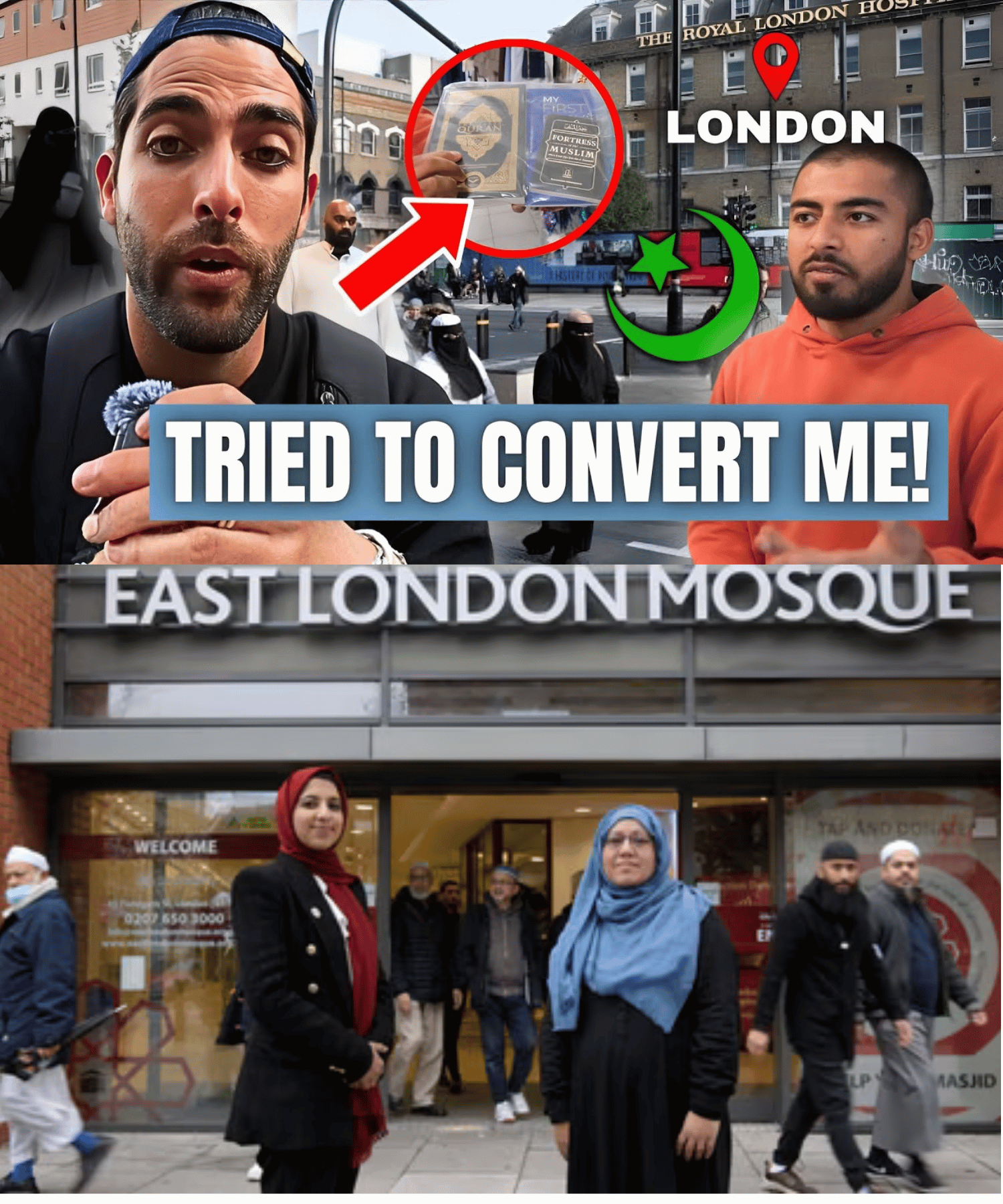
The second nerve is Israel and Palestine. Throughout the video,\ the creator encounters Palestinian products, activity books, flags, scarves, Gaza Cola, and anti-Israel sentiment. When he reveals he is from Israel, several conversations become tense. Some people speak politely but clearly oppose Israel. Others seem unwilling to discuss the subject. The creator interprets the neighborhood’s Palestine focus not simply as political solidarity, but as evidence of a broader Muslim cause.
That interpretation is exactly where the debate becomes dangerous.
Support for Palestinians is not the same thing as support for terrorism. Criticism of Israel is not automatically antisemitism. But after October 7 and the Gaza war, many Jewish Americans and Israelis do feel that some anti-Israel activism has crossed into hostility toward Jews. The line between political protest and identity-based intimidation has become one of the most explosive questions in Western public life.
American cities are already living through this tension.
Synagogues have increased security. Muslim communities have reported harassment. Students have clashed on campuses. City councils have fought over ceasefire resolutions. Protesters have filled streets. Jewish voters, Muslim voters, Arab Americans, progressive activists, conservatives, and civil liberties groups are all watching the same events and seeing different threats.
The Whitechapel video taps directly into that fear.
The third nerve is Islam itself. The creator enters an Islamic bookstore, buys an English Quran, and asks about conversion. A man tells him that becoming Muslim is simple: say the shahada. The creator then asks whether a person who later decides Islam is not for him can leave. The conversation becomes uncomfortable, especially when the video overlays claims about apostasy under Sharia law.
For American viewers, this raises another familiar question: how should a liberal democracy respond to religious doctrines that appear to conflict with modern ideas of individual freedom?
America’s answer is supposed to be clear. The Constitution protects the right to convert, leave a faith, criticize a faith, practice a faith, or reject faith altogether. No religious community gets to override civil law. That principle protects Muslims, Jews, Christians, atheists, Hindus, Sikhs, Buddhists, and everyone else.
But the social reality is more complicated.
Many Americans fear that some religious communities may build internal pressure systems that make dissent, conversion, women’s independence, interfaith relationships, or criticism difficult. Muslims often respond that their communities are being treated with suspicion in a way Christian or Jewish communities are not. Both realities can exist at once: religious freedom must be protected, and coercion must be rejected.
That is the balance America must maintain.
The fourth nerve is language and public space. The creator sees Bengali and English signage and calls it absurd, saying London should not have signs in languages other than English. That sentiment will sound familiar to Americans who have heard similar complaints about Spanish signs, Arabic signs, Chinese signs, or bilingual public services.
Here again, the issue is not simple.
Language access can help immigrants function, work, pay taxes, raise children, and interact with government. But language separation can also deepen fears that communities are living side by side without actually becoming part of one civic whole. The question is not whether immigrant languages should exist. Of course they should. The question is whether a shared national language remains strong enough to hold a country together.
That question matters deeply in the United States.
America has always absorbed immigrants, but it has usually done so through a powerful civic expectation: you can keep your heritage, but you also join the American project. You can speak another language at home, but your children will learn English. You can practice your religion, but civil law comes first. You can support causes abroad, but your public loyalty must remain rooted in the country you live in.
When that bargain feels unstable, anxiety rises.
The Whitechapel video is dramatic, biased, emotional, and sometimes unfair. It frames ordinary Muslim life through a lens of suspicion. It makes sweeping claims that many residents would reject. It treats visible religious identity as a sign of separation, when for many people it is simply daily life.
But dismissing the video entirely would also be a mistake.
It captures something real about the Western mood: people are worried that multiculturalism has moved faster than integration. They are worried that foreign conflicts are colonizing local streets. They are worried that Jewish history is being erased in places where Jews once lived. They are worried that religious freedom may be used by some groups to build communities that do not feel reciprocal, open, or liberal.
America cannot solve those worries by shouting “bigotry” at every concern.
It also cannot solve them by blaming Muslims as a group.
The only serious path is harder: defend religious liberty, protect Jewish communities, oppose anti-Muslim harassment, enforce one civil law for everyone, teach shared history, insist on English as a common civic language, and make clear that no neighborhood belongs exclusively to one faith, ethnicity, or political cause.
Whitechapel may be in London, but the argument it ignited is already American.
It is the argument over whether diversity can still produce unity.
Whether solidarity abroad can coexist with peace at home.
Whether religious freedom can survive without becoming cultural fragmentation.
And whether Western cities can change without making millions feel like strangers in their own country.
The video did not answer those questions.
It simply made them impossible to ignore.