America’s “Mass Baptism Wave” Sparks National Debate as 70,000 Are Reportedly Baptized in a Single Day Across the U.S.
America’s “Mass Baptism Wave” Sparks National Debate as 70,000 Are Reportedly Baptized in a Single Day Across the U.S.
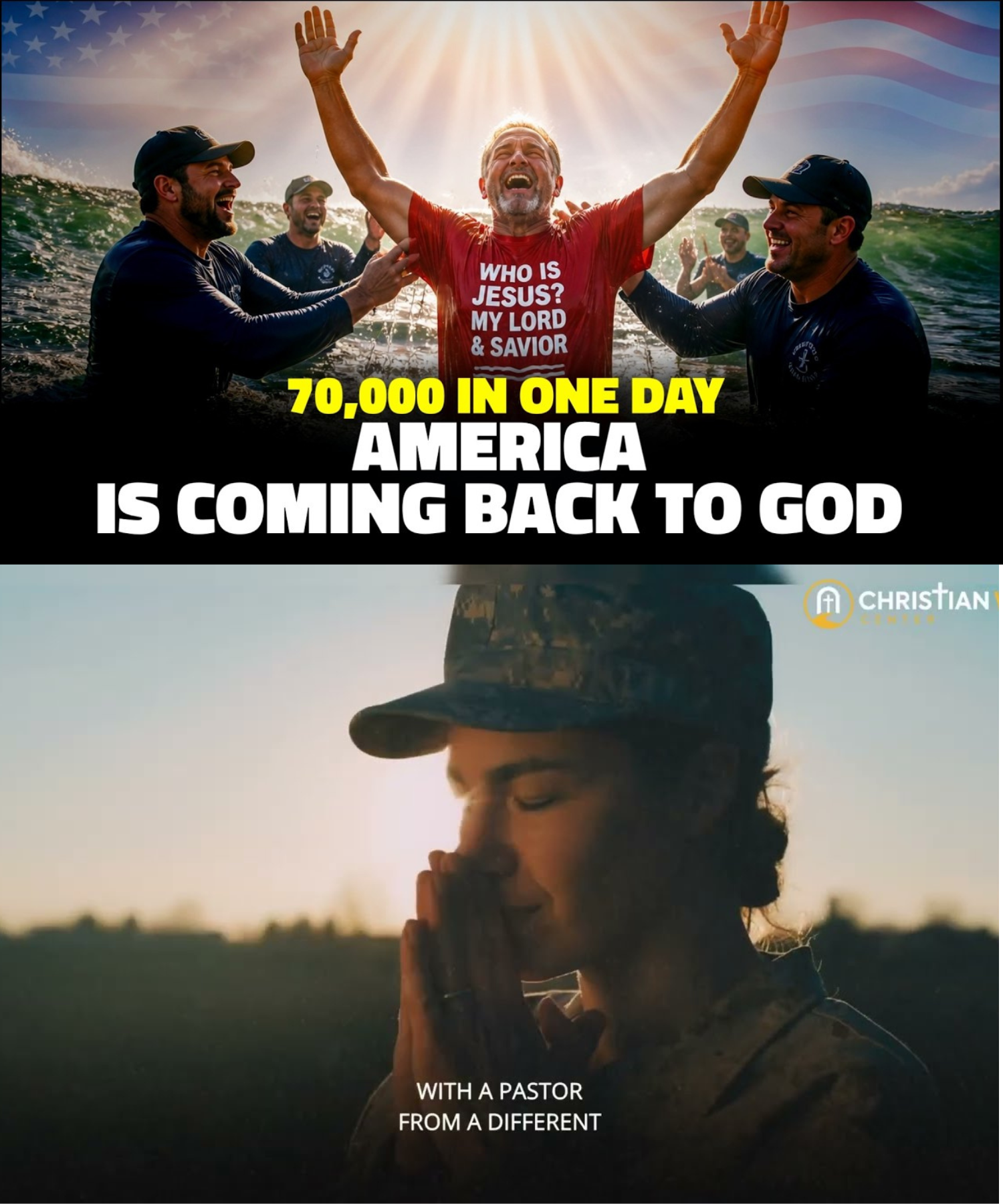
A sweeping wave of baptisms across the United States has ignited intense national discussion, after reports claim that more than 70,000 Americans were baptized in a single day — part of a coordinated religious movement spanning all 50 states and drawing hundreds of thousands of observers to rivers, beaches, lakes, stadiums, and public gatherings.
From Florida’s Atlantic coastline to university campuses in Texas and revival events in Washington, organizers describe the moment as something unprecedented in modern American religious life.
Critics urge caution. Supporters call it a spiritual turning point.
But everyone agrees on one thing: something large is happening.
A Florida Beach Becomes the Center of Attention
The most dramatic scene unfolded in Jacksonville, Florida, where thousands gathered at Hannah Park and nearby beaches for mass baptism events.
Drone footage shows long lines of people entering the ocean under bright sunlight, while crowds watch from the shore. Organizers from a local church reported that 2,552 people were baptized in a single day during one event alone, with an estimated 14,000 spectators present.
For participants, the moment was deeply personal.
For observers, it looked like something larger — a public display of faith on a scale rarely seen in recent American history.
One striking detail from organizers was the story of a shuttle bus driver working the event who, after hours of watching, decided to enter the water himself and be baptized.
Organizers described it as spontaneous transformation. Skeptics describe it as emotional momentum.
But the scale is not in dispute.
A Coordinated Nationwide Movement
Even more remarkable than individual events is what happened weeks later: a synchronized baptism initiative spanning all 50 U.S. states.
On Pentecost Sunday, June 8, thousands of churches participated in what organizers called “Baptize America,” a coordinated effort to hold baptisms across the country on the same day.
According to organizers, more than 71,000 people were baptized through over 1,600 participating churches.
The baptisms took place in oceans, rivers, lakes, swimming pools, and even improvised outdoor setups such as rural tanks and church yards.
While such large-scale religious coordination is not unprecedented in American history, the simultaneous national scale has drawn comparisons to past revival movements.
Even Major Institutions Report Unusual Growth
Adding to the momentum, multiple Christian institutions — including Catholic dioceses — have reported significant increases in adult baptisms.
The Diocese of Cleveland reportedly more than doubled its number of adult converts compared to previous years. In Virginia, the Diocese of Richmond announced nearly 900 baptisms during Easter Vigil services.
Internationally, France reported more than 21,000 adult baptisms this Easter season, described as the highest figure ever recorded in that country.
Religious analysts say the simultaneous rise across different denominations is unusual.
Skeptics argue it reflects short-term post-pandemic religious interest rather than a long-term transformation.
But even critics acknowledge the upward trend.
Universities, Prisons, and Unexpected Places
The movement has not been confined to traditional churches.
At Baylor University in Texas, approximately 3,000 students reportedly gathered for 72 hours of continuous prayer, resulting in baptisms and religious commitments.
In Mississippi, Baptist churches recorded more than 9,000 baptisms in a single year — the highest level since 2016.
In Louisiana, a detention center service led to 19 inmates professing faith, with 12 baptized shortly afterward.
These examples have fueled a narrative among supporters that the movement is reaching places typically resistant to organized religious activity.
Universities, prisons, and urban centers are all represented in the reported figures.
The Return of Young Men to Church
One of the most unexpected trends highlighted by researchers is a shift among younger demographics.
For decades, surveys consistently showed declining religious participation among young Americans, particularly young men.
Recent data, however, suggests a reversal.
Young men are now reportedly attending church in higher numbers than young women — a reversal of previous patterns in religious participation.
Sociologists attribute this to several factors: loneliness, economic uncertainty, mental health struggles, and a search for meaning in an increasingly unstable world.
Religious leaders, meanwhile, interpret the shift as spiritual renewal.
The National Mall Event and “America 250”
The movement has also intersected with a broader national moment: the upcoming 250th anniversary of the United States in 2026.
Thousands gathered on the National Mall in Washington, D.C. for an event titled “Rededicate 250,” where faith leaders and public figures joined in collective prayer and religious messaging.
Speakers described the event as a spiritual recommitment of the nation.
Protestant pastors stood alongside Catholic clergy and worship leaders, creating a rare moment of cross-denominational unity in a politically divided country.
Organizers also launched a 50-day national prayer initiative leading up to Independence Day 2026.
Supporters say these events reflect a spiritual awakening aligned with the nation’s founding ideals.
Critics warn against conflating religious enthusiasm with national identity.
Historical Parallels: Revival or Repetition?
Historians have been quick to point out that the United States has experienced similar waves before.
The First and Second Great Awakenings reshaped American religious life in the 18th and 19th centuries, leading to mass conversions, social reform movements, and the rise of new denominations.
Modern revival leaders openly reference these historical precedents, suggesting that the country is entering a similar phase.
Skeptics, however, caution against overinterpretation.
Religious participation in the U.S. remains lower than historical peaks, and secular identification continues to grow in long-term surveys.
The debate centers not on whether religious activity exists — but whether it represents a sustained revival or a temporary spike.
What We Know — and What We Don’t
Not all reported figures are independently verified.
Some baptism totals come from church networks rather than centralized reporting bodies. National religious statistics will take months or years to confirm.
Additionally, long-term trends still show declining institutional affiliation in many demographics.
Yet even cautious analysts agree on one fact: participation spikes in multiple regions, denominations, and age groups are occurring simultaneously.
A Nation in Spiritual Motion?
Whether interpreted as revival, resurgence, or coincidence, the scale of recent events has placed religion back into the center of American public conversation.
From beaches in Florida to campuses in Texas, from prisons in Louisiana to crowds in Washington, thousands of Americans are participating in public expressions of faith.
Supporters see transformation.
Skeptics see momentum-driven enthusiasm.
Historians see echoes of the past.
But for now, the images remain powerful: lines of people entering water, crowds gathering in prayer, churches filled beyond expectation, and a country preparing for its 250th anniversary while rediscovering questions it thought it had already answered.
And as one organizer put it simply:
“Only God could write a story like this.”