“I Thought I Was Falling Into Hell”: American Muslim Man’s Near-Death Vision and Conversion Story Sparks Global Debate
“I Thought I Was Falling Into Hell”: American Muslim Man’s Near-Death Vision and Conversion Story Sparks Global Debate
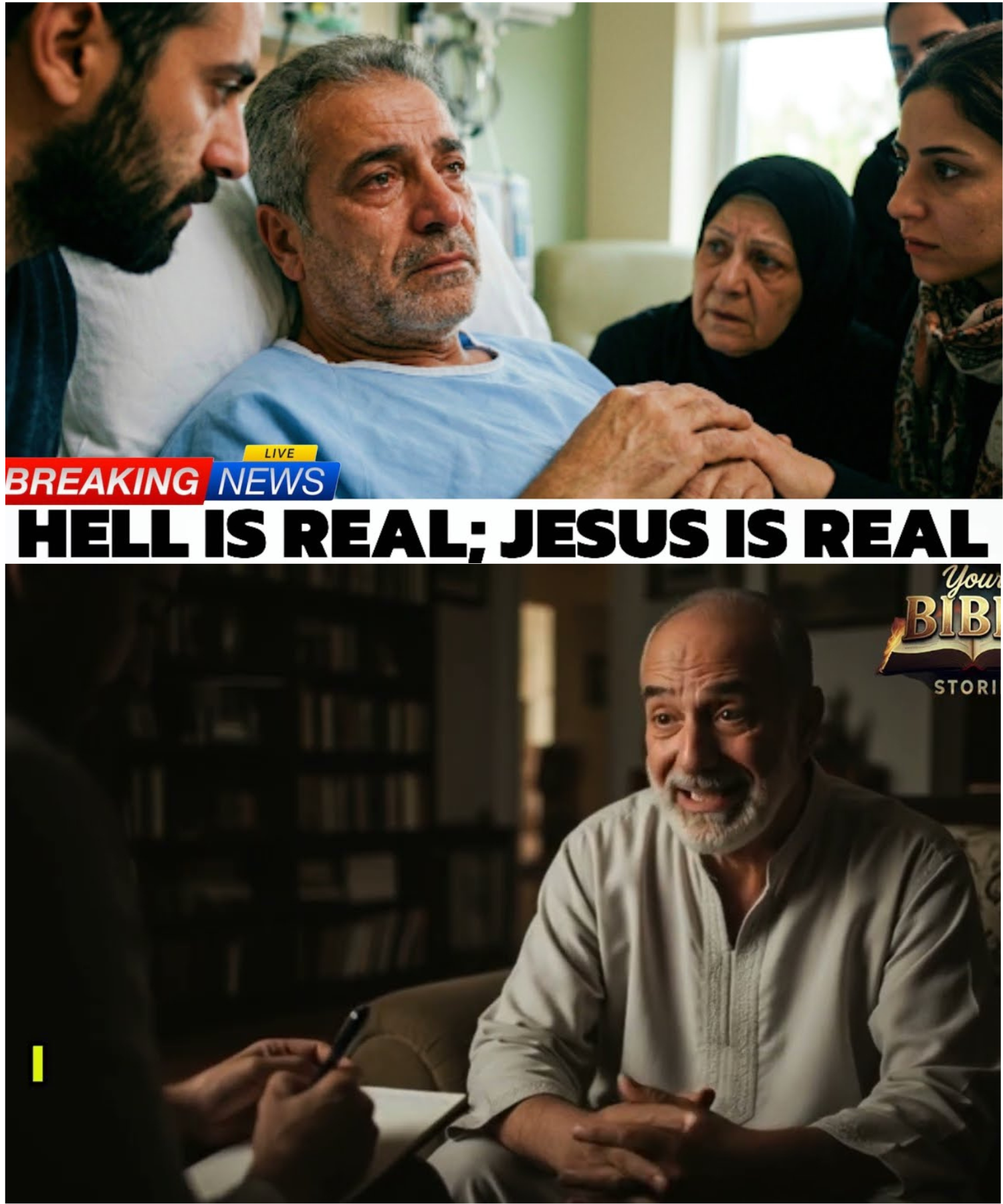
A deeply emotional and highly controversial testimony from a 56-year-old Lebanese-American man is spreading rapidly across social media after he described what he believes was a near-death spiritual experience that led him from lifelong Islam to Christianity.
The man, who identifies himself as Khalil, says he was born and raised in a devout Muslim household in the United States, where faith, discipline, and religious identity shaped every part of his upbringing.
But according to his account, decades of outward devotion masked a deep internal emptiness — one that eventually culminated in a terrifying nighttime experience he describes as “falling into hell and being saved by Jesus.”
A Childhood Built on Devotion and Structure
Khalil describes his early life as deeply rooted in a traditional Lebanese immigrant household where Islam was not simply practiced, but lived as identity.
His parents, owners of a small grocery store in Michigan, worked long hours but maintained strict religious discipline. The mosque was central to family life, and prayer was non-negotiable.
From a young age, Khalil learned Arabic, memorized portions of the Quran, and was trained to observe the five daily prayers without exception.
By adolescence, he had become a respected figure in his local Muslim community — a young man seen as disciplined, knowledgeable, and spiritually committed.
But beneath this outward success, he says, something was missing.
The Silent Struggle: “I Felt Nothing”
Despite performing all required religious duties, Khalil describes a persistent emotional void.
He says prayer felt mechanical rather than spiritual — a series of physical motions and recitations without inner connection.
While he observed others in the mosque experiencing visible emotional intensity during worship, he says he felt disconnected, as if observing religion rather than experiencing it.
This internal disconnect, he explains, created long-term confusion and guilt, as he believed something must be wrong with him spiritually.
Over time, he began to interpret this emptiness as a personal failure rather than a theological question.
Family Life and Growing Internal Pressure
Khalil eventually married Nadia, a woman from a similarly devout Muslim background. Together they raised three children and maintained outward religious practice as expected within their community.
From the outside, he describes his life as stable, respectable, and faithful.
But internally, the tension continued to grow.
He says he increasingly felt like an imposter — someone performing belief without experiencing it. This feeling intensified as he took on more responsibility in mosque activities and began teaching younger men about faith he himself struggled to feel.
The Hidden Crisis: Doubt Without Language
In his testimony, Khalil describes a gradual mental shift in his 40s and 50s, where religious practice began to feel heavier rather than meaningful.
He reports increasing anxiety, sleep disturbances, and a growing sense of psychological pressure that he could not explain.
At night, he says he often lay awake questioning whether his lifelong belief system was true — or whether he had simply inherited it without examination.
These thoughts frightened him deeply, because questioning faith within his environment carried severe spiritual and social implications.
He kept these doubts entirely private.
The Night Everything Changed
The central event in Khalil’s testimony occurred one night when he went to sleep feeling emotionally exhausted and mentally overwhelmed.
He describes waking up in a state he cannot fully explain in physical terms.
According to his account, he found himself outside his body, observing himself from above while simultaneously recognizing that he had died.
He describes an immediate and absolute certainty that he had entered a state of separation from life.
What followed, he says, was an overwhelming descent into darkness.
“I Was Falling Into Hell”
Khalil describes the experience as a rapid descent through darkness accompanied by extreme terror.
He claims he became aware of what he interpreted as hell — a realm of suffering and eternal separation.
He reports hearing cries of anguish and feeling an overwhelming sense of judgment and finality.
During this experience, he says he instinctively began reciting the shahada — the Islamic declaration of faith — believing it would protect him.
However, according to his account, nothing changed.
The descent continued.
The Breaking Point: A Different Name
In the midst of this experience, Khalil describes the appearance of what he calls a guiding presence — an “angel” that urgently communicated with him.
He claims this presence instructed him to call on Jesus rather than Islamic declarations.
At first, he says, he resisted.
The instruction contradicted everything he had been taught throughout his entire life — that salvation is through Allah and adherence to Islamic belief.
But as the experience intensified, he says he reached a point of desperation.
“Jesus Saved Me”
Khalil states that in his moment of perceived final collapse, he called out to Jesus in prayer.
Immediately afterward, he describes a violent reversal of experience.
He reports seeing a flash of intense light, followed by what he interprets as being pulled upward at extreme speed out of darkness.
He says the sensation was accompanied by overwhelming relief, peace, and physical shock as he returned to his body.
He woke up on the floor of his bedroom, drenched in sweat and unable to speak.
Return to Physical Reality and Shock
His wife Nadia reportedly woke up after hearing him fall and found him in a state of distress.
Khalil told her he had “died and returned,” though she interpreted the event as a nightmare or panic episode.
He, however, insists the experience was completely real and fundamentally different from a dream.
He describes it as more vivid and structured than physical reality itself, leaving a lasting impression that he could not dismiss.
A Rapid Shift in Belief
In the days following the experience, Khalil reports a dramatic change in his spiritual perspective.
He began reading the Bible in secret, starting with the Gospel of John, while comparing it to the Quran.
He says he was struck by what he interpreted as a difference in tone: one emphasizing conditional obedience and the other emphasizing unconditional love and assurance of salvation.
He states that this comparison led him to question his lifelong assumptions about faith.
Family Conflict and Social Collapse
When Khalil eventually told his wife and extended family that he no longer identified as Muslim, the reaction was immediate and severe.
He describes emotional breakdowns, accusations of betrayal, and intense pressure to return to Islam.
His community reportedly distanced itself from him, and relationships became strained or completely severed.
He acknowledges that his wife and children were deeply affected, describing the period as one of the most painful in his life.
Conversion and New Community
Khalil states that he later began attending a Christian church where he found acceptance and emotional support.
He describes the community as welcoming and non-judgmental, emphasizing relational faith rather than ritual obligation.
Over time, he says he came to believe that his experience during the night was a genuine encounter with Jesus.
He identifies this as the moment his spiritual transformation became permanent.
A Story That Divides Interpretation
The testimony has sparked strong reactions across religious, psychological, and academic communities.
Some interpret Khalil’s experience as a psychological episode involving sleep phenomena, anxiety, and cognitive stress.
Others view it as a genuine spiritual encounter shaped by personal crisis and emotional vulnerability.
Skeptics argue that such experiences reflect subconscious processing rather than external spiritual reality.
Supporters believe it reflects a meaningful transformation that cannot be reduced to psychology alone.
Conclusion: Between Experience and Belief
Khalil’s story sits at the intersection of faith, psychology, and identity collapse.
It is a narrative of lifelong devotion, internal emptiness, and a moment of extreme crisis that he interprets as supernatural intervention.
Whether viewed as spiritual truth, psychological experience, or symbolic transformation, the testimony continues to generate intense debate.
At its core, the story raises a question that remains unresolved:
What happens when a lifetime of inherited belief collides with an experience that feels more real than belief itself?