Viral Ayaan Hirsi Ali Debate Over Sharia and Women’s Rights Erupts Across U.S. Campuses
Viral Ayaan Hirsi Ali Debate Over Sharia and Women’s Rights Erupts Across U.S. Campuses
Washington — A fiery debate featuring activist and author Ayaan Hirsi Ali has resurfaced online and exploded across American political circles, reigniting one of the most volatile questions in the West: can liberal societies honestly criticize Islamic law without being accused of targeting Muslims themselves?
The viral clip, now spreading across social media, podcast channels, and campus discussion forums, shows Hirsi Ali facing a panel of Muslim speakers and critics who challenge her long-standing argument that Islamic law, when implemented politically, is deeply hostile to women’s rights.
The debate is intense, personal, and explosive. It touches on Sharia, misogyny, religious reform, child marriage, free speech, and whether criticism of Islam as doctrine can be separated from prejudice against Muslims as people.
For supporters, Hirsi Ali delivers a devastating moral argument against religious legal systems that restrict women. For critics, her framing is too sweeping and risks giving anti-Muslim activists language to attack an entire faith community.
Either way, the debate has now landed directly inside America’s ongoing culture war over religion, feminism, immigration, and free expression.
“Why Islam?” The Question That Ignited the Room
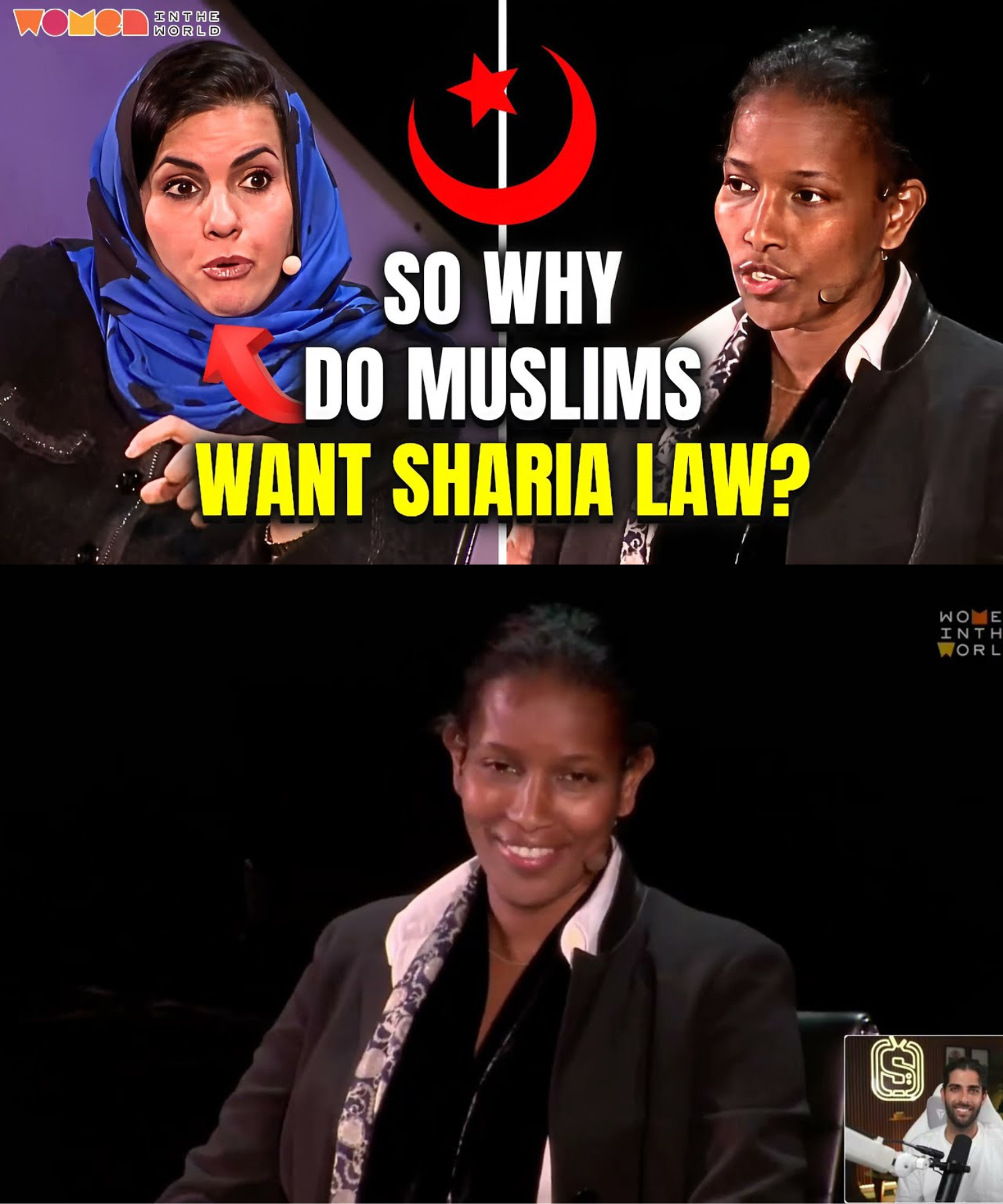
The confrontation begins with a pointed challenge. A panelist asks Hirsi Ali why she focuses so sharply on Islam when misogyny exists across many religions and cultures.
The question is familiar in American debates. Critics of anti-Islamist commentary often argue that Christianity, Hinduism, Judaism, and other traditions also contain patriarchal doctrines or conservative gender norms.
Hirsi Ali does not deny that point.
She says misogyny exists everywhere — in every religion, culture, and geography. But she argues that the panel’s assigned topic is women in Islam, and that avoiding the specific subject by pointing to other religions weakens serious discussion.
Her response immediately shifts the debate from general religious sexism to the particular question of Islamic law.
The Sharia Statistics That Changed the Tone
Hirsi Ali opens her argument with polling data, citing Pew Research findings from Muslim-majority countries where large majorities supported making Sharia or Islamic law the official law of the land.
She references countries such as Indonesia, Afghanistan, Bangladesh, Pakistan, Egypt, Iraq, and Palestinian territories, arguing that support for Islamic law is not marginal in many parts of the Muslim world.
This statistical opening gives the exchange its hardest edge.
Hirsi Ali’s argument is that Islamic law cannot be treated as an abstract academic idea when millions of people support its implementation and when women would live under its consequences.
Critics respond that polling about Sharia is complicated because Muslims understand the term differently. For some, Sharia means personal ethics or moral guidance. For others, it means state-enforced religious law.
That difference becomes central to the debate.
“I Embrace Muslims, I Reject Islamic Law”
Perhaps the most quoted line from Hirsi Ali’s remarks is her distinction between Muslims and Islam as doctrine.
She says she embraces Muslims as diverse human beings but rejects Islamic law because, in her view, it is totalitarian and especially harmful to women.
This distinction has become a key talking point among American conservatives and secular liberals who argue that ideas must be open to criticism even when communities deserve protection from bigotry.
Civil rights advocates, however, warn that such distinctions can collapse in public discourse. They argue that even when critics claim to target doctrine, ordinary Muslims often become the social and political targets.
The tension is one of the hardest in liberal democracy: how to criticize religious ideas without stigmatizing believers.
Women, Guardianship, Marriage, and Legal Inequality
Hirsi Ali argues that when Islamic law becomes state law, women face restrictions involving male guardianship, inheritance, testimony, divorce, marriage, and sexual morality.
She cites examples of women losing basic freedoms under systems where religious law is enforced through state power.
Her supporters say this is the core issue: Sharia is not merely spiritual belief when it becomes law. It becomes governance.
Feminist critics of religious law agree that any system denying equal rights to women should be challenged, whether Islamic, Christian, Hindu, Jewish, or secular authoritarian.
But Muslim reformers argue that Islamic jurisprudence is not frozen in time and that many Muslim women are fighting from within their faith to reinterpret or reject patriarchal readings.
That argument becomes one of the panel’s strongest pushbacks.
“Sharia Is Dynamic” — The Reformist Response
One speaker challenges Hirsi Ali’s definition of Islamic law, arguing that Sharia is not a single fixed code but a dynamic process that must be contextualized.
He accuses her of sharing the same rigid view of Sharia as radical Islamists — treating it as one unchanging system rather than a legal and moral tradition debated across centuries.
That line draws applause from some viewers and sharp disagreement from others.
Hirsi Ali responds that literacy, the internet, and real-world examples make it impossible to ignore what happens where Islamic law is actually enforced by governments.
She points to countries where women have faced severe restrictions under religious legal systems and argues that reform cannot begin with denial.
The Saudi Arabia and Iran Examples
The debate becomes more heated when Hirsi Ali references Saudi Arabia and Iran as examples of countries where Islamic law shaped women’s rights and personal freedoms.
She describes male guardianship, limits on women’s autonomy, and legal inequality as consequences of state-enforced religious doctrine.
She also references Iran after 1979, arguing that religious rule rapidly transformed women’s legal status after the revolution.
Critics argue that these examples reflect authoritarian politics as much as religious doctrine, and that Muslim-majority countries vary widely in law, culture, and gender policy.
Still, Hirsi Ali’s central point remains: where religion and state power merge, women often pay the price.
A Clash Over Credibility
Another panelist challenges Hirsi Ali’s past rhetoric, saying that previous calls to “defeat Islam” damaged her credibility among Muslims who might otherwise support reform.
Hirsi Ali pushes back by repeating her distinction between Muslims and Islam as a doctrine.
She argues that Muslims are diverse and capable of reform, but that unreformed Islamic doctrine — especially when fused with politics — must be confronted directly.
This part of the debate reveals a deeper strategic divide.
Should reform come through internal Muslim voices carefully navigating faith and tradition?
Or through external critics applying pressure from outside?
Both approaches carry risks.
Muslim Reformers and the Free Speech Battle
Hirsi Ali ends by pointing to young Muslims, secularists, bloggers, dissidents, and reformers who challenge Islamist doctrine from within their own communities.
She says these individuals often face danger, intimidation, or even death for criticizing religious extremism or demanding separation between religion and politics.
Her final argument is that free speech must be protected from both violence and accusations used to silence debate.
That point has strongly resonated in the United States, where campus conflicts over Islamophobia, antisemitism, Palestine, feminism, and speech codes have intensified.
America’s Stake in the Debate
Although the panel discussion is international, the American relevance is immediate.
The United States is home to a growing Muslim population, strong constitutional protections for religion, heated debates over women’s rights, and deep polarization over whether criticism of Islam is treated differently from criticism of other religions.
For conservatives, the clip is proof that liberal elites avoid hard conversations about Islamic law.
For progressives, it is a warning that anti-Sharia rhetoric can easily become anti-Muslim politics.
For feminists, it raises a painful question: can women’s rights activists defend Muslim women from bigotry while also defending ex-Muslim women from religious coercion?
No Easy Answer
The debate offers no clean resolution.
Hirsi Ali’s critics are right that misogyny exists across many religions and cultures.
Her supporters are right that state-enforced religious law deserves scrutiny when it restricts women’s rights.
The real question is whether liberal societies can hold both truths at the same time.
America is now being forced to answer that question in classrooms, courts, media studios, mosques, churches, and online battlegrounds.
The viral clip did not settle the debate.
It made it impossible to ignore.