Viral Israel–Palestine Debate Explodes in America as Gaza Hospital Claims, U.S. Aid, and Antisemitism Accusations Collide
Viral Israel–Palestine Debate Explodes in America as Gaza Hospital Claims, U.S. Aid, and Antisemitism Accusations Collide
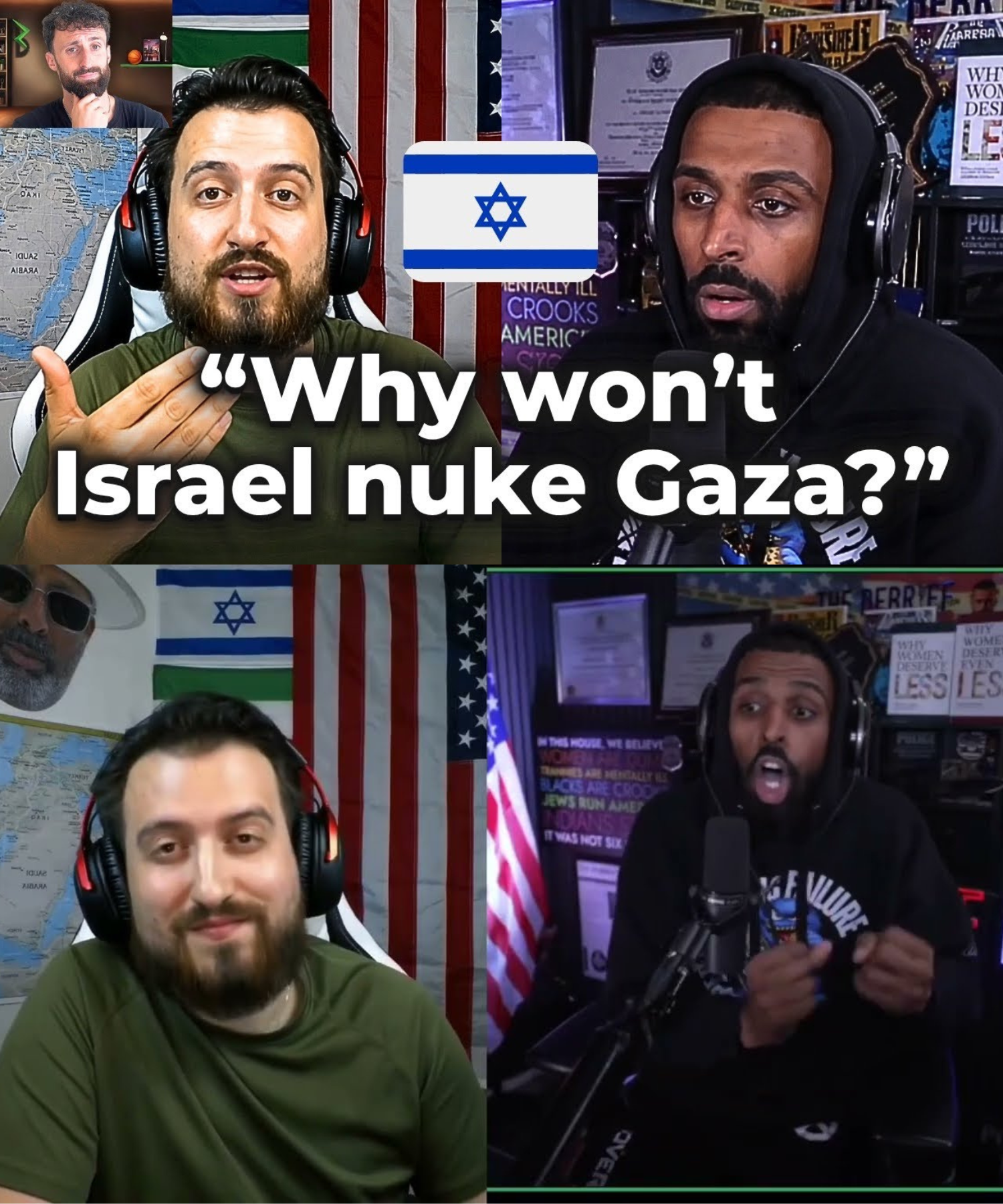
A fiery online debate over Israel, Gaza, and America’s relationship with one of its most controversial allies has erupted across U.S. political media, after two commentators clashed over hospital destruction claims, the role of Hamas, American military aid, and the explosive line between anti-Zionism and antisemitism.
The debate began with a dispute that has become one of the most emotional battlegrounds of the Israel–Hamas war: Gaza’s hospitals.
One speaker argued that Israel’s bombing campaign showed signs of being indiscriminate, pointing to claims that roughly half of Gaza’s hospitals were no longer functioning and that the remaining facilities were operating only partially, without full capacity, proper supplies, or the ability to perform basic medical duties. To him, the technical wording mattered less than the human reality. If a hospital cannot treat the wounded, cannot operate properly, and cannot save lives, then in practical terms it has been destroyed.
His opponent rejected that framing immediately.
He argued that “partially functioning,” “nonfunctional,” “damaged,” “inaccessible,” and “destroyed” are not the same thing. In his view, critics of Israel often use the strongest possible word first, then retreat into softer definitions when challenged. A hospital wing being shut down is not the same as an entire building being reduced to rubble. A facility being inaccessible does not automatically prove it was bombed. A shortage of equipment does not necessarily mean Israel deliberately destroyed it.
That battle over language became the first major flashpoint.
For pro-Palestinian audiences, the hospital issue is a moral indictment. Hospitals represent the most vulnerable parts of civilian life: babies, doctors, injured families, exhausted surgeons, and people with nowhere else to go. If those facilities collapse during a military campaign, critics argue, the campaign itself must be questioned.
For pro-Israel audiences, the issue is more complicated. The opposing debater argued that Hamas has repeatedly used hospitals, mosques, churches, tunnels, apartment blocks, and other civilian spaces for military purposes. He said the key question is not simply whether a hospital was damaged, but whether Hamas was operating from or beneath that site.
The debate then moved into the core dilemma of modern urban warfare.
One side said doctors on the ground had testified that they did not see Hamas operating in hospitals. The other side dismissed that as insufficient, arguing that doctors may not know who is Hamas, especially if fighters operate in civilian clothes or use hidden areas, tunnels, or offices not visible to ordinary medical workers.
From there, the argument turned almost philosophical.
How much evidence is enough before a strike is justified? How much uncertainty is acceptable in war? If a terrorist group embeds itself among civilians, who bears responsibility when civilians die? And at what point does the repeated use of “Hamas was there” become a blanket excuse for destruction?
The critic of Israel argued that even if Hamas uses some hospitals, that cannot justify the collapse of a vast share of Gaza’s medical infrastructure. He said there must be discernment. Intelligence can be wrong. Mistakes kill innocent people. And if every civilian structure becomes a target because Hamas might be nearby, then the concept of civilian protection begins to disappear.
The pro-Israel debater countered that Hamas’s entire strategy depends on exactly that moral pressure. He argued that Hamas cannot defeat Israel militarily, so it seeks international pressure by turning civilian casualties into political weapons. In that view, every hospital becomes strategically valuable to Hamas because any Israeli response can be turned into a global headline.
That was one of the most explosive arguments of the exchange.
One side saw Israel as a state losing moral control in a brutal war. The other saw Hamas as a militant organization deliberately placing civilians in danger to manipulate global opinion. Both sides accused the other of refusing to face the full reality.
The debate then shifted toward the United States.
Asked about America’s relationship with Israel, the pro-Israel commentator gave an answer that surprised some viewers. He said he does not support the current aid model, but not because he opposes Israel. Instead, he argued from a pro-Zionist position that Israel should become more self-reliant. He said the purpose of Zionism is Jewish self-determination in the ancestral homeland, and that true self-determination should include less dependence on direct American aid.
But he did not call for abandoning Israel.
Instead, he proposed shifting the relationship from aid to innovation, technology, defense partnerships, and investment. He pointed to Israel’s high research-and-development spending, its defense technology, its medical breakthroughs, and Israeli-founded companies that he claimed support large numbers of American jobs. In his view, Washington should stop treating Israel like a dependent client and instead treat it like a high-tech strategic partner.
That argument speaks directly to a growing American debate.
Some conservatives and libertarians want the United States to reduce foreign aid and pull back from Middle Eastern entanglements. Some pro-Israel voices want fewer restrictions on Israel’s military and defense industry. Some critics want all aid cut because of Palestinian suffering. The debater tried to carve out a fourth position: end the old aid model, but deepen economic and technological cooperation.
His opponent took the opposite view.
He argued that the United States should give Israel a hard ultimatum: resolve the Palestinian question or lose American support, including military aid, diplomatic cover, and political protection. He said the unresolved Palestine issue is the root of regional instability, repeated wars, stalled Abraham Accords expansion, and global backlash against Israel.
He floated possible solutions, including a one-state framework or a two-state settlement, while acknowledging that both are filled with severe problems. A one-state solution would threaten Israel’s Jewish majority. A two-state solution would require Israel to accept a Palestinian state beside it, something many Israelis see as a security nightmare. Still, he argued that Washington must force movement because the status quo produces endless war.
Then the debate veered into darker territory.
The Israel critic introduced claims about Israel’s nuclear program, the USS Liberty, the JFK assassination, and September 11. He suggested Israeli or Zionist involvement in some of the most sensitive wounds in American history. The pro-Israel debater immediately challenged those claims, especially the familiar “dancing Israelis” narrative around 9/11.
He argued that the story has been exaggerated and distorted, and that people fixate on the five Israelis because they were Jewish while ignoring other detentions, rumors, and reports from that chaotic day. He denied that FBI documentation supported the claim that they were literally dancing or celebrating in the way conspiracy circles often allege.
That moment transformed the debate from foreign policy into an argument over antisemitism.
The pro-Israel commentator accused his opponent of using anti-Zionism as a shield for deeper hostility toward Jews. He said some public figures do not merely criticize Israeli policy but repeatedly rely on narratives about Jewish control, hidden influence, dual loyalty, and sinister power. In his view, anti-Zionism can become a socially acceptable mask for older anti-Jewish rhetoric.
That accusation is now one of the most bitter fights in American politics.
Critics of Israel insist that opposing Zionism, Israeli military policy, or U.S. aid is not antisemitism. Israel defenders respond that some critics cross the line when they blame Jews collectively, spread conspiracy theories, or hold Israel to standards they apply to no other country.
The debate ended without resolution, but it exposed the deeper crisis in American discourse.
Israel–Palestine is no longer only a foreign-policy issue. It is a test of trust, identity, morality, media literacy, and political loyalty. Every word is contested. Every statistic is challenged. Every accusation triggers a counteraccusation.
One side sees Israel as a flawed but necessary ally fighting a terrorist enemy embedded in civilian life.
The other sees Israel as a powerful state shielded by Washington while Palestinians pay the price.
And between them sits an American public increasingly unsure which facts are real, which claims are propaganda, and where legitimate criticism ends and ancient hatred begins.
That uncertainty may be the most dangerous battlefield of all.