23 Bison Rewild the Desert: How a Failed Ecosystem Began Healing Itself in Mexico’s Chihuahuan Borderlands
23 Bison Rewild the Desert: How a Failed Ecosystem Began Healing Itself in Mexico’s Chihuahuan Borderlands
In one of the harshest landscapes in North America, something unexpected is happening beneath the desert sun.
Grass is returning.
Soil is softening.
Water is staying where it once disappeared.
And at the center of this quiet transformation stands a small herd of just 23 American bison — animals once driven to near extinction, now acting as living engineers of ecological recovery.
What began in 2009 as a high-risk conservation experiment in northern Mexico has become one of the most closely watched rewilding projects in the world, challenging long-held assumptions about how broken ecosystems recover — and whether nature, once restored, can fix itself faster than scientists ever predicted.
A Desert That Was Never Meant to Be Empty
More than a century ago, the Chihuahuan Desert region stretching across northern Mexico and the southern United States was dramatically reshaped by human intervention.
Native bison populations, once vital to Indigenous life and central to grassland ecosystems, were hunted to near extinction. In their place, millions of commercial cattle were introduced for grazing, fundamentally altering the structure of the land.
Over time, the shift triggered what ecologists now describe as a cascading ecological failure.
Without large, migratory herbivores like bison, the landscape lost its natural movement system — the constant trampling, grazing, and soil disruption that once maintained open grasslands. Instead, cattle concentrated in limited areas, compacting soil, reducing water absorption, and accelerating desertification.
What followed was not immediate collapse, but slow degradation.
Over decades, native grasses disappeared. Shrubland expanded. Soil hardened. Rainwater ran off instead of soaking in. Flash floods replaced steady absorption cycles. The ecosystem did not die in a single moment — it gradually lost its ability to function.
By the late 20th century, large portions of the region had effectively transitioned into expanded desert.
The 2009 Experiment: 23 Animals, No Safety Net
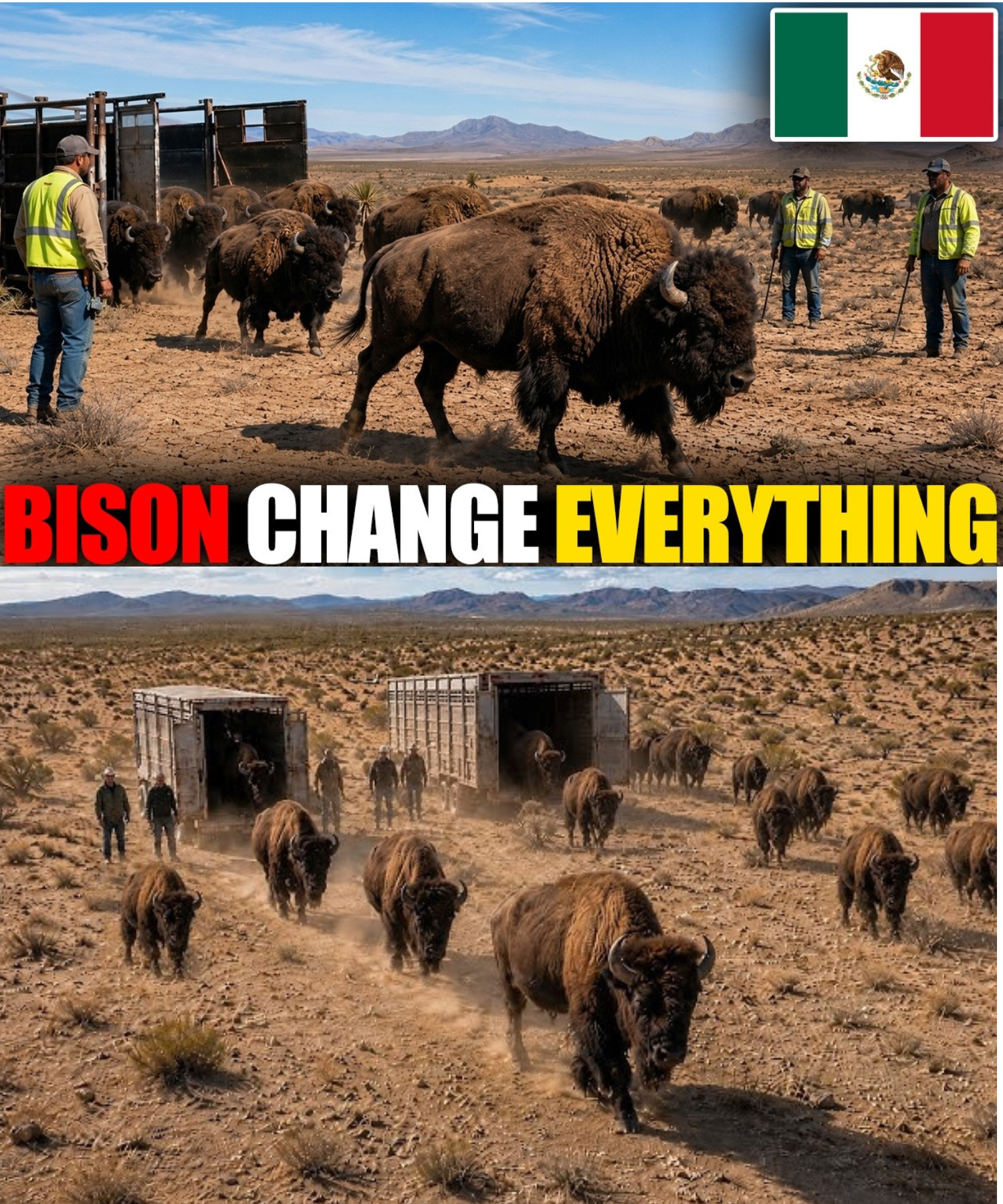
In 2009, conservationists working in the Janos Biosphere Reserve in the Mexican state of Chihuahua made a controversial decision.
They released 23 genetically screened bison into the wild.
No supplemental feeding.
No irrigation systems.
No artificial protection.
Just animals and land.
The herd was sourced from conservation populations in the United States and carefully selected for genetic diversity and disease resistance. But beyond that, the experiment was intentionally minimal. The guiding principle was simple: if bison were truly a keystone species, they should be able to restore ecological processes through their natural behavior alone.
Many scientists were skeptical.
Some openly predicted failure within months.
The environment was too dry. Too degraded. Too unpredictable.
Cattle, bred for ranching and managed with human infrastructure, struggled in similar conditions. Why would wild bison succeed where domestic livestock could not?
The First Signs of Change Were Invisible
At first, nothing appeared to happen.
The herd moved slowly across the desert terrain, grazing sparingly and traveling in wide patterns. There were no immediate visible transformations. No sudden greening. No dramatic recovery.
But beneath the surface, the system was beginning to shift.
Each step a bison took exerted hundreds of kilograms of pressure on the soil. Unlike cattle, which tend to remain in concentrated grazing zones, bison constantly move, distributing their impact across vast areas.
This movement began breaking up compacted earth — a crucial first step in restoring water infiltration.
In a landscape where rainfall is rare and brief, soil structure determines survival. Hardened ground repels water. Cracked ground absorbs it.
The bison were unintentionally re-engineering that structure.
Dust Baths That Became Water Traps
One of the most unexpected discoveries came from observing a behavior that initially seemed unrelated to ecosystem restoration: dust bathing.
Bison roll in loose soil to clean themselves and regulate parasites. In doing so, they create shallow depressions in the ground.
During dry months, these indentations appear insignificant — simple marks in the desert floor.
But when seasonal rains arrive, something changes.
Instead of flowing across the surface and evaporating, water collects in these depressions. It lingers longer than expected, slowly soaking into the ground and rehydrating dormant soil layers.
For seeds that have remained inactive for years — sometimes decades — this brief window of moisture is enough to trigger germination.
Grass begins to return in patches.
Not all at once, but gradually.
The Soil Starts to Remember
As vegetation reappeared, another process began underground.
Bison grazing stimulates plant regrowth rather than suppressing it. When grass is clipped, root systems respond by expanding, not shrinking. Over time, this cycle increases root biomass below the surface — effectively storing carbon in the soil.
At the same time, bison dung introduces nutrients and seeds back into the ecosystem. Insects such as dung beetles break down waste and redistribute organic material, further enhancing soil fertility.
The result is a self-reinforcing loop:
Bison move and break soil
Water is retained longer
Seeds germinate
Vegetation grows
Roots expand and store carbon
Soil fertility increases
More life returns
What started as isolated patches of green began forming connected ecological corridors.
The Food Web Returns
As plant life recovered, insects returned first.
Bees, beetles, and butterflies re-established populations across the region.
Then birds followed, drawn by insects and new nesting cover.
Small mammals like rodents and rabbits reappeared, taking advantage of improved soil conditions and plant diversity.
With prey species returning, predators followed — coyotes, foxes, and raptors gradually re-entering the landscape.
Within a relatively short period, a multi-layered food web had begun rebuilding itself in a system once considered ecologically degraded beyond natural recovery.
From Collapse to Carbon Recovery
One of the most significant scientific findings from the Janos project is its impact on carbon storage.
Grasslands do not store most of their carbon above ground. Instead, they lock it into extensive underground root systems.
Bison grazing accelerates this process by stimulating plant regrowth cycles. As roots shed and regenerate, carbon becomes embedded in the soil in stable forms.
This makes restored grasslands one of the most effective natural carbon sinks on Earth — and significantly more stable than forest-based carbon storage in fire-prone regions.
Why This Experiment Matters Beyond Mexico
The success of the Janos herd has reshaped conservation thinking far beyond the Chihuahuan Desert.
Similar rewilding projects are now being explored in North America, Europe, and parts of Asia, where scientists are reconsidering the role of large herbivores in ecosystem restoration.
Rather than controlling nature through constant intervention, the bison project suggests a different model: restore the missing species, and allow ecological processes to restart themselves.
In this case, 23 animals were enough to begin a measurable transformation.
A Fragile Success Still in Progress
Despite the dramatic improvements, researchers caution that the system is still evolving.
Ecological recovery is not linear. It depends on climate variability, human land use, and long-term population stability of the herd.
But one fact is increasingly clear: the desert is no longer behaving like a system in collapse.
It is behaving like a system in recovery.
Conclusion: The Land That Remembers
The Chihuahuan Desert did not forget how to be grassland.
It was simply missing the animals that once maintained it.
With their return — even in such small numbers — a chain reaction began that is still unfolding today.
Soil is loosening.
Water is staying.
Grass is returning.
And life, once thought lost, is quietly rebuilding itself across the landscape.
Sometimes, as this experiment suggests, restoring an ecosystem does not require invention.
It only requires remembering what was there before — and allowing it to come back.