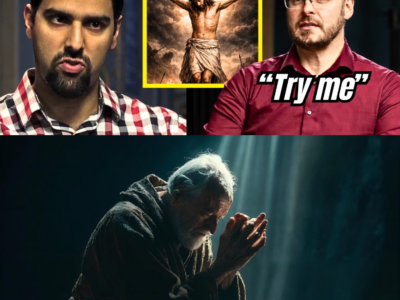
Piers Morgan Interview Sparks U.S. Firestorm as Wes Huff Defends Jesus Against Atheist Challenge
Piers Morgan Interview Sparks U.S. Firestorm as Wes Huff Defends Jesus Against Atheist Challenge
New York — A new faith debate is exploding across America after a hard-hitting interview featuring Piers Morgan and Christian apologist Wes Huff revived one of the most important questions in modern culture: if there are thousands of religions and thousands of gods, why should anyone believe Christianity is true?
The exchange, now being clipped and shared widely across Christian channels, atheist pages, and religious debate forums, has struck a nerve because it does not begin with church language. It begins with the question millions of skeptical Americans quietly ask: how can Christianity claim to be true when the world is filled with competing beliefs?
Piers Morgan put the issue plainly. Comedian and atheist Ricky Gervais has often argued that human beings have worshiped thousands of gods across history. Christians reject nearly all of them, so why not reject one more? Why should the Christian God be treated differently from Zeus, Thor, Allah, Krishna, or any other supernatural claim?
That question has long been a favorite of internet atheists. It sounds simple, devastating, and almost impossible to answer in a single line.
But Huff’s reply is now being praised by Christian commentators as one of the cleanest answers to that objection in years.
He argued that competition does not erase reality. The fact that there are millions of possible suspects in a city does not mean a criminal court cannot identify one guilty person based on evidence. Likewise, the fact that there are thousands of religious claims does not mean they are all equally unsupported. The question is not how many claims exist. The question is which claim has evidence.
That answer has now become the center of the viral debate.
For Christian viewers, it cut through what they see as a shallow atheist talking point. For skeptics, it raised the next challenge: what evidence does Christianity actually have?
That is where the interview moved from philosophy to history.
Huff argued that Christianity is not based merely on private feelings, inherited culture, or blind faith. It is rooted in historical claims about a real person: Jesus of Nazareth. According to Huff, even highly skeptical scholars generally accept that Jesus existed, lived in first-century Roman-occupied Judea, and was crucified under Pontius Pilate.
That claim matters because many everyday skeptics, especially online, still repeat the argument that Jesus may have been mythical or entirely invented. Christian apologists say that view survives more strongly on the internet than in serious scholarship. In the interview, the point was made that mainstream academic debate is not usually about whether Jesus existed, but what to make of his life, death, and the resurrection claims that followed.
The discussion then turned to the heart of Christianity: the resurrection.
Morgan pressed the issue directly. If Jesus truly rose from the dead, then Christianity is not just one spiritual option among many. It is a world-changing claim. If it happened, the entire debate shifts. The resurrection would validate Jesus’ identity and force every other worldview to respond.
Huff argued that the New Testament documents should not be dismissed simply because they are religious texts. In ancient history, historians rely on the earliest available sources. The Gospels and the writings of Paul are among the earliest sources for the Christian movement. Their religious importance today does not automatically erase their historical value.
That point is especially important in America, where many people have been taught to treat the Bible as if it cannot be historical because it is sacred. Huff’s argument pushes back against that assumption. A document can be theological and historical at the same time. The real question is whether it is early, whether it preserves witness testimony, whether it is corroborated, and whether it explains the rise of the movement.
The interview emphasized that the earliest Christians did not merely claim to have a vague spiritual feeling about Jesus. They claimed Jesus appeared to them alive after his crucifixion. They claimed they saw him, walked with him, ate with him, and encountered him over a period of time. Paul refers to hundreds of witnesses, while the Gospels describe appearances to individuals and groups.
Skeptics argue that eyewitness testimony is unreliable, that ancient people were more prone to superstition, and that miracles cannot be established by historical method. Morgan raised these kinds of concerns, including the point that even Matthew’s Gospel says some doubted when they saw Jesus.
But Huff and the commentators responding to the interview pushed back strongly. All ancient history depends on testimony in some form. To dismiss ancient witnesses simply because they are ancient is what C.S. Lewis famously called “chronological snobbery” — assuming people in the past were stupid because they lived before modern technology.
That argument resonated with American Christian audiences because it exposes a double standard. People often accept ancient testimony about emperors, wars, philosophers, and political events, but when the subject becomes Jesus, they suddenly demand a level of proof ancient history almost never provides.
The discussion also highlighted the behavior of the disciples after the crucifixion. If Jesus had died and remained dead, the expected outcome would have been collapse. Other messianic movements died when their leaders were killed. The disciples were frightened, scattered, and hiding.
Yet soon after, they returned to Jerusalem — the very place where Jesus had been executed — and publicly proclaimed that he had risen. That “scene of the crime” detail is now getting attention because it raises a powerful historical question: why preach the resurrection in the city where opponents could most easily challenge the claim?
For believers, this is evidence of courage rooted in conviction. For skeptics, it still requires explanation. Hallucination theories, grief visions, legend development, and religious enthusiasm have all been proposed. But Christian apologists argue that none of those explanations fully account for the early explosion of belief, the empty tomb tradition, the transformation of skeptics like James, and the conversion of a persecutor like Paul.
That is why the resurrection remains the battleground.
The interview then expanded into the problem of religious pluralism. America is no longer a country where Christianity can assume cultural dominance. In major cities, college campuses, workplaces, and online communities, Christians now live next to Muslims, Hindus, Buddhists, atheists, Jews, agnostics, and spiritual-but-not-religious neighbors.
For many younger Americans, exclusivity feels offensive. The idea that Jesus is “the way” and not merely “a way” sounds narrow. Yet Huff’s answer was that truth is not determined by how many alternatives exist. If Christianity is true, then it is not arrogant to believe it. It is only arrogant if Christians refuse to give reasons or refuse to love those who disagree.
That distinction may be the reason the clip is spreading.

It is not just defending Christianity. It is modeling how Christians can speak in a pluralistic culture without sounding confused or ashamed.
The debate also reminded viewers that Christianity is not merely a white Western religion. The commentators pointed out that Christianity is global, growing in Africa, Asia, the Middle East, and among people from Muslim, Hindu, secular, and atheist backgrounds. In other words, the Christian claim is not locked inside American culture. It crosses nations, languages, and ethnic lines.
That matters in a time when critics often frame Christianity as a Western political identity rather than a global faith.
The Piers Morgan exchange has now become more than another interview clip. It is a public test of whether Christians can answer the hardest questions quickly, clearly, and intelligently.
Did Jesus exist?
Did he rise?
Can eyewitness testimony matter?
Can religious texts be historical sources?
Why Christianity among thousands of faiths?
For skeptics, those questions remain open. For believers, Huff’s performance was a reminder that the Christian faith does not have to retreat from scrutiny.
In America’s increasingly hostile public square, that may be the real headline.
Christianity is back on trial.
And this time, its defenders are coming prepared.