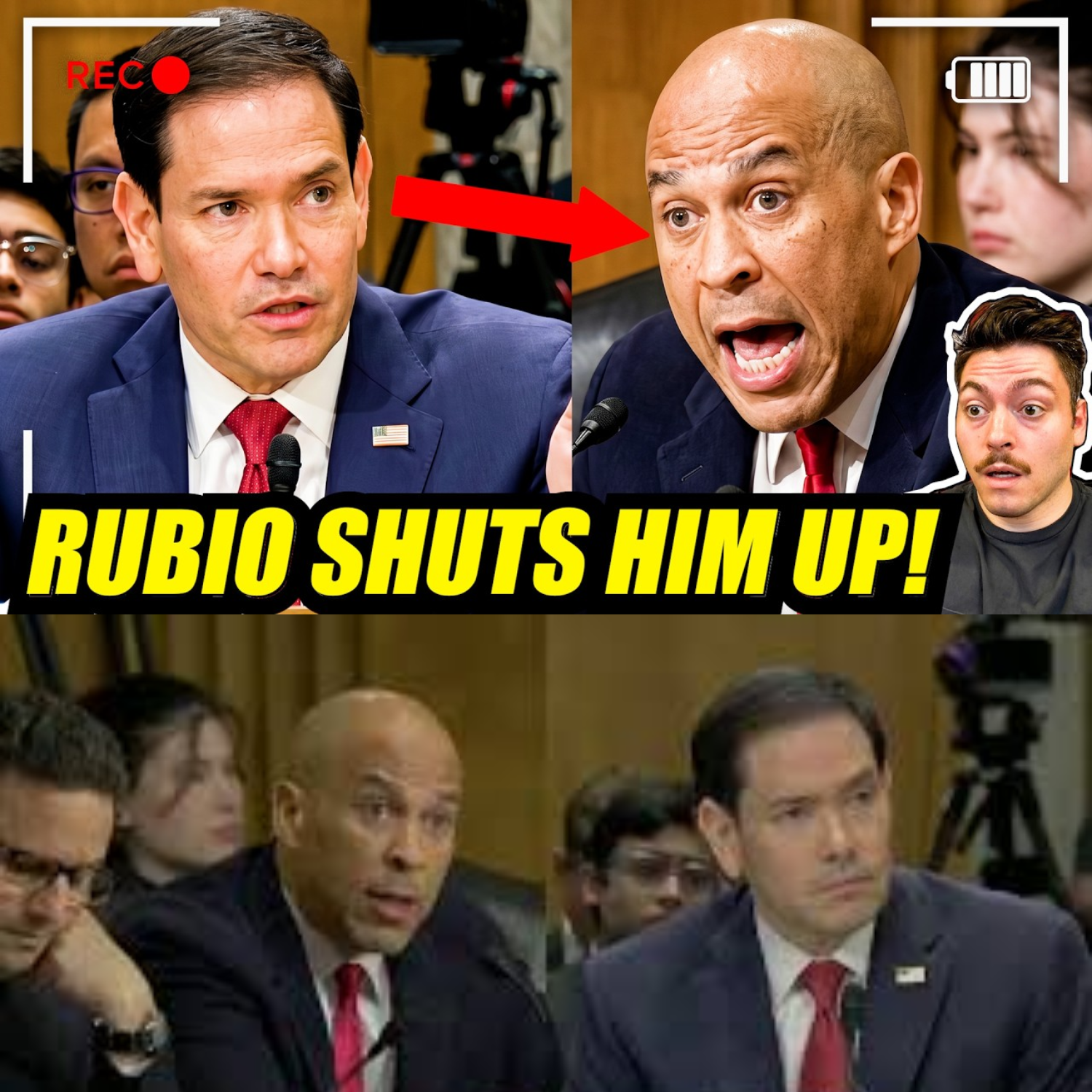
Marco Rubio TAKES DOWN Cory Booker with EPIC response, REFUSES to let him TRASH Trump Iran progress
Introduction
In the highly polarized environment of American politics, even a single exchange during a congressional hearing can quickly escalate into a national talking point. In recent days, a tense confrontation between Senator Marco Rubio and Senator Cory Booker during discussions on U.S. foreign policy toward Iran and the Trump administration’s diplomatic strategy has gone viral across social media platforms.
Clips of the exchange circulated rapidly, with partisan commentators offering sharply different interpretations. Conservative voices framed Rubio’s response as a decisive rebuttal that “shut down” criticism of President Donald Trump’s Iran policy. Progressive commentators, however, argued that the viral clips stripped away important context and oversimplified a complex policy debate.
At the center of the controversy lies a broader question: how should the United States assess its evolving strategy toward Iran, particularly as tensions in the region remain high and diplomatic negotiations continue behind the scenes?
The Context: Rising Tensions Over Iran Policy
Recent months have seen renewed U.S. engagement in Middle Eastern geopolitics, particularly involving Iran’s nuclear program, regional military activity, and control of strategic shipping routes such as the Strait of Hormuz.
According to congressional testimony and multiple reports, the Trump administration has pursued a strategy combining economic sanctions, military deterrence, and conditional diplomatic negotiations. Secretary of State Rubio has been a key figure defending this approach in both Senate and House hearings.
During these hearings, lawmakers from both parties have raised concerns about the consequences of escalating tensions with Iran, including rising global energy prices, regional instability, and the long-term effectiveness of sanctions-based diplomacy.
It was in this environment that the confrontation between Rubio and Booker took place.
The Exchange Between Rubio and Booker
During a Senate Foreign Relations Committee session, Senator Cory Booker challenged the administration’s handling of Iran policy, particularly focusing on the economic and diplomatic consequences of ongoing pressure tactics.
Booker argued that the United States risked weakening its negotiating position while increasing instability in the region. He suggested that the administration’s approach could be inadvertently strengthening Iran’s leverage in international discussions.
In response, Rubio strongly rejected the framing of the criticism.
He argued that the United States was not “begging” for a deal and insisted that any negotiations were conducted from a position of strength. Rubio emphasized that Iran, not the United States, was under increasing economic pressure due to sanctions and military constraints.
At one point, Rubio pushed back forcefully against Booker’s characterization of the situation, stating that the administration was focused on preventing Iran from advancing its nuclear capabilities and that all strategic options remained on the table.
Clips of this exchange quickly circulated online, with selective editing highlighting the most intense moments of the dialogue.
Social Media Reaction and Viral Framing
Within hours of the hearing, short video segments of the Rubio-Booker exchange were shared across platforms such as X, YouTube, TikTok, and Facebook.
The framing of these clips varied significantly depending on political perspective:
Conservative accounts described Rubio’s response as an “epic takedown” of Democratic criticism.
Progressive commentators argued that the clips misrepresented Booker’s argument and exaggerated the intensity of Rubio’s reaction.
Neutral analysts pointed out that the exchange was part of a routine but heated policy debate typical of congressional oversight hearings.
This divergence illustrates a broader trend in modern political communication: the same event can generate multiple conflicting narratives depending on ideological framing and audience bias.
What Rubio Actually Argued
Based on official transcripts and reporting from the hearing, Rubio’s core arguments centered on three main points:
Sanctions Pressure on Iran
- Rubio emphasized that U.S. sanctions were significantly constraining Iran’s economy and limiting its ability to fund regional military activity.
National Security Priorities
- He argued that preventing Iran from developing or advancing nuclear capabilities remained the administration’s top priority.
Negotiation Positioning
- Rubio rejected the idea that the U.S. was negotiating from a position of weakness, instead stating that Iran was under greater pressure due to economic and strategic constraints.
These positions reflect the broader foreign policy approach of the Trump administration, which prioritizes economic leverage and deterrence over immediate diplomatic concessions.
Cory Booker’s Criticism
Senator Cory Booker, meanwhile, raised concerns consistent with long-standing Democratic critiques of aggressive foreign policy strategies.
His arguments focused on:
The potential economic consequences of prolonged conflict or sanctions escalation
The risk of destabilizing global energy markets
The possibility that Iran could use regional conflict as leverage in negotiations
Concerns about transparency and congressional oversight of foreign policy decisions
Booker’s position reflects a broader skepticism among some lawmakers regarding military escalation and unilateral executive action in foreign affairs.
The Broader Debate Over Iran Strategy
The exchange between Rubio and Booker is part of a much larger and ongoing debate in Washington about how the United States should handle Iran.
There are generally three competing schools of thought:
1. Maximum Pressure Strategy
This approach emphasizes sanctions, military deterrence, and economic isolation to force behavioral change.
2. Diplomatic Engagement
This approach prioritizes negotiations, agreements, and gradual de-escalation.
3. Hybrid Strategy
A combination of pressure and diplomacy, using sanctions as leverage while maintaining open negotiation channels.
The Trump administration’s current approach is widely seen as a hybrid model leaning heavily toward pressure.
The Role of Cory Booker in Foreign Policy Debates
Cory Booker has increasingly positioned himself as a vocal critic of aggressive foreign policy strategies.
Representing New Jersey, Booker often emphasizes humanitarian concerns, economic stability, and long-term diplomatic solutions.
In Senate hearings, he frequently challenges administration officials on the unintended consequences of military or economic pressure campaigns.
His exchange with Rubio reflects this broader legislative role as a counterbalance within Democratic foreign policy discourse.
Media Amplification and Narrative Conflict
One of the most significant aspects of the incident is not the exchange itself, but how it was interpreted and amplified by media ecosystems.
Modern political media operates in a highly fragmented environment where:
Short clips replace full hearings
Emotional framing outperforms detailed analysis
Partisan audiences selectively share interpretations that align with their beliefs
This leads to what analysts often describe as “narrative polarization,” where the same event produces fundamentally different realities for different audiences.
The Rubio-Booker exchange is a textbook example of this phenomenon.
Why These Moments Go Viral
Political confrontations go viral for several reasons:
They involve recognizable public figures
They contain emotional tension or disagreement
They can be easily edited into short, shareable clips
They fit pre-existing political narratives
As a result, policy discussions that may last hours in Congress are often reduced to seconds of highlight clips online.
Implications for Democratic Governance
The increasing viralization of political discourse raises important questions:
Does social media improve public engagement or distort understanding?
Are lawmakers incentivized to perform for cameras rather than deliberate policy?
Can complex foreign policy issues be accurately communicated in short-form media?
The Rubio-Booker exchange highlights the tension between substantive policy debate and the realities of modern political communication.
Conclusion
The confrontation between Marco Rubio and Cory Booker over U.S. policy toward Iran illustrates the intersection of foreign policy, domestic politics, and digital media dynamics in contemporary America.
While partisan interpretations frame the exchange in dramatically different ways, the underlying reality is a complex policy disagreement shaped by competing visions of how best to handle one of the world’s most volatile geopolitical challenges.
Rubio’s defense of the Trump administration’s strategy reflects a broader emphasis on deterrence and economic pressure, while Booker’s critique highlights concerns about escalation and long-term stability.
Ultimately, the viral nature of the exchange says as much about the modern media environment as it does about the substance of the policy debate itself. In an age where political moments are instantly broadcast, clipped, and reframed, understanding the full context becomes more important—and more difficult—than ever.