Woman Accuses Ayaan Hirsi Ali of “Racism” at U.S. Event — Her Stunning Response Leaves the Crowd Silent
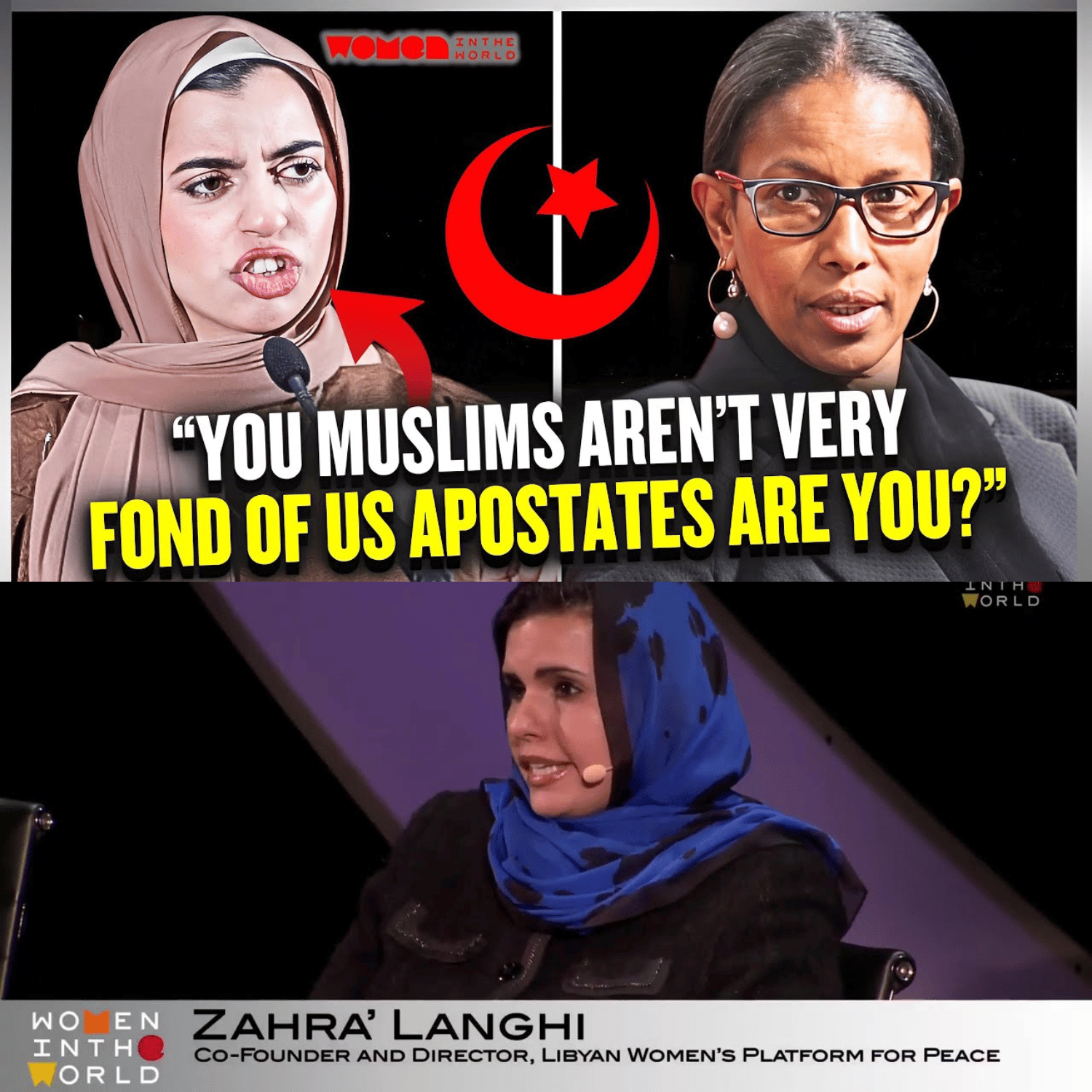
A tense and emotionally charged exchange unfolded at a public conference in the United States when author and activist Ayaan Hirsi Ali was confronted by an audience member who accused her of unfairly targeting Islam in her public criticism of religious practices affecting women.
The confrontation began when the questioner challenged Hirsi Ali on why she focused her criticism primarily on Islam while other religions also contain patriarchal traditions.
“There are so many misogynists and they belong to many different religions,” the questioner said. “Why are you picking only on Islam?”
The question drew applause and murmurs from different sections of the audience, immediately setting the stage for a debate over religion, reform, and free expression.
Hirsi Ali responded calmly but firmly, acknowledging the sensitivity of the topic while rejecting the idea that her arguments were based on selective bias.
“Any public relations person will tell you never open your remarks with statistics,” she said, before adding that she intended to do exactly that.
She then cited global survey data, including Pew Research findings, to argue that in several majority-Muslim countries, significant portions of the population support the implementation of Sharia law as the official legal system.
According to Hirsi Ali, such findings are important for understanding not only religious belief but also how law and governance intersect with culture in different societies.
Her argument quickly moved from statistics to broader claims about human rights and legal systems.
“I embrace Muslims, but I reject Islamic law,” she said. “I reject it because it is totalitarian in its nature and deeply discriminatory, particularly toward women.”
She described examples she believes reflect harmful legal interpretations in certain countries, including restrictions on women’s mobility, inheritance rights, and legal testimony.
Throughout her remarks, she emphasized a distinction between individuals and ideology.
“I make a clear distinction between Islam as a set of ideas and Muslims as human beings,” she said. “Muslims are diverse. They are my allies in many cases. But I reject the legal and political systems that come from certain interpretations of Islamic law.”
Her comments drew both applause and visible discomfort from parts of the audience.
Another speaker in the discussion pushed back, arguing that Hirsi Ali’s framing oversimplifies Islamic jurisprudence and ignores the diversity of interpretation within Sharia traditions.
The exchange intensified as the topic shifted from theology to politics, with the critic arguing that Sharia is often misrepresented in Western discourse and can refer to a wide range of ethical and religious practices rather than a single rigid legal system.
“There is no single thing called Islamic law,” the speaker said. “Sharia is a dynamic process that must be contextualized.”
This prompted Hirsi Ali to respond that while interpretations may vary, real-world applications of Sharia in some countries have led to what she described as systemic discrimination against women.
The discussion then moved into more controversial historical and theological references, with Hirsi Ali citing examples from modern Islamic governance and early Islamic history to support her argument that certain legal interpretations have been resistant to reform.
She also emphasized that her concerns are rooted in human rights rather than religious hostility.
“If we do not talk about the principles, we cannot address the practices,” she said. “And in some contexts, those principles remain deeply problematic.”
The conversation briefly escalated when the critic challenged Hirsi Ali’s past statements about Islam, referencing earlier interviews in which she had used stronger language about the religion and its political influence.
At one point, the exchange became heated as both speakers talked over one another, with audience members reacting audibly to the back-and-forth.
Despite the tension, Hirsi Ali reiterated her core position.
“I consistently distinguish between Islam as a faith and Muslims as individuals,” she said. “I reject violence and discrimination, but I support open debate about ideas.”
She also pointed to what she described as a growing trend among younger Muslims who are advocating for reform from within their own communities.
“I see more and more young Muslims who are questioning rigid interpretations and pushing for separation between religion and state,” she said.
That statement was met with applause from sections of the audience, suggesting that even amid disagreement, there is shared interest in reform, dialogue, and coexistence.
Following the exchange, commentators online quickly amplified the debate, with supporters praising Hirsi Ali for what they described as a clear articulation of women’s rights concerns and critics accusing her of overgeneralization and reinforcing negative stereotypes about Islam.
The incident reflects a broader pattern in Western political and academic spaces, where discussions about religion, identity, and law increasingly intersect with debates over free speech, multiculturalism, and human rights.
Experts note that these conversations are becoming more frequent and more emotionally charged as global migration, digital media, and international conflicts bring religious and cultural questions into sharper public focus.
While no consensus emerged from the debate, the exchange underscored one clear reality: discussions about Islam in Western societies remain among the most sensitive and contested topics in contemporary public discourse.
As the event concluded, organizers encouraged continued dialogue and emphasized the importance of maintaining respectful disagreement even on deeply divisive issues.
For many in attendance, the moment was not just about one confrontation, but about a much larger question still unresolved in Western politics today: how to balance criticism of ideas with respect for people who hold them.