Marie Julie Jahenny’s Prophecies: Are They Unfolding Now?
Imagine a small, quiet cottage in the French countryside, tucked away in a corner of Britany, where the wind smells of salt and the fog often hides the fields.
Most people pass by these old stone houses without a second thought.
But one house in the village of Blaine holds a story that has terrified and fascinated people for over a hundred years.
Inside, a young woman named Marie Julie Jaheni spent 60 years lying in a simple wooden bed.
She didn’t lead an army.
She didn’t write books and she rarely left her room.
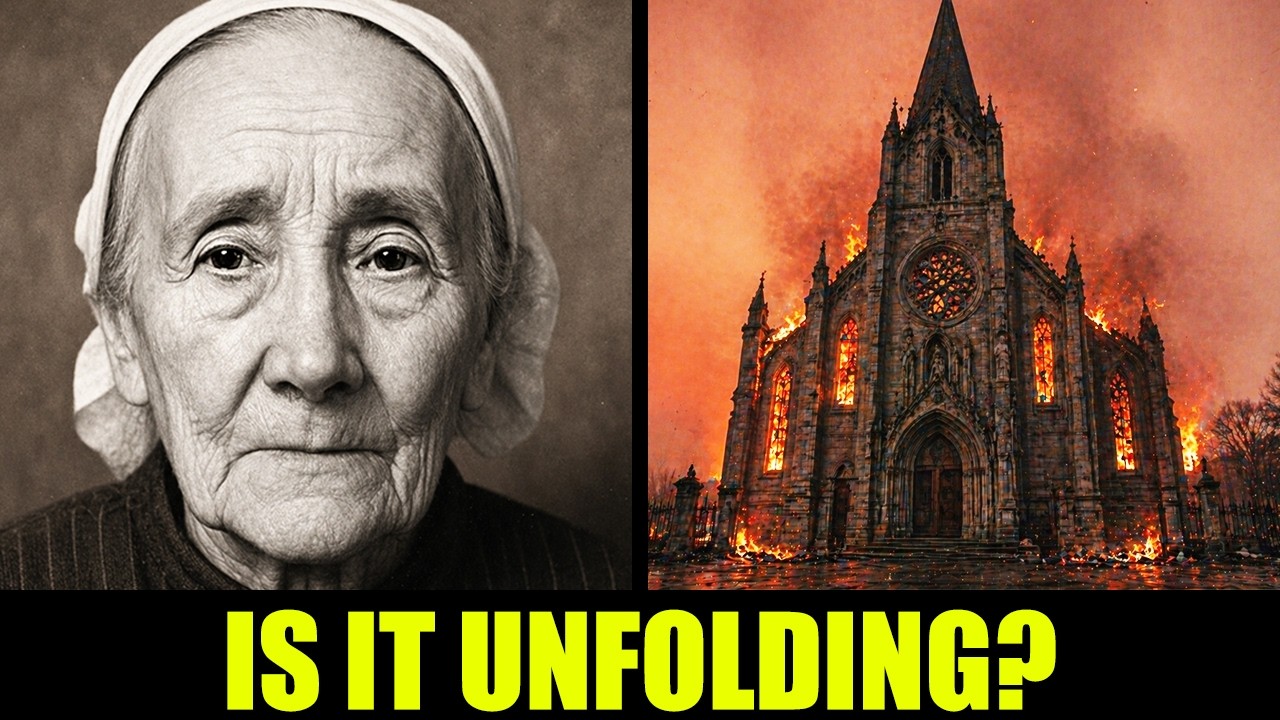
Yet, she became one of the most mysterious figures in history because she claimed to see a future that no one else could.
a future where the world would suddenly go dark.
Marie Julie was a peasant girl who couldn’t really read or write.
But she became famous as the Breton stigmatist.
This is because her body reportedly bore the same wounds that Jesus had on the cross, marks on her hands, feet, and side that would bleed every Friday.
Doctors from all over came to her bedside, baffled by what they saw.
Even more strange were the reports that she stopped eating altogether, living for years on nothing but a single thin wafer given to her during church services.
But while her physical life was a mystery, it was the things she said during her deep trances that really shook the world.
She spoke about a great darkness that was coming not just a storm or an eclipse, but a time when the sun would vanish for three full days.
She warned that during this time, the air would become poisonous and the only light that would work would be from special blessed candles.
To the people of her time, this sounded like a nightmare from an old book.
But as the years went by and the world moved into an age of world wars and giant bombs, her talk of fire falling from the sky and poison air started to sound much more real.
People began to wonder if this quiet girl in the countryside was actually seeing the modern world before it even arrived.
Even now, long after she passed away in 1941, people still talk about Marie Julie Jini.
We live in a world that feels very fragile.
And her story touches on that deep human fear that everything we know could change in an instant.
She wasn’t trying to be famous or rich.
She lived a life of constant pain and silence, believing that her suffering could somehow help a world that was losing its way.
Whether you believe her visions were real or just the dreams of a sick woman, there is something haunting about her life, she sat in the dark for decades, waiting for a storm she was sure was coming and inviting us to wonder if we are ready for what lies ahead.
To understand how a girl like Marie Julie became a figure of such mystery, you have to look at where she started.
She was born in 1850 in a tiny hamlet called Blaine.
At that time, Britany was a place where the modern world felt like a distant rumor.
People lived close to the earth, working the fields from sunrise to sunset.
The sounds of the day weren’t cars or machines, but the loing of cattle and the ringing of the village church bells.
For the Jahini family, life was simple and often quite hard.
They were poor, and Marie Julie was the oldest of five children.
From a very young age, she was expected to help her mother with the chores and look after her younger siblings.
Those who grew up with her remembered her as a girl who was always a bit different.
She wasn’t loud or playful like the other children.
Instead, she had a quietness about her that felt older than her years.
She was deeply religious, but not in a way that felt forced to her.
The stories of the saints were just as real as the neighbors living down the road.
She spent hours in the local church, often found kneeling on the cold stone floor long after everyone else had gone home.
She didn’t have much of an education.
Reading and writing were skills she never really mastered.
But she had a memory for the prayers and the hymns that shaped her world.
In the mid 1800s, France was going through a massive identity crisis.
The country was torn between its old Catholic roots and a new secular government that wanted to move away from the church.
In the cities, people were rioting and dreaming of a world without kings or priests.
But in the countryside of Britany, people clung to their faith like an anchor.
This tension was the backdrop of Marie Julie’s youth.
She grew up in a world that felt like it was under attack, where the things people held most sacred were being mocked or pushed aside.
This sense of a world in trouble likely stayed with her as she entered her early 20s.
When she was 23, something changed that would end her normal life forever.
Marie Julie became incredibly sick.
Her body grew weak and her family feared she wouldn’t survive the week.
It was during this time that she claimed to have her first vision.
She said the Virgin Mary appeared to her not to offer an easy cure, but to ask her a question.
She was asked if she would be willing to suffer for the sake of others to become what was known as a victim soul in the religious culture of that time.
This meant someone who accepted physical pain and illness as a way to pray for the world.
Marie Julie said yes and almost immediately her life shifted from that of a simple peasant girl to something that would baffle doctors and believers for the next half century.
In early 1873, the small room in the Jahini cottage became the center of a mystery that would soon draw the eyes of all of France.
It started with a stigmata.
On a quiet Friday in March, Marie Julie began to bleed from her hands, her feet, and her side.
For those standing by her bed, it was a terrifying sight.
A simple peasant girl was suddenly physically reliving the final hours of Christ’s life.
The wounds didn’t behave like normal injuries either.
Witnesses reported that they would bleed heavily at specific times of the day and then start to close or dry up only to reopen the following week.
As news of the bleeding girls spread, the cottage at Lafraise was flooded with people.
Scientists, skeptical doctors, and curious neighbors all wanted to see if this was a hoax.
The doctors were especially thorough.
They washed her skin to see if the blood was being painted on, and they bandaged her hands in heavy silk to make sure she wasn’t scratching herself in secret.
But time and again, they were left without an answer.
The blood would appear under the bandages, and the wounds remained as real as the skin they were etched into.
To the medical men of the 1870s, there was no biological reason for a body to behave this way, and their confusion only added to the growing legend.
But the stigmata were only the beginning of the strange phenomena.
People began to notice that Marie Julie was no longer eating.
At first, her family tried to force a little soup or bread, but she couldn’t keep anything down.
Eventually, she claimed she no longer felt hunger at all.
According to the records kept by the priests who visited her, she lived for years and eventually decades without eating a single meal.
Her only intake was the small, thin wafer of the Eucharist.
To the modern world, this sounds like a physical impossibility.
Yet, those who lived with her swore it was the truth.
She became a living ghost, a person who seemed to be kept alive by something other than food and water.
While her body was breaking down or defying nature, her mind seemed to be somewhere else entirely.
During these times of suffering, Marie Julie would fall into deep transes.
Her eyes would fix on something no one else could see, and her voice would change.
She began to describe visions of heaven and earth, but mostly she began to give warnings.
She would speak for hours about the sins of the world and the need for people to return to a life of simplicity and prayer.
For those sitting in that small candle lit room, the atmosphere was heavy with a sense of gravity.
It felt as though this young woman was a bridge between two worlds and the messages she was bringing back were intended to shake the world out of its sleep.
In early 1873, the small room in the Jahini cottage became the center of a mystery that would soon draw the eyes of all of France.
It started with the stigmata.
On a quiet Friday in March, Marie Julie began to bleed from her hands, her feet, and her side.
These weren’t just scratches or superficial marks.
They were deep, painful wounds that appeared to open on their own.
For those standing by her bed, it was a terrifying sight.
A simple peasant girl was suddenly physically reliving the final hours of Christ’s life.
The wounds didn’t behave like normal injuries, either.
Witnesses reported that they would bleed heavily at specific times of the day and then start to close or dry up only to reopen the following week.
As news of the bleeding girl spread, the cottage at Lafrodis was flooded with people.
Scientists, skeptical doctors, and curious neighbors all wanted to see if this was a hoax.
The doctors were especially thorough.
They washed her skin to see if the blood was being painted on, and they bandaged her hands in heavy silk to make sure she wasn’t scratching herself in secret, but time and again they were left without an answer.
The blood would appear under the bandages, and the wounds remained as real as the skin they were etched into.
To the medical men of the 1870s, there was no biological reason for a body to behave this way, and their confusion only added to the growing legend.
But the stigmata were only the beginning of the strange phenomena.
People began to notice that Marie Julie was no longer eating.
At first, her family tried to force a little soup or bread, but she couldn’t keep anything down.
Eventually, she claimed she no longer felt hunger at all.
According to the records kept by the priests who visited her, she lived for years and eventually decades without eating a single meal.
Her only intake was the small, thin wafer of the Eucharist.
To the modern world, this sounds like a physical impossibility.
Yet, those who lived with her swore it was the truth.
She became a living ghost, a person who seemed to be kept alive by something other than food and water.
While her body was breaking down or defying nature, her mind seemed to be somewhere else entirely.
During these times of suffering, Marie Julie would fall into deep transes.
Her eyes would fix on something no one else could see, and her voice would change.
She began to describe visions of heaven and earth, but mostly she began to give warnings.
She would speak for hours about the sins of the world and the need for people to return to a life of simplicity and prayer.
For those sitting in that small candle lit room, the atmosphere was heavy with a sense of gravity.
It felt as though this young woman was a bridge between two worlds.
And the messages she was bringing back were intended to shake the world out of its sleep.
Life in that small room became a cycle of silence and pain that lasted for decades.
While the world outside was changing with the invention of the telephone, the car, and the light bulb, Marie Julie stayed in her bed.
She became what many called a living sacrifice.
This wasn’t a life she chose for fame, but one she believed was a job she had to do.
In her mind and in the minds of those who followed her, her physical suffering wasn’t just a random illness.
It was a way to carry the weight of other people’s mistakes.
She believed that by taking on this pain, she was helping to hold back a great wave of trouble that was headed for the world.
Day after day, the scene at the cottage remained the same.
The air was thick with the smell of beeswax and the sound of quiet whispering.
Marie Julie would lie still, her hands often wrapped in white cloths to cover the marks of the stigmata.
She didn’t ask for much.
She didn’t want fancy clothes or comfortable furniture.
In fact, she seemed to prefer the beness of her room.
This lack of ego is what convinced many of the skeptics that she was the real deal.
Usually when people fake something for attention, they want to be seen as powerful or special.
But Marie Julie was humble.
She spoke about herself as if she were a mere nothing, a simple tool being used by a higher power.
Her isolation was almost total.
Yet she seemed to know exactly what was happening in the hearts of the people who came to see her.
Visitors often claimed that before they even spoke, Marie Julie would address the very problems they were secretly worried about.
She had a way of looking at people that made them feel like she was seeing right through their skin and into their souls.
Despite her constant pain, she was described as being remarkably peaceful.
There was no bitterness in her voice, only a deep sense of purpose.
She wasn’t just waiting to die.
She was working in a spiritual sense every single hour of the day.
This work of suffering is a hard concept for us to understand today.
We spend so much of our lives trying to avoid pain.
But for Marie Julie, pain was the point.
She saw it as a form of currency that she could use to buy mercy for others.
This belief turned her tiny room into a spiritual powerhouse for the people of Britany.
They didn’t see a sick woman.
They saw a protector.
They believed that as long as she was there, praying and suffering in the silence of Lafra eyes, there was hope for a world that seemed to be spinning out of control.
It was a heavy burden for a peasant girl to carry.
But for 60 years, she never once asked to put it down.
To really understand why people were so frightened by Marie Julie’s visions, you have to look at what was happening in France at the time.
It wasn’t just a quiet period of history.
It was a time of fire and blood.
Not long before Marie Julie’s visions began, France had been crushed in a war with Prussia.
People were starving, the government had collapsed, and the city of Paris had turned into a literal battlefield.
There was a period called the Paris Commune where the city was essentially taken over by revolutionaries.
They burned down famous buildings, executed the Archbishop, and turned churches into warehouses or clubs.
For someone like Marie Julie, who lived and breathed her faith, it felt like the end of the world had already started.
This chaos created a deep scar on the soul of the country.
The people in the countryside, like those in Marie Julie’s village, felt like their entire way of life was under attack.
They saw the modern world, not as progress, but as a violent force that wanted to destroy their traditions and their god.
This is the atmosphere in which Marie Julie began to speak.
When she told people that Paris would one day burn or that the enemies of the faith would bring about a great disaster, she wasn’t just talking about a distant future.
She was talking about things people were seeing with their own eyes on the news or hearing about from travelers.
It was during this time that she began to focus her prophecies on the fate of France.
She called France the first daughter of the church and warned that because the country had turned its back on its spiritual roots, it would have to go through a crucible, a period of intense heat and testing.
She didn’t speak like a politician.
She spoke like a mother warning a child about a hot stove.
She talked about a coming revolution that would be much worse than the ones before.
She said that blood would flow in the streets of the big cities and that even the priests would be hunted down.
What’s interesting is that she didn’t just blame the bad guys.
She often said that the people who called themselves religious were also at fault because they had become lukewarm or lazy.
This made her messages feel very grounded and real to the people listening.
It wasn’t just them versus us.
It was a call for everyone to look at their own lives.
As the 1800s turned into the 1900s and the world moved toward the horrors of the First World War, her warnings about a world built on pride and greed started to feel less like the ramblings of a sick woman and more like a road map of the 20th century.
She was describing a world that was losing its balance and she was certain that a fall was coming.
Then came the messages that would define her legacy.
The ones that still make people hold their breath today.
Among all her warnings, none were as chilling as her description of the three days of darkness.
Marie Julie didn’t just talk about a typical storm or a brief power outage.
She described a literal physical darkness that would cover the entire earth.
According to those who wrote down her words, she said that for three days and two nights, the sun would completely disappear.
There would be no light from the stars or the moon.
It wouldn’t just be dark.
She described the air itself becoming thick and dangerous to breathe, filled with what she called horrible things.
She warned that when this time came, people shouldn’t try to go outside or even peek through their windows.
She told her followers to lock their doors and stay inside with their families.
In her visions, she claimed that the only thing that would provide light during those 72 hours was a candle made of blessed wax.
She said that even the most advanced lights created by man would fail, and that the wicked would be terrified, while those who had kept their faith would find a strange kind of peace in the silence.
It sounds like a scene from a horror movie, but for Marie Julie, it was a necessary cleansing away for the world to be reset after it had moved too far into greed and violence.
But she didn’t just stop at the darkness.
She spoke about fire falling from the sky and earthquakes that would shake the foundations of the world’s great cities.
She often focused on Paris, which she called the city of sin.
She claimed she saw a day when the city would be almost entirely burned to the ground.
For the people of the 19th century, these visions felt like a return to the frightening stories of the Bible.
But for us today, it’s hard not to notice how much her descriptions of clouds of fire and poisonous air resemble the reality of modern warfare, things she couldn’t have possibly known about, while sitting in her quiet room in 1880.
What makes these prophecies different from others is the level of detail.
She didn’t just say bad things will happen.
She gave specific instructions on how to prepare, focusing more on the spirit than on hoarding supplies.
She told people that the most important thing they could have was a clean heart and a sense of trust.
She wasn’t trying to cause a panic.
She was trying to give people a wakeup call.
To her, the great chastisement wasn’t about God being angry for the sake of being angry.
It was about a world that had become so heavy with its own mistakes that it finally had to break so it could be put back together.
The darkness wasn’t just a punishment.
It was a transition into a world that would finally be at rest.
As the years passed, Marie Julie’s visions turned towards something even closer to her heart, the Catholic Church.
itself.
She didn’t just see trouble for the world at large.
She saw a deep crisis coming for the very institution she loved.
She spoke about a time when the church would seem to be in ruins, not from outside attacks, but from the inside.
She warned that many leaders would lose their way and that the faith of ordinary people would be tested like never before.
In her transes, she described strange changes that would come to the way people prayed and the way the mass was celebrated.
She wasn’t just predicting a few small shifts.
She was describing a total earthquake within the spiritual walls of Rome.
One of the most painful parts of her messages was her description of the desertion of the faith.
She said a time would come when churches would be closed or turned into places of worldly business and when the true teachings would be hard to find.
She spoke of a new religion that would look like the old one but would lack its soul a way of life that followed the world instead of following God.
For a woman who lived for the eukarist and spent every waking hour in prayer.
These visions were heartbreaking.
She reportedly wept during these ecstasies, begging for mercy for the priests and bishops who she claimed would one day lead the people astray.
Despite the heavy nature of these warnings, she also spoke about a holy remnant, a small group of people who would stay faithful even when it felt like the rest of the world had moved on.
She promised that these people would be protected and guided through the confusion.
She didn’t want people to be afraid of the church’s crisis, but to be prepared for it.
She often said that the church had to go through its own passion, just like Christ did before it could be reborn in a more beautiful and pure form.
It was a message of tough love that didn’t sit well with some of the higherups in the religious hierarchy of her time.
This was perhaps why her relationship with the official church was so complicated.
While many priests supported her, others were terrified by what she was saying.
To suggest that the church would go through such a dark period was seen as almost scandalous.
But Marie Julie never backed down.
Even when she was told to be quiet or when her access to the sacraments was restricted, she remained obedient and humble.
She didn’t try to start her own movement or fight back.
She simply stayed in her bed, repeating the warnings she felt she had been given, believing that the truth would eventually come to light, even if it took a century for people to understand what she meant.
But the visions weren’t only filled with shadows and warnings.
Marie Julie also spoke about a great hope that would follow the storm.
She didn’t believe the darkness was the end of the story.
She believed it was the birth pains of a new peaceful era.
She often spoke about a figure she called the great monarch, a leader who would rise up when everything seemed lost.
According to her accounts, this wouldn’t be a typical politician or a power-hungry dictator.
Instead, he would be a man of deep faith, a king of the liies who would help restore order to a broken France and bring the world back to a sense of peace.
She described this future time as a second spring.
In her visions, after the 3 days of darkness had passed and the earth had been cleansed, the sun would shine more brightly than ever before.
She said, “The air would be pure, the fields would be fertile, and people would live in a way that was simple and kind.
The greed and the constant noise of the industrial world would be gone, replaced by a society that valued family, prayer, and the land.
” For the poor farmers of Britany, who sat by her bed, this was a beautiful promise.
It gave them a reason to endure the hard times, knowing that a better world was waiting on the other side of the crisis.
Marie Julie also spoke about a holy pope who would work alongside this great monarch.
She claimed that these two leaders would heal the wounds of the church and the world, bringing people together in a way that hadn’t been seen for centuries.
To her, this wasn’t just a political dream.
It was a divine promise.
She wanted her followers to understand that no matter how bad the great chastisement became, it had a limit.
God wasn’t going to let the world be destroyed entirely.
The purpose of the suffering was to prune the garden so that something more beautiful could grow in its place.
This message of restoration is what kept many people from falling into despair.
Marie Julie’s prophecies were like a map through a dangerous forest.
They showed the traps and the dark valleys, but they also pointed toward the sunny clearing at the end.
She told people to keep their eyes on that light.
Even when she was in the middle of a painful trance, her voice would often turn joyful when she spoke of this coming peace.
She reminded everyone that the great battle was already won in the spiritual world and that their only job was to stay faithful and patient until the dawn finally broke.
Because of the incredible claims surrounding her life, Marie Julie Jawahi was always followed by a cloud of controversy.
Not everyone who heard about the girl from Blaine believed she was a saint.
In fact, many people, including some very powerful figures within the Catholic Church, were deeply suspicious.
They wondered if she was simply a woman struggling with a mental illness or if she was being manipulated by people around her who wanted to use her fame for their own political goals.
At one point, the local bishop even took the extreme step of banning her from receiving the sacraments.
For someone like Marie Julie, who believed her very life depended on the Eucharist, this was a crushing blow.
Yet those who watched her during this time noted that she didn’t get angry or try to start a rebellion.
She simply obeyed, continuing her life of prayer in total silence.
Scientists and skeptics of the late 1800s were also determined to prove she was a fraud.
They couldn’t wrap their heads around the idea of the stigmata or the fact that she reportedly went years without eating.
Some accused her of hiding food in her bed or using chemicals to make her skin bleed.
But the more they investigated, the more frustrated they became.
There were doctors who spent days watching her every move, only to leave more confused than when they arrived.
They found that her wounds behaved in ways that medical science couldn’t explain, bleeding on queue, and then healing without getting infected.
despite the poor conditions of a peasant cottage.
While some dismiss her today as a hysteric, others point out that the sheer consistency of her life over 60 years is something that is very hard to fake.
Even among believers, there is often a debate about which parts of her story are real and which are tradition.
When a person becomes a legendary figure, stories tend to grow and change over time.
Some of the prophecies attributed to her were written down by people who might have added their own fears or hopes to her words.
This is why historians and the church suggest using caution.
They remind us to distinguish between what Marie Julie actually said in her transfers and the many rumors that have popped up on the internet decades after her death.
She never claimed to be a prophet with 100% accuracy.
She saw herself as a witness who was simply reporting what was shown to her in a vision.
Today, the church’s stance on Marie Julie remains complex.
She hasn’t been officially declared a saint, but her home at Lafraise is still a place where people go to pray.
The controversy hasn’t really gone away.
It has just changed with the times.
For critics, she is a fascinating study in how extreme religious devotion can affect the human body and mind.
For devotees, she is a hero who stood her ground against a world that had no room for miracles.
Whether she was a mystic, a victim of her own mind, or something else entirely, one thing is certain.
She lived a life that challenged everyone who came into contact with her, forcing them to ask themselves what they truly believed about the invisible world.
Marie Julie Jahini passed away on March 4th, 1941.
In the middle of a world that was tearing itself apart outside her small room, the Second World War was raging.
France was once again under occupation and the very air seemed heavy with the kind of violence she had been talking about for half a century.
She was 91 years old.
For 68 of those years, she had lived as a prisoner of her own bed, a woman who had seen the sun rise and set from the same window while claiming to see the rise and fall of civilizations.
When she died, it wasn’t with a grand gesture or a final shout.
She simply slipped away into the silence she had lived in for so long.
But while her body was finally at rest, the story of Lafradice was only just beginning its second life.
In the decades since her death, something strange has happened.
You might expect a 19th century mystic to be forgotten, buried under the fast-paced noise of the digital age.
But Marie Julie Jenny is more popular now than she perhaps ever was during her lifetime.
If you go online today, you will find thousands of people from small towns in America to cities in South America and Europe who are obsessed with her every word.
They aren’t just looking at her as a historical curiosity.
They are looking at her as a guide.
They see the world around them, the pandemics, the strange weather patterns, the constant threat of war, and the feeling that society is losing its moral compass.
And they hear an echo of the warnings she gave over a 100red years ago.
Why does she still have this kind of power over people’s imaginations? To understand that, we have to look at the human heart.
We live in a world that often feels like it’s moving too fast.
Everything is high techch.
Everything is tracked.
And yet many people feel more lost than ever.
There is a deep quiet fear that the systems we rely on, our electricity, our internet, our governments are much more fragile than we want to admit.
When Marie Julie spoke about the three days of darkness, she was touching on a primal human fear.
The fear of being left in the dark without our tools, forced to face ourselves and the divine.
For a modern person who feels overwhelmed by the complexity of 2026, her message offers a strange kind of clarity.
It says that the chaos has a purpose, that the darkness is a transition, and that faith is the only light that won’t burn out.
For many Christians today, especially those who feel like the church has become too worldly or has lost its way, Marie Julie is a symbol of the old ways.
They look at her life of extreme sacrifice and total devotion as a challenge to the lukewarm faith of the modern world.
She didn’t have a platform.
She didn’t have a social media account.
And she didn’t care about being liked.
She just prayed and suffered in a dark room.
In an age of influencers and loud opinions, there is something incredibly compelling about a woman who found her strength in total hiddenness.
People see her as a watchman on the wall, someone who stayed awake while the rest of the world fell into a spiritual sleep.
However, we also have to be careful when we look at why her story attracts so much attention.
There is a danger in focusing only on the scary parts of her prophecies.
Some people use her words to create a sense of panic or to fuel doomsday theories that can be very damaging.
But if you look at the actual accounts of her life, she wasn’t a woman of fear.
She was a woman of hope.
She didn’t want people to hoard candles because they were afraid of dying.
She wanted them to find a piece that death couldn’t touch.
She often reminded her visitors that the goal isn’t to survive the darkness, but to be the kind of person who is worthy of the light that comes afterward.
If we only see the three days of darkness as a horror story, we miss the entire point of her life.
Her legacy also forces us to think about how we treat people who don’t fit into our neat, logical boxes.
Was Marie Julie a saint? Was she a victim of a very specific kind of religious trauma or was she something in between? We live in an age that wants to explain everything with a diagnosis or a chemical formula.
We want to say that the stigmata were just skin conditions and the fast was just anorexia.
But when you look at the 60-year consistency of her life, the peace she kept even when the church turned against her and the way she predicted things she couldn’t possibly have known.
You realize that science doesn’t always have the final word.
Marie Julie remains a sign of contradiction.
She stands as a reminder that there are still things in this world that are mysterious, uncomfortable, and beyond our control.
As we look back at the cottage at Lafrodis, we see more than just a place where a sick woman lived.
We see a testament to the power of the human spirit to find meaning in suffering.
In our modern culture, we are taught to avoid pain at all costs.
We have a pill for every ache and a distraction for every worry.
But Marie Julie leaned into her pain.
She believed that her suffering was a bridge that could help others cross over into a better world.
Whether or not you believe in the supernatural side of her story, there is something undeniably beautiful about that level of selflessness in a world that tells us to look out for number one.
She spent her entire life looking out for everyone else.
The story of Marie Julie Jahini ends with a question that hangs in the air for all of us.
If the world did go dark tomorrow if all our lights failed and the noise finally stopped, who would we be? Would we have the interior strength to sit in the silence as she did? Her life was a long 60-year preparation for a single moment of transition.
She taught her followers that the most important prep isn’t what you have in your basement, but what you have in your soul.
She showed that even the smallest most ignored person in the world can have an impact that lasts for centuries if they are willing to stand for something bigger than themselves.
In the end, the Breton stigmatist doesn’t belong to the historians or even just to the religious.
She belongs to anyone who has ever looked at the horizon and felt that a storm was coming.
She is a reminder that we are not just biological machines but spiritual beings caught in a much larger story than we can see.
As her life fades into the past, her message stays relevant because the human condition hasn’t changed.
We still struggle with greed.
We still face uncertainty and we still hope for a dawn that will finally stay.
Marie Julie Janei spent her life waiting for the light.
She died in the middle of a war, but she died with a sense of victory.
She believed that the darkness was only temporary, a short winter before an eternal spring.
As we move forward into our own uncertain future, perhaps we can take a piece of that peace with us.
Her story invites us to slow down, to look at the blessed candles of our own lives, our faith, our families, and our kindness.
And to remember that no matter how thick the fog gets, it can never truly put out the light.
The silence of Laafraise isn’t the silence of the grave.
It’s the quiet, steady heartbeat of a woman who knew that the end of the world is really just the beginning of everything else.