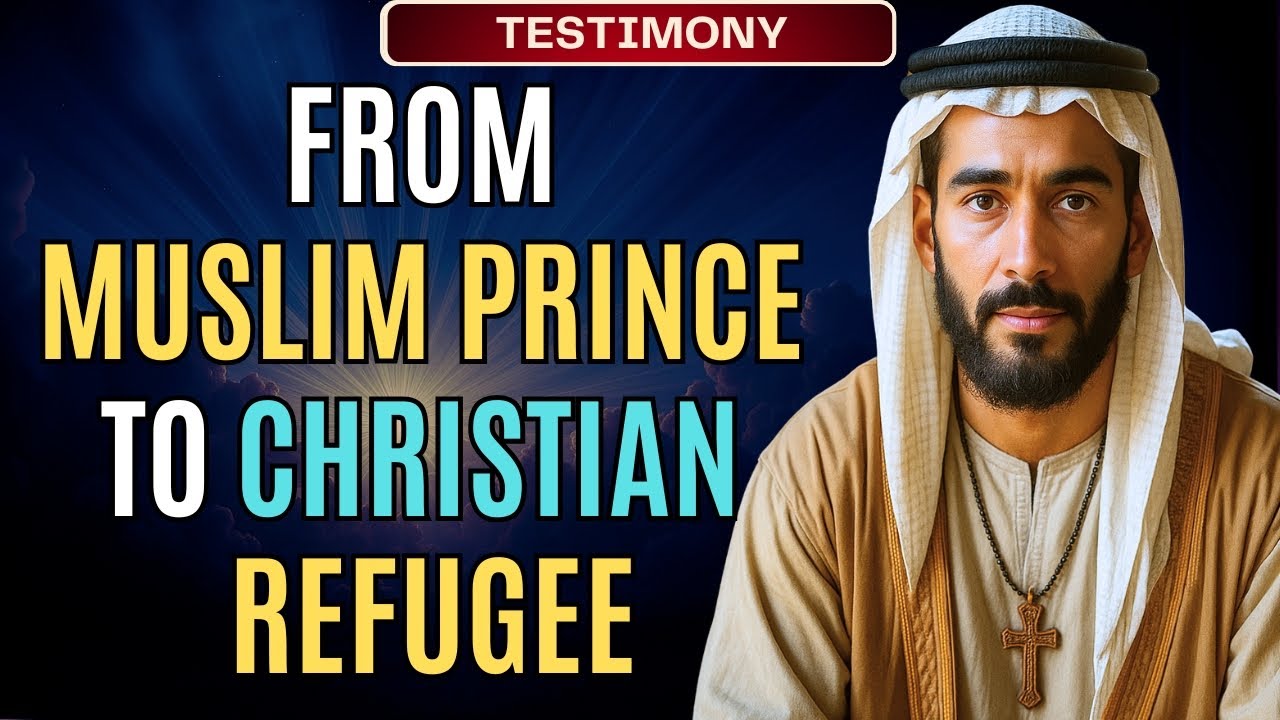
From Muslim Heir to Christian Refugee: A True Story of Faith and Courage
My name was once Khalil Iban Rashid Al-Hadrami. Today that name is still on my documents, but it is no longer in my heart.
I am 24 years old, or so the calendar says. But honestly, my soul carries scars and memories that seem to span several lifetimes.
I write these words now far from the mountains of Hadramout in a place where I can finally breathe without looking over my shoulder.
But I want to take you back with me for a moment to the place where it all began.
A world that seems to belong to another time and perhaps even to another me.
I grew up with a destiny sealed before I could even speak. I was the first born of Rashid Al-Hadrami, chief of one of the most feared and respected tribes in eastern Yemen.
This meant that one day I would be the circa, the successor. My father was the image of authority.
He was tall with a long gray beard falling over his chest and eyes that seemed to decipher your thoughts before you spoke them.
When he spoke in the assemblies, there was silence. Even the wind seemed to listen.
Our tribes territory was vast. Limestone mountains, hidden valleys, where water was a miracle, and each drop was worth more than gold.
The mudouses balanced on the hillsides as if defying gravity, connected by trails so narrow that only the most experienced hikers could venture on without hesitation.
The air was a mixture of dust, cardamom, and incense, a scent that I can still smell today when I closed my eyes.
It was to this smell that I fell asleep and woke up every day. From an early age, everything in me was shaped to take on a role I didn’t yet understand.
Mornings began before sunrise. My father would wake me with a gentle tap on the shoulder and a phrase that still echoes in my mind.
A steady hand knows no laziness. We would walk together to the mosque, an ancient building that seemed to whisper the prayers of all those who came before us.
There, with my feet on the cold ground and my heart full of sleep, I learned the first pillars of faith.
But the learning didn’t stop there. Riding camels that looked like living giants, I learned to balance myself before I even reached the stirrups.
The desert was my school and the wind my teacher. I learned to decipher tracks in the sand, to find water where there was only stone, to negotiate like an old merchant, and to keep my word as if it were a blood oath.
Tribe is blood, and blood is not betrayed. This was the lesson my father repeated most often, spoken with such seriousness that it seemed like a law written in the desert itself.
He repeated it as we rode together, traveling through lands that belonged to our ancestors long before any map existed.
The afternoons were spent studying the Quran. I would sit on the dirt floor of the mosque, listening to the old Imam of the tribe.
His voice was weak, but his memory was a deep abyss of wisdom. He patiently made me repeat the verses until each word became part of me, like the air I breathed.
But it was at night that the true weight of my future fell upon my shoulders.
My father would take me with him to tribal council meetings. The elders sat in a circle on worn carpets who knew more stories than anyone else present.
Hookah smoke hung like dancing veils in the air, and the discussions were deep, serious, sometimes stormy.
In that room, the fate of entire families was decided. And I felt even in silence that my place there was already reserved.
I would sit there silent, absorbing every word the elders said as they decided the fate of the tribe, disputes over territory, trade agreements that could bring boon or woe, and trials that sometimes ended in bloodshed.
My father would say firmly, “Tribal justice knows no forgiveness.” And for a long time, I accepted this as an absolute truth, like a stone that no one dared to move.
Yet even in this hard life, there was beauty. When war gave way to peace, we celebrated with light hearts.
The nights were colored by tribal dances under the shining stars. The drums sounded as if the earth itself had a beating heart.
The smell of roasting lamb, spiced rice, and strong coffee filled the valleys. Women laughed as they prepared the feasts.
And the men, between sips of hookah and tea, recited poems that came from forgotten times, verses of honor, lost love, and the glory that passes from father to son.
I had younger brothers, yes, but none of them carried the weight that was on my shoulders.
From the beginning, I was the chosen one, the firstborn, the one who would inherit everything, the power, the responsibility, the secrets.
My mother used to watch me with that look only mothers know. Her eyes were dark and deep like wells hidden in the desert.
Sometimes when the silence of the night enveloped us, she would come closer, stroke my hair and whisper, “Power is a burden, Khalil.
It can bless or destroy. Use it wisely.” By the time I was 20, I was more than just a spectator at tribal councils.
I had proven myself in minor conflicts, demonstrated intelligence in negotiations, and demonstrated firmness in the face of tradition.
My father, increasingly proud, began to speak openly about my succession. The tribe began to see me differently, no longer as the son of the sheke, but as the one who would one day take his place.
But there was something inside me, something I couldn’t ignore. A quiet restlessness, a shadow that grew on nights when I sat alone in the dunes, looking at the stars and listening to the wind.
Faith had taught me that everything had its place. Destiny was set. And yet, there was an emptiness, a hole that prayer couldn’t fill, that duty couldn’t erase.
It was as if part of me was searching for something that hadn’t yet been revealed, a truth hidden beyond the horizon.
As the years passed, the conflicts between neighboring tribes intensified. More blood was spilled, and silently I began to question the reason for so many deaths.
Fighting for lands that belong to God. Does it make sense? But I swallowed my doubts.
I kept them like a dangerous secret. A leader cannot hesitate. A leader cannot appear weak.
The year was 2021. The Hadramot Mountains still seemed untouched by time, but the world outside was knocking on our door.
Young people from the tribe showed up with cell phones, portable radios, new music, and different ideas.
Small windows into a universe much larger than our own. My father viewed this with suspicion, as if every sign of modernity were a crack in the wall of tradition.
But not even he could stop the arrival of time. It was at this threshold, between the old and the new, between duty and doubt, that my life began to change.
What would come next was not written in any tribal parchment. It was not foretold in the stars.
But now I know it was the hand of God guiding me, taking me away from what I thought was my destiny, and closer, step by step, to who I really am.
It was during the holy month of Ramadan that the illness arrived, like a storm rising out of nowhere in the heart of the desert.
At first, it seemed like just the usual fatigue of fasting, perhaps made worse by the sweltering heat that seemed more brutal than ever that year.
But it soon became clear that it was not just the weight of the sun or hunger.
Something darker was approaching, and none of the elders of the tribe could say exactly what it was.
The fever took me one hot night while I slept in my room of stone and clay.
I woke up drenched in sweat, my body shaken by violent shivers as if an icy wind had passed through my insides.
Every muscle trembled, and my chest burned with each breath, as if the air were burning hot.
My mother tried to touch me, but she recoiled in fright. My skin burned like iron in the sun.
Frightened, my father sent for Abu Salim, the trib’s healer, a man as old as time, with hands gnarled from work and eyes that had witnessed birth and death more times than he could count.
He arrived with his old leather bag full of roots, dried leaves, and glass vials of dark liquids that gave off the smell of wet earth and something else ancient.
Desert fever, he murmured through narrowed eyes after examining me with steady, practiced fingers. But this this is like no other I’ve ever seen.
There was a weight to his words, a tremor that even he couldn’t hide. The potions were bitter, made from herbs that seemed to come from another time.
Compresses were applied. Prayers were murmured around me, and the scent of incense burned softly in the air.
But nothing helped. The fever only grew, and the days became a blur of pain, delirium, and shadows.
My vision wavered. The walls of the room spun as if the world were falling apart.
I heard distant voices like whispers underwater. The prayers of my family, the chants of the Quran recited fervently beside me.
I was there, but also not there, stuck between now and the hereafter. My mother refused to leave my side.
Her eyes were clouded with worry and sleepless nights. Sometimes she would caress my face with wet cloths and whisper, “Fight, Khalil.
You need to go back. The tribe needs you.” But the words seemed to come from a world ever more distant.
Inside me, everything was confusion, a nameless storm. On the fifth day, when everyone was exhausted, when the medicine had run out and my father was silently starting to prepare for the worst, something changed.
Dawn had not yet fully broken, and the desert lay in its rare silence. That moment before the first bird sang before the wind began to blow again.
My body burned as if it were being consumed from within. And then, in the midst of that agony, my mind cleared, as if a gentle breeze, impossible in that hellish heat, had passed through me.
That’s when I saw him. At first, I thought it was just another one of the visions that haunted me, part of the delirium.
But there was something different about this presence. It was solid, real, realer than the very ground beneath me.
Standing in the corner of my room, in the pale moonlight that filtered through the small window, was a figure dressed in white.
His robe fluttered lightly, even without the wind. His face was partially covered, but his eyes, those eyes were like wells of light.
Not dark, not light, just endless. I couldn’t move or speak, but I didn’t feel afraid either.
There was a strange peace that contrasted with the fire inside my body. The presence said nothing.
It didn’t need to. It was as if it spoke directly to my spirit. And for the first time in days, I felt something other than pain.
Hope. Something was happening. Something that escaped the rules of our tribe, of the desert, of men.
And in that silent moment, between fever and light, between what is and what could be, I knew my life would never be the same.
It wasn’t the white robe the men of my tribe wore for Friday prayer. This was different.
It didn’t seem to be made of cloth, but of light, a soft, living light that floated around the figure as if it were part of the air itself.
The man before me carried a serenity that no soul on earth could match. His eyes, deep and calm, conveyed such immense compassion that it made me feel for the first time completely seen.
He approached my bed with steps that didn’t touch the floor. As he got closer, I noticed scars on his wrists, old marks glowing with a faint light, like wounds that had been healed by time itself.
The warmth of his presence was different from the fire that consumed my body. It was like the coolness of an oasis found after a long walk in the desert.
It didn’t just cool my skin, but something much deeper. And then he spoke, Khalil.
That was it, my name. But it had never sounded like that before. It wasn’t the grally tone of my father or the protective sweetness of my mother.
There was something more to this voice. It was as if every syllable was calling me back to life, to purpose, to a truth I hadn’t yet known.
But that seemed to have been in my blood all along. I love you. Two words, simple.
But when they left his lips, they tore through everything I believed about myself. It wasn’t a love that demanded anything.
It didn’t come with demands or obligations or hopes projected by others. It was pure, clean, vast, like the sky that covers the desert on the quietest nights.
I felt stripped of everything. Fear, pride, pain, and for the first time free. The tears came without warning, but they weren’t tears of suffering.
They were tears of relief. Tears of someone who had carried a weight for too long and was finally letting go of it on the ground.
It was like breathing for the first time after years of drowning. I tried to speak.
I wanted to ask who he was, where he came from, what it all meant.
But my voice wouldn’t come out. Yet he understood me as if every thought I had was being heard directly from his soul.
Then he reached out his hand. He didn’t actually touch me, and he didn’t need to.
When his palm opened toward me, I felt the fever recede. I felt the fire dissolve inside me, cell by cell, until only silence and peace remained.
The pain was gone as if it had never been there. It was as if death, which had been hovering over me for days, had been invited out.
Look for me,” he said with a smile that seemed to contain all the tenderness in the universe, and you will find me.
And then he began to fade slowly, like a candle, slowly extinguishing itself. But even after his body was gone, the light he had brought remained with me, filling every corner of the room, and something inside me as well.
My heart beat differently, as if it had been replaced, as if it now beat for something greater.
A few hours later, my mother walked into the room with tired steps. When she saw me, she stopped.
She stood there silent as if she couldn’t believe what she was seeing. My skin was cold again.
The fever was gone. My eyes, once dull and lost, now shone with a clarity I couldn’t even explain.
When Abu Salim came to examine me, his hands touched my forehead, my wrist, my chest.
He said nothing for a few moments. Then he simply looked at my mother and whispered, “It’s a miracle.”
And even he, the old healer, who believed only in what he could feel with his fingers, found no explanation.
But I knew, I knew my life had crossed an invisible line, that I had been touched by something or someone that was not of this world.
And in that moment, a new path began to form before me. Allah has blessed the future shake, Abu Salim declared before everyone, his hands raised to the sky.
But deep inside me something new with a certainty that came neither from argument nor logic that it was not Allah who had visited me that night.
My father overcome with elation organized a grand banquet in my honor. The elders of the tribe came from far away.
The leaders of neighboring clans sat on ceremonial rugs and the smell of roasting lamb and spices filled the valleys for miles.
The men toasted me with hot tea and solemn words. They declared that my healing was a sign from heaven, a confirmation of my destiny as a leader.
The women clapped their hands and shouted with joy, and the children, freed from the weight of the moment’s significance, ran between the tents, laughing loudly.
But I remained silent. He smiled on the outside. Yes, with the respect that had been taught to me since I was a boy, but on the inside, he was distant.
His words, “Look for me,” echoed in my mind like an endless whisper. Even without fully understanding what had happened that night, I knew that everything had changed.
Something had been lit inside me, and that flame would not be extinguished with songs, speeches, or honors.
That night, after the party had died down, and the tribe had fallen into a deep sleep, I lay awake, watching the stars outside my bedroom window.
The same stars I had seen all my life seemed different, as if they had rearranged themselves to form a message that only I could understand.
And deep within my chest, where before there had been only the echo of duty, now burned an urgency, the need to seek, to find, to follow.
The following weeks were marked by a restlessness I couldn’t explain. On the outside, everything was back to normal.
I resumed my duties as heir, leading prayers at dawn, participating in council decisions, riding through the valleys with the trib’s guards, and practicing the lessons that shape a future leader.
But on the inside, I was far away. That voice wouldn’t leave me alone. It always came back, especially in the quiet hours of the morning.
Even before the call to prayer, I would wake up with my heart racing, filled with a strange feeling, as if I were about to lose something if I didn’t act soon.
It wasn’t faith anymore or discipline. It was a calling that went beyond what I understood as real.
It was on one of those restless mornings with the sky still painted dark blue and dusty with stars that an old memory forgotten under the weight of the years came to me.
When I was a teenager, on one of our childhood farms near the ruins of Shibbam, we found something curious.
We were looking for stories, ghosts, hidden treasures, anything that would feed our youthful imaginations.
Among the crumbling stones, and hardened mud of an old building, we discovered a small cavity hidden under rubble.
Inside it were some seemingly useless things, empty cans, torn pieces of cloth, and an old radio that made no sound.
At the time, we laughed, kicked the dust, and moved on. It was just old junk.
No gold, no maps, no revelations. But now, that memory came back with force, as if that foolish discovery had a dormant purpose, waiting for the right moment to be understood.
That night, the new moon plunged the desert into absolute darkness. Everything was silent, the kind of silence that exists only in the heart of the night when even dogs give in to exhaustion.
I waited. I heard my father’s snores echoing softly through the house. I waited a little longer until I felt like the whole world had fallen asleep except for me.
And then finally, I stood up, dressed simply, without the turban of an air, without the rigid posture of a future shake.
I glided through the house silently, like a shadow. This search had ceased to be a desire.
It was now a necessity. And everything inside me told me that the answer, or the next step, was hidden in the forgotten ruins of the past.
With the same caution I had learned on my father’s night hunts, I left the house without a sound.
The night was as thick as ink spilled over the mountains, but my bare feet knew the way.
It was as if my body memory had taken over. Every rock, every undulation of the earth, every curve in the dune trails was familiar to me.
The wind blew softly through the rocks as if the ancient spirits themselves were whispering forgotten secrets.
The stars, the only witnesses to this lonely journey, cast their cold light, just enough to keep me on track without revealing too much.
By the time I reached the ruins near Shibam, my heart was beating fast, a drum beatat of excitement and fear.
The place looked different under the cover of night. It was as if the absence of light had awakened a hidden truth in the stones.
Shadows moved between the broken walls, creating figures that danced as the wind blew. I wondered if the landscape I had known since I was a boy was in fact a facade, and that only now, in silence and solitude, it was showing its true face.
The search for the hidden cavity took longer than I had anticipated. What had once been vivid in my mind now blurred with cracks and rubble.
My childhood memory had become a distorted echo, but my hands persisted, feeling through the dry clay and crumbling stones.
And then finally, I found it. Behind an old decorative wall, there was a small opening, almost imperceptible.
My fingers found the radio. There it was, aged, dusty, covered in sand, but whole.
I picked it up carefully, as if it were a sacred relic. The familiar weight in my hands brought back my memories with a vengeance.
But something was different. Someone had tampered with it. New wires, connectors I didn’t recognize, and components that didn’t belong to the original model.
This wasn’t just an old abandoned radio anymore. I sat down among the rocks and with shaking hands turned the power button.
A sharp click, then silence, then static. A harsh buzzing that cut through the desert silence like an electric sandstorm.
For a moment, I thought it was just noise until a voice emerged. Claraara, welcoming in Arabic, but with a strange, almost foreign accent.
And then she said, “For God so loved the world that he gave his only begotten son that whoever believes in him should not perish but have everlasting life.”
The word struck me like lightning, piercing the darkness of my soul. Only begotten son, eternal life, concepts that until then I had heard with suspicion as distant ideas belonging to other peoples, to other histories.
But now they shone inside me with the same warmth that I had felt that night when I was visited by the man in white, the same love, the same peace.
With my heart hammering in my chest, I adjusted the frequency carefully, fearing that the slightest noise would break that connection.
The voice continued. It wasn’t a sermon like the ones I knew. It was different, intimate, deep.
It didn’t talk about rules, punishments, or judgments. It spoke of a man named Yosua, Jesus, whom they called Christ, the son of God.
The words came like honey, but they were not superficially sweet. They were sweet as the water that saves a traveler on the brink of death.
I stood there for hours, enveloped by a night that seemed to never end, listening to each syllable like someone collecting pearls in a dark sea.
After the teachings came the voices of others, men and women from different places, telling how this Jesus had crossed their paths, testimonies of lives that had been turned upside down, lives restored, hearts that had once been dry like mine were now overflowing.
And there, among ancient ruins and forgotten memories, I knew I was no longer alone.
Some of the stories I heard on that distant frequency came from people like me, raised in strong, ancient, unquestionable traditions, but who had nevertheless felt within themselves a calling to something deeper.
They spoke of a thirst that no religion, no matter how rich in rituals, had been able to quench until they found this Jesus.
And as I listened to each word, it was as if I heard mirrors of my own soul.
As the sky began to lighten with the first hints of pink and gold, I knew it was time to return.
My family’s world would soon wake up, and my absence would surely raise suspicions. Before I left, I carefully hid the radio in the same place I had found it, covering it with rocks and sand as if protecting a sacred treasure.
I left with my heart on fire, a flame that I knew would not go out.
From that morning on I returned every night. It was as if I lived two lives.
During the day, the air to the shakdom, observant of tradition, engaged in prayer, counsel, and ritual.
But at night, when the shadows covered the mountains and the desert slept, I became someone else, a silent seeker, thirsting for answers that seemed ever closer.
The broadcasts became my secret food. The radio, my hidden source. There I discovered that those voices came from distant lands where Christians broadcast their messages in Arabic to anyone who had ears and the courage to listen.
There were Bible studies, serene sermons, songs that made me close my eyes and feel something I could only describe as home.
But what struck me most were the testimonies. Lives transformed. People who, like me, had found something so true that leaving everything behind had become inevitable.
One of those nights, I heard the story of a man who said he had seen Jesus.
He described a figure surrounded by light, dressed in white, radiating peace. His voice was sweet and firm, his presence irresistible.
I stopped breathing for a few seconds. That was exactly what I had experienced, the same words, the same feeling.
I love you. When I heard the man repeat this phrase in a choked voice, I knew beyond a shadow of a doubt that the visitor in my room had not been the result of fever or delirium.
He was real, and now I knew his name. I began carrying paper and pencil with me.
I wrote down everything I could, names, verses, phrases that resonated with me in some inexplicable way.
John 3:16 became the first one I memorized as if it had been written directly to me.
Soon after I discovered John 14:6, “I am the way, the truth, and the life.
No one comes to the Father except through me.” Those words weren’t just beautiful. They were alive.
They had weight. They had fire. Little by little, something inside me began to change silently, but irrevocably.
During the day, my body was present in the mosques, in the councils, on horseback rides through the region.
But my mind, my heart was elsewhere. During prayers, my mouth repeated the ancient words, but my soul sought the Jesus I knew through those nighttime voices.
It was impossible to avoid the comparisons. And where before there had been fear and duty, now there was love and freedom.
The Sunday broadcasts were the most impactful. Somehow, even though they were only audio, they included video testimonies.
People described their stories in detail, and I could see them clearly in my mind.
It was as if I were there right next to them, seeing their tears, feeling their smiles.
They spoke of encounters with Christ that had dismantled addictions, healed traumas, restored families. This was so much more than religion.
It was redemption. But keeping the secret was becoming a heavy burden. My inner transformation was reflected, albeit subtly, in my behavior.
I had become calmer, more measured in disputes, less prone to the anger or harshness that had always been part of our leadership style.
I began to question certain decisions at the tribal council. I spoke once about forgiveness and noticed the suspicious looks from the elders.
My father often watched me, frowning. Something was different, and they knew it. The tension between these two worlds grew within me like an invisible crack that little by little began to open up space between the stones.
On one side, the legacy of blood and tradition, the weight of the name I carried.
On the other, a new faith, fragile and powerful at the same time, that called to me with a voice that I could not and did not want to ignore.
I knew that at some point one side would give in. But for now, like someone walking a tightroppe between two chasms, I kept my balance or tried to.
There was still hope. Hope that God would show me how to put the pieces back together.
How to cross this desert without completely abandoning my roots or denying the truth I was finally beginning to understand.
The months that followed were like walking across a narrow bridge suspended between two worlds and I felt the wind from both sides trying to push me along.
By day, I carried the name and legacy of Khalil Ibn Rashid Al-Hadrami, the shake’s eldest son, shaped to rule with steadfastness, like my father before me.
But when night fell and I found myself alone among the ancient stones of Shibbam, another version of me would awaken.
One who sought something deeper than tradition, truer than power, the voice of that man in white, and all that he stood for.
Living between these two realities began to take a toll on me that I could barely hide.
Small cracks appeared in my facade. I slept less, spoke less, and my mother, who seemed to have been born with the gift of listening, even in silence, was the first to notice.
“Khal,” she said one morning as the scent of coffee and cardamom wafted through the house.
“You feel like the weight of the world is on your shoulders.” Her eyes, dark as deep wells, searched my face as if searching for an answer my mouth refused to give.
“What’s eating you up, son?” I wanted so much to say, “To tell everything about the voices, the verses, the love I had felt on that feverish night, and the new world that had been born inside me since then.
But I only forced a smile, weak as the last ember of a fire. It’s just the responsibilities, Mom.
The expectations, the future.” She didn’t believe it. I know that. But she didn’t insist either.
Like all wise mothers, she chose to wait because some truths only blossom at the right time.
What I could not say to her, I could not express in the tribal councils either.
Here among men accustomed to the sound of weapons and the weight of pride. Any deviation from the norm was seen as weakness.
And yet something inside me could no longer accept that logic. At one of these meetings, where we were debating whether we should retaliate against a neighboring tribe for a minor invasion of territory, a few camels perhaps accidentally had crossed the line we had drawn in the sand.
I couldn’t take it anymore. “Father,” I said, not even realizing that my voice had already risen.
“Wouldn’t it be wiser to try a peaceful solution first? A fair agreement that avoids bloodshed on both sides?”
The room froze. Every gaze turned to me like blades being unshathed. And the worst was my father’s.
There was something there I had never seen before. Not just disapproval, but a shadow of disappointment.
He leaned forward slightly, leaning on his staff as if it weighed more than usual.
To negotiate from strength, he said slowly, his wisdom. But to negotiate from weakness, is to open the door to contempt, silence.
And then, as if my words were nothing more than wind, the elders resumed the discussion more rigidly this time, as if to reaffirm the tribal logic I had dared to question.
I looked down. I knew I had crossed an invisible line. In that culture, a man’s worth was measured not by the justice he offered, but by the fear he inspired.
And here I was, trying to speak of peace in a world shaped by honor and revenge.
But what sounded like weakness to them inside me was conviction because something greater had already been planted in my heart and it was growing, albeit silently, like a seed beneath the sand.
As the days passed, even the most sacred rituals began to become a field of internal conflict.
Each time I knelt for the five prayers of Islam, I felt as if my words were flying aimlessly, like birds that had lost their way in the sky.
The sound of the Quran, which had once brought comfort, now sounded like empty shells, beautiful on the outside, but hollow on the inside.
The truth I sought seemed to have migrated elsewhere, to someone. It was in the quiet moments, when no one could see me, that I discovered where this truth lived.
The prayers I had begun to pray quietly, addressed to Jesus, not with memorized formulas, but with my own words, were charged with a piece I had never experienced before.
It was as if he were truly listening to me. As if even without an audible response, his presence was there, alive, present.
One of those nights, returning from the ruins, with the desert dust clinging to my body and my heart heavy with questions, my mouth opened by itself.
Jesus, if you are really who I think you are, then show me what I must do because I can’t live like this anymore.
Divided. There was no loud response, no miracle, no flash of light in the sky.
But something inside me, calm, steady, began to grow. A quiet certainty like the breeze before a storm.
Little by little, I realized that this inevitable choice was approaching and that it would cost me much more than comfort or reputation.
It might cost me everything. The faith I had discovered in Christian broadcasts could no longer be just a nightly secret.
It was a living, breathing truth that was beginning to bleed into my days. This was evident during a tribal festival, an ancient celebration that celebrated an ancient victory in war.
Drums beat loudly and voices sang poems of glory and revenge, while dances imitated battle scenes.
I who had always been moved by these traditions could now only watch in silence.
Nothing in me moved, not pride, not belonging. The words of the songs which extolled the destruction of enemies as proof of bravery hit me like stones.
And all around me I noticed the looks, some curious, others suspicious. Amidst the excited crowd, I heard a whisper that cut me like a knife.
The future seems far away lately, one of the elders commented to another. Perhaps the weight of leadership is beyond his ability to carry.
But it wasn’t the weight of leadership that crushed me. It was the weight of deception.
Every day I pretended to be the son everyone expected. Strong, devoted, unyielding. Was a day I betrayed both my family and the new faith that was beginning to blossom in my chest.
Tension was building inside me like steam about to burst through metal. And the only escape valve was the ruins of Shabbam, where I could finally let all my masks fall.
There under the starry sky and in front of the radio that had become my invisible shepherd.
I prayed quietly but with my heart open as never before. Jesus, I have sinned.
Forgive me for the violence I have accepted, for the hardness I have inherited. Show me the way, your way.
I began to confess everything. Fears, doubts, scars. The desert was my confessional, the radio my companion.
And one night as the wind rocked the ruins, I heard something that changed everything.
It was the testimony of a man from North Africa. He told his story as if he had written it in my own words.
He had grown up in a devout Muslim family, had discovered Jesus in secret, and had lived through the same dilemma that consumed me.
I thought I had to choose between my family and my faith in Christ, his voice said, mixed with the frequencies.
But I discovered that by choosing Jesus, I was choosing truth and that truth has sustained me.
Even when everything else has been taken away, I stood still. Each word seemed to tear away a part of me that was still resisting.
My face without me realizing it was wet with tears. I knew the choice was made within me, even if my lips didn’t yet have the courage to speak it.
But Jesus showed me that true love sometimes demands painful sacrifices. Not because he wants us to suffer, but because truth cannot coexist with lies forever.
His words pierced my heart like arrows of conviction. I had been putting off the inevitable confrontation in the vain hope of finding a way that didn’t require the loss of my family.
But I was beginning to understand that authentic faith does not allow for compromises that dilute it until it disappears.
The internal conflicts only increased when my father announced plans for me to marry the daughter of a shake from an allied tribe.
The wedding would take place at the end of the year, a strategic alliance that would strengthen our position in the region.
The news was received with celebration by the entire tribe, but to me it sounded like the death nail for any hope of spiritual freedom.
This is a great blessing, my father said as we walked across the tribal grounds, his hand resting firmly on my shoulder.
Amal is beautiful, intelligent, and comes from a family that respects tradition. She will be the perfect mother for the future leaders of our tribe.
I nodded mechanically, feeling the walls of my life closing in around me like the bars of an invisible prison.
Getting married would not only cement my position within the tribal system, but it would also make any future confession of my faith in Christ impossible.
It would seal my fate in a lie that would span generations. That night in the ruins, I cried for the first time since childhood.
Tears streamed silently down my face as I begged Jesus to show me a way that didn’t require destroying the lives of everyone I loved.
But deep in my heart, I already knew the answer. The pressure finally reached a breaking point at a tribal meeting to discuss punishment for a young man accused of blasphemy for publicly questioning aspects of Islamic tradition.
Elders debated whether the offense warranted expulsion from the tribe or something even more severe.
As I listened to the argument and saw the fear in the accused’s eyes, I realized that I was predicting my own future if my secret were revealed.
The realization hit me like a punch in the gut, but it brought painful clarity.
I could no longer postpone the inevitable. The truth, I muttered to myself, barely audible, but with the weight of a decision that would change everything, revealing my faith was not a passing impulse, but a tsunami that had been building on the horizon of my consciousness for months.
I knew the consequences would be devastating, but I also knew that continuing to live a lie was betraying Jesus and my own soul.
I chose my moment with the care of a military strategist, preparing his last stand.
It was a Friday evening after prayers at the mosque when families traditionally gathered to discuss important matters.
My father was in a good mood that evening, pleased with the news that a minor territorial dispute had been resolved in our favor.
The house was scented with cardamom and cinnamon. Sense my mother had carefully infused as she prepared sweet tea and dates to accompany the family conversation.
My younger siblings played in the corner, their laughter filling the air with an innocence about to be tainted by what I was about to reveal.
“Father,” I began, my voice strangely calm despite the storm raging inside me. “I need to talk to you about something important.”
He looked up from his teacup, showing the casual interest of someone expecting perhaps a consultation on tribal strategy or a request for advice on an upcoming wedding.
“Of course, my son. You always have my attention.” My mother approached, her eyes shining with that special warmth she reserved for family moments.
My brothers, sensing the seriousness of the moment, lowered their voices until silence filled the room.
I took a deep breath, aware that my next words could change our lives forever.
During my illness a few months ago, I had a vision. I began. A man dressed in white came to me and spoke to me.
My father nodded, a proud smile on his lips. Yes, you mentioned it. It was a blessing from Allah, a sign that you are destined for greatness.
His voice held no kindness, but firmness cutting through the air like a blade. I shook my head, feeling the weight of the truth I needed to say.
It was not Allah who visited me. It was Jesus, the son of God. The silence that followed was so thick that I could hear my own heartbeat.
My father stood still, his teacup poised halfway to his lips, as if time had frozen.
My mother made a strange sound, clasping her hands to her chest. “What did you say?”
He asked, his voice a whisper filled with danger. The cup trembled in his hands before he carefully placed it on the table as if the simple act required all of his strength.
“I have studied Christianity,” I continued, the words flowing like water breaking a dam. “I have learned about Jesus, about his love, about his sacrifice for humanity.
He is the true way, Father. He is eternal life. My father slowly stood up, the confusion on his face giving way to disbelief, which quickly turned into a fury I had never seen before.
His eyes, usually so controlled, burned with a fierce fire, as if they came from hell itself.
“You are blaspheming,” he roared, his voice echoing through the house like thunder. “You are denying the faith of your ancestors, the faith that has sustained this family for generations.”
My mother began to cry, a silent sobb that shook her entire body. My younger brothers ran to her, frightened and confused by the intensity of the confrontation.
The eldest, Ahmmed, looked at me with horror and disbelief. “I’m not denying God,” I replied firm.
Despite the fear that ran down my spine, “I was discovering the true God. Jesus revealed to me a love I had never felt before, a peace so deep that it surpassed all understanding.
My father began to pace the room nervously, his hands shaking with anger. He seemed to be possessed, poisoned by some outside influence.
“Who put these heresies in your head?” He asked, his voice full of contempt. I took a deep, steadying breath and replied, “No one has corrupted me.”
“It was Jesus himself who revealed himself to me,” I said, my voice growing stronger with each word.
He called me by my name. He told me he loved me. And that love, father, is something that Islam has never been able to show me.
But as I looked into my father’s eyes, I saw something more frightening than anger, a calculated coldness, as cold as the steel of a council meeting when severe punishments were being decided.
His hands stopped shaking, and when he spoke again, his voice was hard, like metal forged in fire.
Listen well, Khalil ibn Rashid, he said, using my full name as if issuing a decree.
You have until dawn to renounce this madness. Ask Allah for forgiveness and return to the right path.
He paused as if he needed to prepare himself for what was to come next so final that even he felt the weight of the decision.
If not, he continued in a whisper that chilled the air, I swear by Allah that I will take your life with my own hands.
I would rather weep over the grave of an honorable son than live with the shame of an apostate.
My mother let out an anguished cry, a raw sound that came from deep within her soul.
She clutched my father’s arm, her eyes pleading with him not to continue, but he stood firm, imposing as a rock in the desert.
“I cannot abandon the truth,” I replied. My voice firm even as everything around me seemed to crumble.
Jesus is the son of God and I belong to him now. My father stared at me for a long moment.
I could see clearly in his eyes that the sentence had already been passed. The son he had raised, the heir to his tribe, had simply ceased to exist for him at that moment.
“Then you are no longer my son,” he said, his voice sharp as a blade.
If dawn comes and you remain under my roof with this heresy in your heart, I will fulfill my oath.
He turned and left, leaving a heavy, dense, almost palpable silence. My mother came closer, her trembling hands touching my face, as if to capture every trace of it before I disappeared forever.
“Khal,” she whispered, her voice cracking with pain. “Please, my son, think carefully. It’s not just your life that’s at stake.
This will destroy the entire family. At that moment, seeing the tears in her eyes, I felt a hesitation, a shadow of doubt crossing my heart.
The weight of family love, of the traditions that ran through my veins, of the entire life I was about to lose, fell upon me like an avalanche.
But in that moment, I remembered the gentle voice I had heard during my illness.
I love you. I thought of the peace I had found in the teachings of Jesus, of that truth that had transformed my heart, even though everything around me was asking me to deny it.
“I’m sorry, Mom,” I whispered, kissing her forehead with a caress that I knew would possibly be my last.
“I love you more than any words can say, but I can’t deny the one who saved me.”
While my family slept restlessly, and my father kept watch in the next room, I quietly packed the few belongings I could take with me.
Time was short. I knew that before dawn, my father’s threat would become reality. My only chance of survival was to disappear into the darkness.
I was carefully folding a robe, putting away the little money I had, when I heard soft footsteps at the door.
“It was Ahmad, my younger brother, his eyes swollen from crying.” “Are you really leaving?”
He asked in a shaky whisper, a mixture of fear and confusion. “I have to go,” I said, kneeling down to be at his level.
“But that doesn’t mean I don’t love you. It means there’s something greater than human love.
Something that calls to me,” he nodded, not fully understanding, but with the pure unconditional trust that only a brother could have.
“Will you ever come back?” He asked, still hesitant. “I don’t know,” I admitted, hugging him tightly, as if I wanted to engrave that hug in his memory forever.
“Pray for me, Ahmad. And remember, you will always be my brother, no matter what happens.”
And when the first rays of dawn began to color the horizon, I left the family home like a silent shadow.
I left behind everything I knew. My identity, my heritage, my family, my future as a tribal leader.
Ahead of me lay only uncertainty, but also the freedom to live the truth I had finally found.
Walking through the desert with only a small water bag and supplies, I whispered a prayer.
Jesus, I don’t know where I’m going, but I trust that you will guide me.
You paid such a high price for my soul to be lost now. The sun rose behind me, illuminating the uncertain path that stretched across the horizon.
Although my heart achd for the life I was leaving behind, I also felt a hope that human pain could not touch.
The Hadramount desert is cruel to those who do not know its secrets. And as I walked under the scorching sun, I realized that despite all my tribal upbringing, nothing had prepared me for being a fugitive.
Every step away from my family’s land was a step into the unknown, and also a step toward the freedom I was beginning to taste for the first time in my life.
On the first day, the scorching desert sun beat down on me like invisible hammers, burning my skin and sapping my strength.
I walked steadily south, trying to get away from the territories my father ruled. I knew that when he discovered I was missing, he had already sent men to hunt me down.
My only chance of survival was to keep my distance, always one step ahead. Thirst struck me sooner than I expected.
The small water skin he was carrying ran out too quickly in the merciless heat.
My lips cracked, my tongue swelled, and miragages began to play at the edge of my vision, creating images that my tired body almost believed were real.
On the second day, already on the verge of despair, when I thought it had all been a mistake, a figure appeared in the distance.
At first, I thought it was just another hallucination. But little by little, the silhouette took shape.
A woman riding a camel, gliding across the dunes with the dexterity of someone who has known these lands all her life.
When she got close enough for me to make out her face, I saw a middle-aged woman, her skin scarred by the sun, but her eyes shining with intelligence and calm.
She wore the typical garb of a nomadic Bedwin. But there was something about her, a serenity that brought to mind the same peace I had felt during my vision.
“Salam,” she said, stopping her camel near where I was leaning against a rock. “You seem lost, young man.
I’m finding my way,” I replied, my voice hoaro from dehydration. While the desert seemed to want to defeat me, she smiled, and that expression completely transformed her face, making it softer, almost welcoming.
The desert is cruel to those who fight against it. But for those who learn to follow its rhythms, it is the most honest place there is.
She offered me water from her water skin, and the cool liquid ran down my throat like a divine relief.
Her eyes studied me with a wisdom that seemed to see beyond appearances. You’re not a nomad, he said slowly.
Not because of the way you walk, the way you dress, or the way you carry yourself.
You come from a strong tribal family. There was no point in lying to someone who clearly understood the desert and its stories.
I’m Kil Al-Hadrami, I admitted. At least that was how I usually introduced myself. His eyes narrowed, showing interest.
Al-Hadrami, I know this tribe. Powerful, traditional, proud. What is the son of a shake doing alone in the middle of the desert like a fugitive?
She asked somewhat surprised. For a moment, I hesitated to reveal everything. But there was something about Amina that calmed me, as if she was able to understand without judging.
I found Jesus, I said simply. And my family decided it would be better to lose me than to accept me.
Her reaction was different from what I expected. Instead of shock or disapproval, a slow smile lit her face, and her eyes shone with a familiar light.
“Brother,” he said with a new tenderness in those words. “My name is Amina, and I too have been found by the Lord.”
Those words were like a flash of lightning in the midst of my darkness, a spark of hope when I had given up hope.
There in that vast desert that I had imagined was filled with nothing but death and silence.
I found someone who carried the same light, someone who had also discovered Jesus. “Are you a Christian?”
I asked almost unable to believe what I was hearing. “For 15 years,” Amina replied, dismounting from the camel to sit beside me on the cool sand.
“I too have lived in the shadow of family rejection.” She said her life before faith was comfortable.
Married to a prosperous merchant in Mukcala, but spiritually empty. Her conversion came through an Ethiopian Christian merchant who passed through town.
A man whose faith exuded a peace she had never seen in Islam. At first, she tried to hide the truth.
But Jesus is not a secret that can be kept for long. His love changes everything.
It changes how you see the world, how you treat people. When her husband discovered her faith, his violence forced her to flee in the middle of the night.
For 15 years, Amina lived as a nomad, surviving on small businesses among remote oases, and most importantly, quietly spreading the gospel to others like us, those rejected by society, hiding in the shadows.
“There are more of us than you can imagine,” she said as we shared dates and dried meat under the starry sky.
Yemen Christians living on the margins in secret supporting each other when the world turns its back on them.
Until then, I thought I was alone in my faith. The only one who had found Jesus in this country.
Knowing that there were others, a secret network, an invisible family, renewed my hope like nothing else had.
“Where are you going now?” Amina asked, looking at the slowly dying embers. “I don’t know for sure,” I replied.
I only know that I can’t go back. My father has sworn to take my life if I don’t renounce my faith.
She nodded with the understanding of someone who had faced the same darkness. There are safe places, he said.
Refugees where Christians can live and worship without fear. But the path is dangerous. That night, lying beneath a sky more full of stars than I’d ever seen.
My heavy heart filled with gratitude. Jesus, I thought I was alone, but you sent me an angel in the form of a wise nomad.
Show me the way. Amina offered to accompany me on the first part of the journey, guiding me along the safest routes to the south, where hope could be born again.
Amina’s knowledge of the desert was astonishing. It was like a living book of sand and wind.
She knew exactly where to find hidden water, which paths to avoid so as not to run into hostile patrols, and how to read the signs in the sky, knowing when storms would come or when the heat would be at its most brutal.
During the days we traveled together, she stopped being just a guide. She became my mentor in faith.
She patiently taught me prayers I could whisper as I walked, Bible verses she had memorized in her long years of solitude and songs that sustained her spirit in her darkest hours.
Faith alone barely survives, she would say, looking up at the starry sky on one of those nights when the desert silence felt almost sacred.
But faith in community flourishes. She also taught me practical lessons that my upbringing in comfort and tradition had never prepared me for.
How to hide my identity in a hostile environment, recognize other Christians with discrete signs, navigate an invisible network of believers who lived on the margins of mainstream society.
But most of all, what Amina gave me was hope. She was living proof that someone could spend 15 years as a Christian in a place like Yemen and not only survive, but also help others find the light.
Her courage showed me that my choice, while painful, was not an end. It was the beginning of something new.
God has a plan for you, Khalil, she told me the morning our paths parted.
I don’t know what it is, but I know it goes beyond simply keeping you alive.
You have a purpose. Before leaving, Amina handed me a small object wrapped in cloth.
A wooden cross, simple but handcarved with care and meaning. This cross has accompanied me for 15 years, she said with a soft smile.
Now it’s time for it to accompany someone else. My hands were shaking as I held it.
I can’t accept something so precious. Faith grows when shared, she replied, her eyes shining with conviction.
And I’m sure you’ll need to remind yourself often that you’re not alone. As I rode south, leaving behind the one person who fully understood my situation.
I carried more than supplies and hope. I carried with me the knowledge that Jesus had guided every step of my escape until I met a woman whose faith had been shaped in the same fire that was now transforming me.
The journey from that meeting to the southern border of Yemen was a true test of faith.
For weeks I tked through dangerous lands, hiding during the day in caves and ancient ruins and proceeding under the veil of night, guided by the stars that I had learned to read like a sacred map.
The dangers were constant. Patrols that might recognize me. Bandits thirsty for easy prey. And the desert unforgiving and deadly to anyone who missed a step or ran out of water.
But every time I thought I couldn’t go on, a greater force sustained me. A strength that could only come from the divine.
There were nights when, exhausted and with my supplies nearly exhausted, I met Bedawin shepherds who, without knowing anything about my history, welcomed me with the legendary hospitality of the desert, sharing food and water as if they were sacred gifts.
On other occasions, lost in unfamiliar territories, I followed flocks of birds that, like silent guides, led me to hidden oases where I could regain strength and soul.
During those lonely nights under the infinite blanket of stars, Jesus seemed to whisper to my heart.
I held tightly to the wooden cross that Amina had given me. And each day I felt the silent confirmation of his presence.
With each obstacle overcome, my love for you is proven even more. The network of secret Christians that Amina had mentioned turned out to be much larger and more organized than I had ever imagined.
With the subtle signs and code words she taught me, I was able to find and connect with other fellow believers, people who, like me, lived in the shadows, offering temporary shelter, food, and most of all, spiritual support.
In a small village near Aiden, I was welcomed by a Christian family who had been waiting for me to arrive.
They had received word online that a young convert needed help to cross the border safely.
For 2 weeks, that home became my refuge. As we waited for the right moment to take the next step, the family patriarch, a man named Ysef, radiated the peace of someone who has found purpose in the midst of suffering.
There is power in the testimony of those who have chosen Christ over privilege. He told me, “Others need to know that this is possible.”
During my time with them, I attended secret meetings where small groups of Yemen Christians gathered to worship and study the Bible.
I saw entire families who had sacrificed everything for their faith. I heard accounts of conversions even more dangerous than my own, which expanded my understanding of what it means to be part of the body of Christ.
“We are not victims,” declared a young woman holding her baby. “We are conquerors who have found something more valuable than any earthly security.
We are living proof that Jesus calls his people from all nations.” Her words echoed in my heart like a revelation.
Until then, I had seen my journey as nothing more than a loss, a letting go of the past.
Now I began to understand that it was a conquest, an entrance into a spiritual family that transcends blood and tradition.
The plan for my final escape from Yemen required caution and patience. Ysef had contacts at the port of Arden, men who helped Christian refugees embark for countries where the faith could flourish without fear.
But the timing had to be perfect. The authorities were heightening their vigilance because of rumors of a conversion ring.
Your father has put a price on your head,” Ysef confided to me one night, his face serious.
“Your conversion has spread beyond your tribe. Some see it as a threat. The news that my story had become a matter of national security brought me a mixture of pride and fear.
On the one hand, my testimony had had an impact. On the other, the danger was greater than I had imagined.”
“Do you regret it?” Yousef asked, fixing his eyes on me. The question paralyzed me for a moment.
The weight of loss nearly crushed me. The family I was leaving behind. The inheritance that seemed to slip away like sand through my fingers.
The future I would never realize as a tribal leader. I imagined my mother consumed by grief and my brothers growing up without my example.
But that sadness was quickly replaced by an unshakable certainty. I remembered the deep peace Jesus had given me.
The unconditional love that had transformed my heart. The truth I could not deny. In a firm voice, I answered Ysef, “Never.
I would rather be a refugee with Christ than a prince without him.” He smiled.
A gleam of approval in his eyes. “That’s the answer of someone who has found treasure hidden in a field,” he said.
Weeks of waiting finally gave way to opportunity. A merchant ship was heading to Djibouti, and the captain, in a discrete agreement with the Christian network, agreed to take on extra passengers, no questions asked.
That night, in the darkness that covered the port, I walked carrying not only the few possessions I had gathered, but also letters written by Yemen brothers and sisters, messages of faith intended for distant communities.
Without realizing it, I was becoming a messenger of a faith that transcended borders. When you are sure, Ysef said as we said goodbye.
The salty sea air mingling with the aroma of the port’s warehouses. Tell your story.
There are millions who need to hear that Jesus still calls, saves, and transforms lives.
The crossing was a whirlwind of emotions. Relief at no longer having to constantly look back.
Fear of the uncertain future. And the harsh realization that everything I knew was left behind.
On deck. As the waters of the Red Sea stretched endlessly before me, I thought, “This tribal prince had become a refugee with a treasure that had cost everything.”
“Faith,” I whispered to the wind. “You are worth more than everything I have lost.
I knew Jesus heard every word.” When I finally stepped onto foreign soil in Djibouti, I felt the weight of the past, but also the promise of a new beginning.
The world beyond Yemen was much bigger and more complicated than I could have imagined.
There were open doors, yes, but also obstacles that I still had to learn to overcome.
Yet, I was never truly alone. The network of Christians, silent and discreet, reached beyond borders, and I soon found myself welcomed by a local church that was waiting for me with open arms.
For the first time, I could celebrate my faith without fear, singing praises loudly, opening my Bible without hesitation, participating in open worship services.
“Welcome, brother,” said a man who embraced me as if he carried the affection of the entire community.
“Your story has already reached us, even before you. It was an honor to begin this new life in Christ, even though I knew that nothing would be easy.
In the months that followed, as I tried to adapt to this new reality, I realized that my story was not just mine.
It was part of something bigger, a living tapestry that connected my experience to that of many others who had chosen to follow their faith in the face of adversity.
I began to share my testimony in churches, in meetings with other refugees, anywhere my voice could shine a light.
I spoke of the man in white who appeared in my illness, of the words, “I love you,” that changed everything.
Of the price paid, but also of the reward of following Jesus. I saw tears welling up in the eyes of those who listened to me, and that gave me strength.
“Your story gives me hope,” one woman said, her eyes shining with new light. After one such meeting, “If Jesus could find you in the mountains of Yemen, he can find me here.”
Later, I became involved with organizations that supported refugees from Muslim countries, converts like myself.
My fluency in Arabic, knowledge of tribal traditions, and personal experience made me a bridge between worlds that seem so distant.
But what touched me most was when I began to receive letters, secret messages that crossed borders through the same network that had helped me escape.
Young people in Yemen who had heard rumors of my story wanted to understand more about this faith that had cost me so much.
One letter in particular brought tears to my eyes. It was from my brother Ahmad, older now, seemingly more mature than I had ever been before in the complexities of the world we live in.
Brother, he wrote in a handwriting different from the one I was familiar with. I do not understand everything that led you to this choice, but I have thought a lot about your words before you left.
You are in my prayers. Even though my father forbids me from speaking your name, my mother still cries at night.
We miss you, Khalil. I think some of us are beginning to wonder if there was something about your journey that we didn’t understand.
That letter renewed hope in my chest. It wasn’t just the absence felt by my family, which in itself was enough to fill my heart with joy.
It was as if a seed had been planted, and questions began to germinate. My silent testimony was perhaps touching even those hearts I had left behind.
That night, holding the letter close to my chest, I prayed, “Jesus, if you could use my story to reach my brother’s heart thousands of miles away, and after so much silence, I trust you can do even greater miracles.”
I pray that God will touch the hearts of my family, that he will open their eyes to the truth he has revealed to me.
Two years have passed since I left Yemen behind, and the life I lead today is very different from the future I imagined as heir to tribal leadership.
It is a life simpler in possessions but infinitely richer in purpose and meaning. Every day I give Jesus the pain of being away from my family but also the joy of knowing that I am exactly where he wants me to be.
My story has become my ministry. Every word I share is a living testimony that Jesus continues to call his people from every nation, tribe, and culture.
Every Christian refugee I meet and welcome is clear proof that God’s love knows no human boundaries.
I am still Khalil Ibn Rashid Al-Hadrami in my heart of hearts. But today I am also a child of God, part of a family that stretches across the world and into eternity.
I have exchanged an earthly inheritance for a heavenly one. And I can say with certainty that it was the best deal I have ever made.
The Hadramut Mountains remain my ancestral home and God willing I will one day return there to openly proclaim the truth I found in the desert.
Until that day I live each moment as a living testimony that the love of Christ can touch any heart anywhere, no matter the cost.
Because when Jesus says, “I love you,” no force on earth is capable of silencing the response of a transformed heart.