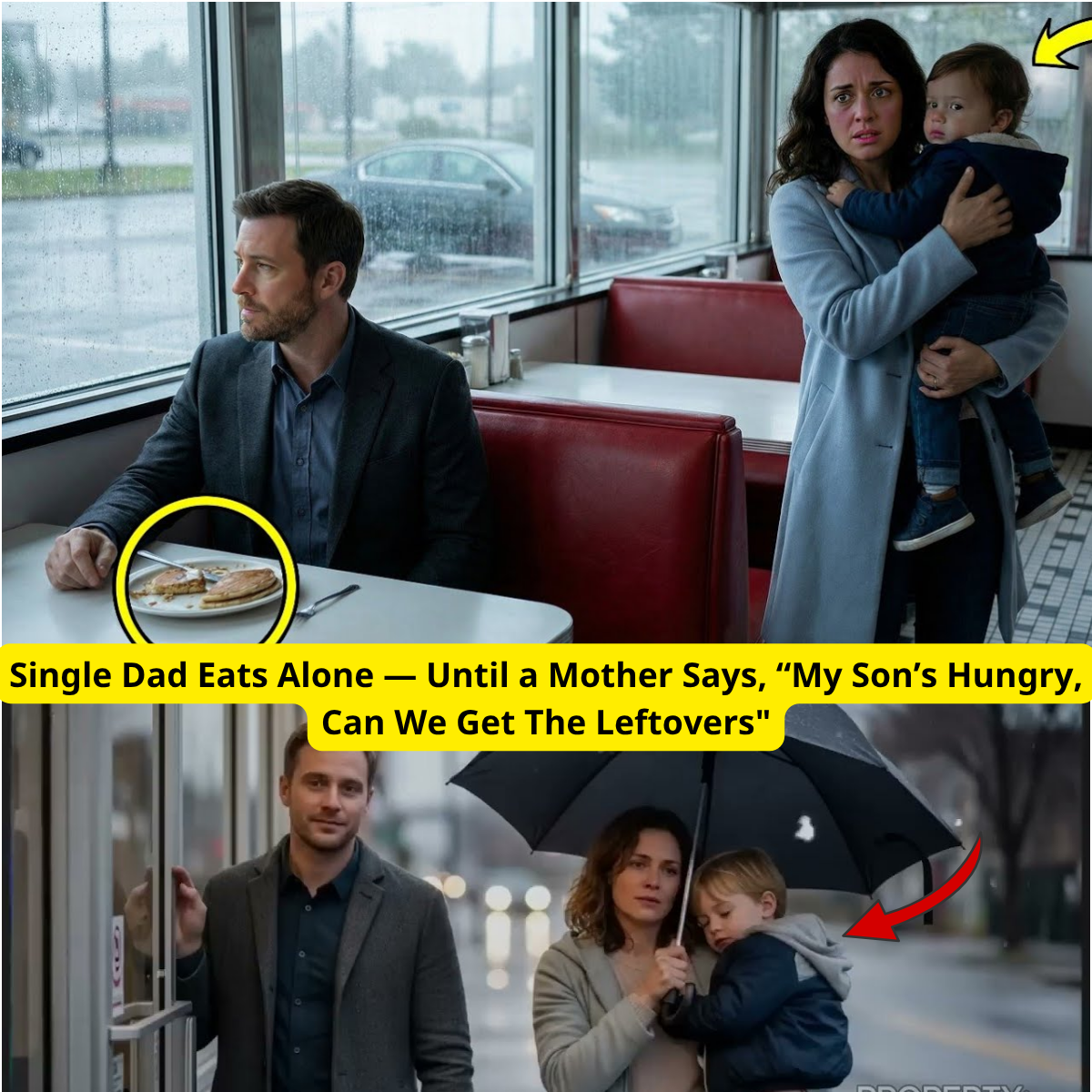
Single Dad Eats Alone — Until a Mother Says, “My Son’s Hungry, Can We Get The Leftovers”
Single Dad Eats Alone — Until a Mother Says, “My Son’s Hungry, Can We Get The Leftovers”
The rain poured against the diner windows like a thousand tiny tears that refused to stop falling. Inside, the dim, flickering yellow neon lights reflected off scratched chrome tables, cracked vinyl booths, and half-empty ketchup bottles. It was the kind of forgotten, roadside place in upstate New York where no one stayed long—a transient pit stop where loneliness clung to every empty seat like a silent ghost.
In the far corner booth, right next to a window streaked with erratic lines of storm water, sat a man who had entirely forgotten what warmth felt like.
Daniel Turner, thirty-eight, had been coming to this specific diner every single night for three agonizing months. At exactly 7:00 PM, he would slide into the same worn booth, stare blankly at the scratched laminate table, and order the exact same thing from the rotating staff: black coffee, scrambled eggs, and wheat toast. He didn’t eat because he was hungry. He ate because it was the only remaining fragment of a routine left in his life. It was a mechanical, desperate anchor keeping him from completely falling apart into the abyss of his own mind.
His wedding ring was gone, leaving a pale, haunting band of un-tanned skin on his finger. His apartment across town was half-empty, filled with cardboard boxes he lacked the emotional energy to unpack or throw away. His heart, well, that was buried somewhere deep under the cold rubble of sudden loss.
His wife, Clare, and their five-year-old daughter, Lily, had been killed in a catastrophic car accident on an icy highway last winter. Since that horrific night, Daniel’s world had dimmed to a flat, suffocating gray. He had stopped believing in fate, in inherent human kindness, or in the promise of tomorrow. To him, every smile from a stranger felt rehearsed, and every act of charity felt temporary and hollow. So, he sat in absolute silence, listening to the clinking of heavy ceramic plates, the distant, rhythmic hum of an old jukebox playing a forgotten country tune, and the relentless sound of the rain that reminded him far too much of the night his entire life had ended.
But that specific night was destined to be different.
The heavy glass door of the diner suddenly swung open with a violent shudder, letting in a sharp, icy gust of midnight air and the roaring sound of the downpour outside. A young woman stumbled past the threshold, soaked completely to the bone, shivering violently as she held a small boy tightly in her arms.
The child, maybe six or seven years old, had a tragically thin frame and tired, hollow eyes that spoke of far too many nights spent without comfort, safety, or a proper bed. The mother’s dark hair was matted down, sticking in wet clumps to her pale cheeks, and the sleeve of her oversized coat was visibly torn at the seam. She stood in the entryway, looking around the brightly lit diner with a desperate, wide-eyed look—like a drowning sailor trying to find a small, stable island in the middle of a catastrophic ocean storm.
Daniel looked up briefly from his untouched eggs, initially uninterested, his defensive walls firmly intact. But then his gaze locked onto the little boy. The kid was clinging to his mother’s neck for dear life, his small lips pale and trembling as he whispered something incomprehensible into her shoulder.
The woman walked unsteadily to the cash register counter, where the evening waitress, a hardened woman named Martha who had seen every tragic story New York had to offer, was wiping down the surfaces. Daniel didn’t mean to snoop, but the diner was so quiet that the young mother’s trembling, fractured voice carried clearly across the empty booths.
“Please,” the woman whispered, her eyes welling with hot tears. “Can I get just a single bowl of hot soup for my son? I… I swear I’ll come back and pay you tomorrow morning. We’ve been walking in the storm for hours, and he hasn’t eaten since yesterday.”
Martha stopped wiping the counter. Her face fell into a deeply apologetic, yet unyielding frown. She sighed, gesturing vaguely toward the security cameras near the ceiling. “I’m truly sorry, ma’am. I really am. But corporate management is incredibly strict. I can’t give out food on credit or charity. It’s a zero-tolerance policy. If I break it, I lose my job tonight.”
The mother’s face collapsed. She didn’t argue. She simply nodded, swallowing her pride as she looked down at her son, who buried his wet face deeper into her jacket, his shoulders shaking from the cold.
“It’s okay, baby,” she whispered to the boy, her voice cracking as she turned back toward the freezing rain outside. “We’ll find something. We’ll find something just a little further down the road, okay?”
Something shifted violently inside Daniel at that exact moment. It wasn’t a gradual realization; it was a sudden, seismic crack in the ice that had encased his soul for a year. Maybe it was the way the little boy looked so terribly fragile and quiet—the exact age his daughter Lily would have been. Maybe it was the crushing weight of exhaustion in the woman’s voice, juxtaposed against a fierce, unbreakable maternal dignity. Or maybe, just maybe, it was the ghost of Clare whispering somewhere deep in his dormant conscience, gently reminding him of the man he used to be before grief had turned him into a stranger.
Without a conscious thought, Daniel stood up. His heavy metal chair scraped loudly against the linoleum floor, cutting through the quiet diner and making Martha and the woman glance over at him in surprise.
He walked directly to the counter, pulled a worn leather wallet from his back pocket, and laid a hundred-dollar bill flat on the surface. He looked at the waitress and said simply, “Add whatever they want to eat to my bill, Martha. Bring them a hot meal, right now.”
The young woman spun toward him, her jaw dropping as she stared at the money and then up at Daniel. “No… oh, please, sir, you don’t have to do that. I can’t accept—”
Daniel met her eyes for the very first time. They were exhausted, surrounded by dark circles of stress, but they were remarkably resilient. “It’s completely fine,” Daniel said, his voice softer than it had been in months. “Please, sit down. Your son needs to get out of those wet clothes and eat something hot.”
Her lips trembled violently, a solitary tear escaping and tracing a path through the rainwater on her cheek. She managed a weak, deeply emotional nod. Martha, looking visibly relieved, immediately pocketed the bill and gestured toward a large booth near the center of the room.
The woman hesitated for a fraction of a second, her fingers tightening around her son’s jacket. She looked back at Daniel, her voice quiet and sincere. “Would it… would it be okay if we sat with you? My son, Noah… he’s been very scared of the dark lately, and he doesn’t like being alone in unfamiliar places.”
Daniel blinked, entirely taken aback. He had spent the last year meticulously avoiding human company, building high, impenetrable psychological walls that no coworker, friend, or relative could climb. He had cultivated an existence of total isolation. Yet here she was—polite, entirely sincere, shivering from the New York rain, asking to share his solitary table. He opened his mouth to politely decline, to retreat back into his safe gray world, but then little Noah looked up. The boy’s wide, innocent eyes locked onto Daniel’s face, silent and pleading.
Daniel swallowed the lump in his throat. “Sure,” he said quietly, gesturing toward his corner booth. “Have a seat.”
They sat down across from him. The woman immediately pulled off Noah’s soaked outer jacket, wrapping her own dry cardigan around his small shoulders, rubbing his arms vigorously to bring the color back to his skin.
“Thank you so much,” she murmured, her voice thick with an emotion she was trying desperately to contain. “I’m Emily. And this is Noah.”
Daniel gave a stiff, unpracticed nod. “Daniel,” he replied, suddenly feeling incredibly awkward. He wasn’t used to casual introductions anymore; he had forgotten the basic vocabulary of human interaction.
But when the food arrived minutes later—two massive, steaming bowls of chicken noodle soup, a basket of warm, buttered bread, and a hot chocolate for the boy—Daniel found himself completely unable to look away. He watched with a strange, gripping fascination as Noah’s small, trembling hands gripped the heavy spoon with meticulous care. He saw the pure, unadulterated joy that sparked in the boy’s eyes the moment the hot broth hit his tongue. He saw the profound, bone-deep relief that washed over Emily’s face as she watched her child eat, a weight lifting from her shoulders that she had likely carried for weeks.
It was a domestic, simple scene of survival and care—a scene Daniel didn’t realize his home had been missing so desperately. For the first time in three hundred and sixty-five days, he felt a spark of something stir deep within his frozen chest. It wasn’t just a fleeting sense of pity; it was the terrifying, beautiful sensation of returning life.
As Noah focused entirely on his food, Emily began to talk in quiet, measured tones. She explained, without an ounce of self-pity, that she had been laid off from her administrative job two months prior. Without an income, she had been promptly evicted from their small apartment in the city. They had spent the last few weeks moving between overcrowded, underfunded county shelters, but tonight, the local facility had reached maximum capacity and turned them away into the freezing storm. She had been walking toward a twenty-four-hour bus station when she saw the diner’s glowing sign.
“I wasn’t looking for a handout,” Emily whispered, her eyes casting downward as her fingers traced the rim of her soup bowl. “I’ve always worked hard. I’ve always provided for him. I just… I just needed a single moment to rest, to keep him warm, and to figure out what our next step is tomorrow.”
Daniel listened. He really, truly listened. Her voice carried the kind of quiet, unbreakable emotional steel that only comes from surviving when absolutely everything has been stripped away from you. It was a strength he recognized, yet one he had failed to find within himself. And when she suddenly laughed softly—a genuine, musical sound—at a silly face Noah made after getting a mustache of hot chocolate foam, Daniel realized with a jolt how long it had been since he had heard a laugh that wasn’t forced or hollow.
Hours passed by like fleeting minutes. The torrential rain outside gradually slowed into a gentle, rhythmic patter against the glass, and the diner grew completely quiet as the midnight grease-fumes settled. Noah, his belly full and his body finally warm, drifted off to sleep, his small head resting heavily in his mother’s lap.
Emily’s eyes softened to a degree that captivated Daniel as she looked down at her son, gently stroking his damp hair. “He is absolutely everything I have left in this world,” she whispered into the quiet booth. “And every single morning when I wake up, I am terrified that I’m going to fail him.”
Daniel’s chest tightened so violently he could barely breathe. The words struck him like a physical blow. He remembered saying those exact, identical words to Clare in the hospital room right after Lily was born, holding a tiny blanketed bundle, terrified of the immense responsibility of fatherhood. He remembered the fierce, protective love that came with it—and the agonizing pain of losing it. For a terrifying moment, the phantom grief returned like a tidal wave, threatening to drag him under the surface.
But instead of drowning in it, instead of retreating into his gray armor, he looked across the table at Emily’s tired face. He reached out, his voice steady and filled with a gentle certainty he thought he had lost forever.
“You are absolutely not failing him, Emily,” Daniel said. “Look at him. He’s safe, he’s fed, and he knows exactly how much his mother loves him. You are here, and you are fighting through a storm most people would collapse under. That is exactly what matters.”
Emily looked up at him, her eyes glistening under the dim diner lights, seeing past his guarded exterior. “You sound like someone who has lost absolutely everything, too, Daniel.”
He gave a small, sad, but remarkably honest smile. “Yeah,” he said, his voice barely above a whisper. “I guess I have.”
When the clock on the wall neared 2:00 AM, they finally stood up to leave. Emily reached deep into her coat pocket and pulled out a heavily crumpled, folded five-dollar bill. She tried to press it into his palm, her eyes fierce with pride. “It’s not much, I know. It doesn’t even cover the bread. But I want you to have it. And I swear, as soon as I get a new job, I will find a way to pay you back the rest.”
Daniel gently pushed her hand away, shaking his head. “You don’t owe me a single penny, Emily. Keep it. Just take care of that boy.”
She hesitated, her lower lip trembling again, before she unexpectedly reached out and squeezed his hand. Her palm was warm, her grip surprisingly strong. “You have absolutely no idea what you did for us tonight, Daniel. Thank you.”
He nodded silently. But after the heavy glass door chimed and they vanished into the damp New York night, Daniel didn’t leave. He sat back down in the empty booth for a very long time, staring intensely at the two empty soup bowls and the wrinkled napkins across from him. The diner felt completely different now. It didn’t feel cold, or lonely, or gray. It felt… warmer, somehow.
He didn’t realistically expect to ever see them again in a city of millions, but fate, it seemed, had entirely different plans for Daniel Turner.
The very next morning, as Daniel stepped out of his half-empty apartment building to walk to his engineering job, he glanced across the street toward the entrance of a small public library. He froze. Sitting on the concrete steps beneath the stone arches were Emily and Noah. She had a thick, worn children’s book open on her lap, and she was reading aloud to the boy, animating her voice to make him giggle despite the morning chill.
Daniel stopped dead in his tracks. Every old, cynical habit told him to mind his own business, to keep his head down, and to walk to his office. But a louder, newer voice inside him refused to let him walk away. He crossed the street, his heart hammering against his ribs.
“Hey,” Daniel said softly, stopping at the bottom of the stone steps. “Are you two doing okay this morning?”
Emily looked up, startled, her eyes widening in recognition before a brilliant, genuine smile broke across her face. “Daniel! Hi. Yes, we’re doing alright. The library opens in a few minutes, so we just needed somewhere dry and quiet to wait until the daytime shelter opens its doors.”
Daniel hesitated, shifting his weight from side to side. The engineering side of his brain was screaming at him, calculating risks, pointing out the absolute madness of what he was about to do. But he looked at Noah, who gave him a small, shy wave, and he thought of his empty, echoing house.
“Emily… have you found a stable place for you two to stay tonight?” he asked bluntly.
She shook her head slowly, her smile fading into an expression of quiet reality. “Not yet. The local family shelter said they might have an open room by next Tuesday. We’re just taking it one hour at a time.”
Daniel took a deep, stabilizing breath. Without planning it, without analyzing the consequences, the words simply tumbled out of his mouth. “I have a spare bedroom in my apartment. It’s… well, it’s completely empty right now, but it’s clean, it’s safe, and the building has great heating. You and Noah can stay there. No strings attached, no timeline. Just a safe place to sleep until you get back on your feet.”
Emily’s eyes widened in absolute shock, her hands dropping to the book in her lap. “Oh, no, Daniel… we couldn’t possibly do that. You’ve already done far too much for us. We are strangers.”
“We were strangers yesterday,” Daniel said, his voice filling with an unshakeable conviction. “But we aren’t today. Please, Emily. Let me do this. It’s a safe place for your son.”
She stared at him for a long, agonizing moment, searching his face for any sign of deception or hidden motives. Finding nothing but pure, raw empathy, her defenses collapsed. Tears welled up in her eyes as she gave a fierce, definitive nod. “Thank you… thank you so much, Daniel.”
Over the course of the next few months, something entirely remarkable happened within the walls of that apartment. Daniel’s home, which had been a silent, freezing tomb of grief for a year, slowly began to fill with vibrant, chaotic life once again.
Noah’s bright, unfiltered laughter began to echo through the long-silent hallways. The boy would run to the door every evening at 6:00 PM when Daniel got home from work, eager to show him a Lego tower he had built or a drawing he had made at the local community center. Emily insisted on cooking breakfast every single morning before Daniel left for the office, filling the kitchen with the rich, comforting aromas of coffee, sizzling bacon, and fluffy pancakes—insisting it was the only real way she could begin to express her gratitude.
And slowly, piece by piece, day by day, Daniel began to feel like himself again. The crushing weight on his chest began to lift.
One quiet weekend, while Noah was napping, Daniel found himself sitting on the living room floor with Emily. For the first time since the accident, he opened up completely. He told her about Clare—how they had met in college, how brilliant she was, and how he had entirely stopped living the second she and Lily were taken from him. He wept openly, the tears flowing freely, but this time, he wasn’t drowning. Emily sat right beside him, listening with eyes full of a deep, profound empathy born of her own suffering, her hand resting gently on his shoulder as a steady, anchoring weight.
In turn, she told him about her own dark nights of the soul, her deep-seated dreams of going back to school to become a pediatric nurse, and how she had become far too terrified to ever hope for a better future anymore. Together, in the quiet spaces of that apartment, they found a beautiful, mutual healing. They found it in the small, mundane moments—the smell of morning breakfast, the sound of a child playing in the living room, and the quiet comfort of shared loss.
Months later, on a crisp autumn evening, Daniel unlocked his front door and walked into the dining room. Noah was sitting at the table, surrounded by a scattered mess of bright crayons, working diligently on a new drawing.
Daniel smiled, walking over and leaning over the boy’s shoulder. “What are you working on there, buddy?”
Noah looked up, his face shining with absolute pride as he pointed a crayon at the paper. The drawing depicted three distinct figures, drawn in bright colors, holding hands tightly under a massive, radiant yellow sun.
“That’s you, that’s me, and that’s Mommy,” Noah said proudly, his small voice carrying an absolute, innocent certainty. “See? We’re a real family now, Daniel.”
Daniel’s throat tightened instantly, a familiar ache returning to his chest—but this time, it wasn’t the ache of grief. It was the ache of an overwhelming, boundless love. He looked up toward the kitchen doorway, where Emily was standing by the stove. She had overheard her son’s words, and she was looking at Daniel, her cheeks slightly flushed, a shy, hopeful smile gracing her lips.
Something inside Daniel—something that had been violently broken and buried deep under the winter snow a year ago—came fully, beautifully alive again. He walked across the room, took Emily’s hands in his, and looked down at her with a clarity he hadn’t possessed in a lifetime.
That night, as the three of them sat together around the dinner table, laughing and sharing a meal, Daniel looked out the window at the dark New York skyline. He realized that sometimes, the people who are destined to heal us don’t arrive with a grand announcement or a perfect plan. They arrive when we least expect them, wrapped in a cold rainstorm, walking through the doors of a quiet, greasy diner when all we originally wanted was to be left entirely alone in the dark. Compassion hadn’t just fed a hungry child that night; it had saved a soul that had completely forgotten how to live.