What If Civilization Is Just a Phase?
What If Civilization Is Just a Phase?
The studio monitors cast a steady, cool luminescence across the mixing console. Outside the high windows, the city of Seattle hummed—a massive, intricate organism of interconnected systems. Somewhere below, automated trucks were delivering the produce people would buy tomorrow morning. Overhead, a satellite quietly routed millions of micro-messages across the Pacific. Behind the drywall, a power grid vibrated at a steady sixty hertz, completely invisible, entirely taken for granted.
Michael adjusted the boom mic, checking the levels on his digital recorder. He had spent his twenties earning a degree in ancient history, a discipline that, if it teaches you anything, teaches you that the ground beneath your feet is far less solid than it feels.
“We take it for granted that civilization is humanity’s natural state,” Michael began, his voice dropping into the familiar, resonant tone of his channel. “The cities, the systems, the institutions. It feels like an inevitable trajectory—the place we were always heading. But the dirt doesn’t support that assumption. For roughly 98% of human existence, civilization apparently didn’t exist at all. And once you understand how terrifyingly recent it is, and how completely past empires have vanished into the soil, it becomes very difficult to believe that ours is somehow exempt from the rule.”
He leaned toward the lens, the studio lights catching the edge of his notes.
“Every generation that has ever lived inside a functioning system has felt exactly this way. The Romans built aqueducts that made water feel eternal, expecting their roads to last forever. The citizens of Angkor Wat lived inside the largest urban complex of the preindustrial world, with absolutely no reason to imagine that their grand reservoirs would one day be choked by roots and swallowed by the Cambodian jungle. Continuity isn’t the historical default. It’s the exception. History isn’t a record of civilizations enduring. It’s a record of civilizations believing they would endure, right up until the moment they didn’t.”
Act I: The Tipping Point of Complexity
Michael flipped to a page marked with a stark date line: 1200 BC.
“Let’s look at the pattern,” he said, tapping the desk. “Around twelve hundred years before Christ, something catastrophic and deeply mysterious swept through the eastern Mediterranean. Within a single fifty-year window, the Hittite Empire collapsed into dust. Mycenaean Greece was utterly destroyed. Ugarit, one of the greatest, most sophisticated trading ports of the ancient world, was burned to the bedrock and never rebuilt. Egypt survived, but it was physically broken, permanently diminished. The Late Bronze Age—a marvelous historical peak of globalization, trade networks, and diplomatic sophistication—simply ended.”
He paused, letting the weight of the collapse settle into the track.
“Historians still debate the precise trigger, but the leading consensus is what we call a ‘systems collapse.’ Everything was so deeply interwoven, so extraordinarily interdependent, that when enough individual threads snapped simultaneously—a prolonged drought, a sudden migration wave, internal peasant revolts, and the resulting failure of supply chains—the entire fabric came apart at once. Complexity, you see, is a trap.”
Michael shifted his notes, bringing up a slide of Roman Britain on the monitor behind him.
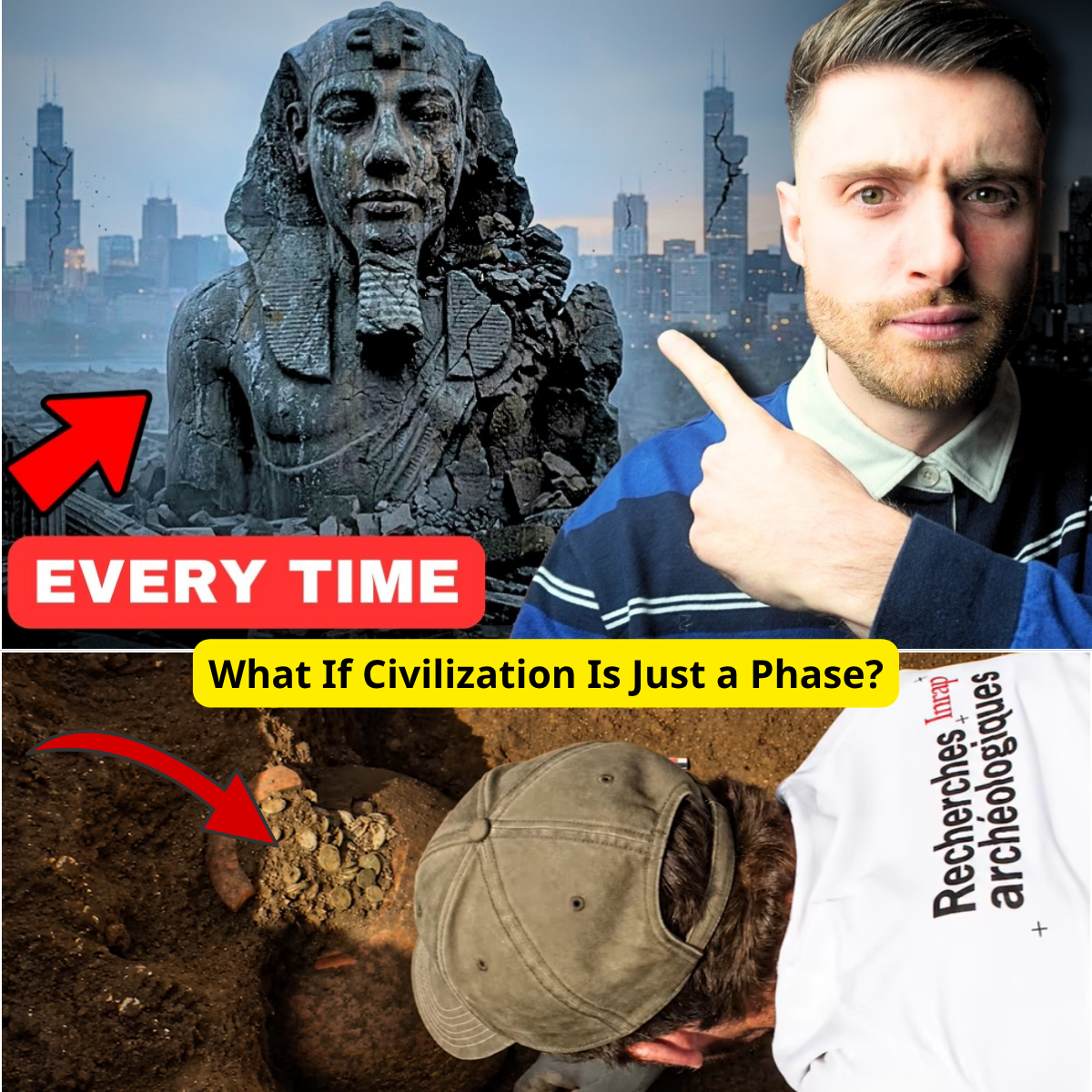
“Then look at Rome. It didn’t vanish overnight, but it happened fast enough to completely stun the people living through it. A imperial metropolis that had once fed over a million citizens shrank within a few centuries to a squalid town of barely thirty thousand. The aqueducts fell silent, breaking open and leaking into the fields. The grand forums filled with mud and became cow pastures. In Roman Britain, the collapse was so absolute that archaeologists can trace it directly in the dirt. There is a literal layer in the soil where the coins simply stop. Where the wheel-turned pottery stops. Where any evidence of systemic occupation just disappears, replaced by dark earth.”
He leaned forward, his expression darkening. “The Indus Valley cities of Mohenjo-Daro and Harappa were larger, cleaner, and better engineered than almost anything in contemporaneous Europe or the Middle East. Yet they vanished so completely into the silt that humanity didn’t even rediscover their existence until the 1920s. None of these people believed they were temporary. Their temples were engineered to defy time. They didn’t fail because they lacked confidence or military might; they failed because they were profoundly mistaken about their own durability.”
Act II: The Math of the Flicker
Michael ran a hand over his face, turning toward a chalkboard on the side of the set. He wrote a single number in stark white chalk: 300,000.
“Here is the number that completely changes the scale of the conversation,” he said, pointing to the board. “Anatomically modern humans—people with our exact brains, our capacity for complex language, our precise ability to plan, cooperate, and imagine abstract futures—have existed on this planet for at least three hundred thousand years. Sit with that timeline for a moment.”
He drew a tiny line at the very end of the scale.
“Agriculture only appeared roughly twelve thousand years ago. True cities emerged barely six thousand years ago. And our modern industrial civilization—the hyper-connected world of electricity, global shipping networks, and digital data storage—is barely two hundred years old. Let’s do the math very slowly. Civilization in any recognizable form accounts for roughly 2% of total human history. But this digital, fossil-fuel-powered version we inhabit? It represents closer to 0.06%. It’s not a destination. It’s a rounding error. A momentary flicker in the dark.”
He dropped the chalk, wiping his hands. “For 98% of our species’ history, humans lived without states, without writing, without permanent infrastructure, without institutions, and without global supply chains. Everything we consider ‘normal’ is actually a bizarre anomaly. And what makes this realization destabilizing rather than just interesting is a simple, terrifying fact: we have absolutely no long-term empirical evidence that civilization is a stable condition.”
Michael’s voice softened, taking on a philosophical weight. “We have excellent, repetitive evidence that complex societies can emerge. We have overwhelming evidence that they collapse. What we don’t possess is a single shred of proof that they can endure. We didn’t evolve for this world of concrete and glass. We evolved for something much older, much harder, and fundamentally more durable. The extraordinary systems we’ve built are magnificent, but extraordinary things are not permanent just because they are brilliant. The universe is a graveyard of extraordinary things.”
Act III: The Trap of Astonishing Coordination
“The core of the issue is a profound historical paradox,” Michael said, leaning his elbows on the console. “The more sophisticated a civilization becomes, the more capable it is—but it also becomes exponentially more dependent. Think about what your life required today just to function. It required a flawlessly stable electrical grid, intact global maritime trade routes, absolute institutional trust, a functioning digital banking infrastructure, and predictable climate patterns stable enough to guarantee agricultural yields for eight billion people living on a shrinking pool of topsoil.”
He shook his head slowly. “Each of these is an independent, highly volatile system. Yet each system depends entirely on all the other systems working perfectly simultaneously. A civilization capable of astonishing coordination is, by definition, a civilization that requires astonishing coordination. Those are not two separate facts. They are the exact same reality viewed from different angles.”
Michael pulled up a photograph of a thick academic volume on his tablet. “The historian Joseph Tainter spent decades studying the mechanics of collapse, and his conclusion is something we can no longer afford to ignore. Tainter argued that civilizations don’t usually fail because they become weak or lazy. They fail because they become too complex. Every time a society encounters a problem—be it a resource shortage, a security threat, or a pandemic—it solves that problem by adding a new layer of bureaucracy, a new technology, or a new system of administration.”
He gestured broadly to the studio around him. “But each new layer of sophistication requires a massive influx of energy, capital, and coordination just to maintain its baseline existence. Eventually, the society reaches a tipping point where the cost of maintaining the existing complexity exceeds the returns the system generates. When the crisis hits at that point, the system cannot afford to pay for its own upkeep. It doesn’t gracefully adapt. It contracts. It simplifies. And in a world entirely optimized for hyper-complexity, rapid simplification looks indistinguishable from total collapse.”
He gestured to the city outside the window. “We are not Rome. We are vastly more advanced. But that doesn’t mean we are exempt from Tainter’s logic. It means we are simply the most complex, and therefore the most fragile, system ever assembled in human history. Complexity isn’t a shield against vulnerability; it is the ultimate source of it.”
Act IV: The Missing Pages
Michael shifted the lighting in the studio, turning off the bright overheads, leaving the set bathed in a moody, intimate amber glow.
“Now, let’s go somewhere genuinely strange,” he murmured, his voice dropping an octave. “Everything we’ve discussed so far—the collapse of the Bronze Age, the fall of Rome, the abandonment of Maya cities—these are events we know about because those cultures left behind things that can survive the elements. Fired clay, worked bronze, carved stone inscriptions. But what about the societies that didn’t?”
He picked up an old, water-logged piece of wood from a display shelf, setting it on the table.
“Think about what actually lasts across thousands of years of geological time. Stone lasts. Fired clay survives. Metal can endure if the soil chemistry is right. But wood rots within decades. Leather disintegrates. Textiles vanish into organic mush within a few centuries under normal conditions. Now look at our modern world. If our civilization vanished tomorrow, what would actually be left in fifty thousand years?”
He looked directly into the camera. “The internet isn’t carved into granite. Our collective human knowledge now exists as magnetic charges on delicate servers, satellite arrays, and fiber-optic networks that require constant, obsessive human maintenance to exist at all. If you remove that maintenance for just a single generation, an astonishing percentage of everything we have ever thought, written, or discovered simply ceases to exist. Future archaeologists might find our concrete foundations, our rusted steel rebar, and the toxic plastic anomalies in the strata, but they would find absolutely none of our data. They would see our bones, but they would miss our mind entirely.”
Michael leaned in, his eyes bright with the mystery of the premise. “And then there is the geography problem. At the peak of the last ice age, global sea levels were roughly 120 meters lower than they are today. The coastlines of the world looked completely unrecognizable. Massive, fertile expanses of land that are now deep underwater were then dry, highly productive valleys. And humans, who have always been drawn to coastlines for transportation, fishing, and trade, almost certainly lived there in massive numbers.”
He pulled up a sonar bathymetric map on the main screen. “Look at Doggerland—the vast landmass that once connected Great Britain to continental Europe. It was rich with deep river valleys, dense forests, and abundant wildlife. It was arguably the most productive, populated landscape in Mesolithic Europe. People lived, hunted, and built communities there for thousands of years. But as the ice caps melted, the seas rose, and Doggerland drowned beneath the North Sea.”
He tapped the screen. “We only know it existed because modern commercial fishing trawlers occasionally scrape the dark seafloor and pull up mammoth bones or beautifully knapped prehistoric tools. But what else is down there? We don’t know. We have barely begun to map or excavate these submerged coastlines at any serious scale. The historical record we possess is not a record of everything that happened. It is merely a record of what happened to survive in the dry places. Those are two profoundly different things. We have been drawing definitive conclusions about human nature and human potential from a book with 95% of its pages torn out and burned.”
Act V: The Recurring Condition
The silence in the studio was absolute now, save for the faint hum of the hard drives recording the session.
“So we have to ask the question that mainstream archaeology almost never asks seriously,” Michael said, his voice measured and intense. “What if this has all happened before? I’m not talking about mystical kingdoms or advanced anti-gravity technology hidden under the Antarctic ice. I am asking a much simpler, more haunting question: What if the cyclical pattern of rise, complexity, and total collapse runs vastly deeper than our written records show?”
He stood up, walking slowly back to the chalkboard. “What if, during that massive 98% of human history where we assume nothing happened, earlier complex societies emerged along those ancient coastlines? What if they built their world primarily out of organic materials, developed sophisticated trading networks, reached their own limits of complexity, became fragile, and were utterly erased by rising seas and the relentless grinding of deep time?”
He looked at the tiny chalk line representing modern history. “The traditional narrative tells us that human history is a long, completely flat line of primitive simplicity, followed by a sudden, miraculous leap into civilization six thousand years ago. But that narrative is built entirely on the tyranny of what is recent and what managed to survive the rot. What if civilization is not a single, linear ascent? What if it is a recurring condition? A temporary, beautiful infection that emerges whenever regional climates stabilize, builds immense complexity until it becomes fragile, collapses under its own weight, and is forgotten so completely that the next cycle begins with absolutely no memory of the last?”
Michael walked back to the console, his hand hovering over the master switch. On the desk, his phone lit up with a notification—an automated reminder of an online order, a tiny testament to the invisible systems keeping his personal world afloat.
“Sitting with that uncertainty changes the way you look at the city outside your window,” he said softly. “Suddenly, the skyscrapers look less like permanent monuments and more like a passing phase. The ruins of the past aren’t just historical curiosities. They are a mirror.”
He smiled gently, a sudden warmth breaking through the starkness of his presentation. “But I don’t want to leave you with a sense of pure dread. Because the alternative view is even more extraordinary. Think about the sheer miracle that civilization exists right now. For three hundred thousand years, something deep within the human spirit has been reaching out toward the light—reaching toward order, toward music, toward medicine, toward writing down our thoughts so the dead can speak to the unborn. And briefly, improbably, against all the entropic odds of a hostile universe, we managed to build it.”
He gripped the edge of the desk. “We built a world that can map the furthest galaxies and carry our voices across oceans in an instant. Perhaps it has happened before, and perhaps we’ve simply forgotten our own ancestors. But the most unexplainable mystery of our past isn’t how civilizations fall. It’s that against the crushing weight of deep time, they manage to exist at all.”
Michael leaned forward and struck the key, terminating the stream. The cooling fans spun down, the monitors went dark, and for a long moment, the studio sat in the quiet, fragile dark of the modern night.