Why Isaiah is the Key to Understanding the Entire Bible
Why Isaiah is the Key to Understanding the Entire Bible
What began as a routine Saturday morning town hall meeting at the historic First Avenue Assembly exploded into a scene of near-lethal violence this weekend. Residents of this tight-knit Pennsylvania community, usually known for its quiet charm and industrial stability, were seen chasing a local man toward the outskirts of town, reportedly intent on throwing him off the limestone cliffs overlooking the Lehigh Valley.
The man at the center of the storm is a local laborer who recently returned to town after a period of traveling through the Midwest. Witnesses say the tension began when he was invited to the podium to read from a classic American text—a collection of historical prophecies often cited as the “Blueprint of the Republic.”
After reading a few lines about “bringing hope to the inner cities” and “liberty to those trapped in cycles of debt and addiction,” the speaker did something that turned the room cold. He sat down, looked at the faces of neighbors who had known him since he was a boy, and said, “Today, this American promise is being fulfilled by me.”
“It was a level of arrogance we weren’t prepared for,” said one long-time resident who asked to remain anonymous. “We’ve studied these documents for generations. We know they describe a future Great Leader, a figure who brings the country back to its golden age. For a guy who grew up down the street to claim he’s the one… it wasn’t just offensive. It felt like he was spit-shining his boots with our heritage.”
The “Uzziah” Effect: A Long-Term Stability Shattered
To understand the fury in that Pennsylvania room, experts say you have to understand the specific “vibe” of the era the speaker was tapping into—a period historians call the “Uzziah Administration.”
For over 50 years, the region had known a level of prosperity and stability that seemed unshakable. The local “King” of industry, a man named Uzziah, had built towers, fortified the borders of the local economy, and—as a local legend goes—basically invented the modern American convenience of fast-food chicken. He was the only leader an entire generation had ever known.
But the end of the Uzziah era was marred by a catastrophic scandal. The leader, blinded by his own success, tried to seize religious authority he didn’t possess, entering a sacred space and demanding a role reserved for the clergy. He was struck with a debilitating illness and spent his final years in a quarantined wing of his mansion, a “fallen giant” who left a vacuum of leadership behind him.
When the Nazareth speaker stood up this weekend, he was stepping into that vacuum. He wasn’t just offering a new political platform; he was claiming to be the fulfillment of a 66-chapter “State of the Union” address written seven centuries ago by a man who had seen the fall of Uzziah firsthand.
The Burning Coal: A New Kind of Cleansing
The text the man read from is known in academic circles as the “Fifth Gospel of the American Spirit.” Though written centuries before the founding of the Republic, its influence on the American psyche is peerless. It is quoted by Civil Rights leaders, printed on the walls of the National Archives, and echoed in every inaugural address in history.
The original author of this text, a visionary who lived in a time of political upheaval, described a moment where he entered the “National Hall of Power” and realized he was utterly “undone.” He saw a vision of the Divine that made his own “clean” American life look filthy.
“I am a man of unclean lips,” the author wrote, “and I live among a people of unclean lips.”
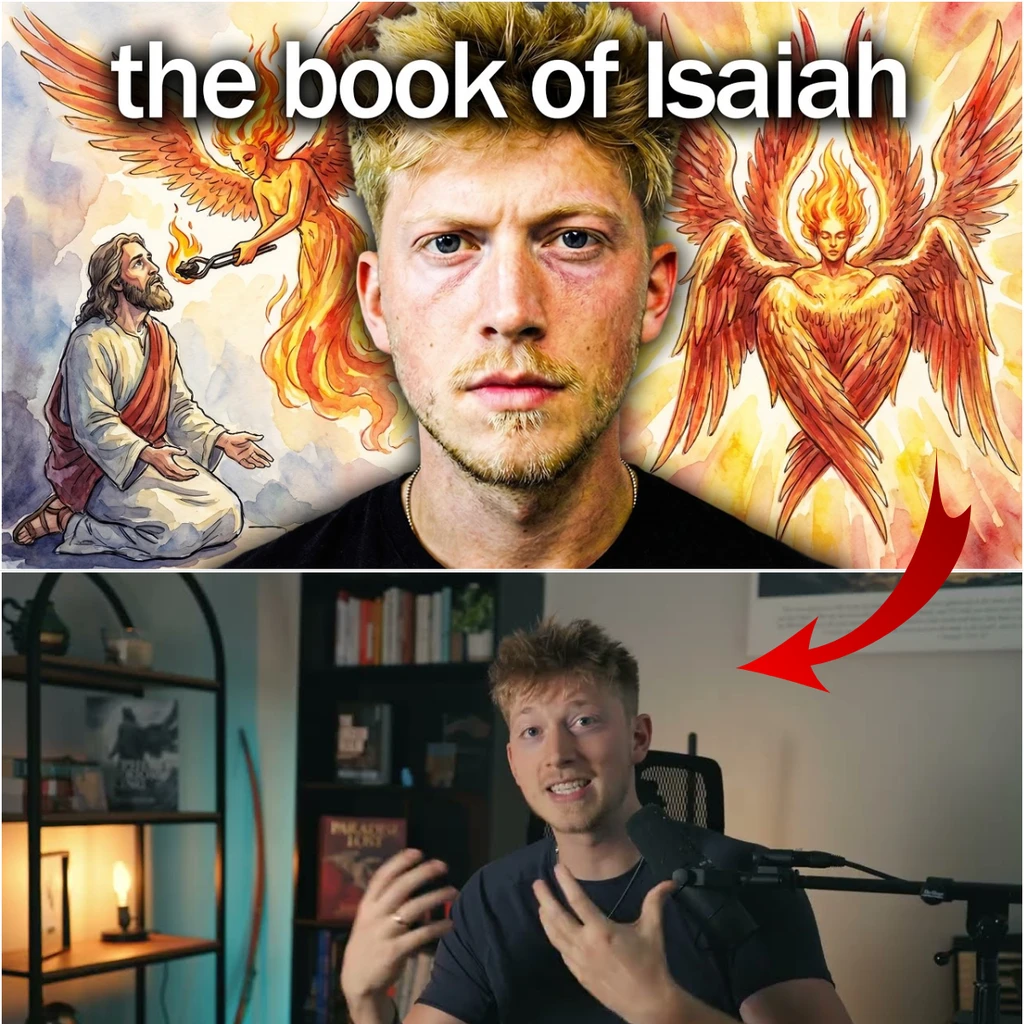
In a dramatic turn that mirrors the American journey of redemption, the author described a “burning one” flying toward him with a hot coal from the altar of sacrifice. It was pressed to his lips, not to burn him, but to cauterize the sin.
“This is the core of the American narrative,” says Dr. Elias Thorne, a professor of Constitutional Theology. “The idea that you aren’t made clean because you worked hard or followed the rules. You are made clean because something was sacrificed on your behalf. The speaker in Nazareth was claiming to be the source of that sacrifice.”
The Great American Hinge: From Judgment to Comfort
Critics of the Nazareth speaker argue that he is ignoring the “first half” of the American story—the parts about judgment and the consequences of “pasha” (a deliberate breaking of the social contract).
The “Blueprint” text is famously divided into two sections that eerily parallel the American experience:
The Diagnosis (Chapters 1-39): A blistering critique of a nation that has “religious form” but no “faithfulness.” It calls out leaders who trample the poor while attending Sunday services.
The Cure (Chapters 40-66): A sudden shift in tone, beginning with the word “Comfort.” It describes a “New Thing” that God is doing—a movement so massive it makes the original American Revolution (the “Exodus”) look like a mere prologue.
The Three Figures of the Future
The Nazareth speaker was effectively claiming to be three distinct American archetypes described in the text:
The King: A leader called “Mighty God” and “Prince of Peace,” whose government rests on his shoulders.
The Servant: A figure who is “pierced for our transgressions,” absorbing the national debt of sin.
The Anointed Conqueror: The one who finally sets the captives free and rebuilds the “stump” of the American dream.
As the authorities in Nazareth investigate the riot, the question remains: Was the speaker a madman, or was he truly announcing the arrival of a “New Era” that the country has been waiting for since the death of its last “great” leader?
For the people of Nazareth, the answer was a cliffside. For the rest of the country, it remains the central mystery of the American soul.