Explosive Christian–Muslim Debate Over Jesus’ Crucifixion Rocks U.S. Faith Media
Explosive Christian–Muslim Debate Over Jesus’ Crucifixion Rocks U.S. Faith Media
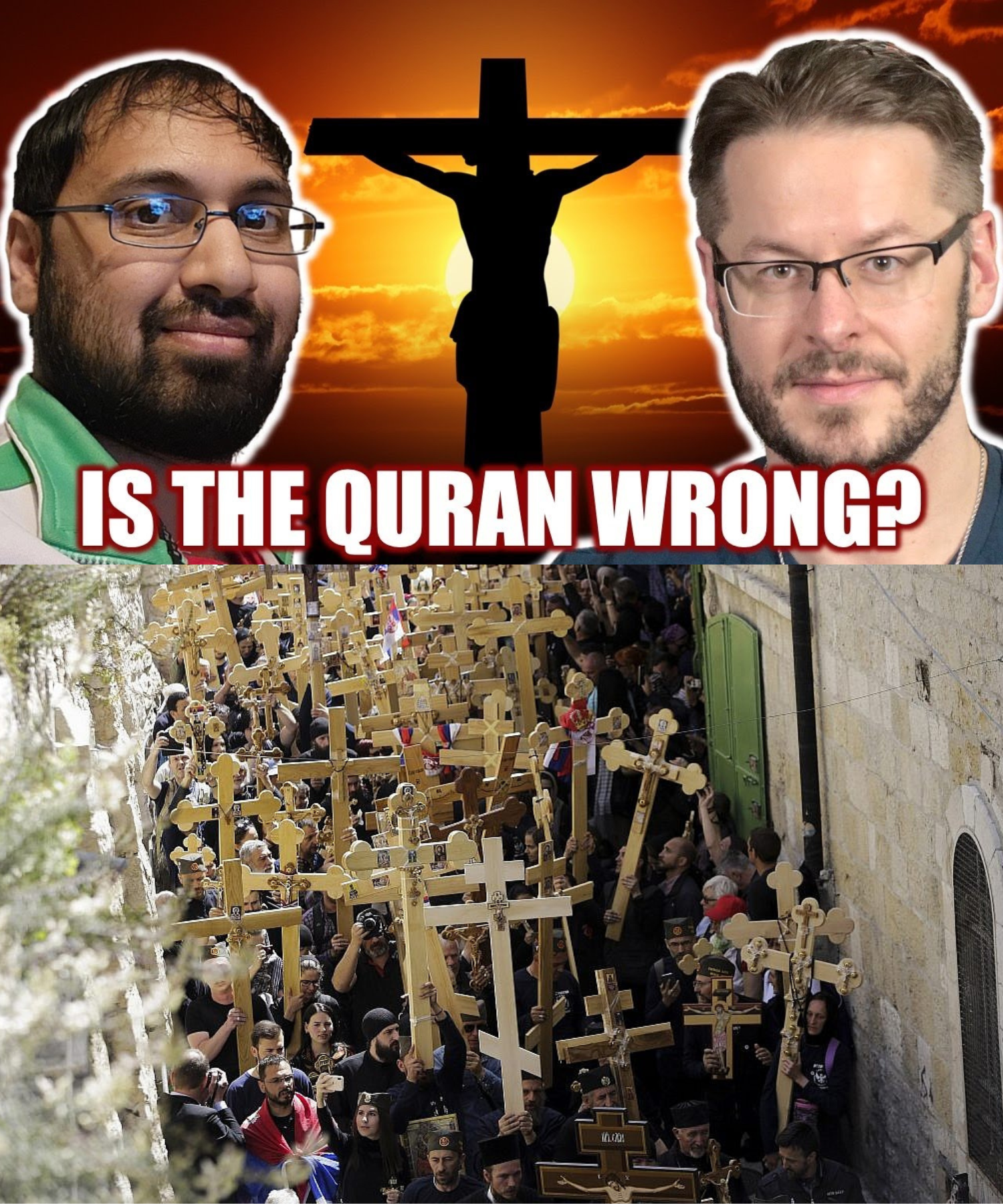
Washington, D.C. — A marathon livestream debate between Christian apologist David Wood and veteran Muslim apologist Eitam Ghulam has reignited one of the oldest and most explosive theological disputes in world religion: did Jesus truly die on the cross, or did he survive the crucifixion and get raised by God afterward?
The debate, now circulating across American Christian and Muslim media circles, is not just another online clash between rival faiths. It cuts straight into the heart of Christianity, Islam, history, scripture, and salvation.
For Christians, the death and resurrection of Jesus are not side details. They are the center of the Gospel. Without the cross, Christianity collapses into moral teaching without atonement. Without the resurrection, the apostolic message loses its explosive force.
For Muslims, the issue is just as sensitive. The Quran’s most cited verse on the subject, Surah 4:157, says that the Jews did not kill Jesus, nor did they crucify him, but that it was made to appear so to them. For centuries, many Muslim commentators interpreted that to mean someone else was made to look like Jesus and was crucified in his place.
But in this debate, Ghulam takes a less common position. He agrees with Wood that Jesus was crucified. He rejects the dominant substitution theory. His claim is different: Jesus was put on the cross, but did not die there. Instead, God preserved him, he was taken down alive, placed in the tomb, and then raised to heaven.
That single concession changes the battlefield.
Wood begins by stressing that Jesus’ crucifixion is not merely a Christian belief, but a historical point accepted by many scholars across ideological lines — including atheist, agnostic, Jewish, liberal Christian, and conservative Christian scholars. His argument is that the crucifixion is one of the strongest facts available about the historical Jesus.
He then describes the brutality of Roman crucifixion in graphic detail: the scourging, the blood loss, the nails, the suffocation, the shock, and the slow public humiliation. His point is simple: crucifixion was not theater. It was an execution system designed to kill.
Ghulam does not deny the crucifixion. He denies the death.
That distinction becomes the most dramatic part of the exchange.
He argues that if both Christians and Muslims believe in miracles, then Christians cannot rule out the possibility that God miraculously kept Jesus alive through the ordeal. He compares it to biblical examples such as Enoch and Elijah being taken by God, or Jonah being saved from death. If God can do those things, he asks, why could God not preserve Jesus?
Wood answers by making a sharp distinction between what God can do and what the evidence gives people reason to believe. Yes, God could preserve a crucified man alive. God could preserve anyone through anything. But the question is not whether it is possible. The question is whether it explains the evidence better than the Christian claim that Jesus died and rose.
That exchange moves the debate away from simple history and into theology.
Ghulam argues that the classic Islamic substitution theory creates serious problems. If God disguised someone else as Jesus, then God misled the people watching. It also makes Jesus look as if he escaped while another person died in his place. For Ghulam, that theory is dishonorable and unnecessary.
Wood agrees that substitution theory has serious problems. But he presses Ghulam’s alternative just as hard.
If Jesus survived the cross but everyone believed he died, Wood asks, did God know that this would create generations of confusion? If Jesus was taken from the tomb and then shown in visions to his followers, did God know that Christians would interpret that as resurrection? If the entire Christian world came to believe Jesus died and rose because of events God orchestrated, then is God responsible for the misunderstanding?
That is the theological trap at the center of the debate.
Ghulam tries to shift blame toward Paul. In his view, Paul is the figure who transformed Jesus’ message into the theology of death, resurrection, atonement, and Gentile mission. He argues that the original disciples may not have taught what Paul later spread. He cites disputes between Paul and others in the early Christian movement, argues that the Gospels were written anonymously in Greek, and questions whether Christians can truly know what Peter, James, and the earliest disciples believed.
Wood responds by going directly to Galatians. He points out that Paul says he later went to Jerusalem and met with Peter, James, and John. According to Wood’s reading, Paul presented his Gospel to the apostolic leaders to make sure he had not run in vain — and they extended fellowship to him. In other words, Wood argues, Paul was not a rogue inventor of Christianity. He was confirmed by the Jerusalem apostles.
Ghulam rejects that conclusion. He insists that Paul’s claim to have received revelation “not from man” shows that Paul’s Gospel came from visions, not the disciples. He also argues that later Christian texts reflect Paul’s victory, not necessarily original history.
At this point, the debate becomes bigger than Jesus’ death.
It becomes a fight over how history is known.
Wood argues that if one dismisses the New Testament sources, early Christian testimony, Paul, later apostolic tradition, and the scholarly consensus, then the same skepticism could be applied to Islam’s own sources. The earliest Islamic biographical sources about Muhammad come much later than the New Testament sources about Jesus. If Christians cannot rely on first-century sources, he argues, why should Muslims rely on sources compiled generations after Muhammad?
Ghulam answers that Islamic tradition preserves earlier material through hadith methodology and transmission chains. But Wood’s challenge is clear: skepticism must be consistent.
This is what makes the debate gripping for American audiences.
It is not only Christians and Muslims arguing about a verse. It is two religious worlds colliding over standards of evidence. What counts as reliable? What counts as revelation? What counts as history? Can theology override historical probability? Can scholarly consensus be dismissed when it conflicts with faith?
The conversation also exposes growing diversity inside Muslim apologetics. Many Muslims still defend the substitution view. Ghulam rejects it. He sides with a minority view closer to a “survival” theory, while still maintaining Islamic belief. That alone has made the debate controversial among Muslims, some of whom see any admission of Jesus’ crucifixion as dangerous.
For Christians, the debate provides a different lesson. They see Ghulam’s concession as a major crack in the traditional Islamic argument. If Jesus was crucified, then Islam must explain why the earliest Christians, the Gospels, Paul, hostile critics, and later tradition all came to believe he died. Saying “he survived” may avoid substitution theory, but it creates a new burden.
For Muslims sympathetic to Ghulam, the survival theory protects the Quran while taking history seriously. It allows them to say Jesus was placed on the cross without conceding the Christian doctrine of atoning death and resurrection.
That is why the debate is spreading.
It does not end neatly. Neither man converts. Neither side surrenders. But the conversation exposes the pressure points that will dominate Christian–Muslim apologetics in the digital age: Quran 4:157, Paul’s reliability, the empty tomb, visions, resurrection, early sources, and the meaning of divine action.
In America, where livestreamed religious debates now reach audiences once limited to seminaries and mosques, this matters.
The battle over Jesus is no longer hidden in libraries.
It is happening live, online, in front of millions.
And the central question remains as explosive as ever:
If Jesus was truly crucified, what happened next?