“Act Like You Love Me, Please.”—The Poor Girl Begged the CEO Millionaire in Front of Her Ex…
“Act Like You Love Me, Please.”—The Poor Girl Begged the CEO Millionaire in Front of Her Ex…
Act I: The Ziploc Postscript
The restaurant was simply too grand for a broken heart.
Ava Mitchell stood just inside the gold-leaf entrance of Lumière, Chicago’s most ruthlessly exclusive rooftop establishment, smoothing the wrinkles from her twenty-dollar thrift-store midi dress with fingers that wouldn’t stop shaking. The fabric was a faded cornflower blue—nice enough for her mundane desk job at a mid-tier logistics firm, but beneath the blown-glass chandeliers of Lumière, it felt less like an outfit and more like a confession.
She hadn’t planned on being here on a crisp Thursday night. She hadn’t planned on a lot of things lately, chief among them the spectacular, humiliating collapse of her three-year relationship with Derek.
Three weeks ago, he had returned her engagement ring. He hadn’t done it over dinner, or even during a screaming match in their shared apartment. He had left it on her particle-board vanity inside a plastic Ziploc bag. A neon-pink sticky note was slapped across the plastic, bearing ten words written in his neat, unbothered architectural script: You’re just not the kind of girl a man builds a future with.
And now, by some cosmic malice, there he was.
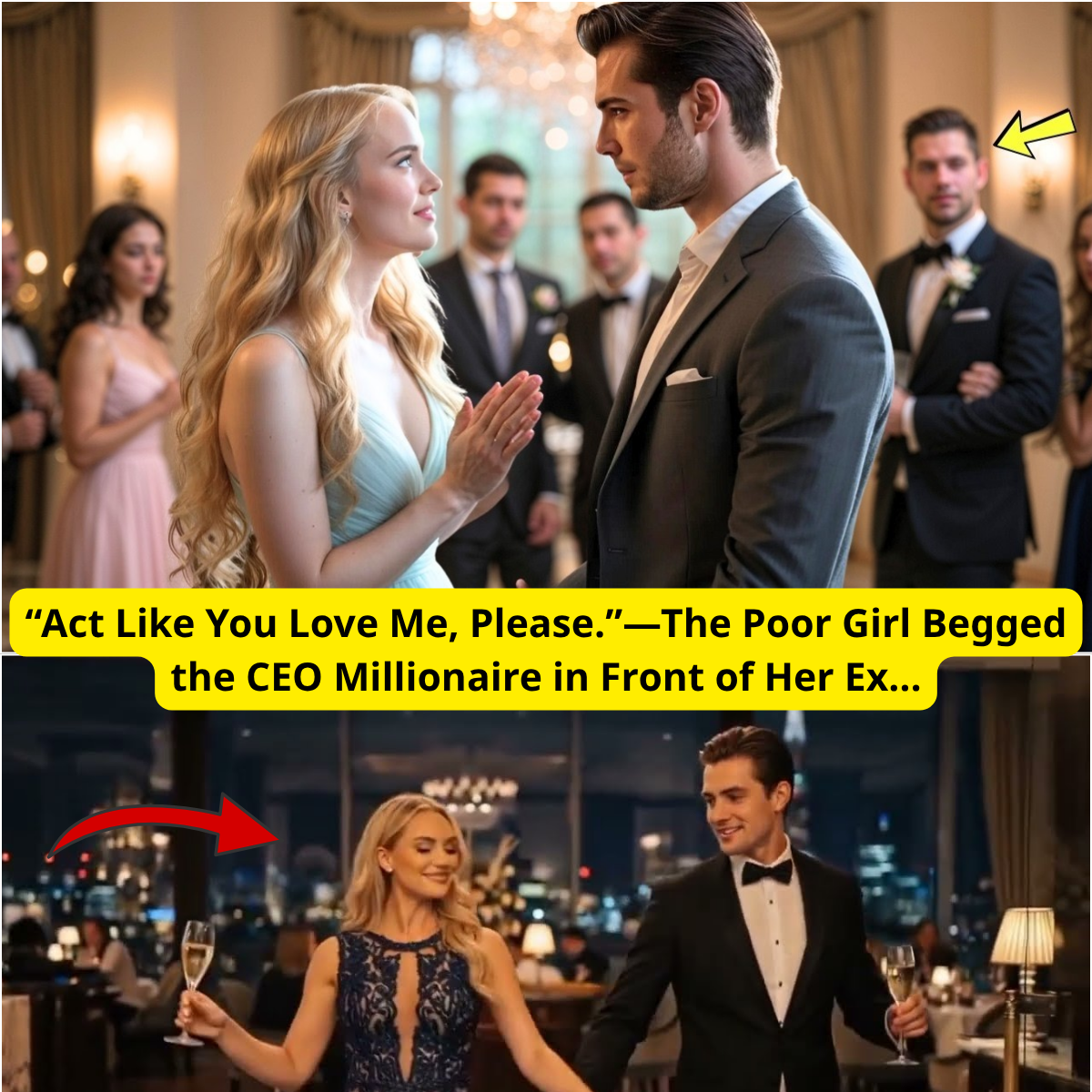
He was standing twenty feet away near the floor-to-ceiling glass windows that overlooked the glittering, black expanse of Lake Michigan. Derek was laughing—that loud, performative honk he used when he wanted everyone within a two-block radius to know he was winning. His hand, sporting the shiny Breitling watch she had gone into credit card debt to help him buy, was wrapped casually around the bare waist of a woman whose neck and fingers practically dripped with flawless, emerald-cut diamonds. He looked sleeker, wealthier, entirely upgraded.
Ava felt her ribs collapse inward, the air leaving her lungs in a sharp, painful rush. She hadn’t come to Lumière to spy or to beg. Her managing partner had simply realized at 7:30 PM that an infrastructure contract envelope absolutely had to be hand-delivered to a high-net-worth client dining at the restaurant before the markets opened Tokyo time. Ava was the lowliest coordinator on staff; she was the designated runner. It was supposed to be a two-minute task. In through the service elevator, hand off the linen envelope to the maître d’, and slip back out into the autumn night before anyone noticed the scuffs on her discount flats. No drama. No history.
But fate possessed a profoundly dark sense of humor.
As if pulled by a string, Derek’s eyes drifted away from his date and locked directly onto Ava. The booming laugh died on his lips, but the expression that replaced it wasn’t guilt. It wasn’t the panicked shame of a man who had left a woman’s life in a sandwich bag. It was something infinitely worse: pure, unadulterated pity.
He leaned down, his lips nearly brushing his date’s diamond drop earring, and whispered something into her ear. The woman turned her head, her sharp, heavily contoured gaze sweeping over Ava’s blue dress and bare legs. Then, she let out a soft, musical giggle, covering her mouth with a manicured hand.
Ava’s feet glued themselves to the polished terrazzo floor. Her brain was screaming a frantic, coherent command: Turn around. Get to the elevators. Walk away.
But her skeleton refused to cooperate. She stood there, dissolving in real time, feeling like a clumsy child playing dress-up in a playground built exclusively for princes. She could almost hear Derek’s voice echoing in her ear from their final semi-annual argument: You always look like you’re about to either faint or commit a minor crime, Ava. It’s exhausting.
“You look like you’re about to either faint or commit a fairly significant crime.”
The voice came from directly beside her shoulder. It was low, dry, and anchored by an impossibly cool, midwestern composure that seemed to lower the temperature of the room by five degrees.
Act II: The Five-Minute Upgrade
Ava startled, her head snapping to the right.
The man standing next to her wasn’t the kind of person who blurred into the background of a room. He was exceptionally tall, with a sharp, geometric jawline that looked like it had been carved out of granite by an artist who specialized in intimidation. He wore a charcoal-gray three-piece suit that possessed the flawless, fluid drape of bespoke Savile Row tailoring—a garment that undoubtedly cost more than Ava earned in a fiscal quarter. His dark, almost black eyes held the kind of quiet, absolute authority that never needed to raise its voice or flash a watch to command a room.
He was holding two crystal flutes of vintage Dom Pérignon, looking down at her with an expression tucked neatly between mild amusement and genuine, analytical curiosity.
Ava’s brain, temporarily short-circuiting from the sheer weight of her humiliation, scrambled through old issues of Crain’s Chicago Business she had filed away at the office. This was Nathan Cole. The head of Cole Industries, a logistics and green-tech monolith, and the youngest self-made billionaire in the Midwest. He was a man famous for buying up failing shipping corridors and turning them into gold mines through sheer, cold-blooded efficiency.
“I’m fine,” Ava blurted out automatically, her customer-service voice kicking in like a faulty generator.
“You’ve been standing exactly three inches inside the frame of the entrance for four minutes and twelve seconds,” Nathan replied, checking his bare wrist with a micro-movement. “The maître d’ is currently adjusting his tie for the third time, which means he’s about to ask security if you’re a protester.”
Ava blinked, her throat tightening. She looked from Nathan’s stark, expensive face across the room to Derek, who was now raising his highball glass toward her in a mocking, silent toast.
Before logic could intervene, before her deeply ingrained midwestern politeness could stop her, the filters of her mind crumbled entirely. “Please act like you know me,” she whispered.
Nathan’s left eyebrow lifted perhaps a millimeter. He didn’t look away from her. “Excuse me?”
“I know it’s insane,” Ava said, the words tumbling out in a desperate, hushed rush, her chest heaving as she fought the hot pressure of tears behind her eyelids. “I know you don’t know me from a wall in this building, but my ex-fiancé is standing twenty feet away, and he’s watching me right now with a woman who looks like she owns a small European country. He left my engagement ring in a Ziploc bag three weeks ago, Mr. Cole. I cannot let him see me fall apart in a thirty-dollar dress. I can’t. So please… just for five minutes… just pretend you’re mine.”
She stopped, the sheer absurdity of her words hitting her like a cold wave. Her face burned a violent, hot crimson. “That… that sounds entirely ridiculous when I say it out loud to a stranger. I’m sorry. Forget I said anything.”
“It does sound ridiculous,” Nathan agreed smoothly.
Then, without a hint of hesitation, he extended one of the crystal champagne flutes toward her hand.
“But I’ve been standing by this pillar for twenty minutes waiting for a rail-line executive who apparently thinks my time is negotiable,” he said, a ghost of a smile grazing the very corner of his hard mouth. “So, all things considered, a five-minute upgrade to a beautiful woman in a blue dress seems like an excellent return on investment.”
Ava stared at the bubbles rising in the glass. Her fingers, still trembling, closed around the cold crystal stem.
Act III: The Internal Firewall
Nathan Cole did not do spontaneous. He did not do unpredictable, and he absolutely did not do charity theater for strangers. He had built an empire by the age of thirty-two on a foundation of ruthlessly calculated decisions, structural risk mitigation, and an almost aggressive, metabolic intolerance for chaos.
But something about the woman standing before him—this terrified, fiercely brave woman who was holding her chin up while her world was visibly turning to ash—had bypassed every legal and logical firewall he possessed. Her blue dress was slightly wrinkled at the hem from a long commute, but her eyes were an intense, unvarnished brown that contained zero calculation. She wasn’t trying to network; she was trying to survive.
He guided her gently toward the long, white marble stretch of the bar, his hand resting lightly against the small of her back. The heat of his palm through the thin thrift-store fabric felt like an electric current.
Across the room, Nathan’s eyes easily picked out the target. He had dealt with men like Derek his entire professional life. Flashy, over-sized watches, loud laughs designed to draw an audience, and a posture that screamed he needed the world to witness him winning because he suspected, deep down, that he was empty. Nathan despised that specific brand of insecurity; it was sloppy, predictable, and inefficient.
He leaned down close to Ava, his shoulder brushing hers, close enough that she could smell the clean, expensive scent of cedarwood and silver needle tea that clung to his lapels.
“Tell me your name,” he murmured.
“Ava,” she whispered into her champagne. “Ava Mitchell.”
“Ava,” he said, repeating it with a slow, heavy familiarity that made her pulse jump. “Look at me, Ava. Do not look back at the window.”
She turned her face up to his. Her eyes were glassy, a thin film of tears reflecting the amber lights of the bar, but her jaw was set.
“You don’t have to fall apart tonight,” Nathan said, his voice dropping into a register that felt intensely private, almost protective. “But you don’t have to perform for me either. You don’t have to pretend you’re okay. Just be right here in this conversation.”
Something shifted in the lines of her face—not the relief of a clean escape, but something far more profound. The defensive mask she had worn since the Ziploc bag appeared on her vanity began to soften.
They talked. To Nathan’s immense surprise, they didn’t talk about his market cap, his recent acquisitions, or the standard conversational currency of Lumière. They talked about real, small, strange things. She told him she had grown up in a small town in southern Ohio where the lack of light pollution meant she could name every constellation in the summer sky, but that she still couldn’t parallel park her Honda Civic to save her life.
He found himself telling her—a woman he had known for less than three minutes—that he hadn’t taken a single consecutive Saturday off in three years, and that he occasionally stared at his calendar on Sunday mornings completely unable to remember what his life had looked like before the corporate machine consumed his identity.
“That’s actually incredibly sad,” Ava said. She wasn’t lowering her eyes or softening the blow for a billionaire. She looked at him with an unblinking, genuine empathy that held no professional angle.
“Most people tell me it’s inspiring,” Nathan countered, amused by her lack of deference.
“Most people in this room are trying to get you to fund their series-B round,” she said, taking a small, brave sip of the Dom Pérignon. “I’m just killing time until my chest stops hurting enough for me to leave a nice restaurant without causing a scene.”
Nathan laughed. It was a real, unguarded sound that came from his chest—a sound so foreign to his own ears that he almost didn’t recognize it.
Across the room, he caught Derek watching them. The smug, patronizing pity on the ex-fiancé’s face had vanished entirely. It had been replaced by a tight, sour expression that looked remarkably like a man who had just realized he had traded a rare piece of art for a collection of costume jewelry.
Act IV: The Exit Clause
Predictably, Derek couldn’t help himself. The need to be witnessed was too strong.
Ten minutes into their conversation, the sound of heavy leather dress shoes approached the bar. Derek arrived with a smooth, well-rehearsed stride, his diamond-clad date floating behind him like an accessory. He stopped two feet from Ava, his face twisted into a smile that suggested he was doing her a massive philanthropic favor simply by recognizing her in public.
“Ava? Wow,” Derek said, his eyes instantly sliding to Nathan with a calculated, aggressive casualness. “I certainly didn’t expect to run into you at a place like Lumière. You look… well, you look good.”
Ava went completely still beside the stool. Nathan watched her profile—watched the old, systemic pain flicker across her eyes, the instinctive micro-movement to shrink her shoulders, the deep muscle memory of a woman who had been systematically trained to feel small and replaceable by this exact individual.
Nathan set his champagne glass down on the marble counter. The crystal made a soft, incredibly deliberate click that seemed to cut through Derek’s manufactured warmth.
Nathan turned his full, unmitigated attention to the man in the suit. It wasn’t an aggressive movement; it possessed the total, terrifying confidence of a predator that had absolutely nothing to prove to anyone in the room.
“She always looks good,” Nathan said simply. His voice wasn’t loud, but it had a cold, final quality that made Derek’s date instantly shift her weight. “She’s also in the middle of an important conversation with me, so if you’ll excuse us.”
It wasn’t theatrical. It wasn’t a shouting match. It was just a door closing in Derek’s face with the weight of a ten-ton vault.
Derek blinked, his mouth opening slightly as he finally processed the full identity of the man standing between him and his ex-fiancé. He looked at Nathan’s charcoal suit, then at the protective slant of his shoulders over Ava, and then down at his own Breitling watch, which suddenly looked very small and very common. His date pulled sharply on his arm, her face burning with social mortification.
“Right,” Derek muttered, clearing his throat as his face turned the color of a beet. “Right. Enjoy your night.”
He turned and retreated toward the elevators, his stride significantly faster and less rehearsed than it had been on his approach.
Ava let out a long, ragged exhale—a sound that felt like she had been holding her breath not just for five minutes, but for the entire three weeks since the Ziploc bag had arrived. Her dignity was entirely intact, her heart was still cracked, but it was no longer actively bleeding onto the floor of Lumière.
“I need to drop this envelope at the front desk,” she said softly, looking up at Nathan with a quiet, clear intensity. “The five minutes are up.”
They walked back toward the gold-leaf entrance together. Ava handed the linen infrastructure envelope to the now incredibly deferential maître d’, then turned to face the billionaire.
“You didn’t have to do that, Mr. Cole,” she said. “You really didn’t.”
“I know,” Nathan replied, his hands sliding casually into his trouser pockets.
“I can’t pay you back for that champagne,” she said, a small, genuine laugh escaping her lips. “And I don’t even know why you bothered.”
“Ava,” he said, stopping her with the simple pronunciation of her name. He paused, and she could tell it cost him something to speak without a calculation—this man who lived his life by the metric of the ledger. “Some things don’t require an underwriting report. Get home safe. And the next time you have to drop off a contract in a room like this… maybe call ahead.”
She laughed again, a bright, clear sound that lingered in the air between them. As she stepped out into the crisp Chicago night, the autumn wind felt clean and sharp against her face. The city lights were blazing below her like an endless sea of diamonds, but as she walked toward the transit station, she didn’t feel like the girl who had been discarded in a plastic bag anymore.
She felt like someone who had just been remembered.
Act V: The Thursday Standard
Three weeks later, the mid-October rain was drumming a steady, monotonous rhythm against the windows of Ava’s logistics office. It was 4:45 PM on a Thursday, and she was buried beneath a mountain of shipping manifests, her fingers typing out automated routing codes with a dull, mechanical regularity.
A sharp ping echoed from her desktop monitor. A single external email had cleared the firm’s firewall.
Ava clicked on the notification. There was no subject line, no professional introduction, and no formal sign-off. The body of the email contained ten words written in a stark, unembellished font:
The rooftop restaurant has a better view on Thursday evenings.
— NC
Ava read the text once. Then she read it again, her fingers freezing over her keyboard as the image of a charcoal-gray suit and the scent of cedarwood flooded back into her mind.
A slow, quiet smile broke across her face—not the performative, brave smile she had used to survive Derek, but the soft, steady expression of a woman who had stopped expecting good things from the world and was carefully, beautifully learning how to believe in them again.
She hit reply, her fingers moving without a single tremor as she typed two words into the blank white box:
I know.
She hit send, closed her laptop, and went home to put on her blue dress.









