Fragile Clues To Identity Of Lost WW1 Soldiers That History Forgot
Fragile Clues To Identity Of Lost WW1 Soldiers That History Forgot
The diesel engine of a hydraulic excavator roared to life, its steel bucket slicing through a thick layer of concrete slag and modern industrial topsoil. It was December 2001, in the flat, low-lying landscape of Boezinge, a small village situated just north of Ypres in the Flemish province of West Flanders. For decades, this patch of earth had been a silent, overgrown scar on the European countryside. Now, the transformation was almost complete. Steel-framed warehouses, asphalt access roads, and neat rows of commercial distribution centers were rapidly obliterating the physical remains of the Western Front, converting a landscape of historic slaughter into a pristine, twenty-first-century industrial estate.
But at the northern edge of the construction zone, where a drainage canal was being widened, the machinery had ground to a sudden halt. A group of men in muddy overalls and high-visibility vests stood at the lip of a deep, waterlogged trench.
They were known as “The Diggers”—a dedicated team of amateur archaeologists and local historians who had spent years monitoring the construction projects around Ypres, racing against the bulldozers to salvage whatever the earth surrendered. Over the course of their ad hoc campaign, they had uncovered a vast, subterranean labyrinth of timber-lined tunnels, crumpled sandbags, rusted unexploded artillery shells, and the skeletal remains of men who had vanished from the face of the earth between 1914 and 1918.
Aurel Sercu, one of the veteran coordinators of the volunteer group, knelt in the frozen Flemish clay, his small trowel scraping away the dense, gray silt. He was working with the methodical patience of a surgeon, fully aware that the clock was ticking. The industrial developers were losing thousands of Euros for every hour their crews sat idle, but some tasks could not be hurried.
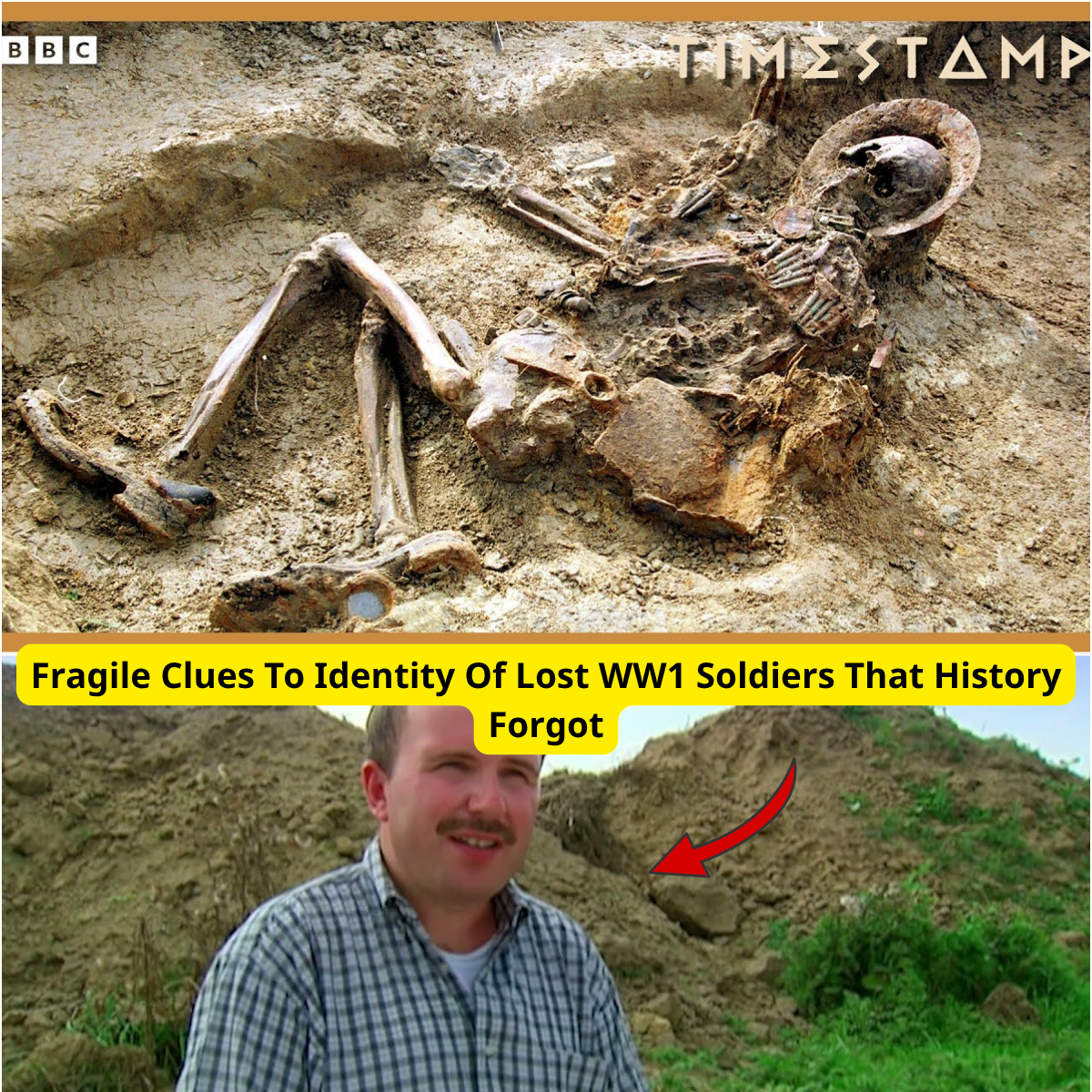
“We have more human remains,” Aurel called up to the project foreman, his voice muffled by the damp, winter wind. “It’s a complete skeleton. This makes number one hundred and twenty-four.”
For more than two hours, the Diggers worked inside the narrow trench, using nothing but hand trowels and fine brushes to separate the artifacts from the heavy, suffocating mud that had held them for nearly eighty-five years. As the clay was cleared away, the chaotic final seconds of a human life began to resolve themselves with terrifying clarity.
First came the heavy, iron-shod leather soles of British army-issue boots, the brass studs still glinting beneath the wet grease. Then, the shattered wooden shaft and rusted iron blade of a standard entrenching tool emerged—the small shovel that every infantryman carried on his pack, used to dig a shallow scrape into the earth while pinned down under machine-gun fire. Beside the pelvis lay the rotted, fiber-flecked remains of a canvas haversack, its brass buckles turned a brilliant, toxic green by decades of chemical oxidation.
This wasn’t a collection of scattered bones or a secondary burial. It was an intact, undisturbed battlefield casualty. Everything the man had owned, everything he had carried into the fire on the day of his death, was still fastened to his frame.
The Seals of the Dragon
The military historian Paul Reed scrambled down the slippery timber shoring into the excavation pit, his notebook open to a list of the British divisions that had rotated through the Ypres Salient. He looked at the structural alignment of the remains, comparing them to the previous bodies the Diggers had recovered from the same sector during the summer months.
“The men we found in July were from the 1915 battles,” Paul noted, pointing a gloved hand at the dark stain of fabric clinging to the shoulder blades of the skeleton. “But this man is different. The equipment configuration has been upgraded. Look here.”
Using a soft brush, Aurel cleared a small pocket of clay from the upper collarbone area of the tunic. A small, blackened disc of stamped brass emerged from the soil. It was a regimental cap badge, its intricate design obscured by a layer of corroded metal. Aurel dipped the badge into a small container of distilled water and rubbed the surface gently with his thumb.
The sharp, distinct profile of a mythical creature appeared: the Welsh dragon, surrounded by a scrolled banner.
“Royal Welsh Fusiliers,” Aurel said, his eyes narrowing as he examined the metal. “This changes the chronology entirely. The Fusiliers didn’t serve in this specific sub-sector of Boezinge during the early gas attacks of 1915. They were brought into the line much later.”
Aurel reached down toward the skull, where a heavy, circular object was partially embedded in the trench wall. It was a British Brodie helmet—a shallow, wide-brimmed bowl of manganese steel.
“The steel helmet wasn’t introduced to the front-line troops until the spring of 1916,” Aurel explained to the small group of onlookers gathering at the lip of the pit. “If he is wearing a steel helmet and carrying the late-pattern leather equipment, he died during the massive buildup to the Third Battle of Ypres—either late 1916 or sometime in 1917. And that means we have a real chance.”
“A dog tag?” Paul asked.
“Exactly,” Aurel nodded. “By the summer of 1916, the British Army had recognized the catastrophic failure of their early identity discs. The early vulcanized asbestos tags frequently dissolved in the wet soil, leaving thousands of missing men with no names. By late 1916, it became an absolute obsession among the infantrymen to secure something more permanent. Men knew that artillery could atomize a body in an instant, leaving nothing for their mothers or wives back home to bury. It became the fashion to buy private, non-issue aluminum discs, stamp them with your name and regimental number, and wear them on a heavy chain around the wrist.”
During twenty-five years of meticulous excavation across the industrial zones of Flanders, the Diggers had recovered dozens of British soldiers, but they had never successfully put a definitive name to a single one. Every set of British remains had been classified simply as an “Unknown Soldier of the Great War,” their headstones at the nearby Commonwealth cemeteries bearing the standard, anonymous epitaph chosen by Rudyard Kipling.
The discovery of a late-war Royal Welsh Fusilier with his wrist bones intact presented an extraordinary, fleeting opportunity to bring one specific name in from the cold.
The Kit Inspection
The work shifted from heavy excavation to a microscopic forensic audit. Every pocket of the rotted serge woolen tunic had to be systematically searched before the bones could be lifted from the clay. The soil inside the uniform acted as a time capsule, preserving the tiny, fragile items that defined the daily existence of a trench soldier.
Near the upper right pocket, Paul Reed uncovered a small, fragile cylinder of clear glass. It was an iodine ampoule—a vital component of the first-aid kit that every British soldier carried into the field. If a piece of shrapnel tore through the flesh, the soldier or his mate was instructed to snap the glass neck of the ampoule, pour the antiseptic directly into the open wound, and apply the sterile field dressing tucked into the special lining at the skirt of his jacket. The fluid inside the glass was gone, but the cork stopper remained tightly wedged in place.
A few inches lower, the trowel clicked against a small, dark object made of rotted ash-wood. It was a small pocket brush, the type used to clean mud from the action of a Short Magazine Lee-Enfield rifle or to scrub the dried clay from a uniform before a formal inspection.
“Patrick, get the water bottle over here,” Paul called out, his excitement breaking through his professional reserve. “We’ve got markings on the wood.”
The team gathered around a small plastic tray as the mud was carefully rinsed from the flat top of the brush. In the harsh glare of the winter sun, a series of faint, hand-scratched indentations became visible in the grain of the wood.
“There’s a straight vertical line here,” Paul muttered, using a magnifying loupe to trace the marks. “It looks like a letter ‘P’. And there are some jagged lines right next to it. Could be initials. Or a portion of a seven-digit regimental serial number.”
The volunteers sat in absolute silence for several minutes, adjusting the angle of the brush to catch the light. But the wood had suffered from decades of compression and moisture. The scratches were shallow, inconsistent, and blurred by general wear and tear from when the soldier was still alive. It was impossible to determine if the marks were a deliberate signature or simply the random abrasions of a tool rattling around inside a haversack for months on end.
“It’s a ghost,” Aurel sighed, shaking his head. “It’s not clear enough to stand up in a military archive. We can’t use this to verify an identity with the Ministry of Defence.”
The disappointment inside the trench was palpable. The window of opportunity was closing, and the industrial excavators were already moving their equipment toward the adjacent grid line.
Then, Patrick’s trowel lifted a small, heavy lump of congealed material from what had been the lower left pocket of the trousers. It was a small, bi-fold purse made of cheap, water-hardened pigskin leather. When Aurel carefully pried the rotting layers apart, the unmistakable dull glint of metal appeared inside the rotted lining.
“Coins,” Patrick whispered. “We’ve got currency.”
Aurel extracted three thin, circular discs of bronze and copper-nickel. He rinsed them in the basin, clearing away the black sulfuric crust that had formed over the inscriptions.
“They are French francs,” Aurel announced, his voice steadying as he read the date stamped beneath the profile of Marianne. “Nineteen-seventeen. Brilliant, uncirculated strike.”
Paul Reed quickly consulted his field charts. “That gives us our absolute historical floor,” he said. “The man couldn’t have been buried here before the spring of 1917. And we know from the war diaries that the Royal Welsh Fusiliers were moved completely out of the Boezinge sector just before the opening phases of the Battle of Passchendaele in July of that year. They never returned to this specific part of the Ypres Salient in 1918. We have a highly specific five-month window: between January and July of 1917.”
The coins had provided the exact historical frame for the man’s death, but they remained stubbornly silent about his individual name. He was still a number on a casualty list, one of thousands of young Welshmen who had left the coal valleys and rural farms of their homeland to disappear into the industrial meat-grinder of the Western Front.
The Box Respirator
The final revelation of the Boezinge pit did not come from the items the soldier carried to survive, but from the specialized apparatus he had been forced to wear in order to die.
As Aurel cleared the final layers of gray clay from the upper torso and head area, the anatomical position of the skull caused him to pause. The head was not turned to the side in a posture of rest; it was tilted backward at an unnatural, strained angle, the jaw frozen wide open in a permanent, skeletal gasp.
Directly over the facial bones lay a complex, degraded mass of rubberized canvas, rusted wire springs, and twin glass eyepieces that had turned a milky, opaque white from decades of underground burial.
“He’s wearing it,” Aurel said, his voice dropping an octave. “He died with his gas mask fully deployed.”
Paul Reed leaned over the edge of the pit, his camera capturing the precise alignment of the artifacts. “It’s a Small Box Respirator,” Paul said, identifying the standard-issue British anti-gas gear introduced in late 1916 to counter the lethal concentrations of phosgene and mustard gas that had turned the Ypres Salient into a toxic wasteland.
The historical layout of the death scene was undeniable. The thick metal clip from the canvas gas mask bag was still fastened to the skeleton’s chest hooks. The rusted metal canister—the filter containing granulated charcoal designed to neutralize the chemical vapors—lay directly beneath the vertebrae of the neck. A perished rubber hose extended from the canister straight to the brass mouthpiece that was still wedged between the soldier’s upper and lower jaws.
The presence of the fully assembled box respirator indicated that this was not a victim of a random artillery shell or a sniper’s bullet while working on a routine trench-repair detail. When the final moment arrived, the soldier was in the middle of a concentrated, overwhelming chemical attack.
“Look at the position of the hands,” Aurel noted, guiding Paul’s attention to the lower portion of the rib cage.
The bones of the left and right hands were not scattered by the weight of the earth. They lay directly on top of one another, the skeletal fingers intertwined and tightly clenched together over the center of the chest. It was a universal posture of intense physical agony—the instinctive reaction of a human being whose lungs were failing, whose airway was closing, and who was attempting to hold onto himself as the world went dark through the fogged lenses of a rubber mask.
The Diggers sat in the cold mud, surrounded by the mounting noise of the modern industrial park—the beep of reversing trucks, the whistle of a factory line, the hum of traffic on the nearby highway. Eighty-five years earlier, this exact coordinate had been a screaming, sulfurous hell of green-cross gas clouds, liquid mud, and the concussive roar of heavy high-explosive artillery.
The soldier of the Royal Welsh Fusiliers had done everything right. He had dug his position with his entrenching tool; he had carried his first-aid dressing; he had managed to secure his advanced box respirator and clear the mask from its bag as the gas alarms sounded across the line. But the environment had simply been too lethal. Whether the rubber seal of his mask had been torn by a flying splinter of stone, or whether the concentration of phosgene gas had simply overwhelmed the chemical filter during a prolonged bombardment, the mud had claimed him anyway.
The Last Return
By the end of December 2001, the drainage canal at Boezinge was successfully widened, the concrete foundations for the new commercial warehouses were poured, and the last remnants of the old frontline trench system were sealed beneath meters of engineered gravel and asphalt. The industrial estate was open for business.
The remains of the one hundred and twenty-fourth soldier were carefully lifted from the clay, placed into a standard white forensic container, and transferred to the custody of the Commonwealth War Graves Commission in Ypres.
For months, researchers combed through the regimental rosters of the Royal Welsh Fusiliers, cross-referencing the five-month timeline established by the 1917 French coins with the list of men reported missing in action near Boezinge. But without a clear serial number from the wooden brush or a legible inscription from a private identity disc, the identity of the man could not be narrowed down to a single individual. The bureaucracy of war had done its job too well; he was one of too many.
In the autumn of 2002, a small military escort accompanied a simple wooden coffin to the New Irish Farm Cemetery, a beautifully manicured plot of land located just a few miles from the site where the warehouses now stood.
The volunteers from the Diggers stood at the rear of the stone arcade, their hands folded against the cold autumn rain. A firing party from the modern Royal Welsh Regiment stood at attention, their brass buttons catching the pale Belgian light.
The coffin was lowered into the earth by six young soldiers, their movements slow, rhythmic, and solemn. The headstone that would be erected over the grave would not bear a name, a birthdate, or a hometown in Wales. It would simply carry the crest of the dragon and the words that science and history had been unable to alter:
A Soldier of the Great War. Royal Welsh Fusiliers. Known unto God.
The Diggers turned and walked back toward their cars, their boots clicking against the neat gravel paths. Behind them, the white headstones stood in perfect, unyielding military ranks, keeping their silence while the modern world continued its loud, busy journey just beyond the cemetery wall.