Gay YouTuber COMES OUT To Muslim Mother, Goes Horribly Wrong!
Gay YouTuber COMES OUT To Muslim Mother, Goes Horribly Wrong!
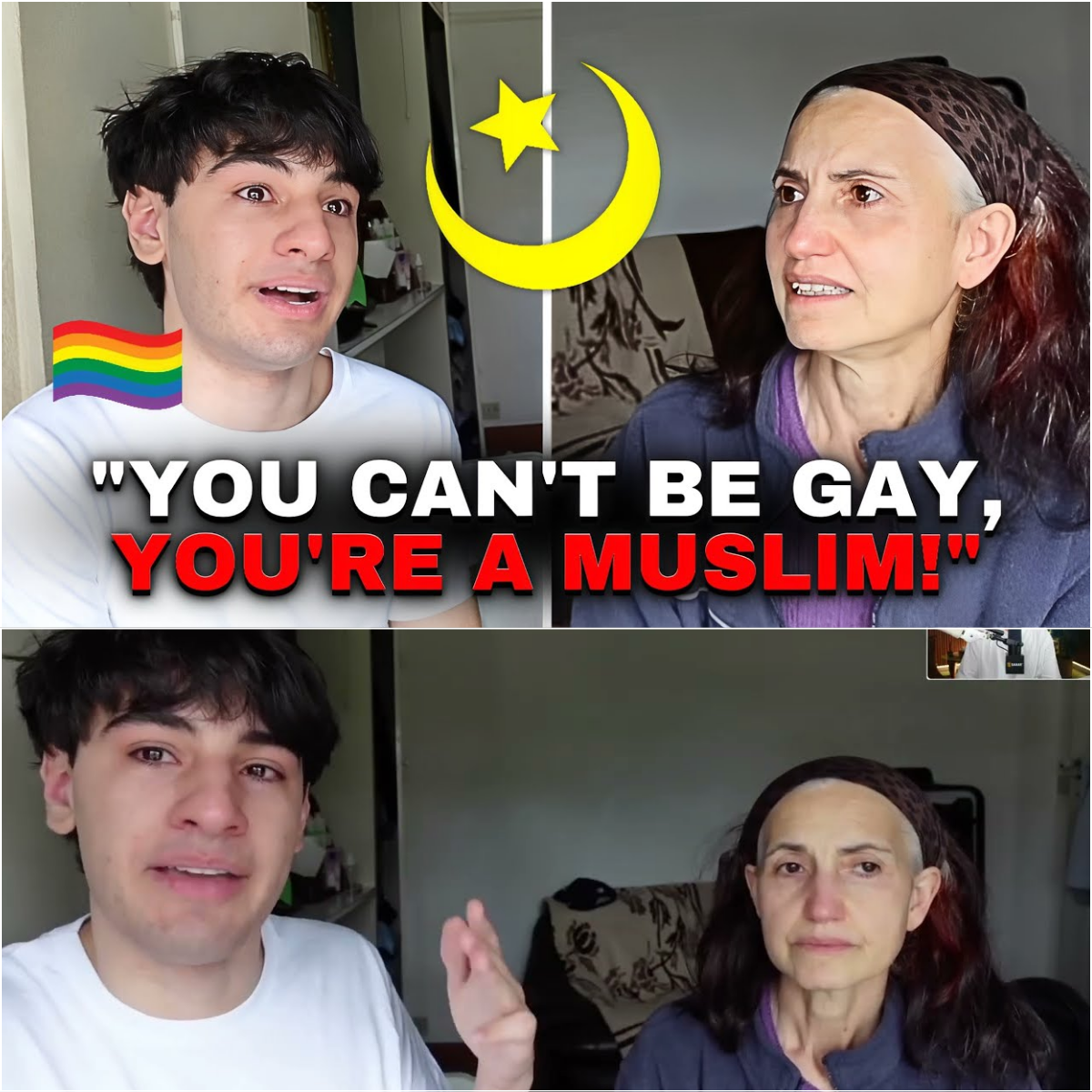
Sitting under the harsh glow of a ring light, a young Turkish-British content creator clears his throat and glances down at his phone, his fingers trembling slightly as he consults a screen of typed notes. “The truth is is that I’m gay and I like boys,” he says, delivering a confession harbored for nearly two decades to the woman sitting next to him: his traditional, Muslim mother. Captured in a raw, multi-part broadcast that quickly traveled across global digital spaces, the ensuing conversation did not feature explosive anger or dramatic disownment, but rather something far more quietly devastating—a painful, drawn-out negotiation of identity, guilt, and theological irreconcilability. For an American audience navigating its own culture wars, the viral footage offers a hauntingly intimate look into the intersection of immigrant family dynamics, LGBTQ+ identity, and the unyielding weight of conservative religious orthodoxy within western diasporas.
The Digital Confessional
The exchange, broadcast to thousands of viewers before being amplified by secular and political commentary channels, serves as a stark reminder of the unique vulnerabilities faced by queer youths within conservative immigrant communities. Jafet, a popular creator who built an online following through comedic streams, beauty commentary, and cross-dressing sketches, chose the ultimate public forum to stage his most private revelation.
To the western viewer accustomed to triumphant coming-out narratives celebrated with pride parades and parental validation, Jafet’s video reads like an exercise in emotional triage. He does not ask his mother for acceptance; he begs her merely to understand that his reality is a biological fact rather than a malicious choice.
“It’s not my choice. You can’t control it,” Jafet repeats throughout the conversation, a desperate refrain aimed at deflecting the immediate wave of maternal maternal failure that washes over his mother. His posture is uniquely deferential, explicitly offering up a life of forced celibacy to soften the blow of his truth.
          [ THE DIASPORIC NEGOTIATION ]
                       |
         +-------------+-------------+
         |                           |
         v                           v
   [ THE SON'S COMPROMISE ]    [ THE MOTHER'S BOUNDARY ]
   * Acknowledges identity     * Rejects basic identity
   * Voluntarily offers        * Demands behavioral
     lifelong celibacy           suppression
   * Shields mother from       * Internalizes choice
     familial shame              as maternal guilt
The Architecture of Maternal Guilt
The mother’s reaction encapsulates the multi-layered grief experienced by traditional parents confronting an reality that completely shatters their cultural worldview. Her response is defined not by predatory malice, but by profound, agonizing confusion and social anxiety.
“I blame myself,” she says, her voice dropping as she attempts to construct a narrative that makes sense of her son’s revelation. She recalls her years working in a local British fish-and-chip shop, remembering her internal discomfort around the gay patrons who frequented the establishment. In her worldview, her current heartbreak is a form of spiritual contagion or divine cosmic retribution—a curse brought about by her proximity to an lifestyle she historically frowned upon.
Jafet immediately tries to intercept this guilt, offering an alternative pseudo-psychological explanation to spare her feelings. He attributes his orientation to a lack of male validation during his formative years, pointing to an abusive brother and an emotionally distant father. “Because of that, the only love in my life I ever got was from you and my sisters,” he reasons. “And that’s why now I crave that love in a man.”
While modern psychological consensus has long thoroughly rejected the theory that homosexuality is caused by distant fathers or overprotective mothers, Jafet’s deployment of this narrative highlights a heartbreaking reality: queer youth in traditional households will often pathologize their own identities or weaponize family trauma if it means relieving their mothers of the crushing weight of religious shame.
The Cultural Impossibility: For the traditional immigrant mother, sexuality is not an innate, immutable spectrum of human identity. It is understood as a series of moral actions, social duties, and spiritual choices. To accept her son as inherently gay is to accept that his soul is fundamentally compromised—an admission no devout parent can easily make.
The Terms of Surrender: Celibacy as a Peace Treaty
One of the most agonizing dimensions of the exchange is the conditional peace treaty Jafet attempts to broker with his mother. To assuage her fear of public scandal and religious condemnation, he repeatedly promises to suppress his desires entirely.
“I wouldn’t date another boy… I’m just going to spend the rest of my life on my own.”
“Even if I was straight, I wouldn’t want to get in a relationship anyway.”
“I’m never going to get a boyfriend because I don’t want to.”
This rhetorical surrender is common among LGBTQ+ individuals within religious communities. When faced with the threat of complete familial exile, many choose a compromise: they ask their families to tolerate the existence of their orientation in exchange for a vow never to act upon it.
To his mother, this concession offers a fragile lifeline. If her son remains single, the family can maintain a veneer of normalcy within their conservative social circles. She pleads with him to stop posting videos online wearing wigs and makeup, suggesting that if he simply stops performing his identity, he might eventually “forget about it.”
But as secular commentators analyzing the footage noted, this compromise is an psychological illusion. The demand that a young person permanently renounce love, companionship, and romantic intimacy to preserve family honor is an unsustainable emotional burden. It transforms the home from a sanctuary of safety into a space of perpetual surveillance, where any deviation from performing heteronormativity is viewed as a betrayal.
The Shadow of the Homeland: Cyprus and the Global Safe Space
Throughout the conversation, the geographical backdrop of Cyprus looms large. Jafet explicitly states that his identity prevents him from returning to his family’s native land. “That’s why I don’t want to go to Cyprus either,” he admits, “because I can’t act the way I want to… I know everyone from our family completely doesn’t like gay people.”
This admission highlights the sharp divergence between the legal realities of the Western world and the social realities of traditional homelands. While the United Kingdom provides robust legal protections, anti-discrimination laws, and a thriving secular civil society for LGBTQ+ individuals, the social architecture of traditional diasporic families can effectively recreate the oppressive conditions of the homeland within a London or Manchester suburb.
                  [ THE GEOGRAPHIC PARADOX ]

  THE WESTERN SURROUNDING               THE DIASPORIC HOUSEHOLD
  =====================               =======================
  * Full legal protection             * Unwritten conservative codes
  * Secular freedom of expression     * Constant threat of communal shame
  * Access to queer community         * Total erasure of identity
  * Validation of human rights        * Demand for lifelong celibacy
In many parts of the Middle East, North Africa, and conservative Mediterranean enclaves, being openly gay remains a social impossibility, and in jurisdictions governed by strict interpretations of Sharia law, it carries severe criminal penalties, including capital punishment. Even in regions where the law is secular, the family unit functions as an enforcement mechanism for public morality. A gay relative is viewed as a stain on the family’s honor (namus), which can have material consequences for the marriage prospects and social standing of siblings and cousins.
When Jafet’s mother claims that “in Cyprus, you don’t see many gay people,” she is stating a superficial truth that masks a darker reality. Queer individuals certainly exist in those societies; they are simply forced into absolute invisibility, trapped in traditional marriages, or driven to migrate to western capitals to survive.
The Limits of Dialogue in a Fractured World
The viral commentary surrounding Jafet’s coming-out story reflects a deeper, systemic polarization in western discourse regarding religion and individual rights. Conservative commentators have seized upon the video as definitive proof that Islamic culture is inherently incompatible with western values of personal liberty and self-actualization. They point to the mother’s stubborn insistence that her son can “change himself” as an example of a fundamental refusal to assimilate into modern secular society.
Conversely, progressive advocates often find themselves caught in a rhetorical trap—defending the religious freedom and cultural traditions of immigrant minorities while simultaneously trying to protect vulnerable queer individuals within those very communities. The result is an ideological gridlock where the individual human being at the center of the tragedy is often forgotten.
Lost in the grand civilizational debates is the quiet tragedy visible in Jafet’s eyes as the camera rolls. He is a young man possessing a gentle soul, trapped between two worlds that refuse to communicate. He loves his mother deeply, recognizing the immense sacrifices she made as an immigrant parent, yet he cannot erase the biological reality of who he is. His mother, bound by centuries of tradition, theology, and communal expectation, looks at her son with a mixture of love and profound disappointment, utterly incapable of providing the unconditional validation he craves.
As the video cuts to a close, no grand resolution is achieved. There are no shouts of anger, but there is no embrace of understanding either. There is only a heavy, uncomfortable silence—the sound of an family agreeing to live in an uneasy state of denial, highlighting the immense, hidden toll that millions of queer individuals continue to pay at the altar of cultural tradition.