Hijabi Muslim Claims Islam “Respects” Women, Then Ex-Muslim Has A Scathering Response!
Hijabi Muslim Claims Islam “Respects” Women, Then Ex-Muslim Has A Scathering Response!
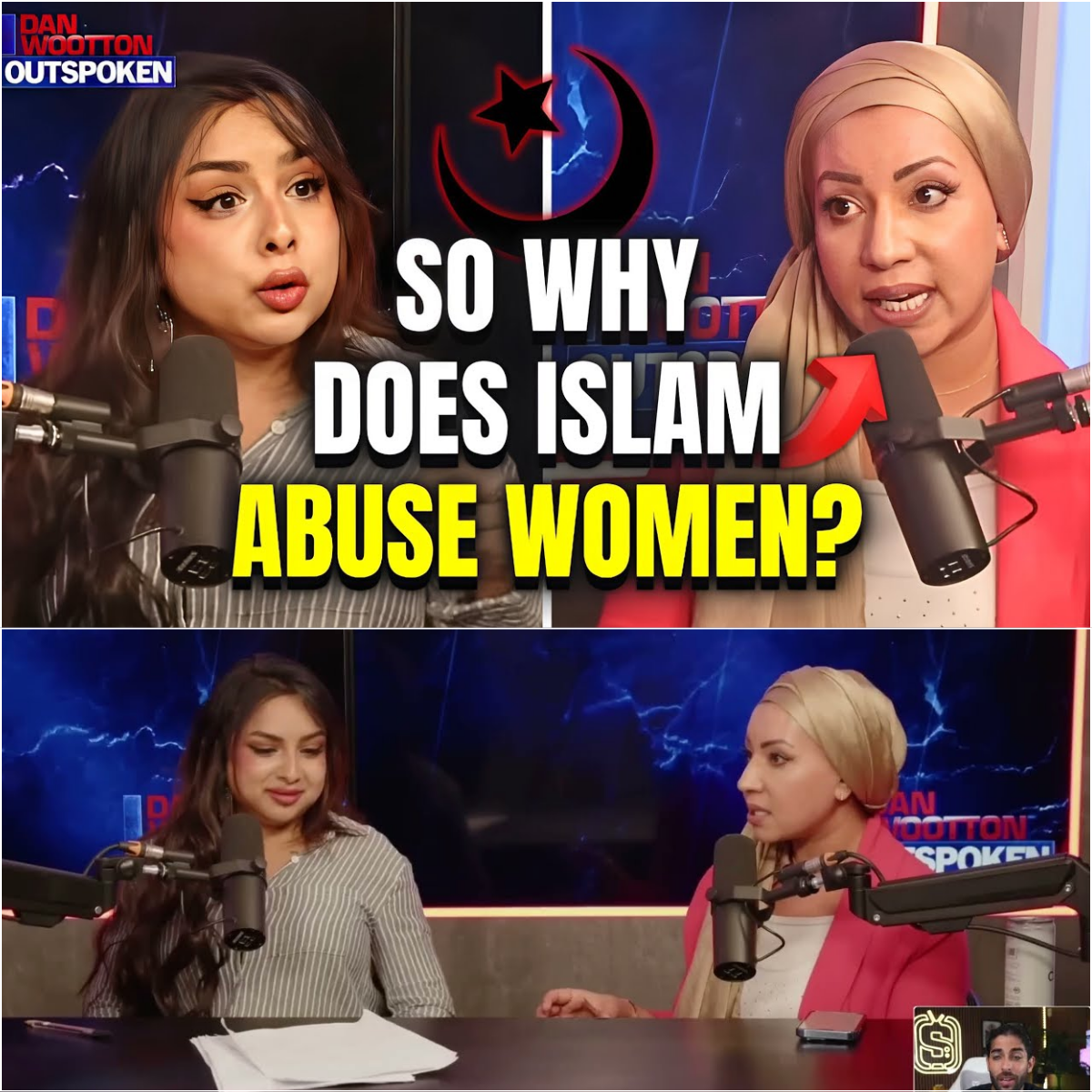
When a British television broadcast transformed into a fierce, raw debate between an apostate woman and a practicing Muslim defender, it laid bare a systemic, global conversation regarding gender, law, and human rights. The focal point of the exchange on the Dan Wootton Show was a question that cuts straight to the core of parental bond: “In Islam, who gets custody of the child after they are done breastfeeding and they are about grown enough to be with the dad?” The answer, provided by an ex-Muslim survivor who had escaped a forced marital return in the United Arab Emirates, was cold and absolute: “It is the man.” For millions of western viewers observing the ongoing debate over the integration of Islamic law within western democracies, this singular revelation serves as a stark entry point into a complex, often terrifying parallel legal reality where centuries-old religious jurisprudence directly overrides modern concepts of gender equality.
The Media Arena and the Reality of Exile
The televised encounter, which quickly circulated across international social networks, highlighted a deep ideological chasm that conventional multicultural diplomacy often struggles to bridge. On one side stood Naria, an ex-Muslim woman who recount her harrowing experience navigating the Sharia courts of Dubai—a city frequently marketed to westerners as a glittering, ultra-modern metropolis, but one that remains anchor to traditional Islamic legal mechanisms behind its glossy facade. On the other side stood Faima, a British Muslim woman who argued for an idealized, deeply personal version of her faith, claiming that abuses are the result of cultural distortions rather than theological mandates.
The dialogue bypassed academic pleasantries, plunging immediately into the mechanics of divorce and child custody under classic Islamic law (Fiqh). Naria described a system where seeking a divorce required her to forfeit her basic financial rights, including the standard monthly maintenance (nafaqah) mandated by traditional contracts.
More critically, she detailed how the state apparatus can be weaponized against a non-compliant wife through the legal doctrine of ta’ah (obedience), which permits authorities to forcibly return a woman to her husband’s home if she is deemed unlawfully disobedient (nashiz). The emotional climax of the debate arrived when Naria revealed that her escape was only possible because she did not have children: “If I had children, all of these judges said to me, ‘If you had children, you would be screwed.'”
The Jurisprudence of Islamic Child Custody
To understand why a mother’s rights are systematically curtailed under Sharia after infancy, one must look past modern political rhetoric and examine the foundational legal texts that govern Islamic family law. In classical jurisprudence, child custody is strictly bifurcated into two distinct phases: Hadanah (care, upbringing, and physical custody) and Wilayah (guardianship, legal custody, and financial control).
                 [ THE SHARIA CHILD CUSTODY SPLIT ]
                                 |
         +-----------------------+-----------------------+
         |                                               |
         v                                               v
   [ HADANAH: Physical Care ]                     [ WILAYAH: Guardianship ]
   * Vested primarily in Mother                   * Vested exclusively in Father
   * Temporary duration                           * Permanent and absolute
   * Focuses on early childhood needs             * Covers education, marriage, property
   * Terminates around age 7-9                    * Defines ultimate ownership
During the initial years of a child’s life, the right of hadanah is almost universally granted to the mother, recognizing her unique biological role in breastfeeding and early nurturing. Across the major Sunni schools of thought—Hanafi, Maliki, Shafi’i, and Hanbali—as well as Shia jurisprudence, the mother is deemed best suited to care for a young child’s physical well-being.
However, this right is temporary. The classical age limit for a mother’s physical custody varies slightly between schools, but it consistently aligns with the end of early childhood—frequently set at age seven for boys and age nine or puberty for girls. Once a child reaches this milestone, the right of physical custody automatically shifts, or becomes highly eligible to shift, to the father.
The underlying philosophy is that as a child grows, they require the moral instruction, societal protection, and disciplinary oversight of the male head of the household. Crucially, the right of wilayah (legal guardianship) remains with the father from the moment of birth. The father retains absolute control over the child’s education, religious upbringing, travel, property, and, in the case of daughters, the authority to contract marriage.
If a divorced Muslim mother chooses to remarry a man unrelated to the child, classical Sharia dictates that she immediately forfeits even her temporary physical custody rights, as her primary duty is seen as shifting to her new husband.
The Obedience Doctrine and Surah An-Nisa 4:34
The televised debate inevitably converged on the most scrutinized and controversial text regarding women’s rights in Islamic scripture: Surah An-Nisa, Verse 34 (Quran 4:34). Naria explicitly cited this passage to explain the legal actions taken against her by the Dubai courts, noting that the concept of nushuz (marital disobedience) is directly derived from it.
The verse has long been the primary battleground between Islamic traditionalists and modern reformists. In standard translations used across the Muslim world, the text establishes a clear domestic hierarchy, stating that men are the protectors and maintainers of women because God has given the one more strength than the other, and because they support them from their means. It instructs husbands who perceive rebellion or disobedience from their wives to first admonish them, then refuse to share their beds, and finally, to strike or scourge them (daraba).
         [ THE HIERARCHICAL STRUCTURE OF QURAN 4:34 ]
                          |
                          v
           [ Financial Maintenance / Guardianship ]
                          |
                          v
         [ Expectation of Wifely Obedience (Ta'ah) ]
                          |
                          v
     [ Remedial Escalation for Disobedience (Nushuz) ]
       1. Verbal Admonition
       2. Marital Bed Separation
       3. Physical Chastisement (Daraba)
In modern Sharia-based legal codes, this scriptural mandate is translated into state-enforced civil law. In countries throughout the Gulf Cooperation Council, the Levant, and parts of North Africa, a wife’s right to financial maintenance is explicitly legally contingent upon her obedience to her husband. If she leaves the marital home without his explicit permission, she can be legally declared nashiz, stripping her of all financial support and blocking her ability to obtain an equitable divorce without his consent.
While Western apologists and progressive Muslim scholars argue that the word daraba should be interpreted symbolically—such as misusing a miswak (tooth-stick) to tap a wife gently without leaving a mark—the practical, structural reality in Sharia courts remains deeply patriarchal. The law establishes an institutional asymmetry where the husband possesses physical, financial, and legal leverage over his wife’s movements and autonomy.
The Evidentiary Crisis: Rape and the Four-Witness Rule
Another highly inflammatory point raised during the broadcast was the threshold of proof required to establish sexual crimes under strict Sharia implementation. Naria criticized the legal frameworks of highly conservative societies, stating that proving a sexual assault often requires the testimony of four upright male witnesses.
This legal standard belongs to the category of Hudud laws—crimes against divine law that carry fixed, mandatory punishments. In classical Islamic jurisprudence, the crime of Zina (unlawful sexual intercourse, which encompasses both adultery and fornication) requires an extraordinarily high evidentiary barrier to prevent false accusations. The Quran explicitly mandates that an accusation of illegal sex must be backed by four eyewitnesses who observed the actual physical act of penetration.
However, when this standard is integrated into contemporary state legal codes without modern safeguards, it creates a catastrophic legal trap for victims of sexual violence. If a woman steps forward to report a rape in a jurisdiction that strictly applies traditional Hudud guidelines, and she is unable to produce four pious male witnesses to testify that the encounter was non-consensual, her report can be interpreted by judges as an open confession to having engaged in sexual relations outside of marriage.
Consequently, the victim can find herself transformed from a plaintiff into a defendant, facing prosecution for Zina or false accusation (Qadhf). While modern legal reforms in several Muslim-majority nations have attempted to separate sexual assault from Hudud frameworks by allowing DNA evidence and medical testimonies, the philosophical shadow of the four-witness requirement continues to heavily influence societal attitudes and police behavior across conservative regions.
The Quest for Reform vs. The Weight of Scholarly Consensus
Faima’s defense during the debate represented a common strategy employed by Western-born Muslims seeking to reconcile their faith with democratic values. She sought to distance her personal practice from the state-sanctioned systems of Iran, Afghanistan, or Saudi Arabia, arguing that these regimes represent extreme, politicized distortions of true Islamic values. “They don’t interpret my sort of way,” she asserted, expressing a desire for more progressive, minority interpretations to gain mainstream traction.
Yet, this defensive line was met with a formidable counter-argument from her interlocutors: “Why is your version better than all the scholars that have ever come?”
This question strikes at the core institutional challenge facing contemporary Islamic thought. Unlike the Catholic Church, which possesses a centralized Vatican hierarchy, or mainstream Protestant denominations that operate via representative synods, Sunni Islam relies on the collective authority of historical consensus (Ijma) developed by the four classical schools of law. For over a millennium, the absolute consensus of these schools has upheld the principles of male guardianship, asymmetrical divorce rights, and the patriarchal transfer of child custody.
       [ THE STRUCTURAL CHALLENGE OF ISLAMIC REFORM ]

  PROGRESSIVE APOLOGY                  HISTORICAL SCHOLARLY CONSENSUS
  ===================                  ==============================
  * Personal, text-isolated reading    * Millennium of codified jurisprudence
  * Focus on spiritual equality        * Institutionalization of gender hierarchy
  * Rejection of state-enforced laws  * State laws explicitly rooted in Fiqh
  * Interpretation as "contextual"     * Laws viewed as eternal divine mandates
When a contemporary believer in London, New York, or Toronto claims that Islam guarantees absolute gender equality, they are often engaging in a highly selective, modern interpretation that isolates specific verses regarding spiritual equality before God while completely bypassing centuries of established, codified jurisprudence.
For women trapped within Sharia courts in the developing world, or even within insular, state-recognized Sharia councils operating in Western countries like the United Kingdom, the abstract theories of progressive intellectuals offer little protection against the institutionalized authority of conservative jurists who view any departure from historical consensus as a dangerous heresy.
The Western Context: Parallel Legal Systems
The debate over the compatibility of Sharia with Western civilization is no longer an academic exercise concerning distant foreign countries. Through migration and the growth of insular diasporic communities, the realities of Sharia family law have become a domestic issue within Western European democracies and, to a lesser extent, North America.
In the United Kingdom, dozens of Sharia councils operate informally across the country, handling arbitration for marital disputes, Islamic divorces (Khula), and custody arrangements. While these councils have no official standing under British common law, they wield immense social, psychological, and spiritual power over religious women. A Muslim woman who obtains a civil divorce from a British court but is denied an Islamic divorce by a Sharia council is often viewed by her community as still married, rendering her an outcast if she attempts to move on with her life.
Critics argue that the existence of these parallel legal frameworks creates a two-tiered system of justice where minority women are effectively deprived of their secular, constitutional rights through intense communal and familial pressure. The fear of ostracism, spiritual damnation, or physical retaliation forces many women to submit to custody handovers and inequitable financial settlements that no Western family court would ever sanction.
The challenge confronting modern Western democracies is to maintain a steadfast commitment to universal human rights, ensuring that the protection of religious liberty does not transform into a shield for the institutionalized oppression of women and children within minority communities. As long as classical jurisprudence continues to prioritize male guardianship over the best interests of the child, the friction between secular constitutional republics and Islamic legal traditions will remain an unresolved crisis on the global stage.