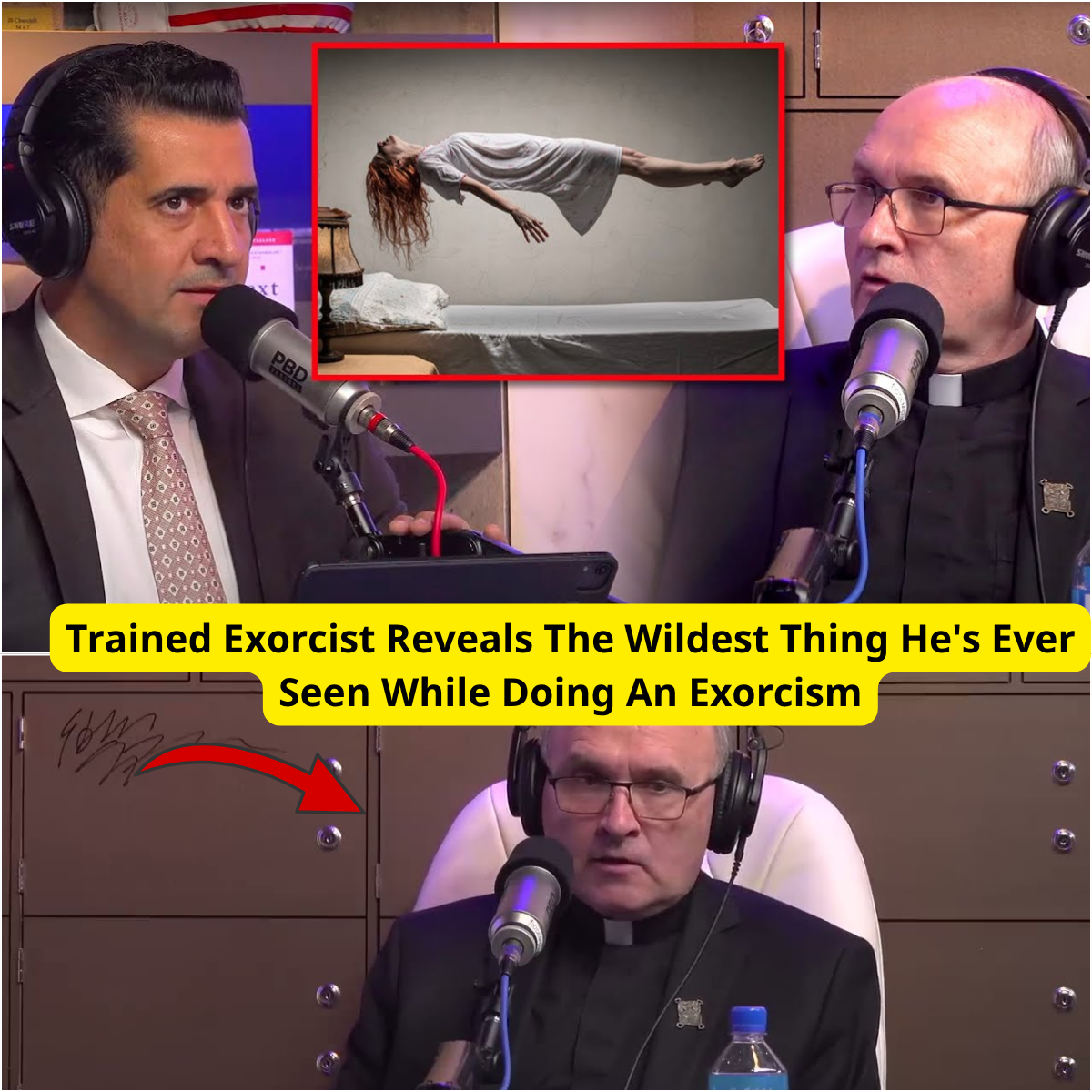
Trained Exorcist Reveals The Wildest Thing He’s Ever Seen While Doing An Exorcism
Trained Exorcist Reveals The Wildest Thing He’s Ever Seen While Doing An Exorcism
Chapter 1: The Protocol of Doubt
The blinds in Father Thomas’s modest parish office in Chicago were turned just enough to let the gray afternoon light slice across the cheap linoleum floor. On his desk sat two thick manila folders. To a layman, they might have looked like legal briefs or corporate audits. To Father Thomas, they were the standard armor of an investigator who specialized in things most people spent their entire lives trying to ignore.
Across from him sat Dr. Alan Miller, a chief psychiatrist from Northwestern Memorial Hospital. Alan was a man of cold metrics, a lifelong skeptic who wore his rationality like a perfectly tailored suit. He rubbed his temples, staring at the files.
“I’ve run every diagnostic protocol in the DSM-5, Thomas,” Alan said, his voice flat, rhythmic, and steeped in academic certainty. “The patient, Sarah Vance, exhibits severe manic-depressive fluctuations, auditory hallucinations, and a profound somatic delusion. She’s convinced her body is no longer her own. I’m recommending a locked inpatient facility and an aggressive course of anti-psychotics.”
Father Thomas leaned back in his leather chair, a faint, weary smile playing beneath his silver-flecked beard. He didn’t push back. He didn’t lecture.
“And her physical examination, Alan? What did the medical team say?”
“Completely normal,” Alan sighed, tossing a second packet onto the desk. “No neurological lesions, no hidden toxicological panels, no organic brain disorders. She’s physically healthy, but mentally shattered. Which is exactly why I’m telling you, as a friend and a scientist, that performing a religious ritual on this woman will cause catastrophic psychological harm. You’ll be validating her delusion. You’ll be labeling her as a monster.”
Father Thomas picked up the gold pen on his desk, rolling it between his fingers.
“An exorcist must be the ultimate skeptic, Alan,” the priest said softly. His tone was devoid of the theatrical fervor one might expect from Hollywood cinema. “I should be the very last person in the room to believe that someone is truly dealing with extraordinary demonic activity. Every other possible explanation—medical, psychiatric, sociological—must be utterly exhausted first. If I leap to a supernatural conclusion, I fail as a priest, and I fail the human being sitting in front of me.”
Alan tilted his head, surprised by the candor. “Then why haven’t you signed off on the commitment papers?”
“Because ninety-nine percent of the people who call my office have already self-diagnosed,” Thomas explained, leaning forward. “They call me sobbing, screaming that they are possessed, demanding an immediate exorcism. And ninety-nine percent of the time, my answer is a firm, compassionate no. They are suffering from schizophrenia, severe bipolar disorder, trauma, or substance abuse. The church does profound harm if we mislabel medical illness as spiritual warfare.”
“But what about the other one percent?” Alan asked, his eyes narrowing.
Father Thomas stood up, reaching for a purple silk stole draped over the back of his chair. “The other one percent is why I spent a year in Rome under a Franciscan friar named Father Carmine. I sat in on forty real exorcisms in a damp stone basement near the Tiber. I’m a skeptic by training, Alan. But I am also a man who has seen the metrics of science entirely collapse. Come with me to the chapel. See for yourself. Be my clinical observer.”
Chapter 2: The First Manifestation
The basement chapel beneath the parish church was a stark contrast to the ornate nave upstairs. There were no stained-glass windows, no soaring vaulted ceilings. It was a functional, utilitarian space containing a heavy wooden table, a few metal folding chairs, and an old iron radiator that clanked rhythmically against the damp stone wall.
Sarah Vance sat in the center chair. She was a diminutive woman in her early thirties, her face drawn, hollowed out by months of sleeplessness. Her husband, David, stood close behind her, his hands resting heavily on her trembling shoulders.
Alan sat in a folding chair in the far corner, a clipboard balanced on his knee, his pen poised like a weapon of defense. To him, this was a clinical observation of a primitive psychodrama.
Father Thomas entered the room carrying a standard brown paper bag. Without a word, he pulled out a roll of paper towels and placed it squarely on the center of the wooden table. Then, he walked to the wall radiator and tied a common, crinkling plastic grocery bag to the iron valve.
Alan frowned, making a quick note on his pad: Theatrical staging? Pre-ritual conditioning?
Thomas didn’t look at the psychiatrist. He draped the purple stole around his neck—the ancient, formal symbol of his priestly authority. In his right hand, he held a small leather-bound volume: the De Exorcizandis Obsessis a Daemonio. In his left, a small glass vial of blessed water.
Thomas stepped in front of Sarah. Her eyes were glazed, staring at the floor in a catatonic stupor that Alan had seen a hundred times in psychiatric wards.
“Peace be to this house, and to all who dwell herein,” Father Thomas intoned, his voice dropping into a deep, commanding resonance.
He unstopped the vial, dipped his fingers into the water, and flicked a few sharp drops onto Sarah’s forehead.
The transition was instantaneous, violent, and utterly devoid of a logical medical ramp-up.
Sarah’s body didn’t just flinch; it convulsed with a terrifying, elastic force. Her head snapped backward with an audible crack, her eyes rolling so far into the back of her skull that only the stark, veiny whites were visible. A thick, yellowish froth began to bubble rapidly from her lips, spilling down her chin.
From the throat of this ninety-pound woman erupted a sound that made Alan’s pen slice clean through his notepad. It wasn’t a human scream. It was a low, guttural, multi-tonal snarl—like a predatory animal trapped inside a metallic chamber.
“Thomas!” the voice roared, a bass frequency that caused the glass light fixtures in the ceiling to hum. “The arrogant little mechanic from Scranton. You think your little purple cloth can hide the rot in your own lineage?“
Sarah’s face distorted into a mask of pure, unadulterated malice. She began spitting a torrent of highly sophisticated, articulate blasphemies, shifting effortlessly between archaic Latin and an obscenity-laced English, hurling personal, intimate details about Thomas’s childhood and Alan’s private failures at the hospital—details a stranger could couldn’t possibly know.
Alan’s breath caught in his throat. His professional detachment shattered. His fingers gripped the edges of his clipboard so hard the plastic cracked. His mind scrambled for a diagnostic label—tourette’s? hyper-religiocentric psychosis? high-functioning hysteria?—but the sheer speed and specific intelligence of the hostility defied the slow degradation of a typical psychiatric episode.
Father Thomas didn’t flinch. He didn’t even look up from his book. He calmly tore a sheet of paper towel from the roll on the table, wiped the foam from Sarah’s lips so she wouldn’t choke, and tossed the soiled paper into the plastic bag on the radiator.
The mundane, domestic nature of his movements was more shocking to Alan than the horror of the manifestation. This wasn’t a Hollywood show. It was a tedious, exhausting, and precise operation.
Chapter 3: The Defiance of Gravity
“We proceed,” Father Thomas whispered, looking directly at Alan, his eyes entirely steady. “Keep your focus, Doctor. Watch the patient, not the performance.”
Hour two of the ritual turned the basement chapel into a claustrophobic furnace. The air grew thick, hot, and smelled faintly of sulfur and stale sweat. Sarah’s voice had degenerated into a rhythmic, mocking chant, an endless loop designed to break the concentration of the priest. David, her husband, was weeping silently, his hands raw from holding her down during her violent thrashing.
Thomas turned the page of the Latin text, his voice raspy but unyielding. He stepped closer, placing the edge of his stole over Sarah’s head.
“I command you, unclean spirit, by the living God, by the true God, by the holy God…“
The chanting from Sarah’s throat stopped instantly. The silence that followed was heavy, pressurized, and unnatural.
Alan watched through his glasses, his medical training forcing him to document every detail. What happened next, however, completely severed his connection to the rational world.
Sarah Vance didn’t slide out of her chair. She didn’t jump.
With a smooth, slow, and linear motion, her entire body began to ascend. The wooden legs of her chair screeched briefly against the linoleum as the center of gravity shifted. Then, the chair remained firmly on the ground, but Sarah’s torso, hips, and legs rose directly into the air.
Alan stood up, his folding chair clattering backward against the wall. He rubbed his eyes, leaning forward, searching frantically for the trick. He looked up at the ceiling for wires, looked beneath the chair for a hidden hydraulic lift, looked at the husband to see if he was hoisting her up. There was nothing.
Sarah Vance was hovering exactly twelve inches off the seat of her chair, suspended in mid-air by an invisible, defying force. Her limbs were completely rigid, her back arched like a bow, her white-rimmed eyes fixed on the ceiling.
Alan’s mind plunged into a chaotic, terrifying void. He knew the laws of physics. He knew mass, gravity, and acceleration. A human body cannot levitate. It was a parlor trick—it had to be a parlor trick. Like David Copperfield, like a stage illusionist using hidden mirrors or thin carbon-fiber threads. But this was a damp parish basement with no stage crew, no lighting design, and no profit motive.
He looked at Father Thomas, expecting the priest to cry out, to call for backup, to manifest the triumphant shock of a man proving a miracle.
Instead, Father Thomas simply sighed.
Without breaking his stride, without pausing for even a single syllable in his Latin prayer, Thomas glanced briefly at the floating woman, looked down at his book to finish his sentence, and then looked back up. With an expression of profound, almost bored irritation—the look of a teacher dealing with a disruptive child—Thomas reached out his right hand.
He placed his palm firmly on the top of Sarah’s head.
With a single, deliberate, downward shove, Father Thomas pushed her back down into the wooden chair.
Sarah’s body hit the seat with a dull, heavy thud. The invisible force snapped, and she collapsed forward, gasping for air, her consciousness suddenly rushing back into her eyes as the demonic presence receded into the shadows of her mind.
Thomas never stopped praying. He adjusted his stole, turned the page of his manual, and continued the Latin text as if he had done nothing more remarkable than closing a window against a draft.
Chapter 4: The Flamboyant Illusion
The ritual concluded at dawn. Sarah, exhausted but completely lucid, was sleeping peacefully on a small cot in the adjoining church vestry, her husband holding her hand.
Alan and Father Thomas sat on the steps of the church entrance, watching the first orange rays of the Chicago sun melt the frost on the parked cars. Alan’s clipboard lay forgotten on the stone step beside him. His hands were shaking slightly as he held a paper cup of lukewarm black coffee.
“I don’t know what to write in the medical file,” Alan said, his voice stripped of its academic authority. “If I report what I saw… I’ll be laughed out of the psychiatric board. They’ll say I experienced a shared hallucination. A mass psychosis.”
“Then don’t write it,” Thomas said gently, taking a sip of his own coffee. “Write that the patient exhibited a severe, unclassified psychological crisis that proved unresponsive to standard sedation but achieved clinical stabilization through religious-centric therapeutic intervention. Protect the patient, Alan. That’s why the church never videotapes these things. It’s not a parlor trick to be consumed by the public. It’s a medical and spiritual liberation of a human soul.”
Alan looked up, his brow furrowing as a thought occurred to him. “But Thomas… if this is real, if this power exists, why is the public face of this ministry so… ridiculous? I’ve seen those televangelists on late-night TV. Bob Larson, the guys who go on stage with the microphones, shouting, screaming, doing these flamboyant shows with the daughters, making people fall over on cue. If you guys have this quiet, devastating authority, why does the world only see the circus?”
Father Thomas let out a soft, dry chuckle, shaking his head.
“Flamboyant showmanship is precisely why nobody believes in true exorcism, Alan,” Thomas said, his face turning serious. “Guys like that are the reason the modern world laughs at the concept of evil. They turn a solemn, grueling ministry of mercy into a commercial product. They feed on the optics, the drama, the money, and the fame. True demonic activity doesn’t want a spotlight; it wants to hide in the quiet, ordinary corners of your life, making you think it doesn’t exist so it can destroy you slowly.”
He turned to look directly at the psychiatrist. “An exorcist doesn’t enter the room to put on a show. We don’t scream, we don’t perform for an audience, and we certainly don’t invite cameras. We enter as skeptics, armed with the sobriety of science and the unshakeable, quiet authority of Christ. The demon in that room didn’t look at me and see a powerful man. It looked at me and saw the Church. And the Church doesn’t need a circus to push a shadow back into the dark.”
Chapter 5: The Metric of Peace
Alan stared down at his coffee, the silence between them stretching long and comfortable as the city of Chicago began to wake up around them. Buses rumbled in the distance; people in business suits hurried down the sidewalk, entirely unaware of the war that had just been fought beneath their feet.
“You pushed her down,” Alan whispered, a sudden, lingering smile of disbelief breaking through his exhaustion. “You didn’t even look up from your book for more than a second. You just… pushed her back into the chair like she was a misbehaving kid.”
“Father Carmine taught me that in Rome,” Thomas smiled, his eyes crinkling at the memory. “The forty exorcisms I watched him perform—he taught me that the enemy’s greatest weapon is distraction. The levitation, the foaming, the ancient languages—it’s all spiritual smoke and mirrors. It’s an attempt to make the priest panic, to make him look away from Christ, to make him focus on the terrifying nature of the manifestation rather than the absolute authority of the Creator.”
He stood up, stretching his tired back, the purple stole now neatly folded over his arm.
“When you realize that Christ has absolute, effortless power over the invisible world, a person rising a foot out of their chair isn’t a terrifying miracle, Alan. It’s an annoyance. It’s an interruption to a prayer. So you push them down, you keep your back to the theater, and you finish the work.”
Alan stood up beside him, picking up his cracked clipboard. He looked at the church doors, then out at the busy street. He was still a scientist, still a man who believed in medicine, in chemistry, and in the intricate architecture of the human brain.
But as he walked down the stone steps toward his car, he realized his metric for the universe had permanently changed. He had arrived at the church seeking a diagnosis for a broken mind, but he left having witnessed a profound, unshakeable peace—a metric that couldn’t be captured on a chart, but could turn the darkest, gravity-defying terrors of the night into nothing more than a shadow that must obey a simple command to sit down.