Wes Huff’s Quran Challenge Ignites U.S. Faith War as Muslim Defenders Rush to Answer
Wes Huff’s Quran Challenge Ignites U.S. Faith War as Muslim Defenders Rush to Answer
Dallas, Texas — A new Christian apologetics clip has exploded across American faith media after scholar and speaker Wes Huff laid out what he called three of the biggest problems facing Islam’s scripture — and triggered a fierce response from Muslim defenders online.
The debate is not merely about religion. It has become a battle over history, textual preservation, the crucifixion of Jesus, and whether the Quran can survive the same critical pressure often applied to the Bible.
At the center of the controversy is one claim that lands like a grenade in Christian–Muslim dialogue: if the crucifixion of Jesus is one of the most secure facts in ancient history, what happens to a scripture that appears to deny it?
Huff’s argument begins there.
Speaking before an audience, he argued that the Quran, written roughly six centuries after Jesus, claims to describe many of the same figures and events found in the Bible, yet repeatedly departs from them in ways he says damage its historical credibility. His first and most explosive example is Quran 4:157, a verse often understood by Muslims to deny that Jesus was killed by crucifixion.
For Christians, this is not a minor detail. The crucifixion is the foundation of salvation theology. Jesus dies, bears sin, and rises again. Without the cross, Christianity loses its center.
But Huff’s point goes beyond Christian doctrine. He argues that even many skeptical, secular, and non-Christian scholars accept that Jesus was crucified under Pontius Pilate. In other words, Huff is not simply saying, “The Bible says it.” He is saying history says it, too.
That is why the clip has gone viral.
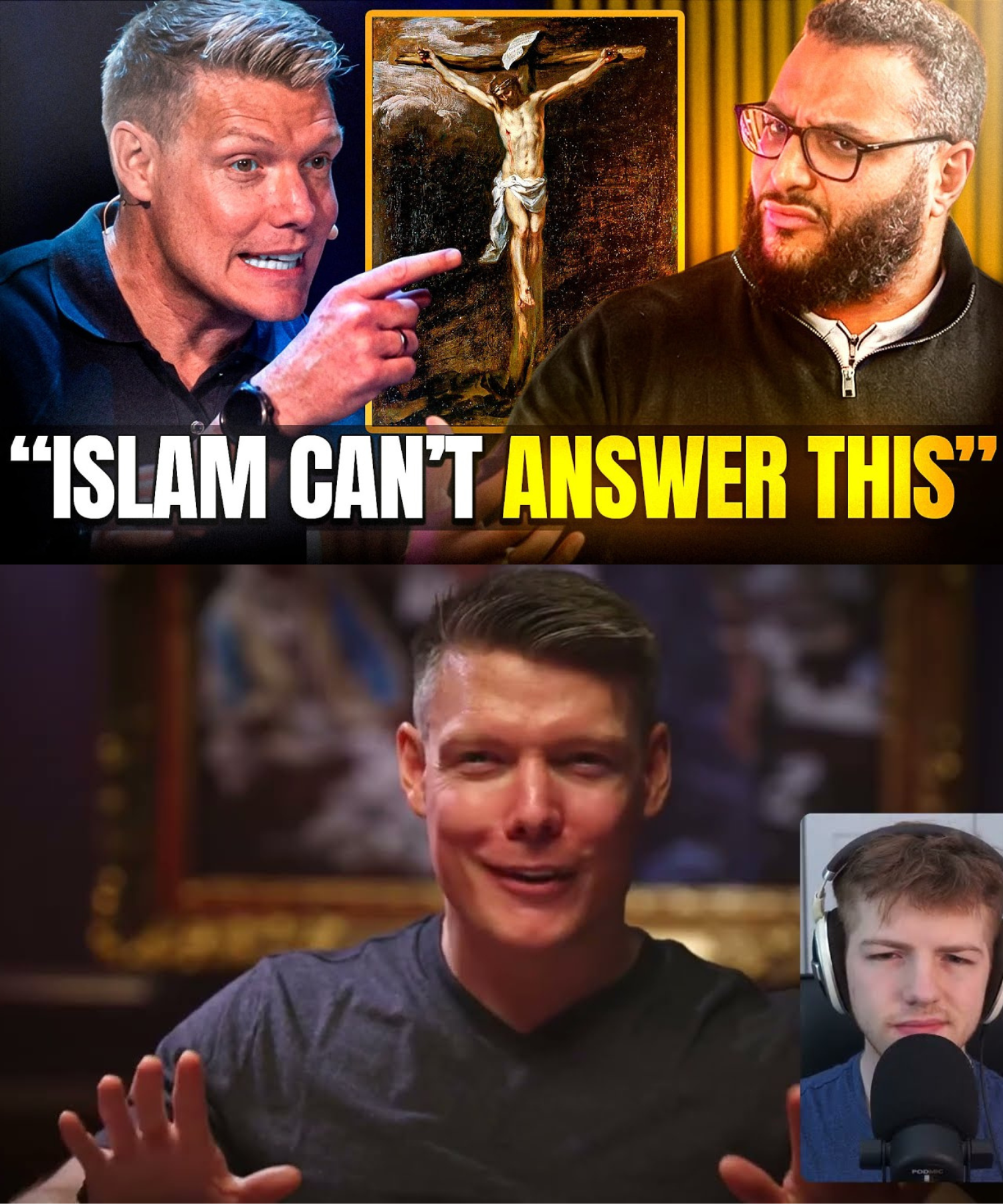
For Christian viewers, Huff appears to put Islam in a corner: either the Quran is denying a historically established event, or Muslims must reinterpret the verse in a way that departs from centuries of popular understanding.
For Muslim defenders, the argument is incomplete. Some insist the Quran does not deny that Jesus was placed on a cross, only that his enemies successfully killed him. Others defend the classic view that God made it appear so while saving Jesus. Still others argue that history itself is not neutral and that Christian claims shaped later sources.
But Huff’s second argument may be even more dangerous for Islamic apologetics.
He points to Quranic passages that speak positively of the Torah and the Gospel, describing them as guidance and light. The Quran, in his reading, tells Christians to judge by what God gave them in the Gospel. Huff says that if he obeys that command and judges the Quran by the Gospel, the Quran fails — because it denies the central claims of the Gospel itself.
That is what he calls the dilemma.
If the Gospel available to Christians was trustworthy, then the Quran contradicts it. If the Gospel was corrupted before Muhammad, then Muslims must prove when, where, and how that corruption happened. Huff’s challenge is that Christians in Muhammad’s era had Gospel texts substantially similar to those Christians read today. If that is true, then the claim of a lost, original, Islamic-friendly Gospel becomes historically fragile.
This is where Muhammad Hijab enters the debate.
Hijab’s response is direct: the Quran is not telling Christians to judge the Quran by a corrupted Gospel. It is affirming the original revelation and functioning as a guardian over what came before. In his framing, the Torah and Gospel were once divine revelations, but Jews and Christians failed to preserve them correctly. Therefore, the Quran becomes the criterion by which truth and corruption are separated.
To Muslim audiences, that answer may sound familiar and strong.
To Huff and his supporters, it simply pushes the question back one step.
When exactly were the Christian Scriptures corrupted? If sixth- and seventh-century Gospel manuscripts already match the core New Testament Christians possess today, then the corruption argument must produce evidence, not assumption.
That is the pressure point.
The third charge is about apocryphal stories.
Huff argues that the Quran contains narratives about Jesus and other biblical figures that resemble later legendary stories rather than the earliest Christian sources. One example often cited in Christian apologetics is the story of Jesus creating birds from clay and breathing life into them — a story also known from later infancy traditions. Huff argues that such material looks less like divine correction and more like oral legends circulating in late antique religious environments.
He also points to alleged conflations involving biblical characters, including Haman appearing in the Pharaoh story rather than in the Persian context associated with Esther. To Christian critics, these examples suggest confusion. To Muslim defenders, such claims are often answered through alternate historical reconstructions, different identifications, or the argument that the Quran is correcting corrupted Jewish and Christian narratives.
But the force of Huff’s presentation lies in accumulation.
First, the crucifixion. Then, the Gospel dilemma. Then, apocryphal material. Then, preservation.
By the time he turns to the Quran’s own transmission history, the audience is already primed. Huff argues that standardizing the Quran under Uthman was not the same thing as proving perfect preservation. If multiple recitations or written collections existed and competing versions were destroyed, then one version becoming dominant does not automatically prove nothing was lost or altered. It proves a text was controlled.
That charge cuts directly against one of Islam’s strongest popular claims: that the Quran has been perfectly preserved while the Bible has been corrupted.
Muslim scholars and apologists reject the framing. They argue that the Quran’s preservation includes oral transmission, communal memorization, controlled recitation, and early standardization. They say Christian critics misunderstand what variant readings mean and impose Western textual criticism categories onto Islamic tradition in a misleading way.
Still, the clip has found a huge American audience because it lands in a country already experiencing a religious information revolution.
A Muslim teenager in Michigan, a Christian college student in Texas, an ex-Muslim in California, a pastor in Florida, and a skeptic in New York can now watch the same arguments in real time. The old walls between mosque, church, university, and private doubt are collapsing. The internet has turned theology into public combat.
That is why both sides are fighting so fiercely.
For Christians, Huff’s argument is not simply anti-Islamic polemic. It is framed as a defense of the historical Jesus. The cross happened. The Gospel has been preserved. The Quran arrived later and contradicts the earlier record.
For Muslims, the stakes are just as high. If the Quran is the final revelation, then it must be allowed to correct what came before. Christian sources cannot be treated as neutral judges when Christians themselves believe doctrines Islam rejects.
The final section of the transcript shifts to Islam’s growth.
Huff argues that growth does not prove truth. Islam, in his view, has a social and political component that helps it expand. He contrasts that with early Christianity, which he frames as a movement built not on conquest, but on a crucified Messiah, martyrdom, evangelism, and the willingness to suffer.
Muslims will dispute that contrast, arguing that Islamic civilization, charity, scholarship, family structure, worship, and spiritual discipline are major reasons for Islam’s endurance and growth. They will also point to Christian political empires, crusades, colonialism, and state power to challenge the claim that Christianity is historically free of political force.
But the argument has already caught fire.
In America, the question is no longer whether Christians and Muslims disagree. Everyone knows they do. The question is which side can defend its claims under scrutiny.
Huff’s viral challenge has reopened the fight at the deepest level:
Was Jesus crucified?
Can the Gospel be trusted?
Was the Quran preserved?
And if the Quran tells Christians to judge by the Gospel, what happens when Christians do exactly that?
For millions watching online, this is no longer an academic debate.
It is a battle over truth itself.