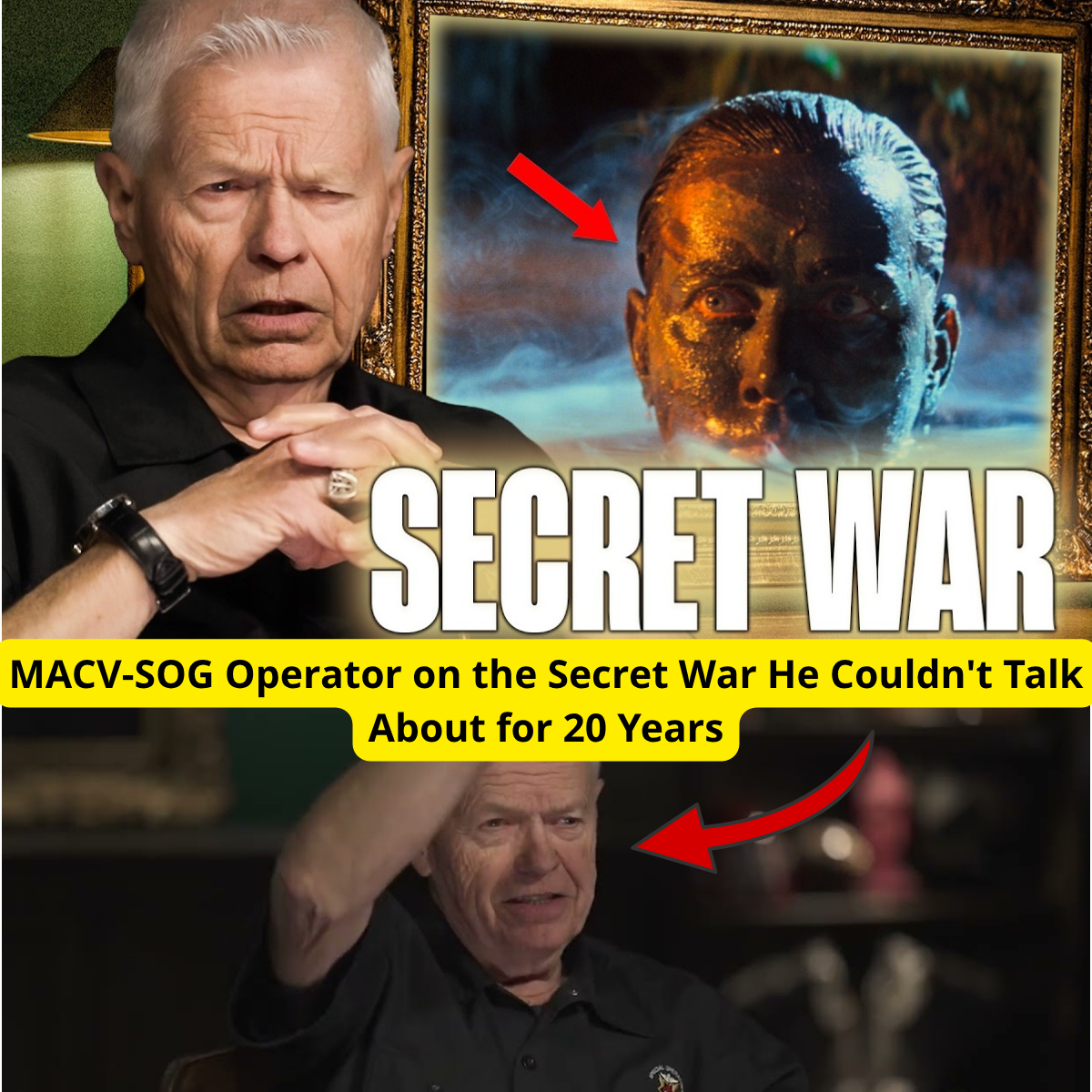
MACV-SOG Operator on the Secret War He Couldn’t Talk About for 20 Years
MACV-SOG Operator on the Secret War He Couldn’t Talk About for 20 Years
The morning sun had not yet broken over the razor wire at Da Nang, but inside the briefing room, the humidity was already thick enough to rust steel. A dozen young men, fresh out of the training group with crisp, starched jungle fatigues and boots that still smelled of factory leather, sat in folding chairs. Up front, heavy olive-drab curtains sealed the windows, and a canvas sheet draped a large, rectangular frame against the wall.
John “Tilt” Stryker Meyer adjusted his notepad on his knee. He and his buddy, Johnny McIntyre, had been professional students for over a year, shifting from basic training to jump school, then deep into the brutal mechanics of Special Forces qualification. They were accustomed to notebooks, lectures, and precise procedures.
The door banged open. A Sergeant Major walked in, his face looking as though it had been carved out of dry river stone. He didn’t look at them; he looked through them.
“Put that shit away,” he said, his voice a low, raspy gravel that instantly froze the room.
Pads and pens vanished into pockets.
“This is a top-secret briefing,” the Sergeant Major continued, leaning heavily on the podium. He reached into a folder and tossed a stack of identical papers onto the front table. “Right in front of you, there is an NDA—a Non-Disclosure Agreement. Read it. If you want to stay, sign it. If you want to leave, you are welcome to walk right out that door. There are no hard feelings. But if you sit in these chairs, you belong to the mission.”
He paused, letting the silence sweat. “Because this is a top-secret briefing.”
Tilt picked up the document. The text was dense, military-legal jargon, but the core of it was razor-sharp. It was a twenty-year vow of absolute silence. If you spoke, if you wrote, if you took a single photograph of what you saw past the wire, you wouldn’t just be court-martialed; you would face federal prosecution, astronomical fines, and decades in a federal penitentiary.
The Sergeant Major stepped closer to the front row. “Read those carefully. You can’t talk to your mama. You can’t talk to your girlfriend. You can’t talk to anybody. No pictures, no diaries, no nothing. You don’t discuss this mission with a living soul unless it’s another man working on your specific base. Welcome to the secret war, gentlemen. Your reports go directly to the White House.”
Tilt didn’t look at McIntyre. He simply gripped his pen, signed his name at the bottom of the parchment, and passed it forward. Every man in the room did the same.
The Sergeant Major walked over to the wall and yanked the sheet off the map.
Act I: The Target Boxes
The map was a massive, detailed rendering of Southeast Asia, but it wasn’t partitioned by standard military boundaries. It showed South Vietnam divided into its four military regions—the rugged, mountainous I Corps up north; the wide highlands of II Corps stretching from Kontum down to the beaches of Nha Trang; III Corps surrounding the strategic hub of Saigon; and IV Corps, a brutal, miserable labyrinth of swamps and waterways in the southern delta.
But Tilt’s eyes weren’t drawn to the corps boundaries. They were drawn to a string of red, six-by-six-kilometer squares aligned like teeth along the western borders.
“These are target boxes,” the Sergeant Major explained, tracing his finger along the blank space west of the line. “All the way up and down the frontier. And as you can see, they sit inside Laos and Cambodia. This is what we do. We go across the fence.”
The room grew colder despite the heat. Going “across the fence” meant operating where the United States government officially claimed no American soldiers set foot.
“You’ll run top-secret operations under the banner of SOG—Studies and Observations Group,” the Sergeant Major said. “You’ll either be with a recon team or a Hatchet Force. A recon team is a small knife—two or three Americans, acting as the team leader and the one-one, controlling four to six indigenous personnel. They could be Montagnards, South Vietnamese, Nungs, or Cambodians. You slide in, you watch the Ho Chi Minh Trail, you gather intelligence, and you slip out. A Hatchet Force is your hammer—a platoon or company-sized operation led by Green Berets for each squad, designed to go in when a recon team hits the horn.”
The next morning, the reality of the briefing materialized on a hot tarmac. Tilt, McIntyre, and another new arrival, John Hodgkins, were led toward a helicopter that looked like a relic from a previous era.
It wasn’t an American Huey. It was an H-34 Kingbee, operated by the South Vietnamese Air Force. Developed during the Korean War and built by Sikorsky, it was a massive, rounded beast powered by a nine-cylinder B-17 rotary engine. The fuselage was built so strangely that the pilots essentially sat directly on top of the massive engine block.
Tilt climbed into the rear passenger compartment through the single cargo door on the right side. Sitting down on the canvas bench, he looked up through the internal framing and could literally see the pilot’s boots resting on the rudder pedals.
A South Vietnamese pilot, wearing an oversized helmet and a cigarette dangling from his lip, looked back into the cabin and grinned at the three Americans. Tilt knew what they looked like—”green pukes” with perfect, unsoiled uniforms and unmarred boots.
The radial engine roared to life with a violent, coughing smoke trail, vibrating the entire metal frame until Tilt’s teeth clicked together. They rose into the humid air, banking heavily as they began tracking Highway One toward FOB 1—Forward Operating Base 1—near Phu Bai.
The flight was smooth for the first twenty minutes, tracking the coastal flats and passing the sprawling tarmac of the Phu Bai airport and the training grounds of the 2nd ARVN Division. Tilt was just beginning to relax when the world suddenly went completely sideways.
Without warning, the helicopter pitched into a violent, ninety-degree bank, throwing Tilt against the cargo webbing. Through the open door, he found himself looking straight down at the green canopy of the jungle floor spinning beneath them. The pilot executed a tight, pulling three-hundred-and-sixty-degree spiral toward a clearing below.
McIntyre and Hodgkins were white-knuckled, grabbing the structural ribs of the airframe, their eyes wide with the sudden terror of an imminent crash. “What the fuck is going on?” McIntyre yelled over the engine roar.
The Vietnamese door gunner, hanging out into the slipstream by a single tether, turned around and flashed a brilliant, gold-toothed smile, giving them a thumbs-up. “We got him!” he shouted over the wind.
They weren’t being shot down; they were landing.
Act II: Spike Team Idaho
The Kingbee bounced onto the dirt pad of FOB 1, kicking up a blinding storm of red dust. As Tilt and his team unbuckled and scrambled out of the side door, another unit was already waiting on the perimeter of the pad, their gear heavily camouflaged, their faces painted in jagged green and black lines.
It was Spike Team Idaho.
Tilt locked eyes for a split second with the team leader, Glenn Lane, a veteran whose eyes had the flat, hollow look of a man who lived on the other side of the fence. Beside him was Robert Owen, the assistant team leader, followed by six indigenous Montagnard tribesmen carrying cut-down CAR-15 rifles.
Idaho didn’t wait for the dust to settle. They loaded into the vibrating bay of the Kingbee before Tilt’s boots had even cleared the perimeter. The helicopter lifted back into the sky, banking west toward the blue-gray ridges of the Laotian border.
They took off, and within the hour, Spike Team Idaho vanished from the face of the earth.
Tilt carried his duffel bag down the long dirt pathway of the compound. To his right, the high wire fence of the adjacent ARVN compound stretched into the brush. He reported into the S1 supply shack to sign the base log. As he stepped back out into the blistering noon heat, a familiar voice cut through the compound chatter.
“Tilt-Meyer! You son of a bitch!”
Tilt turned. Walking toward him was “Spider” Parks, a lean, sunburned Green Beret with his sleeves rolled up.
“Holy shit, Spider,” Tilt laughed, shaking his hand. “You’re here?”
They had gone through the Special Forces training group together back in the States. Spider had been in A Company with Tilt, while Johnny McIntyre had been in B Company.
Spider immediately turned to McIntyre, a massive grin on his face. “Look at this B Company puke,” Spider ribbed, nudging Tilt. “Hey McIntyre, remember when our A Company softball team beat you guys in every single game? That’s because we had a real pitcher.”
McIntyre groaned, but the tension of the arrival broke. Spider took them on a quick tour of the small, heavily fortified base, pointing out the S3 operations shack, the bunkers, and the mess hall. When the supply sergeant tried to assign Tilt to a general transient barracks room, Spider intercepted the order.
“No way,” Spider told the sergeant. “He’s staying with me. Us A Company guys gotta stick together. The B Company pukes can sleep down the line.”
After a quick lunch of warm rations, Spider stood up from the wooden bench, his demeanor shifting back to the quiet alertness that defined the veterans of FOB 1. “I’m heading over to S3 to check the radios,” he said to Tilt. “Come along. You can meet the guys running the boards.”
They walked into the dimly lit operations room, where the static of high-frequency radios hummed from several speakers. Men sat over maps, their faces illuminated by small desk lamps, headsets pressed tightly to their ears.
Spider walked up to the tactical board. “We’re monitoring Idaho’s progress,” he muttered. He looked at the radio operator, who was tuning a dial through empty, rushing static. “Anything?”
The operator shook his head. “Nothing since the insertion drop, Spider.”
Tilt stood in the corner of the room, watching the red grease pencil marks on the plastic map overlay. They never heard from Spike Team Idaho again. No radio clicks, no emergency beacons, no wreckage. The jungle simply closed over them.
Act III: Into the Crater
Two days later, the base was thick with a grim, defensive energy. Spike Team Oregon was ordered to launch an immediate combat search and rescue mission to the last known coordinates of Idaho’s insertion.
The team was led by George Sternberg and Mike Tucker, accompanied by six indigenous personnel. They flew out on a flight of Kingbees, descending directly into the same clearing where Idaho had vanished forty-eight hours prior.
Tilt stayed by the radio room at FOB 1, listening to the fractured, frantic comms as Oregon hit the ground.
The grass in the landing zone was high, but Sternberg immediately spotted broken stalks and heavy boot tracks leading toward a tree line. They began to move, tracking the signs through the dense growth, attempting to locate any sign of their missing brothers.
They didn’t move more than a few hundred yards before the world dissolved into gunfire.
An NVA lookout post on a distant ridge had spotted the insertion. The North Vietnamese Army wasn’t just waiting; they were hunting. Within minutes, heavy automatic weapons fire opened up from three sides, cutting off Oregon’s route back to the clearing.
“Contact! Contact!” the radio blasted into the S3 shack, the background filled with the tearing-linoleum sound of AK-47s.
Sternberg rallied his men, pulling the team back into a massive B-52 bomb crater that scarred the center of the ridge. The steep earth walls of the crater provided the only cover against the intersecting fields of fire, turning the dirt pit into an improvised fortress.
The firefight escalated with terrifying speed. NVA regular troops swarmed the rim of the crater, firing downward. Oregon fought back, their CAR-15s roaring in short, controlled bursts, while tactical air support scratched the sky overhead, dropping ordnance along the ridge line to keep the enemy from overrunning the position.
Then the grenades started coming.
The NVA began lobbing fragmentation grenades directly down into the bowl of the crater. But they weren’t just using their own Chinese-made ordnance; they were throwing captured American M26 grenades back at the team.
George Sternberg stood in the center of the smoke and loose dirt, his reflexes honed by pure survival instinct. He watched a grenade arc over the rim, land in the dust, and sizzle. He lunged forward, scooped the hot metal up with his bare hand, and whipped it back over the lip of the crater before it detonated.
Seconds later, another cylinder tumbled down the dirt wall. Mike Tucker dove for it, kicking it free or throwing it out, his movements a blur of adrenaline.
Then came the third. It cleared the lip and rolled deep into the bottom of the crater, settling into the loose shale near the feet of the team’s medic.
Tucker lunged, but the fuse was too short. He couldn’t reach it in time.
The explosion inside the confined dirt walls was deafening. The blast wave slammed Sternberg against the earth. When the smoke cleared, the medic lay severely wounded, paralyzed from the waist down by the shrapnel that had ripped through his lower spine. The force of the detonation had been so violent it had literally blown the jungle boots clean off Mike Tucker’s feet, leaving him bleeding and dazed in the dirt.
Act IV: The Chase Ship
Through the radio speakers at FOB 1, Tilt could hear the frantic coordination of the extraction. The first Kingbee rolled out of the sky, ignoring the small-arms fire clipping through its rotor blades. The pilot held the ship steady above the crater rim while Sternberg and Tucker dragged the paralyzed medic and the worst of the wounded up the dirt embankment, hoisting them into the passenger cabin.
The helicopter lifted off, its tail rotor smoking as it cleared the trees.
A second Kingbee broke through the smoke to take the remaining men. The firefight had degraded into a point-blank melee. It was down to George Sternberg and two indigenous troops, holding the rim with empty magazines while tactical air support laid down a wall of napalm just fifty yards away.
Sternberg, a left-handed shooter, hauled the last wounded indigenous soldier toward the open door of the hovering helicopter. As he turned back around to secure his own retreat, a North Vietnamese soldier rose from the brush right at the lip of the crater, his AK-47 leveled directly at Sternberg’s chest.
The NVA soldier fired. The rounds slammed into Sternberg, spinning him around.
But Sternberg didn’t drop. Fueled by shock and pure combat instinct, he pivoted on his heels, brought his CAR-15 up left-handed, and fired a burst that killed the enemy instantly. Before the body could hit the dirt, a second NVA soldier appeared behind the first. Sternberg shifted his weight, tracked the target, and dropped him into the brush with his remaining rounds.
He stumbled backward, falling into the bay of the Kingbee as the pilot yanked the collective and climbed vertically out of the hot zone.
George Sternberg never knew how close he had come to staying in that crater. The entire sequence had passed in a three-second blur of blood and cordite. But somebody else had seen it.
Spider Parks was up there. He was sitting in the open door of the third helicopter—the “Chase Ship”—which flew over every insertion to act as an emergency medic platform or rescue vessel if a primary ship went down. Looking through his binoculars from the high orbit, Spider had watched Sternberg take the hits, turn like a wounded lion, and eliminate both targets before collapsing into the bay.
Oregon was pulled out, their bodies broken but their lives intact. They would spend the next several months in military hospitals, slowly recuperating from the deep shrapnel wounds and bullet holes that marked their introduction to the target boxes.
Back at FOB 1, Tilt stood outside the S3 shack as the sun finally dipped below the western ridges, casting long, purple shadows across the compound. The dust on his boots was still fresh, but the starch in his uniform was completely gone. He looked toward the wire, toward the blank spaces on the map where Spike Team Idaho had gone.
The twenty-year NDA sat in a locker somewhere in Washington, an abstract promise of silence. But out here, past the fence, the silence didn’t need a signature to keep its secrets.