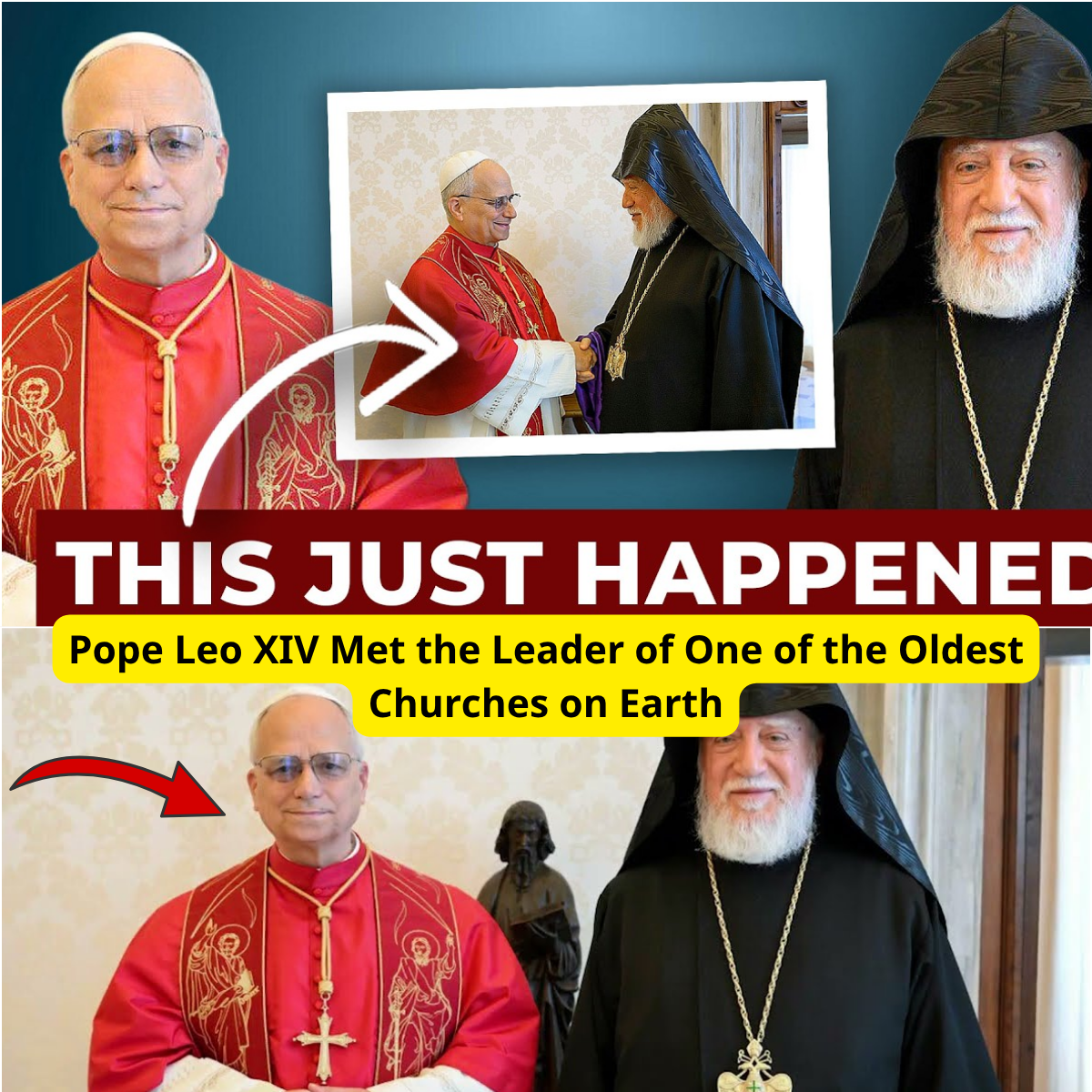
Pope Leo XIV Met the Leader of One of the Oldest Churches on Earth
Pope Leo XIV Met the Leader of One of the Oldest Churches on Earth
The light filtering through the stained glass of St. Jude’s Media Ministry office was a cool, washed-out blue, a sharp contrast to the harsh studio lighting Marcus had spent the last several hours under. It was late—past midnight on a warm May evening—and the steady rhythm of the spring rain against the brick wall outside provided a low, meditative bassline to the quiet room.
Marcus sat at his auxiliary workstation, his massive frame hunched over a legal pad covered in hasty scribbles, arrows, and Greek terms. He wasn’t broadcasting anymore, but the adrenaline of the night’s theological battle hadn’t completely left his system. Across the desk, David was meticulously packing up the secondary audio mixer into its road case, his movements slow and deliberate.
“You know, Marcus,” David said, breaking the silence without looking up from the foam inserts of the case. “The chat from that last segment… it didn’t just stay on politics. A lot of the guys were genuinely confused about the Armenian thing. One kid from Ohio kept insisting that if they split at Chalcedon over the nature of Christ, they’re technically monophysites—heretics who think Christ’s human nature was swallowed up by His divinity. He couldn’t wrap his head around why the Pope would roll out the red carpet for them.”
Marcus sighed, a heavy, rumbling sound that seemed to vibrate his chest. He reached over and tapped a printed transcript sitting on top of his stack of books. It was the official Vatican press release from the morning of May 18, 2026.
“That kid is fighting a war that’s fifteen hundred years old with a wooden sword, David,” Marcus said, his voice low but carrying that natural, gravelly authority. “He’s missing the forest for the trees. What happened inside the Vatican on Monday morning wasn’t a compromise of the faith. It was an awakening. It was two lungs of an ancient body breathing the same air for the first time in centuries.”
Marcus pulled his reading glasses down from his forehead, looking intently at the text.
“Let’s trace the geography of what actually happened. Pope Leo XIV received His Holiness Aram I, the Catholicos of the Great House of Cilicia. This isn’t just an institutional meet-and-greet. They didn’t just smile for the cameras, swap medals, and head to a buffet. After the formal speeches, they did something that should make every serious Christian stop and take off their shoes. They walked into the Urban VIII Chapel of the Apostolic Palace, closed the doors to the diplomats, and they knelt down and prayed together. Two ancient lines, two massive historic structures, one single voice ascending to heaven.”
Marcus stood up, his joints popping slightly as he walked over to a large framed map of the ancient Mediterranean hanging on the wall. He ran a thick index finger across the mountainous terrain of the South Caucasus down into the Levant.
“To understand the shockwaves of Monday morning, David, you have to realize who Aram I actually is and the staggering weight of the crown he wears. Think about the pedigree. Armenia was the first sovereign nation on the face of the earth to adopt Christianity as its official state religion. 301 AD. Not Rome under Constantine, not Constantinople—Armenia. King Tiridates III was converted by the preaching of St. Gregory the Illuminator. While the rest of the Roman Empire was still trying to figure out how to stop throwing Christians to the lions, an entire nation plunged into the baptismal waters and swore an oath to Christ that they have never broken.”
“But they did split at Chalcedon,” David noted, looking over Marcus’s shoulder at the map. “451 AD. That’s the classic dividing line.”
“Yes, 451,” Marcus nodded, his eyes fixed on the map. “The Council of Chalcedon defined that Christ exists in two distinct natures—fully God and fully man—without confusion, without change, without division, without separation. The Armenian bishops couldn’t make the council because they were fighting for their literal survival against the Persian Empire at the Battle of Avarayr. When the theological formulas finally filtered back to them in their own language, the terminology looked dangerous. It smelled like Nestorianism to them—like Christ was split into two different people. So they held fast to the phrasing of St. Cyril of Alexandria: the one incarnate nature of God the Word. We call it Miaphysitism.”
Marcus turned around, leaning his lower back against the map frame, his arms crossed over his chest.
“For fifteen hundred years, Rome and Constantinople looked at the Orientals and called them heretics. The Orientals looked back and called the West betrayers of the faith. But here is the beauty of the modern era, David—the part that the internet conspiracy theorists hate because it requires nuance. In recent decades, serious, grueling, face-to-face dialogue between Catholic and Oriental Orthodox theologians has revealed something miraculous. The massive canyon of 451 was primarily a tragedy of language and cultural translation, not a betrayal of divine truth. They weren’t flattening Christ’s humanity. They were trying to protect His absolute, personal unity. The faith was the same; the vocabulary was different.”
Marcus walked back to his desk, picking up the Vatican transcript and pointing to a highlighted paragraph.
“Look at where Aram I is forced to live today. There are two patriarchal seas for the Armenians. The historic, original seat is in Etchmiadzin, inside modern Armenia. But Aram leads the Catholicate of the Great House of Cilicia, based in Antelias, Lebanon. Why is his see in Lebanon, David? Because of the fire. His church is a church of the diaspora, composed of the sons and daughters of those who survived the systematic horrors of the 1915 Armenian Genocide. They were driven from their ancestral lands in what is now Turkey, marched into the Syrian desert, slaughtered by the hundreds of thousands, and scattered across the Middle East like dust. They rebuilt their altars in exile—in Beirut, Aleppo, Damascus, and Nicosia.”
Marcus’s voice dropped an octave, losing its sharp apologetic edge and taking on a tone of deep, historical reverence.
“Aram I has been the Catholicos since 1995. For over thirty years, this man has been leading an ancient flock in the most explosive, volatile region on the planet. He is a survivor among survivors. He didn’t lock himself in an ivory tower; he became a builder of bridges. He helped forge the Middle East Council of Churches, keeping the flickering flame of Christianity alive in lands where the Christian population has been steadily hunted, marginalized, and reduced to a fragile minority. When this man speaks, the dust of the martyrs is on his shoes.”
He turned a page of the transcript, his eyes flashing as he read the Pope’s response.
“And Pope Leo XIV didn’t treat him like a foreign diplomat. He called him ‘dear brother.’ He didn’t play institutional games. In his speech, the Pope pointed out something that feels like an intentional, divine design. St. Paul of Tarsus—the Apostle who shed more tears and wrote more letters for the unity of the early churches than anyone else—was born in Tarsus, which sits squarely within the historic borders of Cilicia, the exact region of Aram’s see. The Pope also invoked St. Nerses the Gracious, a twelfth-century Armenian Catholicos who spent his entire life trying to heal the breach between East and West. Leo recently added Nerses to the official Roman Martyrology. Think about that—Rome now officially recognizes an ancient Armenian patriarch as a saint in heaven. The Pope called it the ‘ecumenism of the saints.’ It’s a recognition that long before our human institutions figure out how to sign a contract, our martyrs and our holy men are already standing hand-in-hand before the throne of God.”
David pulled up a digital document on his laptop, scrolling through a list of ecumenical agreements. “They’ve actually been under a formal dialogue commission since 2003, right? I see three major documents listed here.”
“Exactly,” Marcus said, gesturing toward the laptop. “The Joint International Commission for Theological Dialogue. They’ve already published definitive, shared statements on the nature and mission of the Church, on the structure of communion in the first centuries, and on the theology of the sacraments. This isn’t cheap sentimentalism. It’s hard, rigorous intellectual labor. But look at what Pope Leo said right after praising that work. He didn’t sugarcoat the reality. He said, ‘There can be no restoration of communion between our churches without unity in faith.’“
Marcus smacked the desk with the flat of his palm, his eyes bright behind his glasses.
“That is the line that clears the room of the internet critics, David! The Pope isn’t playing the liberal ecumenical game where we pretend doctrine doesn’t matter and everyone just holds hands in a circle. He’s explicitly stating that true communion cannot be faked. If we don’t share the exact same apostolic deposit of faith, we can’t pretend we’re at the same altar. He’s acknowledging the deep, painful difficulties that still remain, but he’s refusing to walk away from the table because Christ commanded us to sit there.”
He leaned forward, his face growing serious as he looked at the geographic context of the meeting.
“And then you have the shadow of Lebanon hanging over the whole room. Remember, Aram’s cathedral is in Antelias. Lebanon is a country that has been trapped in a slow-motion car crash for years—total economic collapse, political paralysis that leaves the presidency vacant for months, the horrific psychological scars of the Beirut port explosion, and now immense external pressure threatening to rip the country’s stability to shreds. Pope Leo XIV went there last December. He called it a land dear to his heart. And on Monday, he looked Aram in the eye and issued a warning that hits like a physical blow when you understand the region.”
Marcus read directly from the document:
“At a time when the unity and integrity of your country are once again under threat, our churches are called to strengthen the fraternal bonds that unite not only Christians amongst themselves, but also with their brothers and sisters from other communities in their shared homeland.”
“He’s talking about the delicate, fragile experiment of Christian-Muslim coexistence in Lebanon,” Marcus explained, his voice intense. “A system that has been fractured by civil war, foreign intervention, and sectarian hatred for decades. The Pope is telling the world that the Christian response to an existential crisis is not to build a higher wall and hide inside an enclave. It’s to go out, strengthen the bonds with your neighbors, and prove that human beings can live together under the sovereignty of God without slaughtering one another. It’s a message of profound, terrifying courage.”
Marcus took off his glasses and dropped them onto the legal pad, leaning back in his chair and looking out the window into the dark Chicago night. The intensity of his delivery gave way to a quiet, contemplative focus.
“We are just days away from Pentecost, David,” Marcus said softly. “The feast of the Holy Spirit. The exact moment the Church was brought into the world in a rush of wind and fire. That was the day that shattered the ancient curse of Babel—the day where different languages, different cultures, and different nations suddenly heard the one, unified truth of God spoken in their own tongues.”
He looked back at the screen, where the image of the two elderly churchmen kneeling in the candlelit chapel remained frozen.
“Leo XIV explicitly brought that up at the end of his audience. He said he was profoundly grateful to kneel beside Aram, asking the Holy Spirit to grant the churches the gift of unity, to bestow an enduring peace on the blood-soaked soil of the Middle East, and to renew the face of the earth. That is the true frame for everything that happened on Monday morning. It isn’t globalist politics. It isn’t Vatican diplomacy. It isn’t a board meeting of institutional executives negotiating a merger. It is prayer. It is two old men who carry the weight of centuries of suffering on their backs, kneeling on a marble floor, asking God for something that human intelligence cannot manufacture.”
Marcus reached out, his hand resting on the mouse, his thumb hovering over the master delete key for the evening’s temporary video files.
“That is what ecumenism looks like when it isn’t just a dirty word used by internet trolls to scare people,” Marcus said, his voice firm and steady. “It looks like two men from completely different worlds, who have inherited fifteen hundred years of institutional silence, sitting in a quiet room, calling each other brother, and walking into a chapel together to face the altar. It doesn’t make the front page of the secular newspapers. It won’t trend on social media. But in the grand, cosmic ledger of the Kingdom of God, it changes the weight of the air.”
He looked up at David, who had finished packing the mixer and was now standing by the door, his jacket on.
“If people want to understand what the Church is actually doing in the world—if they want to see the real, quiet movements of grace instead of the loudest screams on the internet—they need to look at Monday morning inside that Vatican chapel,” Marcus said with a quiet finality.
He clicked the master power toggle on his console. The screens went dark one by one, plunging the studio into the natural, shadows of the rainy night. Marcus stood up, grabbed his coat from the back of the chair, and walked out into the hallway, leaving the quiet room to the silence of the rain and the ancient memories of the saints.