The Problem WITH NIKOLA JOKIC DEBATES
The Problem WITH NIKOLA JOKIC DEBATES
DENVER — For the better part of the 2020s, Nikola Jokić has been the NBA’s ultimate mathematical certainty. Like gravity or the sunrise, you could set your watch by the efficiency: the cross-court water-polo passes, the somnambulant flip shots that somehow find the nylon, and a PER (Player Efficiency Rating) that hovered in a stratosphere previously occupied only by Wilt Chamberlain and prime Michael Jordan.
But as the dust settles on the 2026 NBA playoffs, the “Joker” finds himself at the center of a different kind of calculation. Following a catastrophic collapse against a shorthanded Minnesota Timberwolves squad, the basketball world is grappling with a jarring reality: the best player in the world is human, and the Denver Nuggets’ championship window hasn’t just closed—it has been slammed shut by the very evolution of the league.
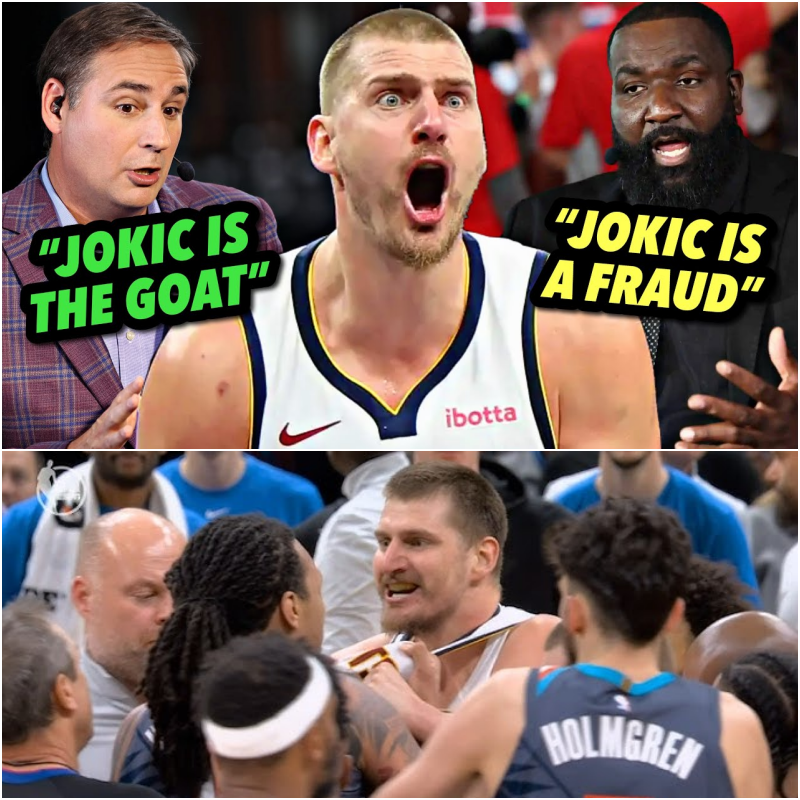
In the court of public opinion, the pendulum of sports discourse rarely stops at “nuance.” It swings violently between “Greatest of All Time” and “Total Fraud.” For Jokić, the 2026 postseason represented the most grueling swing of his career. Yet, as the vitriol pours in from the Mile High City to the talking-head studios in Manhattan, we are forced to ask: Why are we so incapable of having a rational conversation about greatness?
The Anatomy of a Collapse
To understand the current disdain, one must look at the wreckage of the Nuggets’ 2026 campaign. In mid-November, Denver looked like a juggernaut. Jokić was not just leading the MVP race; he was on pace for the statistically superior season of his life. The Nuggets were eyeing a 60-win plateau that would have solidified them as the team of the decade.
Then came April.
The implosion was not merely a loss; it was a surrender. Denver fell to a Minnesota team that was, by all medical accounts, a “shell.” When Anthony Edwards went down in Game 4 with a knee injury, and Donte DiVincenzo followed with an Achilles tear, the series was Denver’s to lose. In Game 6, Minnesota played without their defensive anchor.
And yet, Denver played worse.
For the first time in his Hall of Fame trajectory, Jokić didn’t just lose—he disappeared. For nine straight quarters during the heart of the series, the three-time MVP looked like a ghost of his former self. The numbers are, quite frankly, sickening for a player of his caliber: 53 points, 13 assists, and 8 turnovers over a nine-quarter stretch. He shot an abysmal 16-of-55 from the floor and 2-of-15 from behind the arc. His plus-minus? A staggering -43.
For a superstar whose entire brand is built on “impacting winning,” this wasn’t just a bad week at the office. It was an all-time stinker.
The Perils of Hyperbole
The backlash to this performance is, in many ways, a monster of the media’s own making. For years, analysts like Stan Van Gundy have championed Jokić as potentially the greatest offensive force in the history of the sport—perhaps even the greatest player, period.
When you set the bar at “James Naismith’s ultimate vision,” any descent back to earth is treated like a freefall. The hyperbolic praise of the last three years created a vacuum that “Slander Twitter” and reactionary pundits were all too happy to fill.
The problem with the Jokić debate is the refusal to meet in the middle. Is he the GOAT? No. Is he a “fraud” who “lucked” into a ring in 2023? Absolutely not.
Between the extremes lies a simple, if boring, truth: Nikola Jokić is an all-time great who just suffered the worst playoff series of his life at age 31. This isn’t a career eulogy; it’s a resume stain.
The “Fraud” Fallacy
If we are to label Jokić a fraud for his 2026 exit, then the entire upper crust of the NBA must also be fitted for masks. The 2020s have been defined by parity and “parity’s” more aggressive cousin: instability.
Consider the peers often used to beat Jokić over the head:
Luka Dončić: A generational talent who has seen first-round exits and even missed the playoffs entirely in 2023.
Shai Gilgeous-Alexander: The darling of the new school, yet a player who spent years in the lottery before his recent ascent.
Giannis Antetokounmpo: The “Greek Freak” secured a legendary title in 2021, but followed it with two first-round exits and a season lost to injury.
Does Giannis’s failure to return to the Finals invalidate his 50-point masterpiece to close out Phoenix? Of course not. Greatness is not a perpetual motion machine. It is a series of peaks, often separated by deep, dark valleys.
We’ve seen this movie before. In the mid-90s, Hakeem “The Dream” Olajuwon reached the summit with back-to-back titles in ’94 and ’95. In the four years that followed, his Rockets suffered a second-round exit, a Finals loss, and two first-round departures. By 1999, critics were using Hakeem’s decline to “contextualize” his championships as products of Michael Jordan’s baseball hiatus. History, however, has been kinder. We remember the “Dream Shake” and the rings; we forget the 1998 first-round exit.
Jokić deserves the same historical grace. His post-bubble resume is unmatched: top five in scoring, second in rebounding, and fifth in assists across the entire league. He is the only player in this era to rank in the top five in all three categories. He has created over 3,000 points in postseason play. That isn’t a fluke; it’s a reign.
The Death of the Duo
While Jokić’s individual legacy is secure, the same cannot be said for the Denver Nuggets as currently constructed. The 2026 playoffs exposed a fatal flaw in the team’s DNA: the Jokić-Jamal Murray two-man game has gone stale.
In 2023, their pick-and-roll was a symphonic masterpiece—unpredictable, rhythmic, and lethal. In 2026, it looked like a cover band playing the hits to a thinning crowd. The league has caught up. Lengthy, athletic wings and versatile bigs have figured out how to “nerf” the gravity that Murray and Jokić once used to bend defenses to their will.
When the two-man game is neutralized, the Nuggets have no Plan B. Their offense becomes redundant, their lack of pure athleticism becomes glaring, and their defense—always the team’s Achilles heel—cannot hold the rope.
The hard truth for Denver fans is this: The front office should consider blowing it up.
This isn’t a slight to Jamal Murray, a player who has provided some of the most clutch playoff moments in franchise history. But the pairing has run its course. For Jokić to find his second peak, he needs a new ecosystem. The current roster is a relic of 2023 trying to survive in a 2026 world.
The Old School Virtue
Perhaps the most frustrating part of the “Joker is a fraud” narrative is that it ignores the very thing we usually claim to love about superstars: loyalty.
In an era of “player empowerment,” where stars demand trades the moment a second-round pick is botched, Jokić did it the hard way. He didn’t hop on a private jet to form a “Big Three” in Miami or Los Angeles. He stayed in Denver. He endured the “through-thick-and-thin” years, developed within a single system, and delivered a championship to a city that had never seen one.
He followed the Tim Duncan blueprint, the Dirk Nowitzki path, the Giannis route. To use his 2026 failure as a tool to dismantle his 2023 success is not just bad sports takes—it’s “asinine logic,” as some have pointed out.
The Verdict
Nikola Jokić is 31 years old. In the NBA, that is the age where “prime” begins to transition into “legacy.” He will likely have more double-doubles, more MVP votes, and perhaps even another deep playoff run. But the 2026 series against Minnesota will always be the asterisk—the “stinker” that proved he was made of flesh and bone.
However, a stain on a resume does not ruin the document. You can recognize that he played “semi-decent” when he needed to be “great” without calling him a bum. You can admit that the Minnesota Timberwolves owned him for nine quarters without suggesting that his career has been a mirage.
The “Problem with Nikola Jokić Debates” isn’t actually about Jokić. It’s about our own inability to appreciate a masterpiece because we found a smudge in the corner of the canvas.
The Joker isn’t a fraud. He’s just a great player who finally ran out of magic. And in a league this tough, that’s not an embarrassment—it’s just the way the game goes. Let’s stop pretending otherwise.









