“You Need a Home, and I Need a Mommy,” Said the Little Girl to the Young Homeless Woman at the Bus…
“You Need a Home, and I Need a Mommy,” Said the Little Girl to the Young Homeless Woman at the Bus…
Act I: The Bus Shelter on 4th Street
The December wind didn’t just blow through the city; it hunted. It cut straight through the thin, cream-colored cotton dress Margaret wore, biting into her skin with a cruel, structural indifference. She sat perfectly still on the cold metal bench of the bus shelter on 4th Street, her spine pressed against the plexiglass partition, her hands tucked deeply into her armpits. Beside her sat a worn canvas backpack, its zipper held together by a rusty safety pin—the repository of her entire life.
At twenty-four, Margaret looked older. The last six months on the streets had weathered her face, carving faint, permanent lines of vigilance around her mouth and hollowed gray shadows beneath her eyes. Her long blonde hair, once her pride, hung in limp, dull strands across her shoulders. Her bare feet, pressed flat against the freezing concrete pavement, had long since passed the stage of sharp pain; they were entirely numb, white and marbled with blue. She had sold her last pair of scuffed leather shoes three days ago to a pawn shop down the avenue for eight dollars—just enough to buy two bowls of hot soup and a pack of generic cough drops.
Outside the shelter, the snow fell in heavy, silent flakes, blurring the harsh evening neon of the city into soft halos of golden red and pale amber. Margaret pulled her knees tightly against her chest, attempting to trap what little residual warmth her body possessed. The three-sided shelter offered almost no protection from the draft that swirled off the river. Through the frosted glass, she watched the citizens of the city hurry past. They were bundled in heavy wool overcoats, down jackets, and thick scarves, their faces buried in their collars as they rushed toward subway entrances and parked cars—toward warm kitchens, bright living rooms, and lives that made sense. Lives she could now only imagine.
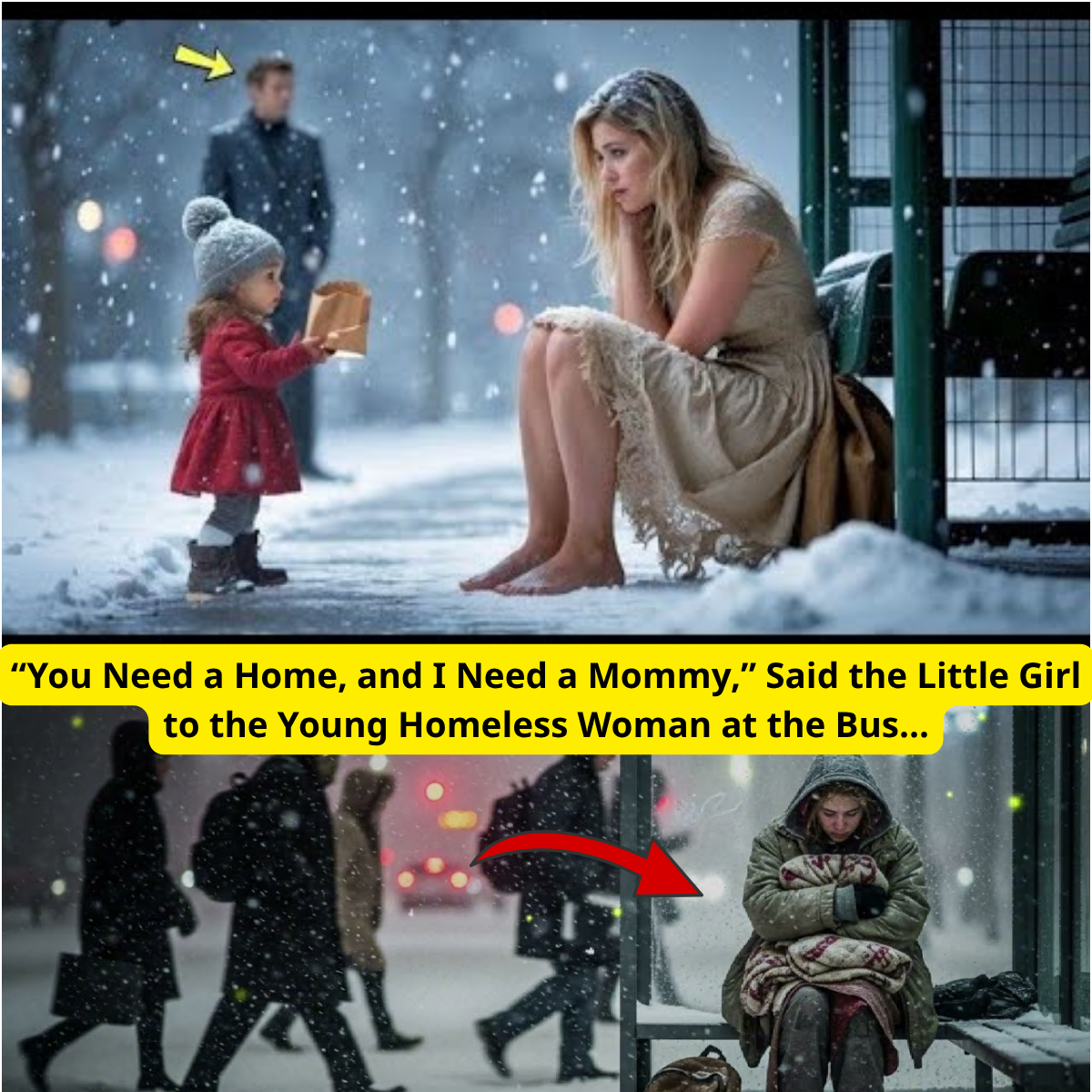
Then, a small figure broke through the white curtain of the snowfall.
It was a little girl, perhaps four years old, walking with the exaggerated, careful concentration of a toddler navigating an icy sidewalk. She wore a deep burgundy wool dress that peeked out from beneath a small gray coat, and a mismatched gray knitted cap sat slightly crooked on her head. In her mitten-covered hands, she held a small, grease-stained brown paper bag like a sacred artifact.
The girl stopped directly in front of the open bus shelter, her small winter boots planted firmly in the slush. She didn’t look away or hurry past. Instead, she stood there, studying Margaret with a pair of solemn, unblinking brown eyes.
“Are you cold?” the child asked. Her voice was remarkably clear, slicing through the muffled rumble of city traffic and the whistling winter stillness.
Margaret looked up, her eyelashes heavy with frost. She tried to smile, though the muscles in her face felt stiff and unresponsive. “A little bit, sweetheart,” she whispered, her voice raspy from the cold. “But I’m okay. Don’t worry.”
The girl didn’t look convinced. She lowered her gaze, staring intently at Margaret’s bare, frozen feet resting on the concrete, then looked back up into her face. Without saying a word, she extended her mitten-covered arms, thrusting the small brown paper bag forward.
“This is for you,” the girl said simply.
Margaret’s throat tightened, a sudden, hot knot of emotion swelling behind her chest. “Oh… oh, no, honey. I can’t take your food. You keep that.”
“It’s okay,” the child insisted, taking another half-step into the shelter. “Daddy bought me bakery cookies because I was good at the grocery store. But you look like you need them. You look hungry.”
Margaret blinked back tears, her gaze drifting past the little girl’s shoulder. A few yards away, standing near a lamppost where the snow gathered in white ridges on his dark cashmere coat, a man stood watching them. He was tall, perhaps forty years old, with dark hair and kind, deeply expressive eyes that carried a heavy, visible sadness. He had his hands buried in his pockets, making no move to call the child back or interrupt the interaction. He simply watched his daughter with a quiet, patient reverence.
Act II: Fresh Bread and Hard Truths
With shaking, pale fingers, Margaret slowly reached out and accepted the paper bag. The moment her skin touched the paper, she felt it—the radiating, distinct warmth of fresh baked goods. She opened the top of the bag. Inside were three large, thick chocolate chip cookies, still warm from the ovens of the bakery down the block. The rich, buttery scent of vanilla and melted chocolate bloomed into the freezing air, so potent it made her dizzy.
A single, hot tear escaped her eye, tracing a clean path through the grime on her cheek. “Thank you,” she whispered, her voice cracking entirely. “Thank you so much.”
The little girl tilted her head to the side, her solemn brown eyes assessing Margaret with a strange, innate wisdom that seemed far beyond her four years. She took a deep breath of the winter air and said something that caused the entire world to stop spinning.
“You need a home,” the child said, her tone completely matter-of-fact. “And I need a mommy.”
The words hung in the snowy air between them, heavy and impossible, like an unspoken prayer suddenly given form. Margaret froze, a cookie halfway to her mouth, completely stunned by the raw, unvarnished honesty of the statement. She looked from the little girl to the man by the lamppost, who had taken his hands out of his pockets, his posture suddenly rigid.
“What’s your name, sweetheart?” Margaret managed to ask, her heart hammering against her ribs.
“Lucy,” the girl said, adjusting her crooked gray cap. “My mommy went to heaven six months ago. Daddy says she’s an angel now, up in the clouds.” She looked closely at Margaret’s pale face and blonde hair. “Are you an angel?”
Margaret let out a wet, breathless laugh, shaking her head as she took a small bite of the warm cookie. “No, baby. I’m definitely not an angel. I’m just… I’m just someone who made some mistakes. And I got very unlucky.”
Lucy reached out, her small, knit mitten surprisingly gentle as she brushed a stray strand of damp blonde hair away from Margaret’s cheek. “Daddy says everyone makes mistakes. That’s why we need love. If we don’t have love, the mistakes stay lonely.”
The man finally approached, his heavy leather boots crunching softly in the snow. He knelt down on the wet pavement right beside his daughter, placing a large, protective hand on her small shoulder.
“I’m so sorry if she startled you,” he said to Margaret. His voice was a low, comforting tenor, but it carried the distinct, hollow resonance of a man intimately acquainted with grief. “Lucy has a way of finding people who need help. She sees things the rest of us miss. I’m Daniel. Daniel Hayes.”
Margaret instinctively pulled her bare feet backward, trying to hide them beneath the hem of her damp dress, her old defenses rising out of habit. “I’m sorry, I… I don’t want to bother you. I’m not begging, I swear. She just walked up to me—”
Daniel held up a hand, his expression incredibly gentle, cutting off her panicked apology. He looked at her backpack, her thin dress, and then looked directly into her eyes without a single shred of judgment.
“My daughter is right,” Daniel said quietly, his gaze steady. “You need shelter, and we happen to have an extra room. My wife passed away six months ago in an accident. The house… it feels far too empty these days.” He paused, letting the wind whistle through the shelter before continuing. “Look, I’m not making any promises beyond tonight. I know the world is a dangerous place, and you have no reason to trust a stranger. But nobody should be out here in this cold. If you’d like a warm meal and a safe, lockable place to sleep, the offer stands.”
Margaret had spent months learning to be profoundly wary. The streets of the city were an unmerciful teacher, and she had learned hard, violent lessons about the cost of misplaced trust. Men who offered shelter usually expected a currency she wasn’t willing to pay.
But as she looked at Daniel, she saw no predatory calculation in his eyes—only the profound, clean sorrow of a fellow survivor. And when she looked at Lucy’s innocent, expectant face, she felt something break open inside her chest. A frozen, armored place she had thought completely dead since her world fell apart began to thaw.
“I… I don’t want charity,” she whispered, her pride flaring one last time.
“It’s not charity,” Daniel said, his eyes softening into a small, empathetic smile. “It’s just humanity. Someone helped me once, a long time ago, when I thought I was completely under water. I’m just passing it forward.”
Lucy reached out, her small mitten wrapping around Margaret’s cold, bare thumb. “Please come home with us. It’s Christmas soon, and Santa only brings presents to people who have houses with chimneys. We have a big chimney.”
Margaret closed her eyes for a brief second, the warmth of the bakery bag still bleeding into her palms. “Okay,” she whispered, opening her eyes. “Just for tonight.”
Act III: The Architecture of Grief
One night turned into three. Three nights turned into two weeks.
Daniel had driven her to a modest, beautiful craftsman-style home in a quiet, older neighborhood of the city. The moment they arrived, he had shown her to a bright guest bedroom on the second floor, complete with its own attached bathroom, clean linens, and a lock on the door. He asked for absolutely nothing in return, making only one rule: that she join them at the dining room table for breakfast and dinner.
Lucy attached herself to Margaret almost instantly. The little girl became her shadow, trailing her through the house, enthusiastically showing her every plastic toy, every illustrated storybook, and every hidden corner of the property.
Over the shared meals, Margaret began to piece together the architecture of their life. Daniel was a history teacher at the local public high school. His wife, Amanda, had been killed in a sudden, multi-car collision on the interstate during a summer rainstorm. The suddenness of the loss had left Daniel and Lucy stranded in an ocean of grief, making the three-bedroom house feel impossibly vast, silent, and cold.
She learned that Lucy had begun having severe, screaming nightmares after her mother’s death, often waking up inconsolable. Strangely, within days of Margaret’s arrival, the nightmares began to fade. Margaret’s presence—her quiet, calm movements and the soft, late-night murmurs from the guest room—seemed to act as an emotional anchor for the traumatized child.
In turn, over cups of hot tea after Lucy had gone to bed, Margaret shared her own story. She hadn’t always been a ghost at a bus stop. A year earlier, she had been a normal young woman, working as a junior copywriter and caring for her ailing mother. But the medical bills from her mother’s terminal cancer had completely decimated their meager savings. When her mother finally passed, the landlord had doubled the rent on their apartment. Two weeks later, her company downsized, and Margaret found herself laid off.
It was a swift, terrifying cascade of ordinary misfortunes. She had been too proud to ask her few remaining friends for help, letting her pride isolate her until her bank account hit zero and her phone was turned off. By the time she realized how deep the hole was, she was already sleeping on a piece of cardboard in an alleyway. She wasn’t an addict; she had never been in trouble with the law. She had simply been incredibly unlucky, slipping through the thin ice of modern life.
Daniel listened to every word without a single hint of condescension. “Life can break any of us, Margaret,” he said one evening, his hands wrapped around a ceramic mug. “It doesn’t take much. A bad turn on a highway, a medical diagnosis, a corporate spreadsheet. None of us are as safe as we like to think. What matters isn’t how we fall; what matters is whether someone is standing there to help us get back on our feet.”
Over the next two months, the house began to change. The thick, suffocating fog of mourning that had defined the rooms began to dissipate, replaced by the natural, messy rhythms of a home. With Daniel’s encouragement and a reference from his school principal, Margaret landed a steady, part-time job as an assistant archivist at the neighborhood public library. She used her first two paychecks to buy her own clothes, a pair of sturdy winter boots, and a small, beautiful set of watercolor paints for Lucy.
Every single night, without fail, Lucy would refuse to go to sleep until Margaret came upstairs to tuck her in. It became a sacred, unbroken ritual for both of them. Margaret would sit on the edge of the small twin bed, smoothing back Lucy’s wild brown curls, singing low, old lullabies until the little girl’s breathing turned deep and even.
Act IV: The Grey Armor
One evening, nearly three months after that fateful night at the bus stop, the house was filled with the scent of a roast chicken Daniel had made for dinner. Margaret walked into the living room to find him sitting on the floor near the fireplace, a heavy leather photo album spread open across his knees. The amber glow of the fire illuminated pictures of a vibrant, dark-haired woman laughing on a beach.
“She would have really liked you, you know,” Daniel said softly, not looking up immediately as Margaret sat down on the sofa near him. “Amanda always used to say that kindness recognizes kindness. She believed that good people are like tuning forks—if you strike one, the others in the room start to hum.”
Margaret leaned forward, her elbows on her knees. “Lucy offered me her bakery cookies that night because she thought I looked hungry. But she gave me so much more than a snack, Daniel. She gave me my life back. She gave me a reason to believe that the world wasn’t just a cold, indifferent machine designed to crush people who lose their way.”
Daniel closed the album with a gentle click, turning his head to look at her. “She needed you just as much, Margaret. You think we saved you, but it’s the other way around. Ever since the accident, Lucy had this… this wall up. She stopped playing with her dolls. She stopped talking about school. But since the night you walked through that front door, she started smiling again. Really smiling.”
As if summoned by her name, Lucy appeared in the arched entryway of the living room. She was wearing her favorite flannel nightgown, but notably, her gray knitted winter cap was still perched firmly on her head. Over the past three months, Margaret had noticed that Lucy wore that cap constantly—indoors, at the dinner table, during playtime. It was her armor against a world that had suddenly snatched her mother away without warning; as long as the cap was on, she felt protected.
Lucy walked across the room, her small bare feet padding over the rug, and stopped right in front of Margaret. She looked up with that same serious, analytical expression she had used at the bus stop.
“Are you staying forever?” Lucy asked directly, her brown eyes completely unblinking.
Margaret gasped slightly, her breath catching in her throat. She looked up at Daniel. He didn’t look away. Instead, he smiled—a deep, genuine, and incredibly hopeful smile—and gave her a small, definitive nod of his head.
Margaret reached down, lifting Lucy up into her lap, wrapping her arms around the little girl’s warm frame. “If you and your daddy will have me, Lucy,” Margaret whispered, her eyes filling with tears of pure gratitude, “I would like to stay forever very, much.”
Lucy buried her face into Margaret’s neck, her small hands wrapping tightly around her collar. “Good. Because you’re my mommy now. I told Santa Claus in a letter last week, and he wrote back and said it was totally okay with him.”
Daniel moved from the floor, sitting beside Margaret on the sofa. He reached out, his large hand wrapping over Margaret’s shoulder, pulling both her and his daughter into a tight, unbroken circle. The three of them sat together in the firelight—a family formed not by the traditional ties of blood, but by the far more resilient bonds of mutual compassion, born out of the simple, universal human need to belong and to be loved.
Outside the living room window, the March snow began to fall once again, swirling gently against the dark glass. But inside the craftsman house, beneath the warmth of the roof and the steady hum of the fire, everything was perfectly, completely warm.
Sometimes, angels truly do come to us in our absolute darkest, most desperate moments. They don’t always appear with white wings or golden halos. Sometimes, they wear crooked gray knitted caps, possess a wisdom beyond their years, and carry warm chocolate chip cookies in a greasy paper bag. And sometimes, if we are just brave enough to drop our pride and accept their heavy gifts, they save us. They save us not just from the bitter, biting cold of the winter outside, but from the terrifying, permanent cold within.