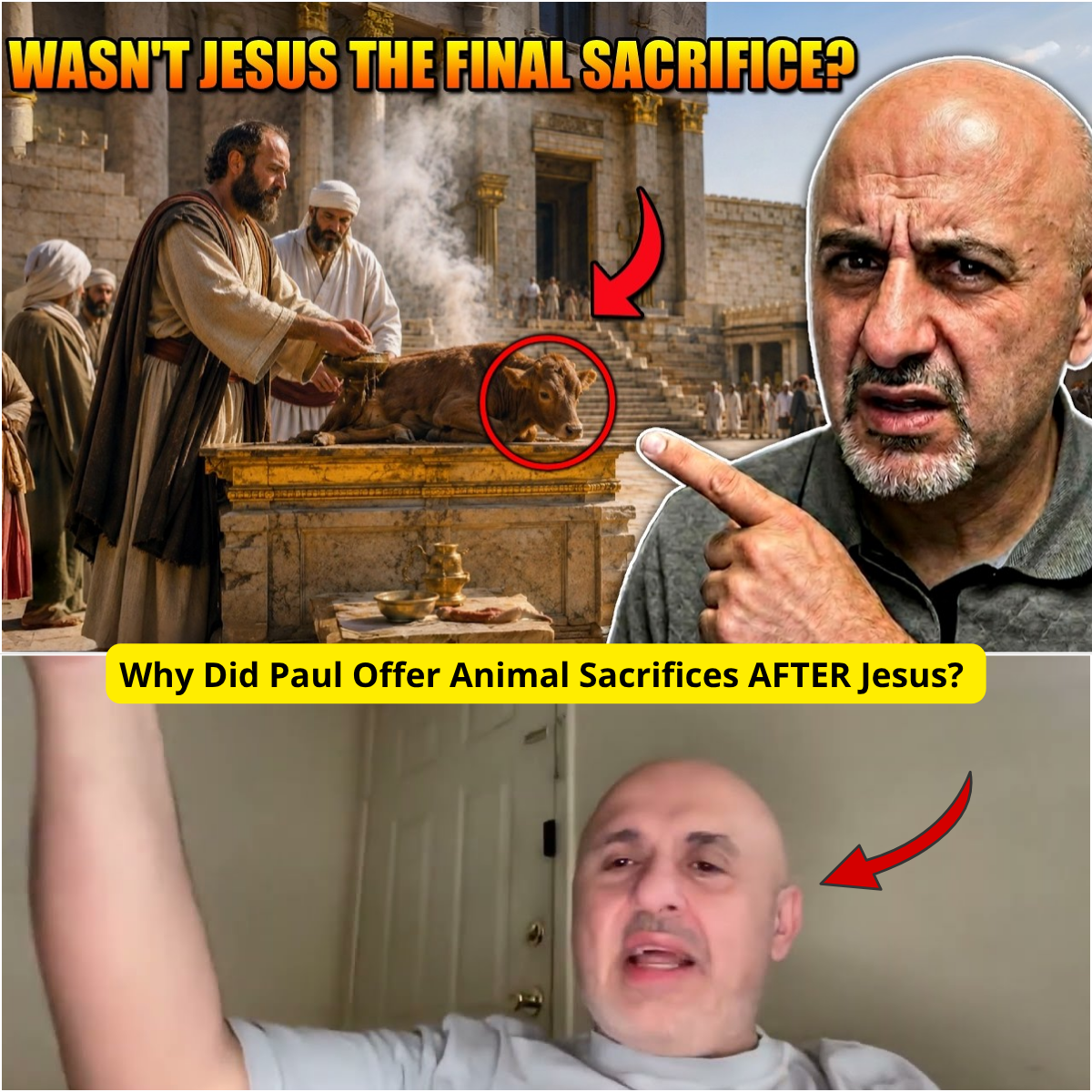
Why Did Paul Offer Animal Sacrifices AFTER Jesus?
Why Did Paul Offer Animal Sacrifices AFTER Jesus?
The neon hum of the baseline recording equipment pulsated in the corner of David’s cramped studio, casting an amber glow over stacks of leather-bound lexicons and Greek manuscripts. Across the scratched cedar table sat Sam, leaning back with the dangerous, relaxed posture of a veteran litigator who had spent twenty years in theological trenches.
Beside him, a massive monitor displayed a live video feed that had just cut to black. The title of the stream read: “Class Has Begun: The Myth of the Final Sacrifice.”
David sighed, rubbing his eyes. “He didn’t last ten minutes, Sam. You tore his logic apart before he could even define his terms.”
“Because they don’t study the architecture of the texts, David,” Sam said, his voice dropping into a low, gravelly resonance. He gestured aggressively at the open page of Acts 21 on the desk. “They look for cracks to insert a wedge, but they don’t realize they’re wedging themselves into a vault. The boy comes on my stream, fresh out of a university group, thinking he’s discovered a hidden contradiction that will collapse two thousand years of Christian orthodoxy. He quotes Acts 21:26—Paul going into the Temple, paying for Nazarite vows, allowing bloody animal sacrifices to be offered by the Levitical priesthood. And he thinks, ‘Aha! If Christ is the final sacrifice, Paul is a hypocrite, or the Gospel is a lie.’“
David pulled up a secondary screen, scrolling through the frantic live-chat replay. “To someone poorly catechized, Sam, it looks like a contradiction. If the author of Hebrews says Christ offered one sacrifice for sins for all time, why is the Apostle to the Gentiles buying lambs for a sin offering in Jerusalem?”
“Class is in session,” Sam smiled, a sharp, white flash against his neatly trimmed beard. “Let’s break down the anatomy of the first-century Church. Because until people understand the difference between expiation for eternal salvation and ritual purity for covenantal solidarity, they will remain blind to what Luke is actually recording.”
The Gathering in Jerusalem
To understand the drama that unfolded in Jerusalem around the year 58 AD, one had to feel the dust of the Roman province of Judea and smell the heavy scent of burning fat and wood smoke drifting from Mount Moriah.
Paul had returned from his third missionary journey. His skin was leathered by the Aegean sun, his hands calloused from tentmaking in Ephesus and Corinth, and his heart heavy with a collection of silver and bronze coins gathered from impoverished Gentile congregations across Macedonia. He had come to deliver alms to the suffering mother church in Jerusalem—a gesture of profound theological unity.
But the air in the city was volatile. The Zealot movement was gaining traction, knife-wielding Sicarii were slipping through crowds to assassinate Roman sympathizers, and rumors flew through the narrow stone streets like wildfire.
“Look at the text,” Sam pointed to the verse. “Acts 21:18. Paul goes to see James. This isn’t just a casual meeting; James is the elder of the Jerusalem church, the brother of the Lord. And James says to him: ‘You see, brother, how many thousands there are among the Jews of those who have believed, and they are all zealous for the Law.’“
David leaned forward, analyzing the Greek text. “The word there is myriads—tens of thousands. These aren’t unbelieving Pharisees. These are Jewish Christians who have confessed Jesus as the Messiah, yet they are still keeping the ancestral customs. They’re circumcising their children, keeping Kosher, and attending the festival cycles.”
“Exactly!” Sam slammed his hand down on the table, not in anger, but with the raw passion of a teacher striking a blackboard. “And what is the rumor they’ve been fed? The rumors say Paul is traveling around the Diaspora telling ethnic Jews to forsake Moses, to stop circumcising their boys, and to abandon the customs. Is that rumor true?”
“No,” David said. “Paul explicitly taught that circumcision mattered nothing for justification, but he never forbade ethnic Jews from living as Jews. He circumcised Timothy because of the Jewish community in Lystra!”
“Right. So James proposes a tactical solution to destroy the slander,” Sam continued, his eyes scanning the verses. “He says, ‘We have four men under a vow. Take them, purify yourself along with them, and pay their expenses so that they may shave their heads.’ That is the Nazarite vow from Numbers chapter 6. And why does James want Paul to do this? ‘So that all will know that there is no truth to the things they’ve been told about you, but that you yourself also walk orderly, keeping the Law.’“
The Nature of the Nazarite Vow
The studio grew quiet as Sam flipped his Bible back to the Torah, his fingers tracing the ancient lines of Numbers 6.
                       [ THE NAZARITE VOW: NUMBERS 6 ]
                                      |
         +----------------------------+----------------------------+
         |                            |                            |
[ THE BURNT OFFERING ]        [ THE SIN OFFERING ]       [ THE PEACE OFFERING ]
    (Olah - Devotion)          (Chatat - Purity)           (Shelamim - Communion)
         |                            |                            |
  One male lamb,               One ewe lamb,                 One ram,
  without blemish              without blemish               without blemish
“Look at what the Law demands when a Nazarite completed their period of separation,” Sam explained, his voice softening into an intense, academic focus. “They had to present three specific animals to the priest at the door of the Tabernacle or Temple. A burnt offering, a peace offering, and a sin offering—the Chatat.”
“That’s the stumbling block for modern readers,” David remarked, tapping his pen against the desk. “The word ‘Sin Offering.’ If Jesus paid for sin on the cross, how could Paul sponsor a ritual that included a sacrificial lamb for sin?”
“Because the Western mind has completely misconstrued the ancient Hebrew concept of sacrifice,” Sam said, leaning forward. “The Hebrew word for sin offering is Chatat, which derives from the root meaning ‘to cleanse’ or ‘to decontaminate.’ In the ancient Near East, the Temple was considered the localized dwelling place of God’s manifest presence. Human moral failure and physical ritual impurity generated a spiritual ‘miasma’ or pollution that stained the sanctuary. The blood of the Chatat was not a mechanical payment for eternal damnation; it was a ritual detergent.”
He pointed to a quote from a prominent biblical scholar on his monitor:
“The animal sacrifice did not substitute for the moral guilt of the human soul in an ultimate eschatological sense; rather, it purged the sacred space of the Temple so that a Holy God could continue to dwell among an imperfect people.”
“Think about it this way, David,” Sam used his hands to illustrate. “If I tracking mud into a pristine cathedral, my apology to the priest fixes my relational standing with him. But the carpet is still dirty. The Chatat was the spiritual vacuum cleaner for the earthly Temple. Paul wasn’t looking at the priest on Mount Moriah to save his soul from Hell; he knew only the blood of Jesus shed outside the gates of Jerusalem could do that. He was participating in a civil, national, and ritual cleansing appropriate for an ethnic Jew entering the physical precinct of Yahweh’s earthly house.”
The Dual Citizenship of the Early Church
David picked up a legal pad, sketching out a timeline of the first century. “So what you’re saying is that the early Church operated under a framework of dual reality. They lived in the overlap of two ages.”
“Precisely,” Sam nodded. “The New Covenant had been inaugurated at Pentecost, but the Old Covenant structural shell—the physical Temple, the Levitical priesthood, the Roman-occupied state of Judea—was still standing. It hadn’t yet been dismantled by the Roman legions in 70 AD. Until that temple fell, it remained the epicenter of Jewish national life.”
To demonstrate this, Sam pulled up a comparative table he had compiled for his articles:
Dimension
The Earthly Temple (Acts 21)
The Heavenly Sanctuary (Hebrews 10)
Domain
Material, Terrestrial, Temporal
Spiritual, Celestial, Eternal
Priesthood
Sons of Aaron (Imperfect, Mortal)
Melchizedekian (Christ, Immortal)
Frequency
Continual, Daily, Cyclical
Once for All (Epheapax)
Function
Ritual Cleansing, Covenant Sign
Eternal Redemption, Heart Cleansing
Scope
National/Ethnic Israel
All Nations (Jew and Gentile)
“Look at the Book of Acts,” Sam challenged, his voice rising with that characteristic apologetic vigor. “The critics want to isolate Acts 21:26 to prove a contradiction, but they completely ignore the structural coherence of the whole narrative. Who wrote the Book of Acts? Luke! The companion of Paul. The same Luke who records Peter’s sermon in Acts 15 where he declares that Jews and Gentiles are saved exclusively ‘through the grace of the Lord Jesus.’ The same Luke who records Paul’s farewell address to the Ephesian elders in Acts 20, where he declares that the Church was purchased ‘with the blood of God’s own Son.’“
“It’s an issue of hermeneutical blindness,” David agreed. “They treat the authors of Scripture like they lacked basic logical consistency. They think Luke didn’t notice that his hero was doing sacrifices while preaching grace.”
“Exactly! They think Paul forgot what he wrote to the Galatians!” Sam laughed, a sharp, barking sound that echoed in the studio. “They think Paul went up to Jerusalem, suffered a bout of spiritual amnesia, and said, ‘Oh, actually, let me get this lamb to save me from my sins.’ No! Paul understood context. To the Jew, he became a Jew, so that he might win Jews. Going to the Temple, keeping a Nazarite vow, paying for those men’s sacrifices—it was a profound act of pastoral love and cultural solidarity to prevent an unnecessary riot, to show that faith in Christ does not make one a traitor to one’s heritage.”
The Confrontation
Suddenly, the intercom on David’s desk buzzed. The production assistant’s voice came through, sharp with excitement. “Sam, we’ve got a re-entry on the call line. It’s Yusuf—the guy who logged off earlier during the Surah 10:94 debate. He claims he’s ready to address Acts 21 properly without changing the subject.”
Sam’s eyes lit up. He adjusted his microphone, his posture instantly snapping into battle readiness. “Put him through. Let’s see if he’s brought an argument or just another script.”
The line clicked. A young man’s voice, slightly hesitant but trying to project confidence, came through the studio monitors. “Assalamu alaikum, Sam. Listen, I don’t want to talk about Pharaoh or the number of plagues anymore. Let’s stick to your text. You claim that Paul didn’t believe the sacrifice was saving him. But your own text says it was an offering for purification. If Christ’s blood purifies from all sin, any other purification is a denial of Christ. You’re trying to separate what cannot be separated.”
“Yusuf, welcome back to class,” Sam said, his tone firm but measured, avoiding the explosive volume of his earlier streams to ensure the point landed cleanly. “Let me ask you a very simple question about your own framework to show you the flaw in your logic. When you go to Mecca for Hajj, do you perform Wudu—ritual ablution?”
“Of course,” Yusuf replied. “It is required for prayer.”
“Does that physical washing with water forgive your sins eternally, or does it grant you the proper ritual state to stand in a sacred space?”
“It is for ritual purity before Allah,” Yusuf said slowly.
“Bingo!” Sam pointed a finger at the microphone. “If you can understand that physical washing can be required for entering a designated holy space without it competing with Allah’s ultimate decree of forgiveness, why can’t you apply that same nuance to first-century Judaism?
“The Temple in Jerusalem was a physical house governed by a specific code of ritual cleanliness outlined in Leviticus. If an ethnic Jew contracted ritual defilement or completed a holy vow like the Nazarite vow, the civic and ceremonial law of the nation demanded a ritual presentation at the Temple. Paul was a Jewish citizen operating within the functioning civil and religious laws of his nation. He wasn’t looking at that lamb to clear his conscience before the Judgment Seat of God; he explicitly writes in Romans that justification is by faith apart from works of the Law. The sacrifice was an external, terrestrial compliance to maintain peace within the community.”
Yusuf paused over the line, the sound of papers shifting audible through the microphone. “But what about the author of Hebrews? He says that it is impossible for the blood of bulls and goats to take away sins.”
“Exactly!” Sam’s voice cracked like thunder, his hand hitting the desk again with absolute conviction. “The author of Hebrews—who was either Paul or one of his closest associates—says that animal blood never took away eternal sins, even before Jesus died! It could only sanctify ‘for the purification of the flesh’—Hebrews 9:13. Look at the language! The New Testament itself explicitly limits what animal sacrifices could achieve. They cleaned the flesh, they maintained the ritual covenant on earth, but they could never clear the human conscience. Only the divine, unblemished sacrifice of the Messiah could pierce the heavenly veil.”
The Shadow and the Substance
The line remained quiet for a long moment. Yusuf didn’t launch into a counter-attack; the comparison to ritual ablution had disrupted his standard polemical trajectory.
“Think about the timeline, Yusuf,” David stepped in, his voice calm and pastoral. “In 58 AD, when Paul went into that temple, Jesus had already ascended. The early Christians still viewed the Temple as their father’s house, but they knew its time was short. Jesus had prophesied that not one stone would be left upon another. For those forty years between the crucifixion and the destruction of Jerusalem, God allowed the earthly shadows to run parallel to the heavenly reality, until the shadow was completely removed by history.”
“Look at Acts 3,” Sam added, closing his Bible with a deliberate, heavy thud. “Peter and John went up to the Temple at the ninth hour—the hour of the evening sacrifice. Why did they go? To watch a goat die? No! They went because that’s where the people of Israel gathered to pray. They used the cultural machinery of their nation as a platform to preach the resurrection of Jesus. They didn’t see the Temple as an enemy; they saw it as a signpost that had fulfilled its purpose.”
“I… I need to read your articles on this,” Yusuf muttered, his voice stripped of the aggressive edge it carried at the beginning of the evening. “The videos online make it seem like a direct contradiction.”
“Because the videos online are designed for clicks, not for truth, my friend,” Sam said, his voice dropping into an earnest, sincere register. “Don’t settle for cheap polemics from people who don’t know the difference between the Greek words Prosphora and Thysia. Go read the text in its historical context. See how beautifully the writers of the New Testament maintained their identity as Jews while proclaiming a salvation that broke down the wall between Jew and Gentile. I want you to see the truth, Yusuf. I don’t spank you guys on stream because I hate you; I do it because I want you to stop running down blind alleys.”
“Thank you for the explanation,” Yusuf said quietly. “I will look into it.”
The line went dead.
After the Storm
David leaned back in his chair, watching the audio meters drop back to zero. The studio was quiet again, the intense energy of the theological arena dissipating into the cool night air.
“Do you think he’ll actually look?” David asked.
“Some do, some don’t,” Sam said, picking up his cold coffee mug and taking a slow sip. “But the seed is planted. You see, David, the church today has forgotten its roots. We live in a world of quick soundbites and superficial theology. Christians get shaken by these arguments because they’ve been poorly catechized. They think grace means history doesn’t matter. They think faith means the old covenant was just a mistake.”
He stood up, walking over to the window that looked out over the city lights.
“But when you understand the architecture—when you realize that Paul could walk into that limestone temple, hear the chants of the priests, see the smoke rising from the altar, and smile because he knew that the true Temple was standing right there in his heart—that’s when the Gospel becomes unshakable. Class isn’t just about winning an argument, David. It’s about showing them the glory of a plan that spans from Genesis to Revelation, woven together without a single torn thread.”