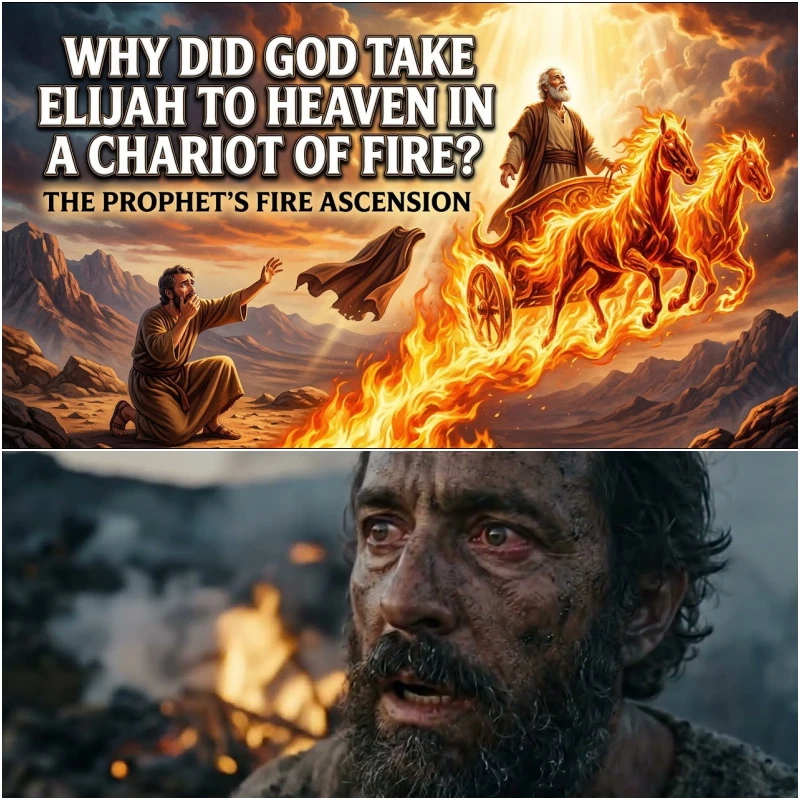
Why Did God Take Elijah to Heaven in a Chariot of Fire?
The Mantle of the Red Desert
The sky over the Jericho Basin did not look like heaven. It looked like a bruised throat, purple and swollen with a coming heat that promised to boil the very marrow in a man’s bones.
Elias Thorne sat on a sun-bleached rock, his skin the color of cured leather and his eyes two chips of flint. He was a man of the “Old Fire,” a preacher who didn’t use a pulpit but spoke to the wind and the outlaws of the Nevada Territory. For forty years, he had been the conscience of a land that wanted no conscience. He had stood before the silver barons of Virginia City and told them their wealth was a shroud. He had stood before the gunmen of the Black Rock and told them their lead was but dust.
Beside him sat Caleb, a young man who had followed Elias for three years, ever since the old man had found him starving in the ruins of a burned-out homestead. Caleb carried the water skins, mended the sandals, and listened. He listened to the “still small voice” Elias always talked about—though to Caleb, the world mostly felt like a roar of silence.
“It’s coming today, son,” Elias said, his voice a dry rasp.
Caleb looked at the horizon. “The storm? We should find cover, Elias. The arroyos will flood.”
“Not a storm of water,” Elias replied, a ghost of a smile touching his cracked lips. “The Chariot. The Lord is done with my feet. He’s sending for my soul.”
Caleb felt a cold shiver despite the 100-degree heat. He had heard the stories. He knew the scriptures Elias had breathed into him like oxygen. He knew about the Prophet on the Jordan. But this was the high desert of 1884. God didn’t take people in chariots anymore; He took them with consumption, or Comanche arrows, or the slow, grinding rot of age.
“Don’t talk like that,” Caleb whispered. “You’ve got miles left in you. We have to get to the settlement at Dry Creek. They need to hear the word.”
Elias stood up. His knees popped like pistol shots. He reached into his tattered duster and pulled out a heavy, salt-stained cloak. It was made of wolf hide and sheep’s wool, a garment that had seen a thousand miles of dust.
“Stay here, Caleb,” Elias commanded. “Go back to the settlement. I walk the rest of this ridge alone.”
“As the Lord lives and as my soul lives,” Caleb said, his voice cracking, “I will not leave you.”
The Walk of Three Trials
They began to walk. It was a journey that mirrored the ancient path from Gilgal to Bethel, but here, the landmarks were different.
First, they passed The Ghost Mine. A place where men had once worshipped the “Silver Baal,” tearing the earth apart for a glimmer of metal while their families starved. “Elias, stay here,” Caleb pleaded as they passed the yawning, dark mouth of the mine. “The shade is good.” “The Lord has sent me to the River,” Elias said, never looking back.
Second, they passed The Hanging Tree, a twisted juniper where the law of men had replaced the law of mercy. “Stay here, Caleb,” Elias said again. “This is a place for the dead. You are for the living.” “I will not leave you,” Caleb repeated, his boots bleeding through the soles.
Finally, they reached the Rio Rojo. It wasn’t a mighty river like the Jordan; it was a muddy, sluggish vein of water cutting through a canyon of red rock. But to Elias, it was the edge of the world.
Elias stopped at the bank. He took off his heavy cloak, rolled it tight, and struck the surface of the muddy water.
In that moment, the physics of the Nevada Territory seemed to buckle. The silt-heavy water didn’t just splash; it sighed. It pulled back, baring the cracked, sun-baked clay of the riverbed. A path opened, bone-dry and smelling of ancient minerals.
Caleb’s heart hammered against his ribs. He followed Elias across the dry gap, his mind screaming that this was impossible. On the other side, the air felt different. It hummed. It tasted like ozone and honey.
The Final Request
Elias turned to face his apprentice. The old man looked younger now, the lines of exhaustion fading. “Ask what I shall do for you, before I am taken.”
Caleb didn’t hesitate. He didn’t ask for gold or the ability to heal. He looked at the vast, terrifying emptiness of the American West—a place that swallowed men whole—and he felt his own inadequacy.
“I want a double portion of your spirit,” Caleb said. “I want the fire that makes you stand when everyone else kneels. I want the voice that the wind obeys.”
Elias looked sad. “You have asked a hard thing. To have my spirit is to have my loneliness, Caleb. It is to be the only one awake in a room full of sleepers. But if you see me when I am taken, it shall be yours.”
They walked on, climbing toward the “Crown of Thorns,” a jagged peak that pierced the purple sky.
The Chariot of the Frontier
At exactly noon, the sun didn’t just shine; it exploded.
The sound came first—not a thunderclap, but the roar of a thousand prairie fires. The wind whipped up a whirlwind of red dust that spiraled into a column a hundred feet high.
Then, out of the heart of the dust, the “Chariots” appeared.
They weren’t the gold-leafed wagons of a Roman epic. To Caleb’s American eyes, they looked like wheels of living brass and white-hot iron. They moved like lightning, pulled by horses whose manes were flowing magma and whose hooves struck the air like hammers on an anvil.
They didn’t ride on the ground; they tore through the fabric of the air itself.
Elias Thorne didn’t climb into a carriage. He simply walked into the center of the fire. The whirlwind caught him, his tattered duster turning into a garment of blinding light.
“My father! My father!” Caleb screamed, shielding his eyes as the heat singed his eyebrows. “The Chariots of the West! The horsemen of the Lord!”
For a split second, the veil between the dirt and the divine was torn wide. Caleb saw the geography of eternity—a place where the desert bloomed and the thirsty soul was finally quenched. And then, with a sound like a Great Plains locomotive disappearing into a tunnel, the fire vanished.
The sky snapped back to its dull, bruised purple. The silence that followed was so heavy it felt like a weight.
The Inheritance of Dust
Caleb fell to his knees. He was alone. The man who had been his compass, his father, and his shield was gone. He looked up at the empty sky, feeling the crushing weight of the Nevada silence.
Then, he saw it.
Floating down through the settling red dust was the wolf-hide cloak. It fell slowly, tumbling over itself until it landed softly on the riverbank.
Caleb stood up. His legs shook. He walked to the cloak and picked it up. It was heavy. It still smelled of Elias—of tobacco, old sweat, and the “still small voice.”
He looked at the Rio Rojo. The water had returned to its sluggish, muddy flow, blocking his path back to the world of men.
Caleb took the cloak, rolled it tight, and looked at the water. He thought of the silver barons. He thought of the outlaws. He thought of the lonely families in their sod houses, waiting for a word of hope.
“Where is the Lord God of Elias?” Caleb whispered.
He struck the water.
The Rio Rojo didn’t just part; it recoiled. The path opened wide, a highway of dry ground through the center of the flood.
Caleb put on the cloak. It was too big for him, the hem dragging in the dirt, but as he stepped into the riverbed, he felt a heat beginning to grow in his chest—a fire that didn’t consume, but purified.
He didn’t look back at the mountain. He looked toward the settlements. He had a double portion of the spirit, and the frontier was waiting.
Why the Fire Matters: An Afterword for the Reader
In the American tradition, we often view the “prophet” as a lone figure against the landscape—the pioneer, the whistleblower, the voice in the wilderness. The story of Elijah’s chariot is the ultimate “Passing of the Torch.”
The chariot of fire serves three profound purposes in this narrative:
The Shield of the Nation: When Caleb (Elisha) cries out about the “chariots and horsemen,” he is acknowledging that the strength of a people isn’t in their gunpowder or their borders, but in their moral marrow. Elijah was the true “defense” of Israel.
The Open-Ended Story: By not dying, Elijah becomes a permanent fixture of hope. In the American West of this story, and in the biblical text, he represents the idea that Truth cannot be buried in a grave. It stays “in the air,” ready to return.
The Transformation of Weakness: Elijah was a man who wanted to die under a broom tree. He was depressed, exhausted, and ready to quit. God didn’t take him then. He waited until Elijah had mentored the next generation. The chariot isn’t just a reward for being strong; it’s a testament to finishing the race after you’ve been weak.
Elijah’s departure reminds us that while the messenger may be caught up in the whirlwind, the mantle—the responsibility to speak truth to power—always falls back to earth, waiting for someone brave enough to pick it up.