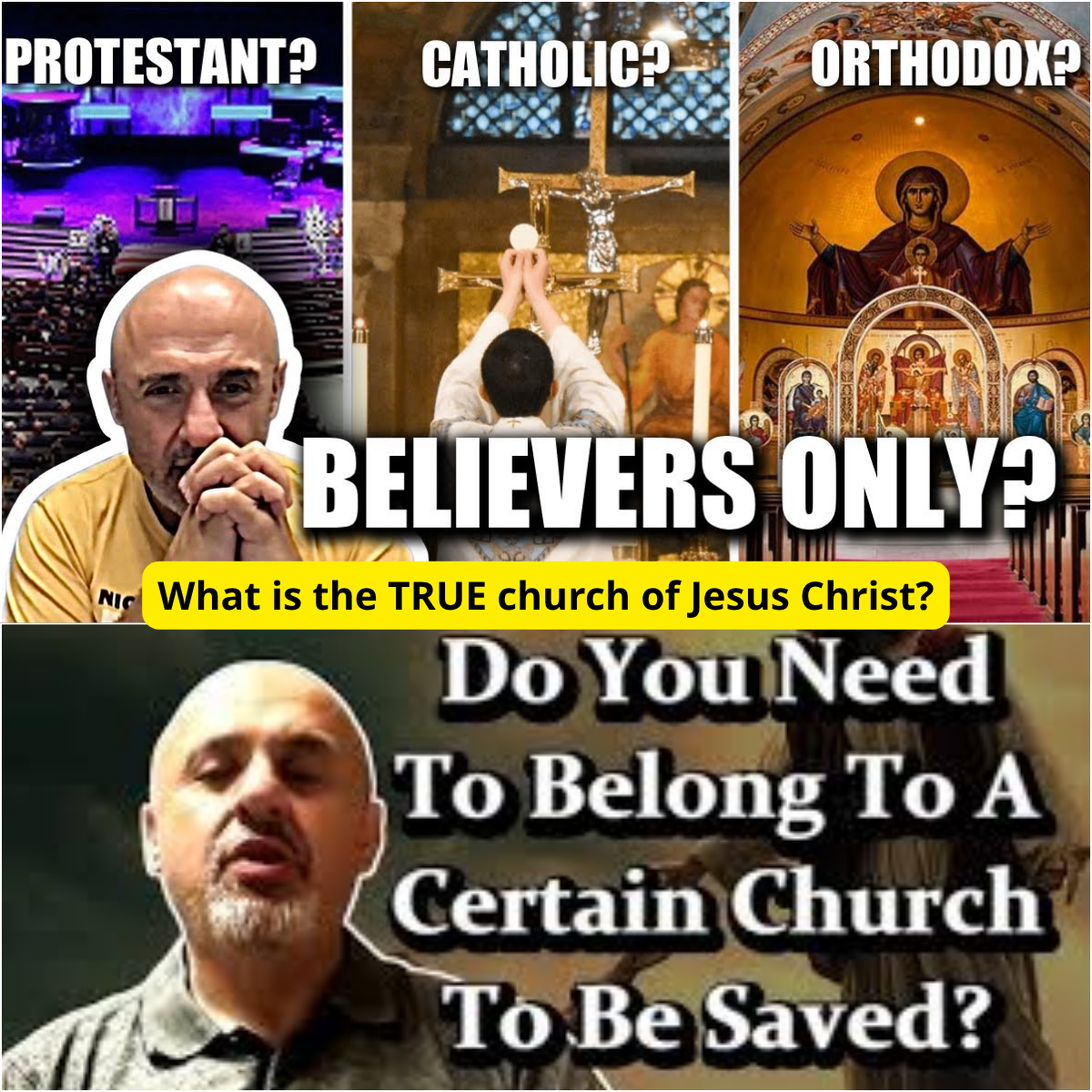
What is the TRUE church of Jesus Christ?
What is the TRUE church of Jesus Christ?
The ceiling fan in Kwaku’s small apartment in Accra revolved with a dry, rhythmic click, cutting through the heavy coastal humidity but doing nothing to cool the air. Outside, the night was loud with the characteristic sounds of the capital: the distant, competitive thrum of bass from rival charismatic mega-churches down the road, the low grind of trotros shifting gears on the asphalt, and the smell of roasting plantains drifting up from the street.
Kwaku sat at his small plastic desk, a laptop open in front of him. The screen glowed with the stark, blue-lit face of Terren, a fiercely traditional apologist broadcasting his live-stream from a studio in North America. Terren was a man who spoke in clean, uncompromising lines—a theological surveyor who didn’t believe in gray areas.
Kwaku cleared his throat, adjusting his headset. “Hi, Terren. My background is… well, I live in West Africa, Ghana. And I actually have three questions for you, if you don’t mind.”
“What’s your Christian denomination?” Terren’s voice cut through the static, immediate and sharp.
“I’m Protestant,” Kwaku said, his fingers tightening around a wooden cross he kept on his desk. “Or, I’m assuming I am. But I’m kind of in a place where I’m trying to figure things out, if that makes sense.”
“Okay,” Terren said, his eyes narrowing slightly through his glasses on the stream. “So, what’s your question?”
“The first one is on the idea of a ‘true church,'” Kwaku said, leaning toward his microphone. “I hear it a lot over here. The Catholics are saying they are the one true church. The Orthodox are saying they are the one true church. But it’s like… isn’t the true church just the believers of Christ? Because really, I mean, we, the believers—anybody who has accepted Jesus as their Lord and personal savior—aren’t we the body?”
Terren didn’t blink. He let the question hang in the air for a second, a small, knowing smile creeping onto his face. “So, by that definition, the Jehovah’s Witnesses and the Mormons… they are also part of the true church? Because they accept Jesus as their Lord and Savior.”
Kwaku paused, the ambient noise of Accra suddenly sounding very loud through his open window. “I mean… no. No, they aren’t.”
“Oh,” Terren said, leaning back, his voice dropping into a trap-jaw snap. “So now you have to qualify it. You’re changing your answer. So what is a true believer then?”
“A true believer is somebody who…” Kwaku hesitated, his mind scrambling through twenty years of Sunday school definitions. “Somebody who has accepted Jesus as Lord and personal savior, and… and witnesses to that.”
“Jehovah’s Witnesses believe Jesus is Lord and Savior in their own way,” Terren countered instantly. “So they’re the true church?”
“No,” Kwaku said, heat rising into his face. “You also have to… probably like accept the Trinity. Like, there are certain core principles. Core fundamentals that you probably need to have.”
“And who told you what those fundamentals are?” Terren asked. The chat on the side of the screen began to scroll at hyper-speed, a blur of commentary. “Who defined that list for you?”
“I’m… I’m just assuming,” Kwaku murmured, looking down at his desk.
“You see the point?” Terren said, his voice softening just enough to let the weight of the realization land. “You’ve already assumed to know what Christianity is, and you’ve already assumed that you have the criteria to determine what a true believer is. But it’s all based on your own private understanding. You’ve made yourself your own pope, Kwaku. How do you know you’re right?”
The Silent Commonality
Kwaku let out a long breath, his shoulders dropping. “Yeah. I don’t.”
“Exactly,” Terren said. “That’s why I’m pushing you, so you can realize the corner you’ve painted yourself into. Because if you tell me, ‘Well, the Bible says so,’ I’ll tell you two things. Number one: it’s your private interpretation of the Bible that says so. Number two: even the Bible you are holding right now was given to you through the historical Church. How do you even know what the Bible is apart from that Church? You have to look at history.”
Terren reached for a heavy leather volume on his desk, flipping it open but keeping his gaze fixed on the camera.
“Look at the first three hundred years of church history,” Terren continued. “Look at the church that God actually used to preserve the text, copy the manuscripts accurately, and explain them. Those ancient Christians taught the very things you find today in the Catholic and Orthodox communions. I do this all the time, and I’ll do it again right now.”
Terren leaned forward, pointing a finger at the lens. “If you ask the Oriental Orthodox, the Eastern Orthodox, the Syrian Church, and the Roman Catholic Church about what they believe in common—not their differences, because if you actually study the schisms, they aren’t even based on core moral doctrines; they’re ancient disputes over the precise language of how Christ is one person with two natures—but look at what they share.
Do they all believe in Mary’s perpetual virginity? Yes. Do they all believe Mary was kept pure by the grace of God to be the living Ark of the New Covenant? Yes. Do they all celebrate her Dormission—that the Lord took her soul and body into heaven? Yes. Do they all believe in the intercession of the saints, that those who have died in Christ are alive, perfected, and praying for us? Yes. Do they all believe the Eucharist literally becomes the body and blood of Christ? Yes. Do they all believe water baptism is the instrument used by the Spirit to save you? Yes. Do they believe in infant baptism? Yes. On and on it goes.”
Terren slammed the book shut, the sound a sharp crack over the audio feed. “Now explain this to me, Kwaku. These churches have been in total schism since the fifth century. The Syrian Church broke off over Nestorius. The Oriental Orthodox rejected the language of Chalcedon in 451 AD. They separated across thousands of miles of desert and sea. They had no internet. They had no email. They had no iPhones. They couldn’t communicate, and they didn’t want to communicate because they had condemned each other as heretics. Yet, fifteen hundred years later, they preserve the exact same complex, sacramental dogmas. How do you explain that?”
Kwaku stared at his monitor, his mind tracing the vast geographic sprawl from Rome to Alexandria, from Damascus to the mountains of Ethiopia. “I mean… they were passed down, right?”
“From whom?” Terren demanded.
“From… from the disciples, over time.”
“Exactly!” Terren’s hand hit the table. “Because if you have churches separated by vast distances and centuries of silence, and they all hold these identical, non-negotiable anchors, it means these teachings were spread universally long before the divisions of the fifth century. They are ancient. They are apostolic. And if God is in charge of preserving His Church, He is not going to allow the entire global body to accept completely false, paganized doctrines universally for fifteen hundred years. If the Church went totally corrupt in the 400s, then Christ lied when He said the gates of hell wouldn’t prevail.”
Terren leaned back, his expression turning sober. “And that means, fundamentally, bye-bye to Protestantism. Even your modern Protestantism comes out of the Roman Catholic Church. The Reformers were all children of Rome. Luther himself was an ordained Catholic priest. Whether you like it or not, Kwaku, your spiritual history runs directly through the very institutions you’re trying to bypass.”
The Weight of the Ninety Percent
Kwaku rubbed his temples, the weight of the historical timeline pressing down on him like the pre-storm atmosphere outside. “Yeah… yeah, I do understand that. I see the logic. But then… it’s like I’ve been raised in a specific system. I don’t know if you know how the culture is here, Terren.”
“Tell me,” Terren said.
“The culture here, in this part of the world… let’s say ninety percent of the Christians around me are born into Protestantism. Independent ministries, evangelical chapels, charismatic fellowships. It’s what is natural for us. It’s common. Everyone I know, my whole family, my friends—they are all in these churches.”
“Let me tell you something,” Terren said, his voice dropping into a lower, warmer register that caught Kwaku off guard. “Don’t worry about the ninety percent. Let God worry about them. You need to worry about you, because right now, God is exposing you to more truth. God meets people where they are at, Kwaku. Those millions of Protestants in your country who worship with sincere hearts—they have no fault of their own in this. They were born into that stream; they don’t know any better history. God extends His mercy, His love, and His grace to them right where they are standing, and He saves them.”
Terren’s face became intensely serious on the screen. “But don’t use them as a shield. God, in His grace, is giving you more revelation and illumination. You are learning the roots. And the more you know, the more you will be held accountable. The greater the knowledge, the greater the judgment when you stand before the altar. So instead of focusing on the ninety percent who don’t know what you now know, the question is: what are you going to do with the truth that’s sitting on your desk?”
Kwaku looked at his Bible, then at the concrete walls of his room. The sense of isolation felt suddenly immense. “But there’s a practical difficulty, Terren. Where do I fellowship? If I look around Accra… I think there is only one Orthodox church that I even know of, and it is very far from my neighborhood. It’s deep in another district. I won’t be able to get there every week. The transport, the time—it’s not possible with my job.”
“Brother,” Terren said, his eyes locking onto the camera lens with absolute certainty. “Your God will make a way if He sees your heart is sincere. Think about it. You would travel miles across the country, you would cross borders if you had to, for a better education, for a better life, or for a job that paid you three times your current salary. We make those sacrifices for the world without thinking twice. Is Jesus not worthy of that same sweat?”
The apologist paused, letting the challenge settle into Kwaku’s mind before softening his tone. “But listen to me: God sees your actual condition. If you physically cannot get there, He is not going to damn you to hell for the logistics of your city. There is a difference between a man who can go but chooses convenience, and a man who wants to go but is truly trapped by his circumstances. God meets you in your inability. If all you have right now—because of a genuine lack of options—is that Protestant church down the street, then you keep going there to hear the Word preached.”
The Untouched Cup
“But,” Terren added, his finger rising to emphasize the boundary line, “you go there with your eyes open. Since you now know the history, since you know that their sacraments are not connected to that ancient, apostolic root… when they pass around the tray with the plastic cups of grape juice and the crackers, you don’t touch it. You don’t partake of their communion.”
Kwaku felt a distinct chill. “Don’t take it at all?”
“No,” Terren said flatly. “Let me give you an example from my own life. Right here where I live, there is an evangelical church just around the corner from my house. Sometimes on a Monday night, if I want to hear a specific sermon or study, I walk over there and sit in the back row. But they have what they call ‘open communion.’ They pass around the cracker and the juice. It is not the Eucharist. There is no priesthood there, no apostolic succession, no real presence. I don’t dare touch it. If I did, I would be sinning against my own conscience because I know better.”
Terren leaned back, the screen showing him checking his audio levels as the next caller lined up in his queue. “That is the only option you have in light of your situation, Kwaku. You go, you study, you pray, and you ask God to open a door to the true altar. And until He does, you keep your hands off the imitation. God understands your situation better than you do. Trust Him with the distance.”
The line went quiet for a moment before Terren’s producer clipped the connection to move to a caller from Chicago, leaving Kwaku sitting in the sudden silence of his apartment.
The fan continued its steady, metallic scrape overhead. Kwaku took off his headset and set it on the desk next to his laptop. Outside, the bass from the charismatic church down the road seemed to shake the louvers of his window, a vibrant, modern sound that felt incredibly present, yet suddenly hollow.
He looked down at his hands, then at the small wooden cross. On the table sat a plastic bottle of water and a piece of bread he had bought for dinner. He thought about the millions of people in his city, the ninety percent who would wake up on Sunday morning to sing and pray in warehouses and glass-walled cathedrals, completely unaware of the fifth-century lines drawn across the earth.
He knew he would still go to his local fellowship the coming Sunday; his mother would be waiting for him by the steps, and his friends would occupy their usual bench. But he also knew that when the trays were passed down the row—when the neat little cups of juice reached his section—he would simply pass the wooden tray along to the person next to him without taking one. He would sit there in the crowded, loud room, a Protestant by geography but an exile by history, waiting for the road to the distant altar to finally clear.









