Three Rich Men Refuse to Pay the Waitress Until the Billionaire Owner Shows Up Behind Them
Three Rich Men Refuse to Pay the Waitress Until the Billionaire Owner Shows Up Behind Them
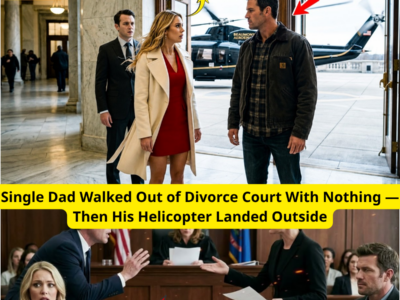
The afternoon light cutting through the leaded-glass windows of the Magnolia Bistro was golden, thick, and entirely unbothered by the human drama unfolding at table twelve.
“Do you really expect us to pay for this?”
The voice belonged to a man in his late thirties, his hair slicked back with expensive pomade. He sneered up at the young woman standing by his elbow, ensuring the heavy gold Rolex on his wrist caught the sun as he carelessly tossed a leather-bound bill fold back onto the table. It slid into a pool of condensation left by his half-empty glass of sparkling water.
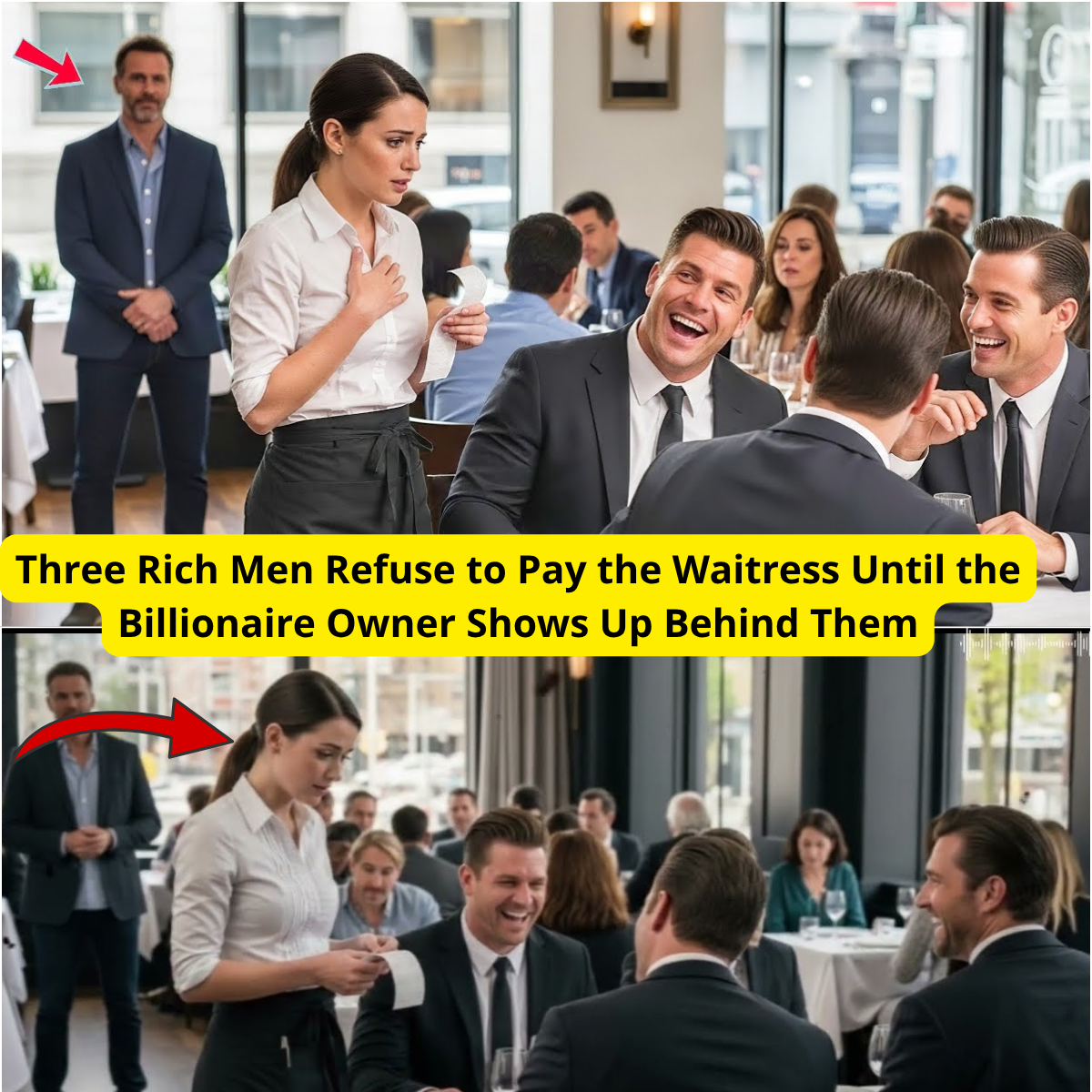
Emily Carter froze. Her fingers, stained lightly with espresso foam and locked tight around a heavy oval serving tray, began to tremble. Her shift had already stretched past six grueling hours on her feet. Her lower back was a dull ache, her aproned waist was damp from a minor spill at the service bar, and she couldn’t remember the last time she had taken a full breath of air that didn’t smell like burnt butter and garlic.
And now, this.
Sitting in front of her were three men impeccably dressed in custom-tailored linen suits, looking as though they had just stepped off a yacht at the marina down the street. They had spent the last ninety minutes ordering premium ribeyes, vintage wines, and imported desserts, all while treating her like an invisible fixture of the room. Now, they were refusing to honor the simplest, most fundamental courtesy of a civilized society: paying for what they had consumed.
Emily’s heart began to hammer against her ribs, a volatile cocktail of cold fear and hot frustration rising in her chest. In her three years at Magnolia Bistro—a high-end establishment nestled in the historic heart of Savannah’s waterfront—she had encountered her fair share of difficult patrons. She had dealt with demanding tourists, impatient local politicians, and eccentric old money. But there was something uniquely malicious about the aura of entitlement radiating from these three. They weren’t complaining about a cold steak or a forgotten side dish. They were laughing among themselves, exchanging quick, amused whispers as if her growing distress were a private punchline designed specifically for their entertainment.
“Sir, I’m just doing my job,” Emily said. She was proud of how steady her voice sounded, even though her stomach felt like it was riding an elevator with a broken cable. “If there is a legitimate issue with the preparation of your meal or the accuracy of the bill, I can bring my floor manager over right away to resolve it.”
The man in the center—tall, broad-shouldered, with an aggressive jawline and a silk pocket square—leaned back in his leather chair. He folded his hands over his stomach and smirked up at her, deliberately raising his voice so the neighboring tables could hear.
“Call your manager? Little girl, we don’t need any managers here,” he said, his tone dripping with a condescending sweetness that felt worse than an insult. “We’re grown men. We decide what things are worth. And right now, we’ve decided that the slop you dragged out of that kitchen is worth exactly zero. So, we’re deciding to pay zero.”
His two companions chuckled softly, throwing small, mocking glances at her uniform before looking back at their phones.
Emily’s stomach sank down to her scuffed black work shoes. Every single dollar mattered to her. She wasn’t working this job for pocket money or a summer fund; she was juggling twenty-four credit hours at the state university while pulling forty hours a week at the bistro to support herself and her fourteen-year-old brother, Leo, since their mother had passed. Every tip paid for groceries; every dollar kept the electricity from being cut off in their small apartment over the garage. To these men, the two-hundred-and-eighty-dollar bill was pocket change, the price of a decent bottle of cologne. To her, if they walked out, corporate policy dictated an investigation, and a missed ticket could cost her a full week’s worth of shifts.
“I… I can’t let you do that, sir,” she stammered, hating the slight wobble that had crept into her tone. She tried to pull together a sense of authority she didn’t possess, her knuckles turning white as she gripped her tray like a shield. “This is a direct violation of restaurant policy. I cannot allow you to leave the premises without settling the account.”
“Ah, but you see,” the second man interrupted, leaning forward and resting his elbows on the linen tablecloth, invading her space. “We aren’t particularly afraid of a waitress. Let’s look at the hierarchy here, sweetheart. You work here to serve us, don’t you? That’s what that little apron means. Well, we are the customers, and we’ve decided your service today wasn’t worth a single penny. Now, take the folder away before I get annoyed.”
The words stung like a whip. It wasn’t the first time a wealthy patron had tried to belittle her because she wore an apron instead of a corporate blazer, but today, under the crushing weight of physical exhaustion and mental worry, the insult landed with devastating force. She felt incredibly small, exposed under the bright, elegant chandeliers of the dining room.
She cast a desperate glance around the restaurant, praying for an intervention. But the bistro was packed with the usual afternoon rush—lawyers, brokers, and tourists, all deeply absorbed in their own conversations, their own plates, and their own insulated worlds. No one was looking. No one wanted to get involved in a standard dispute between a server and a table.
Emily reached down, her hand trembling visibly as she picked up the leather folder containing the check. “I… I really must insist,” she whispered, her eyes flicking nervously toward the front doors. “If you refuse to pay, I will have no choice but to notify the owner immediately.”
The three men shared another amused look, the tallest one letting out a loud, barking laugh that caused a few diners at table ten to turn their heads.
“Notify the owner? Do you hear this, boys?” he mocked, leaning in. “You think Jonathan Sullivan is going to bother himself with a measly dinner bill? The man is a billionaire. He’s currently in Atlanta or New York running a global shipping empire. I highly doubt he’s going to waste a single second of his day listening to a low-level waitress whine about her tip.”
Emily felt her spirit begin to crack, but deep beneath the exhaustion, a stubborn spark of basic human dignity refused to go out. She knew her rights. She knew she had provided flawless service. More than anything, she knew that letting people like this walk over her was a habit she couldn’t afford to form if she wanted to survive in a world that routinely undervalued people who worked with their hands.
She opened her mouth to speak, to call their bluff, but before she could utter a syllable, the heavy oak and brass front doors of the Magnolia Bistro swung open with a distinct, authoritative weight.
The low hum of the dining room didn’t stop, but it shifted. Heads turned instinctively, drawn by the sheer presence of the newcomer.
Jonathan Sullivan had walked into the restaurant.
He wasn’t wearing a three-piece suit like the men at table twelve; he wore a simple, dark navy polo shirt, well-fitted dark jeans, and leather boots. But he carried himself with the unmistakable, quiet gravity of a man who owned the land beneath the building, the building itself, and the dock across the street. His sharp, piercing blue eyes scanned the room with practiced efficiency, immediately cutting through the ambient noise and locking onto the rigid posture of Emily and the sneering faces of the three men.
He didn’t hesitate. He walked straight down the center aisle, his stride calm but filled with an undeniable, heavy purpose. He stopped at the edge of the table, looking down at the scene.
“What seems to be the problem here?” Jonathan asked. His voice wasn’t loud, but it possessed a deep, resonant baritone that silenced the immediate radius of the room.
The three men shifted uncomfortably in their seats, their arrogant postures dissolving slightly as they realized the power dynamic in the room had just permanently altered.
“Uh, it’s nothing, really, Mr. Sullivan,” the first man began, his voice suddenly losing its sharp edge, his face flushing a light pink. “Just a minor misunderstanding about the quality of the vintage we were served. Nothing to trouble you with.”
Jonathan didn’t look at him. He kept his eyes fixed entirely on Emily, his expression softening into a calm, encouraging mask. “Emily. Tell me what happened.”
Taking a deep, shaky breath, Emily seized the lifeline. She didn’t exaggerate; she didn’t cry. In short, precise sentences, she explained exactly what had transpired over the last ten minutes. She described the refusal to pay, the explicit mockery of her position, and the flat statement that her labor wasn’t worth a penny. As she spoke, she watched Jonathan’s jaw tighten. His face didn’t twist into a mask of rage, but his eyes grew incredibly cold—a deep, protective sense of justice settling over his features.
When Emily finished, Jonathan turned slowly to face the three executives. The silence around table twelve was now absolute. Even the clinking of silverware at the back of the restaurant seemed to die down.
“You think it’s acceptable to treat my staff this way?” Jonathan asked, his voice low, steady, and terrifyingly calm.
The tallest man, trying desperately to salvage his dignity in front of his associates, cleared his throat and offered a weak, defensive smile. “Look, Sullivan, we’re clients of the firm down at the avenue. We come here all the time. We didn’t mean any harm, we were just making a point about the service—”
“I don’t care who you are, and I certainly don’t care about your points,” Jonathan interrupted, his words cutting through the man’s excuse like a sheet of ice shattering on pavement. “You don’t get to decide what is acceptable in this establishment. My employees are the absolute backbone of this business. Without them, you wouldn’t even have the luxury of sitting here in your fancy suits, drinking my wine and looking out at my river.”
He stepped closer to the table, leaning down slightly so his shadow completely engulfed the lead speaker.
“You will pay your bill. Every single penny of it. And then, you will stand up, you will look this young woman in the eye, and you will apologize for your disgusting behavior. If you choose not to, I will personally have the police department waiting at the front door to charge you with theft of services, and I will ensure your names are printed in the local business ledger by tomorrow morning.”
The three men swallowed heavily, their faces burning with an intense, public embarrassment. The realization that their wealth and status meant absolutely nothing to the man who controlled the room had hit them with the force of a physical blow.
With fumbling, nervous fingers, the man in the center reached into his tailored jacket, pulled out a thick leather wallet, and hastily extracted three one-hundred-dollar bills. He slammed them down onto the table, his hand shaking slightly.
“Keep the change,” he muttered, his voice choked with humiliation.
“No,” Jonathan said coldly. “Emily will take exactly what is owed for the food. The rest you will leave on that table as a penalty for her time. Now, the apology.”
The three men stood up, their expensive chairs scraping loudly against the hardwood floor. They refused to look at Jonathan, their eyes fixed on the floor or the table. The leader looked at Emily, his jaw clenched. “We apologize for the remarks,” he muttered quickly.
“We’re sorry,” the other two echoed in a hurried whisper.
Without waiting for a response, they grabbed their briefcases and quickly exited the restaurant, their heads bowed as they hurried past the front desk, leaving behind a thick, lingering tension that felt almost palpable.
The moment the front doors clicked shut behind them, a spontaneous, soft wave of applause broke out from the surrounding tables. The local attorneys and regular diners nodded in approval, acknowledging the quiet victory of dignity over arrogance.
Emily let out a long, ragged breath she felt like she had been holding for an hour. The intense tension in her shoulders began to melt, replaced by an overwhelming wave of relief and gratitude. She tried to offer a professional smile, but her eyes were bright with unshed tears.
Jonathan walked over, completely ignoring the applause from the room, and placed a reassuring, steady hand on her shoulder. “I’ve got your back, Emily,” he said quietly, his voice carrying a warmth that was meant for her ears alone. “You never have to take that from anyone. Not in my house.”
“Thank you, Mr. Sullivan,” she whispered, her throat tight with emotion. “Thank you for walking in when you did.”
Jonathan chuckled lightly, shaking his head as he looked at the cash left on the table. “No, Emily, thank you. I know it might not feel like it when you’re standing in the middle of a storm like that, but defending the people who work hard, stay honest, and keep this world running is the most important part of any business I own. It’s the most important part of any decent life. Never, ever let anyone make you feel small for simply doing your job with integrity.”
For the first time that entire afternoon, Emily felt like she could truly breathe. She looked down at her uniform apron, and for some reason, it didn’t feel like a symbol of servitude anymore; it felt like a badge of honor. She realized that her courage, even when it was mixed with a terrifying amount of fear, had held the line. She had stood her ground, and fairness had arrived because she refused to simply bow her head and let the world roll over her.
As the restaurant slowly returned to its usual hum of activity—the clinking of glasses, the murmur of polite conversation, the rush of the kitchen doors—Emily moved through her remaining tables with a completely renewed sense of confidence. The old ache in her feet was still there, but her posture was straight, her head held high. Customers smiled warmly at her as she passed, some leaving extra tips, others offering quiet words of validation.
By the time her shift ended and the golden afternoon light turned into the deep, indigo shadows of a Savannah evening, Emily knew that something fundamental inside her had shifted. She understood now that courage wasn’t some magical absence of fear; it was the decision to stand tall even when your heart was hammering against your ribs.
The three men never returned to the Magnolia Bistro. But the story of their arrogance and the young waitress who refused to be broken by it became a permanent part of the building’s lore, a quiet reminder to everyone who worked or dined there that dignity, honesty, and respect were always worth fighting for.
Emily stepped out of the employee exit into the soft, cooling evening air. She was exhausted, her body spent, but as she walked toward the bus stop under the streetlights, she looked up at the stars. Life would undoubtedly continue to test her, but she finally had the proof she needed: integrity, when met with persistence, could overcome the heaviest storms the world could throw her way.