They Were Just Living a Normal Day in Pompeii | Until Vesuvius Ended Everything
They Were Just Living a Normal Day in Pompeii | Until Vesuvius Ended Everything
The morning of August 24th, 79 AD, broke over the Bay of Naples with a clarity that felt almost deceptive. To the twenty thousand souls living in Pompeii, it was just another Thursday. The summer heat had settled deep into the volcanic soil of Campania, but at dawn, the narrow stone streets still held the faint, lingering coolness of the night.
In a small bakery near the Via dell’Abbondanza, a woman named Julia adjusted the wooden peel in her hands, sliding smooth, round mounds of dough into a massive brick oven. The scent of yeast and charring wood swelled into the air, mixing instantly with the sharper, saltier tang from next door. There, a merchant named Marcus was busy on the threshold of his shop, grunting as he slid heavy ceramic amphorae of garum—the fermented fish sauce that made Pompeii famous across the empire—into a neat row to catch the eyes of morning buyers.
A block away, the sharp slap of leather sandals on stone echoed through an alley. Two children, laughing and trading breathless insults in street Latin, darted past a plaster wall heavily scored with fresh election graffiti. They nearly collided with a magistrate’s slave, who hurried toward the forum carrying a bundle of rolled papyrus correspondence, his mind fixed entirely on his master’s demanding schedule. Meanwhile, in the quiet, shaded courtyard of the gladiatorial barracks, a murmillo named Crescens stretched his heavily muscled arms, his skin glistening with oil as he eyed the wooden training post.
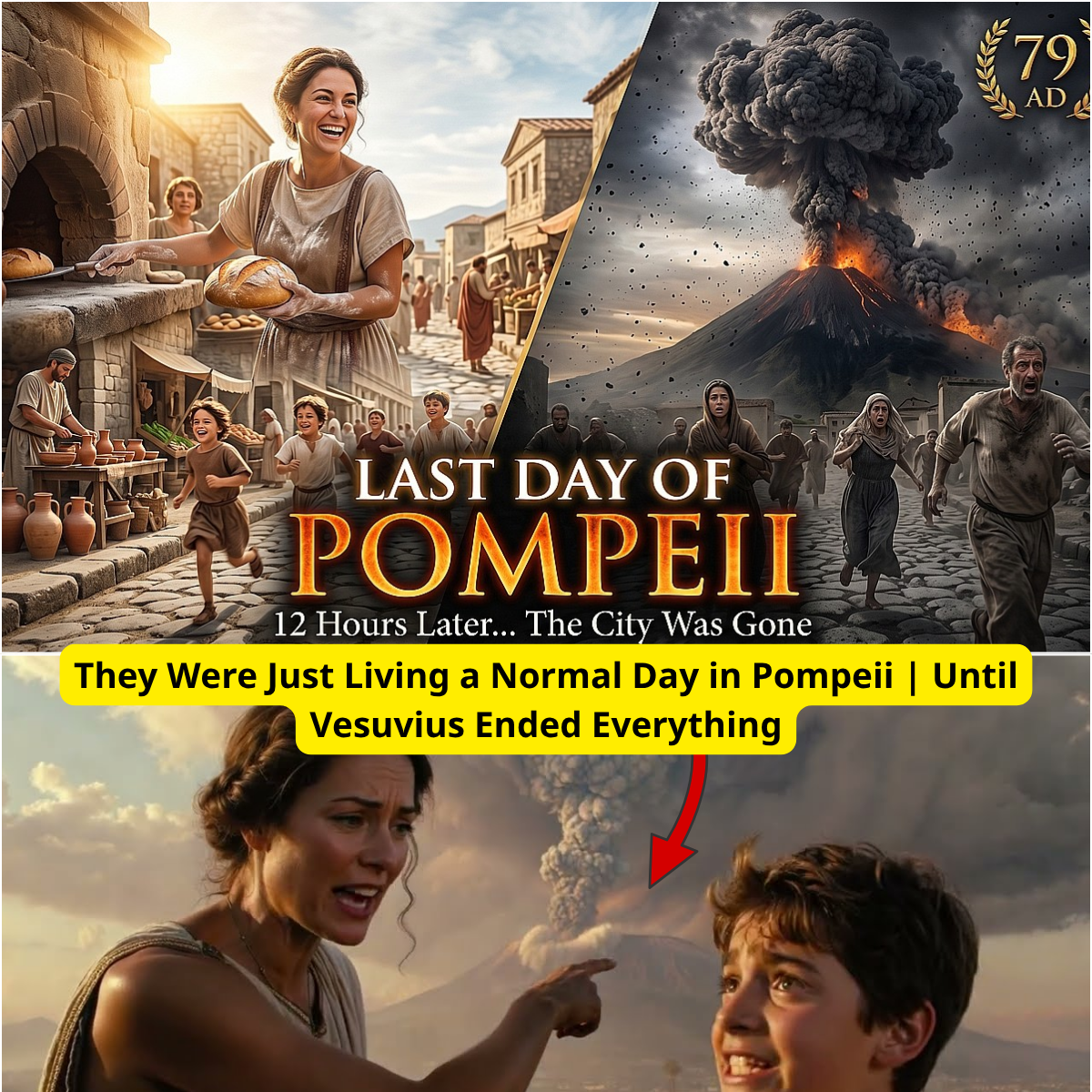
None of them looked at the mountain. Why would they? To the people of Pompeii, Vesuvius was not a threat; it was a blessing. Its emerald slopes were carpeted with rich, terraced vineyards that produced some of the finest, sweetest wines in the Roman world. It was simply a beautiful, silent backdrop to their noisy, ambitious, deeply alive existence.
None of them knew that in less than twelve hours, the ground beneath their feet would tear open, and the city they loved would cease to exist.
Pompeii was a city in the middle of a sentence. It was not a grand imperial capital like Rome, nor a center of philosophy like Athens, but it possessed a confident, comfortable wealth. Built at the mouth of the Sarno River, it was a bustling commercial hub where goods from across the Mediterranean converged.
To walk its streets that morning was to experience a sensory assault. The grinding of iron-rimmed cartwheels over deep basalt ruts, the high-pitched bartering of textile merchants at the building of Eumachia, and the thick, sour heat rising from the fullonicae—the public laundries where workers stomped on fabrics in vats of aged urine—created a chaotic symphony of urban life.
For the hungry citizen or traveler, Pompeii offered unparalleled convenience. Street-side restaurants, the thermopolia, occupied nearly every major corner. Their stone counters, embedded with deep ceramic jars called dolia, served up hot stews of lentils, pork rinds, and roasted duck to customers on the go.
It was a deeply democratic, intensely expressive landscape. Everywhere you looked, the walls spoke. Ordinary Romans used charcoal and iron styluses to scratch their innermost thoughts directly into the painted plaster of homes and public buildings. Some were political, with professional sign-writers painting bold endorsements for the upcoming aedile elections. Others were fiercely personal. Lovers scratched vows of eternal devotion, while rivals flung crude insults. On one wall near the forum, a traveler had hastily scribbled: “Gaius Pumidius Dipilus was here.” On another, an explicit, humorous directive remained: “Restitutus, take off your tunic, please, and show us your hairy privates.”
It was messy, flawed, and vibrant. It was a community completely absorbed in the business of living. And then, the mountain changed the script.
The warnings had been there for weeks, but the ancient world lacked the language of geology to read them. Deep beneath the earth, superheated magma was shifting, forcing its way upward and displacing the regional water table. Across Campania, deep wells and freshwater springs that had fed the towns for generations suddenly went dry.
The animals knew first. In the days leading up to the disaster, farm dogs grew restless, refusing to eat and howling at the dirt. Sea birds, usually thick along the rocky coast of the bay, vanished entirely from the sky, flying inland toward the Apennines.
Then came the tremors. Minor earthquakes rippled through the city, rattling glassware on tables, cracking a few fresh coats of plaster, and causing tavern keys to jingle on their pegs. Yet, the Pompeians were largely unbothered. Seventeen years earlier, in 62 AD, a massive earthquake had leveled large portions of the city. Pompeii had spent nearly two decades rebuilding itself, modernizing its theaters, patching its temples, and expanding its baths. To the average citizen, a shaking floor was merely an annoyance—the recurring tax one paid for living in a coastal paradise.
Across the bay, roughly thirty kilometers to the northwest at the imperial naval base of Misenum, the standard routine of the Roman elite was underway. Pliny the Elder, the famous naturalist and commander of the fleet, was at his desk studying. His seventeen-year-old nephew, Gaius Plinius Secundus—known to history as Pliny the Younger—was focused on his rhetoric lessons.
At approximately one o’clock in the afternoon, Pliny’s sister noticed something strange on the horizon. She called her brother and son to the terrace. Looking across the blue water of the bay, they saw an extraordinary sight: a colossal, dark cloud rising from the summit of Vesuvius. It shot straight up into the stratosphere like a massive tree trunk, before spreading out at the top into vast, branch-like plumes.
Pliny the Elder, driven by an insatiable scientific curiosity, immediately ordered a light vessel to be prepped so he could sail across the bay and investigate. But before he could leave the dock, a messenger arrived with a frantic letter from a friend named Rectina, whose villa sat directly at the foot of the mountain. The only escape route was by sea, and she was trapped.
The commander’s mission instantly shifted from scientific exploration to a massive naval rescue. He ordered the great quadriremes to launch, sailing directly into the maw of the developing nightmare.
The detonation of Vesuvius was sudden and total. In modern scientific terms, it was a Plinian eruption—the most violent, catastrophic category of volcanic event. The initial explosion tore the mountain’s peak apart, launching a column of superheated gas, ash, and pulverized rock eighteen kilometers into the sky with the force of a nuclear blast. The deafening roar of the rupture rolled across the Italian peninsula, heard hundreds of miles away.
In Pompeii, eight kilometers downwind to the southwest, the sky simply vanished. The afternoon sun was choked out in minutes, plunging the city into an unnatural, terrifying midnight. Then came the rain.
It was not ash at first, but pumice—lightweight, porous volcanic stones that cascaded from the black sky like frozen gray hail. It rattled against the clay roof tiles, bouncing off the stone streets and piling up in inches, then feet.
This was the critical moment of human choice, the dividing line between life and death. The city did not die instantly; the pumice rain was terrifying, but it was survivable. For hours, a window of escape remained open.
Thousands recognized the peril. They poured out of their homes, grabbing whatever was closest—a handful of silver coins, a gold bracelet, the keys to their front doors—and flooded through the city gates. They used cloaks, shirts, and even tied pillows to their heads with linen cloths to protect themselves from the falling stones. They staggered through the dark, guided only by flickering torches, making their way toward the sea or the open roads leading south to Stabiae and Salerno. In many cases, these people survived.
But others stayed. Some were elderly or sick, unable to move through the rapidly accumulating rocks. Some were slaves, ordered by absent masters to guard the family wealth on pain of crucifixion. Others were simply paralyzed by the sheer incomprehensibility of the event, retreating deep into the inner rooms of their villas, praying to the gods that the anger of the mountain would pass.
As afternoon turned to night, the trap closed. The weight of the pumice on the roofs became unbearable. Heavy oak beams groaned and snapped, collapsing upper floors and crushing those huddled beneath them. The streets became impassable, filled with drifts of white stone four to six feet deep. Exit doors were blocked from the outside by the rising tide of rocks.
Then, in the early morning hours of August 25th, the physics of the eruption shifted, and the true executioner of Pompeii was unleashed.
The towering column of volcanic debris, which had reached a staggering height of thirty kilometers, could no longer sustain its own immense weight. The upward pressure of the volcanic gas slackened, and the massive cloud collapsed under gravity.
When a Plinian column collapses, it does not fall gently. It drops back to earth and surges outward in what geologists call pyroclastic density currents. These are terrifying, fast-moving avalanches of superheated gas, ash, and pulverized rock. They slide down the slopes of the volcano like liquid fire, traveling at speeds exceeding seven hundred kilometers per hour. The temperature inside these clouds can top 300°C (over 570°F).
The first surge hit Herculaneum, a wealthy coastal town north of the volcano, around one in the morning. The city was incinerated and buried in seconds.
By dawn, the subsequent, larger surges rolled over the walls of Pompeii. For those who had survived the night in basements, vaults, and public temples, there was no escape. The superheated air struck them before the physical ash did.
At 300°C, death is instantaneous. The intense heat causes muscles to contract violently into a defensive posture known as the pugilistic stance. Brains boiled, bones fractured from thermal shock, and the lungs were scorched in a single, agonizing breath.
When the cloud finally settled, it deposited a thick, uniform blanket of fine ash over everything. It filled every room, contoured around every fallen pillar, and sealed the bodies of the dead exactly where they had spent their final seconds. The ash cooled and hardened, forming a protective, airtight shell over the city. Over centuries, the rain soaked through the earth, the flesh decomposed, the clothing rotted, and the bones crumbled, leaving behind perfect, hollow voids in the compressed volcanic soil—hollow molds of the dead.
The memory of Pompeii did not vanish immediately, but it faded with agonizing completeness. The Emperor Titus sent imperial commissioners to Campania to distribute aid to survivors and organize refugee resettlement in nearby Neapolis and Cumae. But the city itself was gone, buried under eighteen feet of stone. Eventually, the grass grew back. Vines took root in the volcanic soil. The Sarno River altered its course, and the coastline shifted outward.
For seventeen centuries, Pompeii became a phantom, a name whispered in old tax documents and classical texts, its precise location entirely forgotten.
It was not until 1748 that a Spanish military engineer named Roque Joaquín de Alcubierre, surveying land for a royal canal near the town of Civita, hit a massive stone wall beneath the dirt. Subsequent excavations revealed frescoes of staggering brilliance, intact marble statues, and paved streets. They had found Pompeii.
The world was stunned. This was not an archaeological site of broken pillars and weathered foundations; it was a city frozen mid-breath. Loaves of bread, carbonized but perfectly preserved, were still sitting inside Julia’s bakery oven. Amphorae of Marcus’s garum stood by the tavern doors.
Yet, the ultimate breakthrough in understanding the human cost of Vesuvius came in 1863, when the Italian archaeologist Giuseppe Fiorelli took charge of the digs. Workers had long complained about encountering odd, hollow spaces in the hardened ash that contained nothing but a few fragments of bone.
Fiorelli realized what these voids were. He devised a brilliant, simple technique: clear a small hole into the top of a void, pour in liquid plaster of Paris, wait for it to harden, and then carefully chip away the surrounding volcanic ash.
The results devastated the world.
The plaster did not produce statues; it produced the exact, terrifying shapes of human beings in the precise moment of their deaths. It captured the texture of their tunics, the leather straps of their sandals, and the expressions of their final agony.
The casts revealed narratives that historical texts could never capture. There was the heavy guard dog, chained to his post in the House of Vesonius Primus, contorted and twisting onto his back as he tried desperately to climb above the rising ash. In a small room, a family of four was discovered; the mother and father had fallen over their two small children, their arms outstretched in a futile, beautiful attempt to shield them from the heat.
One young woman died with her face pressed firmly into her wool cloak, trying to filter out the toxic gas. Another cast revealed a pregnant woman, her hand resting near her stomach. In the gladiatorial barracks, a man was found shackled by his ankles in a cell, unable to run as the darkness closed in.
These casts are not art. They are the physical imprints of real people who had families, fears, routines, and names. In their final postures, something deeply, fundamentally human survived both the mountain and the passage of two millennia.
Today, Pompeii stands as the most complete and vital archive of ordinary Roman life in existence. It has allowed historians to bypass the grand histories of emperors and generals and look directly into the lives of the working class.
We know what they ate for lunch, not because of recipes, but because the carbonized remnants of their meals—sea urchins, figs, lentils, and olive pits—remain in the bowls of the thermopolia. We know how they conducted politics, down to the fact that night-workers and late-night drinkers banded together to endorse specific candidates on town walls. We know the cosmopolitan makeup of the Roman Empire; modern DNA analysis of the bones within the casts has revealed that Pompeii was an incredibly diverse melting pot, with residents tracing their lineages back to North Africa, the Near East, and the Danube.
The volcano did not just destroy a city. It preserved a mirror of ourselves.
On that distant morning of August 24th, 79 AD, the people of Pompeii woke up to a normal day. They argued with their spouses, checked their financial ledgers, swept their doorsteps, and baked their bread. They had no idea they were about to become history’s most profound witnesses to an ancient world.
Vesuvius silenced the city, but it could not silence the people. Every footstep worn into the stone thresholds of its shops, every name scratched into its plaster walls, and every shape captured in Fiorelli’s plaster is a voice speaking across the centuries.
Pompeii was a city that died in a single afternoon, and it has been speaking to us ever since.