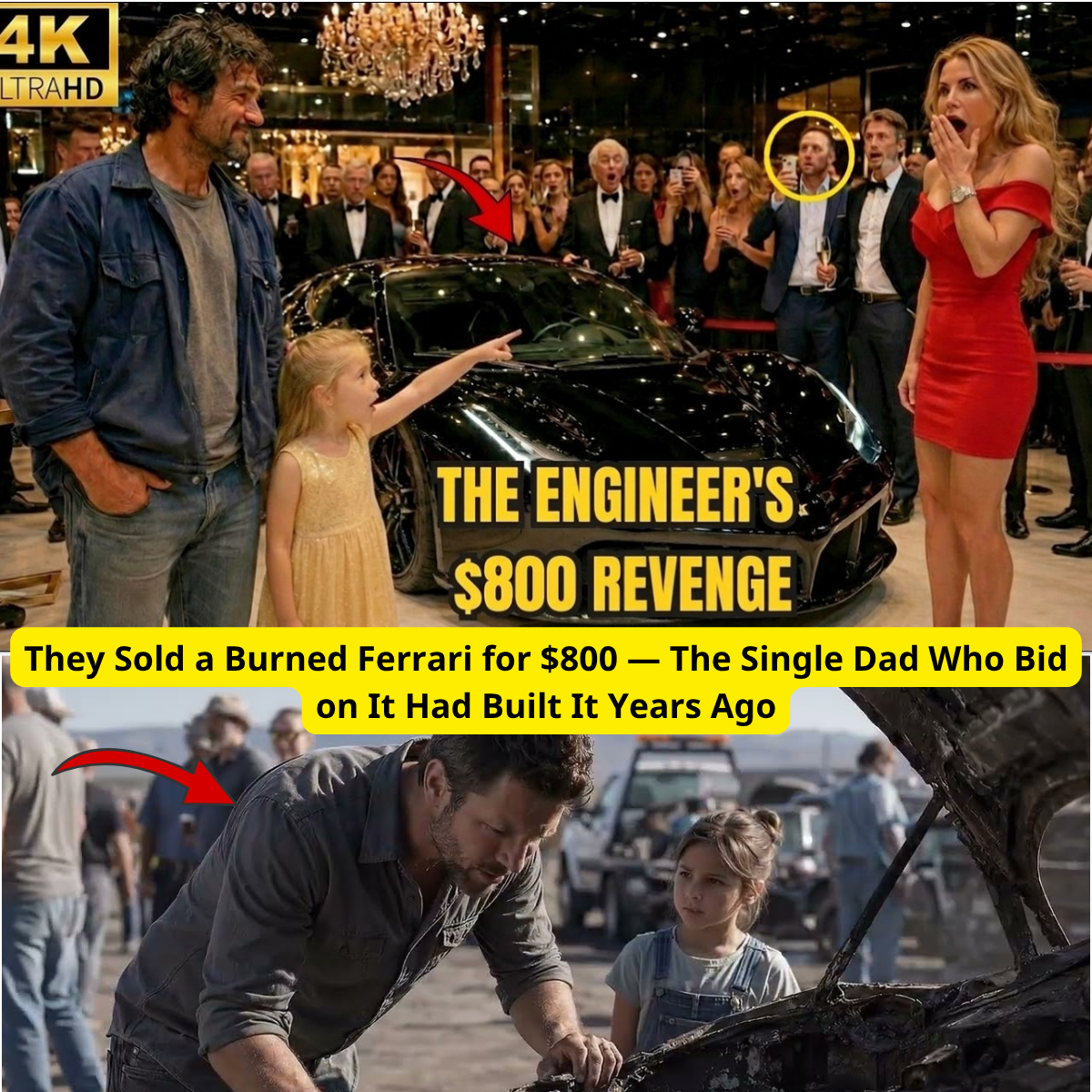
They Sold a Burned Ferrari for $800 — The Single Dad Who Bid on It Had Built It Years Ago
They Sold a Burned Ferrari for $800 — The Single Dad Who Bid on It Had Built It Years Ago
The salvage auction outside Las Vegas occupied a gravel-strewn lot on the absolute, bleeding edge of the desert, where the city’s electric neon glow faded into a vast expanse of nothingness. Here, the ground turned a pale, chalky gray, stretching out flat and indifferent in every direction.
On a searing Thursday morning in late July, with the sun already punishing the earth at 7:00 AM, 140 vehicles were lined up across three acres of cracked, heat-buckled concrete. Some were heavily charred by engine fires; some were waterlogged and reeking of river silt from distant flash floods; others were simply crushed into abstract shapes that made their original automotive forms difficult to reconstruct. This was not a place for the hopeful, the romantic, or the sentimental. This was a graveyard for the practical—a staging ground for people who understood that value was a subterranean quality, and for those who simply needed mechanical parts cheap enough to justify the long, dusty drive out into the heat.
Mason Reed arrived with his eight-year-old daughter, Ava, in a white Ford F-150 that had clocked 180,000 miles and was not particularly troubled by the fact. At forty years old, Mason was lean in the specific, wire-drawn way men get when they spend decades working with their hands in confined, uncooled spaces. His forearms were mapped with faint, pale scars—the permanent record of reaching into tight engine bays and gripping heavy steel components that stubbornly resisted being moved. He wore a faded charcoal work shirt that had been through the wash too many times to count, heavy boots that had been resoldered and resoled once, and nothing else that required description. Standing among the assembled salvage dealers and high-end parts brokers with their crisp polo shirts and confident, predatory postures, Mason looked like a man who had materialized from a completely different world. Which, in a way, was entirely true.
Ava stood close to his hip. At eight years old, she already understood that the proper behavior at a live salvage auction was to maintain a quiet, vigilant stillness. She had dark, serious eyes that moved slowly across the lot, taking in the chaotic machinery with a patience unusual for a child her age. It was a trait she had developed without ever being asked to, a byproduct of spending her formative years in the quiet corners of her father’s shop while the world spun fast outside.
The auctioneer moved through the early lots with the brisk, rhythmic indifference of a bureaucratic process that did not require anyone to care about what was being sold. Flood-damaged commercial pickups went for a song. A pair of sport motorcycles with severely bent frames were cleared in seconds. A regional delivery van that had been rear-ended with enough violent force to collapse its cargo area by two full feet was aggressively bid down. The buyers moved through the wreckage with practiced, transactional calm.
Then, a heavy-duty flatbed truck rolled slowly through the chain-link gate.
What sat chained to its bed had once been a Ferrari. Now, its original factory color was completely unidentifiable. The aluminum body had been subjected to an intense, localized fire, a blaze serious enough to turn the exotic paint into flaking carbon and the polished chrome trim into a dull, lusterless metallic gray. The passenger side remained intact in its general outline, though it had been completely hollowed out, stripped bare of everything that had once constituted an interior. The driver’s side had taken a heavy physical impact—not quite catastrophic enough to tear the chassis apart, but sufficient to depress the structural door frame and severely misalign the low, aggressive roofline. What remained of the windows was absolutely nothing. The driver’s seat was a skeletal, blackened frame of melted springs. The dashboard was a hardened landscape of synthetic materials that had long since surrendered their original identities to the terrifying heat.
Eric Vaughn, who bought and liquidated high-end exotic write-offs for a boutique showroom near the Las Vegas Strip, looked at the blackened wreck from the front row of the crowd. He wore designer aviators and a linen shirt that practically announced his commission rates. He let out a short, cynical sound that floated somewhere between a laugh and a sneer.
“That’s a parts car at best,” Vaughn muttered loudly to a broker standing beside him. “And honestly, not many of those parts are even worth the labor of pulling.”
The auctioneer noted the vehicle’s intake status with the rapid-fire efficiency of a man who had sold things in every imaginable condition and no longer assigned moral or financial weight to the wreckage. “Lot 42. No title, documentation incomplete, salvage certificate only. Sold strictly as seen, folks.”
Most of the crowd moved on mentally before the auctioneer had even finished his standard spiel. The brokers turned their pages, looking for the next luxury SUV. But Mason Reed wasn’t looking at the charred body panels. He was staring directly into the engine bay—or rather, what was visible of it through the collapsed, buckled hood. The heavy panel had been pried partially open, either by the jaws of life during the initial rescue or by a curious inspector who had looked inside later, grown discouraged, and walked away.
Mason’s eyes moved the way they always moved in the presence of complex machinery—not with excitement, but with the intensely focused attention of a scholar translating a dead language. His gaze locked onto the lower subframe. There was a highly specific configuration there—a pattern of reinforced titanium mounting points and a custom-milled crossmember that absolutely did not belong to any production Ferrari that had ever rolled off a dealership floor.
Mason stood perfectly still. The desert heat radiated off the concrete, but he didn’t blink. Ava looked up at him, sensing the sudden, absolute shift in his gravity. He said nothing, but his jaw tightened.
The auctioneer cleared his throat, wanting to clear the lot. “Do I hear an opening bid of two hundred dollars? Just looking for two hundred to get it off the bed.”
Nobody moved. A lone cicada buzzed in a nearby scrub bush. The auctioneer sighed. “Alright, let’s look for one hundred and fifty. One-fifty for the scrap weight.”
“Eight hundred,” Mason said. His voice wasn’t loud, but it carried a flat, undeniable weight that cut through the low murmur of the crowd.
The auctioneer looked at him with the mild, fleeting surprise of a man who thought he was incapable of being surprised. Nobody countered. There was a prolonged, uncomfortable pause during which several prominent buyers in the vicinity turned to glance at Mason. Their expressions ranged from casual pity to quiet amusement.
Eric Vaughn chuckled, loud enough for the entire front row to hear. “Hey, congratulations, pal. You just bought yourself a very expensive recycling project.”
Mason didn’t look at him. He stepped forward, pulled a weathered white envelope from his shirt pocket, counted out the eight hundred dollars in cash, and quietly arranged for a local flatbed operator to trail him back to his shop on the forgotten industrial outskirts of Henderson. Ava climbed back into the passenger seat of the Ford F-150 without a word. As they pulled out of the dusty lot, she looked sideways at her father’s profile.
“It still has its bones, Daddy,” she said softly.
Mason glanced at her, a faint, ghost of a smile touching the corner of his mouth. “Yeah, baby,” he said, shifting the truck into gear. “It does.”
The Program in the Dark
The garage sat on a desolate half-acre lot that Mason rented on a precarious month-to-month basis—an arrangement that had always felt unstable and was becoming increasingly dangerous as the commercial real estate market squeezed the edges of the valley. The building itself was a functional, unadorned concrete-block structure. Inside were four hydraulic vehicle lifts, of which only two were currently operational; one had been waiting six months for a specialized valve assembly that Mason simply hadn’t been able to afford. The small office in the back smelled permanently of old chicory coffee and brake cleaner. It contained a foldout cot, a metal desk buried beneath a mountain of technical wiring diagrams, and a steel shelf packed with worn European reference volumes—the essential library of a man who had spent twenty years accumulating highly specialized knowledge.
The flatbed arrived at 4:00 PM. Together, Mason and the driver carefully winched the blackened Ferrari down onto the smooth grease-stained floor. Once the driver left, the garage returned to its natural silence. Mason didn’t immediately reach for his tools. Instead, he grabbed a high-powered inspection flashlight and began a slow, methodical circuit of the vehicle, dropping to his knees to peer into clearances that weren’t visible from a standing position.
Ava settled herself cross-legged on the concrete near the main workbench, opening a library book she had borrowed earlier that week. She had been doing this since she was old enough to sit up without assistance—accompanying her father to work, occupying herself with her own quiet world while he immersed himself in his. She understood instinctively that the garage was a sanctuary of intense focus, and that the proper relationship to that focus was to leave it entirely undisturbed.
Mason found the definitive marker after twenty minutes of silent searching.
Deep beneath the charred remains of the intake plenum, stamped into the primary structural bulkhead, was a chassis sequence that defied every standard factory manual. It wasn’t that the stamp was crude or fraudulent; it was that it was additional. Beside the standard production identification numbers, someone had carefully pressed a secondary, hand-stamped code: 00-NERO-01.
Mason sat back on his heels, the flashlight slipping slightly in his grip. His breath caught in his chest.
He knew that code. He knew it because he had hand-stamped it himself, nearly eight years ago, in a restricted, windowless development facility in Maranello that no longer existed under that name.
The code belonged to an incredibly classified, short-lived Skunkworks initiative known internally as Ferrari Nero. It had run for exactly three years inside Ferrari’s advanced racing and research division. The project had produced precisely one prototype—a vehicle that had never been named because it was never meant to be shown to the public, a machine that had never been entered into an official race because its variable-geometry aerodynamics and experimental powertrain were considered too far ahead of what the contemporary technical regulations could support. According to the official corporate archive, the car had been completely decommissioned and destroyed after a severe high-speed testing accident in the hills above Turin had damaged the structural frame beyond what the program’s secret budget could address.
Mason Reed had been one of the seven senior engineers chosen for that program. He had been the lead mind on powertrain integration. He had known that specific chassis in the way men only know things they have spent three years building from partial ideas, incomplete equations, and desperate, late-night arguments about whether a experimental carbon-alloy weld would hold under extreme thermal load. It wasn’t a sentimental connection; it was something close to a personal accountability.
In the political fallout following the Turin accident, Mason had been asked to leave the company. The asking had been swift, corporate, and incredibly unkind. He had returned to the United States with a non-disclosure agreement in his file and a profound sense of disillusionment, eventually building this modest repair business in Nevada and never speaking a single word about Ferrari Nero to another living soul.
Until now.
He looked at the blackened skeleton sitting on his shop floor. He looked at the prototype mount points he had spotted at the salvage lot, understanding their purpose completely now. He stood up, walked into the office, poured a cup of lukewarm coffee, and sat at his desk for a long, unbroken interval, staring at nothing.
Then, he stood up, grabbed his heavy leather work gloves, and walked back out into the bay.
The Signatures of Damage
The initial phase of the project had nothing to do with active restoration; it was entirely an exercise in forensic documentation. Mason spent the first four days doing nothing but taking high-resolution photographs, mapping precise measurements with digital calipers, and recording detailed entries in a black composition notebook. He needed to understand exactly what he was dealing with before his tools altered a single piece of evidence.
The car had survived a complex history of trauma: a high-speed impact, an intense fuel-fire, a long period of abandonment, and then whatever casual neglect it had suffered in the salvage storage yard. Each of those events had left its own distinct damage signature on the metal, and the signatures overlapped in ways that required an expert eye to read.
What emerged from his documentation was a miracle of engineering. The fire had been incredibly hot, but it had been contained primarily to the outer cosmetic panels and the interior cabin. The advanced tubular space frame—the defining structural breakthrough of the Nero program—was miraculously intact. It was slightly deformed in the driver’s side door aperture, and there were tiny stress fractures in two of the primary structural members, but its core integrity was sound. The exotic powertrain core—a high-revving, naturally aspirated power plant—had sustained severe heat damage to its external wiring looms and ancillary fluid lines, but a careful inspection with a flexible borescope revealed that the internal cylinder walls and the experimental titanium valves were entirely pristine.
“The car is different, Ava,” Mason said on the fifth evening, as they sat at the laminate kitchen table of the small house they rented a few blocks from the shop. “It’s not what the people at the auction thought it was.”
He didn’t tell her about Maranello, or the secret program, or the corporate politics that had driven him across an ocean. He kept it simple. “It’s highly unusual. I’m going to try to bring it back to life, but it’s going to take a long time, and it’s going to cost us more than we have to spare right now.”
Ava listened with her characteristic gravity. She was eight, but she possessed her father’s relentless patience and her late mother’s absolute precision—a combination that made her someone who rarely spoke, but was always worth listening to when she did.
“Is it like the special ones in your big book?” she asked, pointing toward the heavy, cloth-bound volume on Ferrari’s historical racing line that lived on the shelf above the office coffee maker.
“It’s different from those,” Mason said softly. “It’s the one they didn’t want the world to see.”
Ava thought about that for a moment, her fingers tracing the edge of her placemat. “Then it deserves to be fixed,” she said definitively.
The financial reality, however, was a constant weight that couldn’t be ignored. Mason’s shop operated on razor-thin margins that left absolutely no room for error. His bread-and-butter income came from three dependable commercial accounts: a local apartment complex that kept a fleet of maintenance trucks, a small regional logistics company with an aging delivery van, and a steady stream of neighborhood customers who brought him their daily mechanical headaches because he was far more reliable and honest than the corporate dealerships.
Those regular accounts paid the rent on the shop, kept the lights on, and—most importantly—secured Ava’s monthly prescriptions.
Ava had been born with a structural irregularity in her heart, a condition discovered during a routine checkup when she was four. It was currently managed with a regimen of expensive, specialized medications that kept her stable, but at every annual pediatric cardiology appointment, the specialist delivered the same carefully worded advice: a targeted surgical correction remained the preferred, permanent long-term outcome. The surgery cost a staggering sum—a number that hospital administrators always presented to Mason in terms of complex financing schedules and medical loans, which he knew was just a polite way of saying it was a sum that did not exist in his universe. He kept the medical folder in the bottom drawer of his desk. He didn’t look at it every day; he didn’t need to. The number was permanently burned into his mind.
To protect his daily income, Mason worked on the prototype only during the hours that the regular business could not claim. This meant waking up at 4:30 AM to weld before the first customer arrived, utilizing late evenings after Ava was asleep, and dedicating the occasional full Saturday when the shop’s schedule allowed for it.
He worked systematically. He addressed the structural frame first, because everything else was a lie if the frame wasn’t straight. He utilized a heavy-duty MIG welder and a set of alignment jigs he had engineered himself over the years, setting up manual reference points with absolute laser accuracy. Sourcing the highly specific, high-tensile steel tubing required cutting into his meager savings, ordering it from an industrial supplier in Phoenix who didn’t ask what a small-time mechanic in Henderson needed that grade of alloy for.
Through those blistering summer weeks, Ava developed a quiet routine of her own. She would walk to the shop after school on the days her energy levels allowed for it, setting up her homework on a clean corner of the long workbench, safely clear of the welding sparks. When her schoolwork was finished, she simply watched him. She had learned the subtle grammar of her father’s movements—the difference between the still, silent inspection phase and the fast, fluid momentum of active fabrication. She knew the exact moment a mechanical problem had been solved because the tension in his shoulders would break just a fraction of a second before his hands moved to implement the solution.
Lately, she had begun anticipating his needs. She would silently appear at his elbow with a bottle of cold water, or hold a flashlight at the precise angle required to illuminate a blind dark corner beneath the oil pan. Once, without being asked, she handed him a 14mm socket just as he was about to stand up to find one. She did it completely without theater, which was the exact right way to behave around serious work.
One night, deep into the third month of the build, Ava fell asleep on the foldout cot in the office. Mason walked in, spread his heavy canvas work jacket over her shoulders, and left the door cracked so the ambient light from the workshop could reach her without the harsh glare of the overhead LEDs.
At 2:00 AM, with the critical frame repairs finalized and the bare metal of the structural skeleton fully aligned, Mason stepped back into the shadows of the bay to look at the car from a distance.
Without its body panels, without its interior, it looked incredibly raw—a minimalist cage of dark steel and aluminum tubing, completely honest about its structure because its skin had been removed. But Mason could see its trajectory. He had always possessed the rare ability to hold the entirely finished form of a machine in his mind while working through the chaotic, messy reality of its current state. It was the exact talent that had caught the attention of the directors in Maranello all those years ago.
He heard the faint sound of a bare foot on the concrete and turned. Ava stood in the office doorway, his work jacket draped over her shoulders like a cape, her eyes blinking against the light.
“I fell asleep,” she murmured.
“I know, sweetie. Go back to bed.”
She walked forward anyway, her eyes locking onto the bare chassis sitting on the lift. She stood beside him for a long moment, studying the exposed tubing. “It looks like a skeleton right now,” she whispered.
“It is a skeleton, Ava.”
She considered this, her small face incredibly serious. “Skeletons aren’t sad, Daddy,” she said softly. “They’re just waiting for their skin to come back.”
Mason looked down at his daughter. Then he looked back at the machine. “Yeah,” he said, his voice tightening with an emotion he couldn’t entirely define. “That’s exactly what they’re doing.”
The Return of the Past
The man who arrived at the garage on a windy Tuesday morning in the fifth month of the build was seventy-one years old, with an absolute shock of snow-white hair and the deeply lined, oil-stained hands of someone who had spent half a century living in European engine bays. He stepped out of a modest rental car he had parked at the curb and walked into the shop with the absolute, unhurried certainty of a person who knew exactly where he was going and didn’t care whether he was expected.
His name was Luca Moretti. He had been the senior materials engineer and director of the Ferrari Nero program.
Luca had been the man who had originally approved Mason’s innovative powertrain layout in Italy, defending the young American engineer in the corporate boardroom when the traditionalists wanted to stick to safe, obsolete configurations. In the bitter aftermath of the Turin crash, Luca had chosen to remain entirely silent during the corporate inquiry—a silence that had protected his pension but had cost him a piece of his conscience he had never quite been able to recover.
Mason froze, a half-inch wrench suspended in his hand.
Luca stopped two feet from the lift. He looked at the partially sheeted chassis for a long, unbroken minute, his face completely unreadable. Then, he spoke in a low, resonant Italian.
“Ho sentito một voce.” I heard a rumor.
“How did you find me, Luca?” Mason replied, his Italian rusty but functional, carrying the distinct technical vocabulary of a man who had learned the language on a factory floor rather than in a classroom.
“From a commercial materials distributor in Phoenix,” Luca said, switching to a precise, accented English as he stepped closer to the car. “A man who sells specialized high-tensile titanium tubing, and who sometimes talks to old friends in Italy when he should probably keep his mouth shut.”
Mason didn’t reply. He watched as the old engineer walked slowly around the lift. Luca crouched at the rear, tracing his fingers along the delicate subframe geometry. He stood up, leaning over the open engine bay, his eyes moving across the custom-machined oil paths. Finally, he placed his bare palm against the primary structural member that Mason had welded weeks ago, his thumb gently feeling the precise, clean seam of the weld. His expression softened into something that looked remarkably like grief.
“It is real,” Luca murmured, turning to face Mason across the top of the bare chassis. “I spent seven years believing the documentation that said it had been crushed at the scrapyard in Turin. But you brought it across the ocean.”
“I found it at a salvage auction outside the city,” Mason said. “It was listed as an unverified scrap write-off. No one even looked at the subframe.”
Luca nodded slowly, his eyes bright beneath his heavy white brows. “The corporate directors wanted it buried, Mason. The Turin accident was real—the test driver broke his collarbone, the body panels were destroyed—but the decision to kill the program had been made weeks before that car ever hit the guardrail. The machine was simply too fast. It violated the product roadmaps. It made the upcoming production models look obsolete before they even left the design studio. It was an institutional inconvenience.”
The two men stood in the quiet Nevada morning, surrounded by the ghost of a project that had been buried in corporate archives for nearly a decade. Outside, a heavy semi-truck rumbled down the highway. Inside, the harsh fluorescent lights caught the clean, polished metal of the repaired space frame, making it look like an object that had spent a lifetime waiting to be looked at directly.
“I still have the original fuel-mapping schematics, Mason,” Luca said quietly. “The ones we drew on the napkins at the restaurant in Modena. I have them in a private safe at my home. I can help you finish it.”
Mason looked at the old man, then at the empty passenger bay of the car. He had spent months working under the fierce conviction that he had to see this through entirely alone. But the Nero prototype possessed complex variable-timing systems whose exact electronic voltage parameters existed only in two places: inside Luca Moretti’s private files, and inside the old man’s memory.
“When can you start?” Mason asked.
The Circuit Closes
The rumors began traveling through the specialized collector world faster than Mason had intended. In that highly insular community, everyone who collected rare European machinery knew everyone else, and sensitive information moved through that world the way an electrical charge travels through a closed copper circuit. It wasn’t that anyone deliberately leaked the details; it was simply that the conditions for transmission existed, and the information inevitably found its path.
Eric Vaughn heard a whisper during a private collector’s dinner in Scottsdale from an exotic dealer who had heard something from an international parts scout. The information was highly imprecise, but in Vaughn’s experience, imprecise information was often far more profitable than certainty because it left a window for fast, aggressive action before the rest of the market caught on.
Vaughn arrived at Mason’s garage on a bright Saturday morning, carrying himself with the distinct, patronizing air of a man who believes he is doing a monumental favor just by stepping into a low-rent zip code. He wore a tailored sports coat that cost more than Mason’s monthly shop lease and carried a premium coffee from a boutique hotel near the Strip, indicating he had driven far out of his way to get there.
He walked past the operational lifts, glanced at the partially sheeted Ferrari chassis for less than ten seconds, and turned to Mason, who was busy replacing a brake line on a customer’s old Honda Civic.
“I’ll give you two hundred thousand dollars for the carcass,” Vaughn said, slipping his sunglasses down his nose. “Right now. I can have a certified check cut and delivered to this desk by 5:00 PM.”
“No,” Mason said without looking up from his wrench.
“Look, pal, I was there at the salvage lot,” Vaughn said, his voice dropping into a smooth, persuasive sales pitch. “You paid eight hundred bucks for a lump of charcoal. I’m handed you an absolute lottery ticket.”
“I know what I paid, Mr. Vaughn,” Mason said, wiping his hands on a rag and standing up to face him. “And it’s not for sale.”
Vaughn’s eyes narrowed, his professional smile faltering for a fraction of a second before he recalibrated. “Four hundred thousand. Cash. That is four hundred thousand dollars more than anyone else in this valley will ever offer you for a car with no title and an unverified history.”
“It’s not for sale.”
Vaughn stared at him, his expression hardening into the distinct irritation of a man encountering a logic he was constitutionally incapable of processing. “You honestly don’t know what you’re sitting on, do you? You think you’re going to build a hot rod out of a prototype racing chassis? The moment the lawyers in Italy find out you have this, they’ll tie you up in structural injunctions until you’re bankrupt.”
“Let them try,” Mason said flatly.
Vaughn stayed for another five minutes, throwing out two more variations of the same offer with increasingly aggressive framings, before finally walking out of the bay in a way that made it absolutely clear he considered the negotiation unfinished.
Ava emerged from the back office the moment the roar of Vaughn’s luxury sports car faded down the street. She stood by the lift, looking at the door. “He wasn’t actually trying to help us fix it, was he?”
“No, baby,” Mason said, adjusting the lift arms. “He was offering to bury it again.”
She looked at the car. “That’s not the same thing.”
“No,” Mason said. “It’s not.”
The woman who arrived two weeks later was different in every single way a person could be different from Eric Vaughn while still existing in the highest tiers of global wealth.
Valentina Duca was fifty-three years old, with sharp, silver-streaked dark hair and the effortless, powerful bearing of someone who had spent her entire life navigating rooms where the stakes were real. She was the most significant private collector of historic Ferrari racing vehicles in Europe—a fact quietly documented in major museum loan agreements and the occasional high-end international publication. More importantly, she had been a major financial patron of the Ferrari Nero program during its development, a position that had given her an intimate knowledge of the internal politics that had ultimately killed the machine.
She arrived completely alone in an ordinary, unpretentious rental sedan, walking into the Henderson garage without a phone call or an appointment. The moment her eyes locked onto the bare, hand-formed aluminum panels Mason had recently hung on the space frame, she stopped dead in her tracks. She didn’t speak for nearly three minutes.
Luca Moretti, who was sitting at the back workbench translating an old wiring schematic, looked up. When his eyes met Valentina’s, an expression passed across his weathered face that was far too complex to be captured in a single word.
“Valentina,” Luca said softly.
“Luca,” she replied, her voice low and steady. She didn’t look at him for long; her gaze pulled right back to the lines of the car.
Mason watched her from the opposite bay, staying completely still. He had learned from twenty years of working around complex systems that some moments were far better observed than interrupted.
Valentina walked a slow, reverent circle around the lift. She examined the delicate, hand-fabricated welds on the rear subframe from three different angles. She peered into the immaculate engine bay, noting the prototype variable-induction intakes that Mason and Luca had spent the last month painstakingly reconstructing. Finally, she stopped at the bare metal front quarter panel, her long fingers gently tracing the fluid, aerodynamic curve where the nose section rolled into the wheel well.
“Who did the aluminum shaping on this panel?” she asked, her voice echoing slightly in the concrete room.
“I did,” Mason said, stepping out of the shadows. “I had to modify the original wooden bucks because the access templates from the archive drawings didn’t account for the thermal expansion of the subframe.”
Valentina turned to look at him, her dark eyes steady and piercing. “Most master coachbuilders in Modena would not have known to adjust for that expansion.”
“Most master coachbuilders didn’t spend three years building this specific powertrain integration from scratch, Ms. Duca,” Mason said quietly.
A long, heavy silence descended on the shop. Valentina looked back at the car. When she finally turned to face Mason again, the expression on her face was one he recognized instantly—it was the exact look he had seen years ago in a secure conference room in Maranello, the afternoon the first telemetry data came back from the private test circuit and a room full of hardened Italian racing veterans had gone absolutely silent.
“It was faster than anything we had ever engineered, Mason,” Valentina said, her voice dropping into a tone that was entirely devoid of pretense. “We ran it on the Fiorano circuit three separate times before the crash. Each time, the telemetry computers told us the numbers were impossible. They were better than our most advanced simulations predicted. It meant our mathematical models were completely wrong. It meant this chassis was a full generation ahead of what the factory was prepared to commercialize.”
She paused, her hand resting lightly on the cold aluminum of the nose. “The board of directors wasn’t angry about the Turin accident. They were terrified of it. They used the crash as a convenient shield to kill the program before it disrupted their entire commercial structure.”
“I know,” Mason said. “I was the one they blamed for the fuel line failure.”
“I tried to stop them from dismantling it,” Valentina said softly, stating it as a simple, historical fact. “But I didn’t have enough leverage on the executive committee seven years ago. I have thought about that failure every single day since.”
“So have I,” Mason said.
The garage went completely quiet. Luca had stopped his work at the bench, his head bowed over the technical drawings.
“What are you going to do when it is finished, Mason?” Valentina asked, looking at him across the bare hood.
Mason walked over, his boots clicking softly on the concrete. He looked down into the heart of the engine bay, seeing his own youth, his own ruined career, and the incredible, pure design that had survived a fire and a scrapyard to find its way back to his floor.
“I’m going to finish it exactly the way we intended,” Mason said, his voice entirely certain. “And then I’m going to turn the key, and we’re finally going to find out what it can do.”
The Note in the Vessel
The final phase of the restoration took eleven weeks of non-stop, exhausting labor. Luca remained present in the shop four days out of every seven, his ancient, brilliant fingers handling the delicate assembly of the prototype fuel injection system with absolute precision.
Valentina Duca became an invaluable partner from afar. She didn’t offer a corporate buyout; instead, she opened her private archives, couriering over original factory engineering files, microfilmed technical blueprints, and highly proprietary material specifications she had quietly kept secured in her European estate for seven years. It was a wealth of data that no one else on earth could have provided.
The shop fell into a beautiful, rhythmic momentum. It wasn’t frantic or chaotic; it was the deliberate, purposeful movement of craftsmen who knew exactly what they were building toward. Mason hand-fabricated the remaining body components from bare sheets of high-grade aluminum, working from the blueprints and the inherent, internal logic of the design—the precise way one panel organically implied the curvature of the next, the way the extreme aerodynamic intent of the nose section resolved itself perfectly along the door sills. He wasn’t simply trying to build a replica of what had existed before the crash; he was completing a masterpiece that had been interrupted.
Ava’s role in the shop shifted completely during those final weeks. She moved seamlessly from a quiet observer to an active participant in the environment. She kept the workspace immaculate, anticipated where Luca would drop his specialized tools, and asked questions that were consistently more insightful than any an adult engineer would have posed—questions that came from a mind that didn’t yet know which ideas were supposed to be impossible.
One cool evening in October, as the final assembly was being lowered onto its suspension, she looked up at her father. “How do you know when a machine is completely done, Daddy?”
Mason sat down on a tire casing, looking at her seriously. “When the physical thing you’ve built perfectly matches the intention of the people who designed it, Ava. When you build something with absolute honesty, it carries a piece of your soul inside it. When you finally finish it, you can feel the air in the room change.”
She thought about that for a long, silent interval. “Like when a beautiful song ends exactly on the right note?”
Mason felt a lump form in his throat. He reached out, gently tucking a stray lock of dark hair behind her ear. “Yeah, baby,” he whispered. “Exactly like that.”
The evening of the first engine start was completely unannounced. It was a crisp Tuesday night in late October. No ceremony had been planned. Luca was there, his white hair illuminated by the shop lights, and Ava was tucked into her usual spot near the main tool chest.
Mason had spent the entire afternoon going through a meticulously detailed four-page pre-start checklist he had annotated over the past week. He had learned from a lifetime of engineering that the terrifying difference between a historic success and a catastrophic mechanical failure always lived in the absolute quality of the checklist.
He primed the advanced, high-pressure fuel system. He monitored the voltage drop across the prototype electrical harness. He checked the fluid lines one final time, looking up at Luca.
The old Italian engineer looked at him and gave a slow, solemn nod.
Mason leaned through the open driver’s side frame, reached into the bare, functional cockpit, and turned the heavy ignition key.
The starter motor whined sharply—once, twice, three times.
Then, the prototype Ferrari Nero engine caught.
The sound that erupted into the Henderson garage was not merely the sound of an internal combustion engine starting up. It was a massive, complex, and deeply resonant note that had been trapped inside the history of those three men for seven long years, finally finding the exact right conditions to emerge. It filled the concrete building the way water fills an empty vessel, pressing hard against the block walls and vibrating through the very foundation of the floor.
It wasn’t loud in the cheap, theatrical way show cars are loud; it was immensely powerful in the way things are powerful when they are doing exactly what they were engineered to do without a single ounce of excess or theater. It was a pure, symphonic hum of absolute mechanical commitment.
Mason sat back against the driver’s frame, his hands resting on the steering wheel, completely unable to speak. The resonant vibration traveled through the steering column and straight into his chest, clearing away seven years of bitterness, seven years of obscurity, and seven years of feeling forgotten by the world.
Luca stood at the front of the car, his weathered hand resting flat against the vibrating aluminum fender, his head bowed in a silent, tearful prayer of absolute validation.
Ava stood near the workbench, her dark eyes wide, both of her hands flat at her sides. A beautiful, radiant smile broke across her small face—a look of absolute, unshakeable wonder. As the magnificent sound of the restored engine echoed out into the dark desert night, carrying the promise of a future where her father could finally afford the care she needed, she looked at the machine and then at her father.
The skeleton had its skin back, the song had found its final, perfect note, and the world was finally listening.