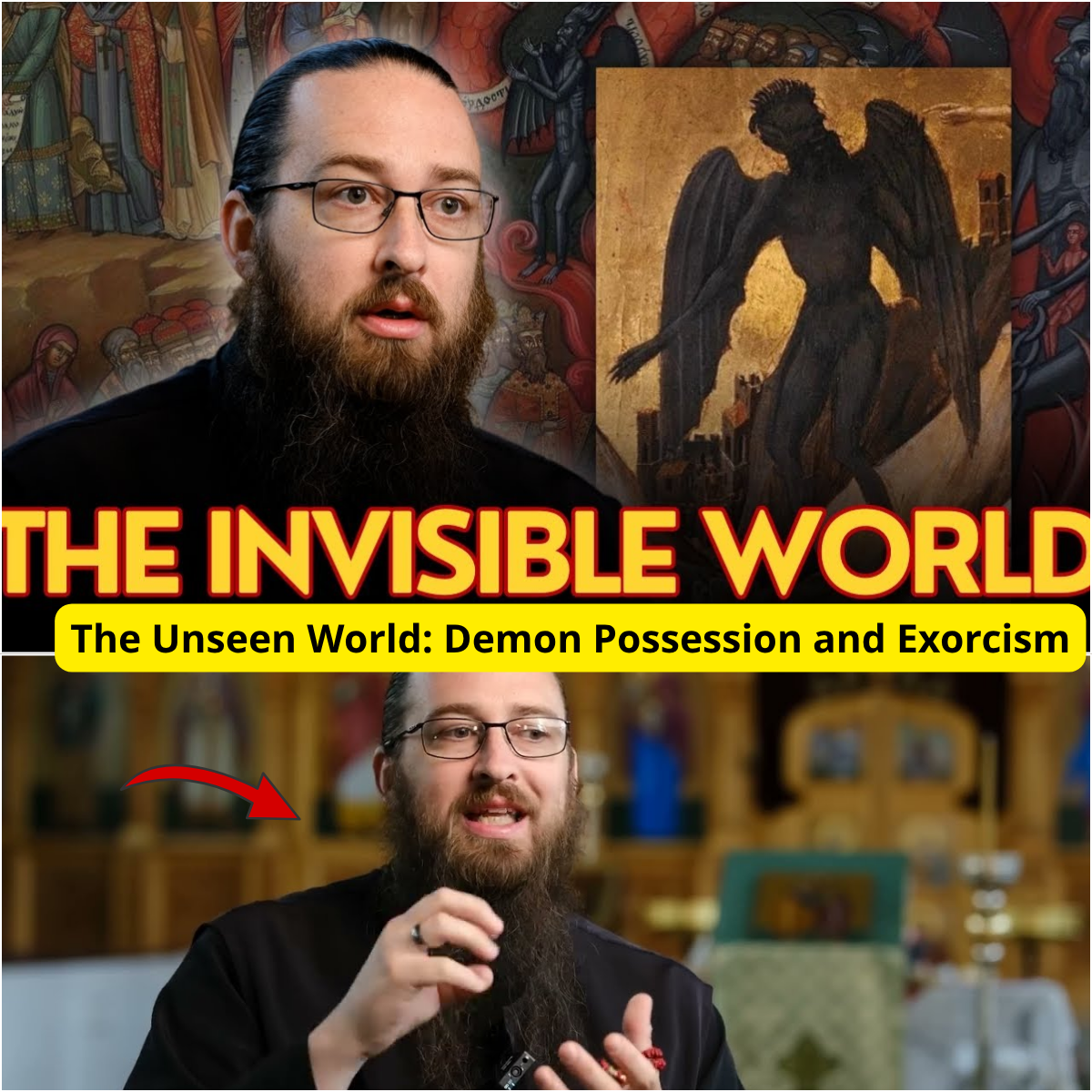
The Unseen World: Demon Possession and Exorcism
The Unseen World: Demon Possession and Exorcism
Chapter 1: The Weight of the Whispers
The tire irons on the wall of Julian’s garage didn’t just hang; they vibrated with the low, teeth-grating rattle of the freight trains that rolled past the industrial edge of Scranton every morning at 3:15 a.m.
Julian didn’t need to look at the grease-smeared clock hovering over his workbench. He knew the time by the cold, heavy pressure that settled directly behind his breastbone. It was the hour when the ambient noise of the city died, leaving nothing but the hum of the fluorescent shop lights and the intrusive architecture of his own mind.
For twelve years, Julian had been a mechanic, a man who fixed things that were broken, misaligned, or fractured. He understood tolerances. He understood that if a piston was off by a fraction of a millimeter, it would eventually shred the engine from the inside out.
Lately, he felt like that piston.
“Lord Jesus Christ, Son of God, have mercy on me, a sinner,” he muttered, his voice a flat rasp in the empty garage.
He wiped his black-stained hands on a shop rag, but the oil had worked its way deep into the crosshatching of his palms—a permanent map of his labor. He was thirty-four, but his shoulders slouched with the exhaustion of a man twice his age. It wasn’t the physical labor that was breaking him; it was the logismoi—the random, intrusive thoughts that the ancient Orthodox texts warned against.
An hour later, Julian was driving his beat-up station wagon down the dark, rain-slicked ribbon of Route 6. In the back seat, his seven-year-old daughter, Clara, was fast asleep, her face illuminated by the passing amber glow of the highway streetlights. Her breath fogged the window in a slow, peaceful rhythm.
Then, out of the absolute blue, it hit him.
A thought, cold and sharp as a razor blade, dropped into his consciousness: Jerk the wheel. Just three inches to the right. Hit the concrete overpass at seventy miles an hour. It would end everything instantly. Her too.
Julian’s hands froze on the steering wheel. His heart lunged into his throat, hammering with a terrifying, suffocating violence. A wave of nausea washed over him. He had never had a thought like that in his life. He loved his daughter more than his own skin. Where had it come from? Was he losing his mind? Was he secretly a monster?
“No,” he whispered fiercely, his knuckles turning white against the vinyl grip. He looked into the rearview mirror, checking on Clara, his breath ragged.
The thought lingered, hovering in his mind like a foul odor, tempting him to analyze it, to worry about it, to ask why he had thought it. He felt the sudden, paralyzing urge to pull over and weep.
Instead, he remembered the words of his parish priest, Father Thomas, spoken in the quiet corner of the nave after a recent Vespers service.
“When a crazy thought flies into your head, Julian, do not give it a home. Do not argue with it. Do not analyze it. If you begin to worry about it, you give it a power it doesn’t naturally possess. You let it live rent-free in your mind. Use the holy shrug. Say, ‘Yeah, okay, whatever,’ and look straight back at Christ.”
Julian took a deep, shuddering breath. He forced his gaze straight ahead at the road, refusing to let his mind loop back to the horror of the image.
“Lord, I know that thought was insane,” Julian whispered aloud into the dark cabin of the car. “It didn’t come from me, and it certainly didn’t come from You. Banish it.”
He didn’t pull over. He didn’t check his pulse. He simply leaned into the steering wheel and began to quietly recite the Jesus Prayer over and over, fighting for Christ with his back firmly turned toward the darkness. By the time he pulled into his driveway, the thought was gone, dissolved like ash in the rain.
But the encounter left him deeply shaken. He was starting to realize that the invisible world wasn’t a theological concept discussed in dusty books; it was an active, aggressive landscape, and he was walking through it completely unprotected.
Chapter 2: The Acclimation of the Heart
The following Sunday, the air inside St. Tikhon’s was thick with the scent of frankincense and beeswax. The morning light streamed through the high windows, cutting through the blue-gray clouds of incense and illuminating the painted faces of the saints on the walls.
Julian stood near the back, his eyes fixed on the icon of the Pantocrator on the ceiling. Yet, his mind was a battleground. Every secular habit he had cultivated over the years felt like a weight dragging him away from the liturgy.
After the service, Julian waited by the candle desk until the nave emptied out. Father Thomas, a gray-bearded man with kind, piercing eyes that seemed to see right through armor, emerged from the altar carrying a small brass censor.
“You look like you’ve been fighting a war, Julian,” Father Thomas said gently, adjusting his black cassock.
“I am, Father,” Julian admitted, leaning heavily against a wooden pew. “It’s everything. The thoughts on the highway. But it’s also… the everyday stuff. I tried what you said—the holy shrug—and it worked. But I feel like I’m constantly opening the door to these things without even realizing it.”
Father Thomas nodded slowly, gesturing for Julian to sit. “Saint Silouan the Athonite tells us that the spiritual life exists in stages. Before we are baptized, before we wake up to the faith, the enemy works from the inside of the heart, and Grace knocks from the outside. But once we commit to Christ, the order is reversed. Grace resides within, and the demons attack from the outside, trying to reclaim lost territory. That is why the struggle suddenly feels more violent when you try to live a holy life.”
“But how do they get back in?” Julian asked, his voice strained. “I don’t dabble in the occult. I don’t use Ouija boards.”
“They don’t always need an open invitation, Julian. A cracked window is enough,” Father Thomas explained, his tone becoming serious. “We acclimate ourselves to evil in ways we consider harmless. What do you consume? What enters your senses? We live in a culture that treats darkness as entertainment. We watch movies about horrific violence, we listen to music that glorifies anger, greed, and a loose sense of morals. We tell ourselves, ‘It’s just a song, I just like the energy, I’m not thinking about the lyrics.’ But everything we consume leaves a fingerprint on the heart.”
Julian shifted uncomfortably. He thought of his daily routine—the heavy, aggressive alternative rock he blasted in his truck to stay awake on the drive to work, the violent video games he played for hours late at night to ‘unwind’ from the stress of the garage.
“Is it really that bad?” Julian murmured. “It’s just secular culture. It’s not like I’m worshiping the devil.”
“To be entertained by evil is a strange thing for a Christian, don’t you think?” Father Thomas countered with a soft, candid smile. “The fingerprint of secularism may not look overtly demonic at first, but if it creates an anti-Christian worldview within you, if it makes you angrier, more cynical, and less Christ-centered… is that not exactly what the enemy wants? You cannot run a clean engine on contaminated fuel, Julian. You must begin to wean yourself off these things.”
The priest stood up, placing a hand on Julian’s shoulder. “Don’t try to change everything overnight in a frenzy of guilt. If you play games for four hours, try three and a half, and give that extra half hour to prayer. If you drive in the car, make a rule: pray the Jesus Prayer for the first ten miles, then listen to what you want. Create a reward system for yourself. Put the spiritual before the secular, and eventually, the taste for the cheap ground beef will fade when you realize Christ is offering you a perfect steak.”
Chapter 3: The Cold Pocket
Three weeks later, Julian was put to the ultimate test.
He had been trying to follow Father Thomas’s advice, weaning himself off the aggressive music and the late-night gaming. The silence in his truck had initially been deafening, filling him with anxiety, but gradually, it had turned into a space of profound quiet. He was beginning to recognize the baseline rhythm of his own soul.
Then, his phone rang on a Tuesday evening. It was his childhood friend, Marcus.
Marcus had recently purchased an old, abandoned Victorian property on the rural outskirts of Carbondale. The land had been vacant for decades, a sprawling estate of rotting wood, overgrown brambles, and a dark history of local folklore that nobody liked to speak about clearly. Marcus wanted to turn it into a modern homestead, but he called Julian in a state of absolute panic.
“Julian, you need to come out here. Bring your tools, bring a flashlight, bring whatever,” Marcus’s voice was shaking so violently he could barely articulate his words. “Something is wrong with the air out here. My dogs won’t leave the truck. They’re scratching their own faces raw trying to get away from the house. And… I heard someone walking right behind me in the woods. Clear as day. Footsteps. But when I turned around, there was nothing.”
Julian felt a cold spike of adrenaline. He remembered Father Thomas’s warnings about places and things that could become heavy with demonic energy.
“Don’t go inside the house, Marcus,” Julian said firmly. “I’m calling Father Thomas. We’re coming.”
An hour later, Julian’s station wagon followed Father Thomas’s sedan down a dirt road that seemed to swallow the headlights. The rain had stopped, leaving a heavy, suffocating fog that hung low over the dead grass.
When Julian stepped out of his car, the atmosphere hit him like a physical blow. It wasn’t just cold; it was an unnatural, static-heavy chill that made the hairs on his arms stand up. The air smelled of stagnant water and ozone. The silence was absolute—no crickets, no owls, no wind. It felt as if nature itself had abandoned the property.
Marcus was sitting in his truck, the headlights cutting through the fog, his face pale and eyes wide with terror. His two hunting dogs were huddled on the floorboards, whimpering low in their throats.
Father Thomas stepped out of his car, wearing his black cassock and an epitrachelion—the priestly stole. In his hand, he carried a silver vessel of holy water and a heavy leather book containing the exorcism prayers of Saint Basil the Great and Saint John Chrysostom.
“Father,” Marcus stammered, stepping out of the truck. “I thought it was just my imagination. But look.” He pointed to the dirt path leading to the main house.
Julian shone his flashlight toward the path. The fog shifted, and for a terrifying, fraction of a second, Julian saw the distinct silhouette of a tall, unnaturally thin figure standing near the porch, staring directly at them. Julian blinked, his heart leaping into his throat, and looked again. The figure was gone, vanished into the mist.
“Stay close,” Father Thomas said, his voice entirely devoid of fear, radiating a calm, authoritative power that instantly cut through Julian’s panic. “The enemy wants you to focus on him. Keep your backs to the demons, and your eyes on Christ.”
Chapter 4: The Sound of the Shift
They began at the threshold of the main house. Father Thomas dipped a sprig of dried basil into the holy water and struck the ancient wood of the door, his voice ringing out into the dark wilderness.
“Let God arise, and let His enemies be scattered! Let those who hate Him flee from before His face!”
As the priest began the long, rhythmic cadence of the exorcism prayers, Julian felt the air grow noticeably heavier, as if the atmospheric pressure in the room had suddenly skyrocketed. They walked through the skeletal frame of the house, moving from room to room.
In the basement, the darkness felt thick, almost palpable, like walking through cobwebs. Julian’s flashlight beam seemed to weaken, struggling to pierce the shadows. Behind them, from the dark corners of the foundations, Julian heard a sound that made his blood run cold—a low, rhythmic scraping, followed by the distinct sound of heavy, deliberate footsteps walking right behind them.
Julian’s instinct was to turn around, to shine his light, to confront the source of the noise. His heart screamed at him to panic.
“Keep praying, Julian,” Father Thomas said without breaking his stride, his voice continuing the steady, unyielding intercession.
Julian closed his eyes for a brief second, took a deep breath, and unleashed the holy shrug against his own terror. Yeah, okay, whatever you are. You don’t get my focus. He turned his mind completely to the words of the prayer, chanting the responses internally. Lord Jesus Christ, have mercy on me.
The prayers took hours. They moved from the main house to the dilapidated barn, then to the old caretaker’s cottage. With every bucket of holy water emptied, with every petition raised to the heavens, Julian felt a strange, cosmic friction occurring around them. It was a invisible war of wills, but Christ’s authority was an absolute, unshakeable wall.
By the time Father Thomas chanted the final Amen, the clock on Julian’s phone read 2:45 a.m.
They stepped out onto the porch of the main house. Julian took a breath, and suddenly, his lungs filled with air that felt completely different. The static-heavy pressure in his chest had vanished. The foul odor of ozone was gone, replaced by the clean, damp scent of late-night earth.
“Look,” Marcus whispered, pointing toward the sky.
The heavy fog had entirely split open. Above them, the night sky was a brilliant, crystal-clear canopy of stars. The air felt incredibly peaceful—so peaceful that Julian felt an overwhelming temptation to simply lie down on the grass and sleep under the open sky. The terror of the previous hours felt like a distant, faded dream.
The next morning, Julian drove back to the property to drop off some tools he had left in Marcus’s truck. As he pulled up the dirt road, he came to a sudden halt, his jaw dropping.
The secluded wilderness property, which had been devoid of any signs of life for months, was absolutely teeming with nature. A family of white-tailed deer stood calmly near the edge of the woods, unbothered by the sound of his engine. Two rabbits hopped across the clearing, and a large owl sat on the low branch of an oak tree, watching the morning sun rise.
It looked like a scene straight out of a Disney movie. Nature itself had recognized that the suffocating, demonic energy had been lifted, and life had instantly flooded back to reclaim the territory.
Chapter 5: The Fingerprint of Peace
A week later, Julian was back in his garage. The freight train rolled past at 3:15 a.m., rattling the tire irons on the wall just as it always did.
But this time, there was no cold pressure behind Julian’s breastbone.
The garage was quiet, save for the low, rhythmic hum of an Orthodox choral chant playing softly from a small speaker on his workbench. He had cleared out his old music playlists, uninstalled the violent games from his phone, and spent his commutes in a state of deliberate, prayerful silence.
The bell above the garage door rang as a customer walked into the small office. Julian wiped his hands on his rag and stepped inside. It was a young man, barely twenty, looking stressed and exhausted, holding a car key with a heavy, stylized skull keychain.
“Hey, man,” the kid said, slouching against the counter. “My engine’s making this weird knocking sound. I can’t figure it out. It’s driving me crazy. I’m stressed out enough as it is, and now this.”
Julian looked at the kid, noticing the tight, anxious lines around his eyes, the aggressive music still bleeding faintly from the headphones hanging around his neck. He saw himself from just a month ago—a man unconsciously letting the world contaminate his heart, walking through an invisible war zone without armor.
“We’ll get it sorted out,” Julian said, his voice carrying a warm, grounded peace that made the kid visibly relax. “Engines are easy to fix once you find out where the misalignment is. You just have to be careful about what you let inside the system.”
The kid blinked, a little confused, but nodded. “Yeah. Thanks, man.”
As Julian walked out to the parking lot to check the car, he looked up at the pale morning sky. He knew the invisible world was still active around him. He knew that random, crazy thoughts would still occasionally fly into his mind like rogue arrows.
But he wasn’t afraid anymore. He had seen the power of Christ turn a dark, suffocating wasteland into a sanctuary of peace. He had learned to give the darkness nothing but a holy shrug, keeping his eyes firmly fixed on the light, fighting for his soul with his back to the monsters.