The Powerful Lessons of the SERMON ON THE MOUNT: Jesus’ Words That Will Leave You SPEECHLESS
The Powerful Lessons of the SERMON ON THE MOUNT: Jesus’ Words That Will Leave You SPEECHLESS
PART I: THE CROWD AT THE CIRQUE
The wind that descended from the limestone ridges of Upper Galilee carried the sharp, clean scent of crushed wild mustard and damp earth. It was a restless, unpredictable wind, mirroring the mood of the thousands who had choked the narrow goat tracks leading up from the Sea of Tiberias.
They were not a uniform assembly. There were Galilean farmers with hands calloused from wooden plows, tech-impoverished day laborers whose skin was baked to a dark leather by the Syrian sun, anxious mothers clutching coughing infants, and political agitators—the Zealots—whose fingers nervously twitched against the hilts of concealed iron daggers beneath their tunics. They had all come because the provincial air was thick with rumors. They expected a standard revolutionary manifesto. They expected a warrior-prophet who would stand upon a platform, draw a line in the dirt, and call down the fire of heaven to incinerate the iron legions of Rome.
Instead, the young carpenter from Nazareth simply climbed a natural limestone terracing, found a flat, sun-warmed boulder, and sat down.
In the ancient Near East, when a rabbi sat down, it meant the official decree was about to be issued. The low murmur of the crowd died away, replaced by the rhythmic rattling of the dry thistle stalks in the breeze.
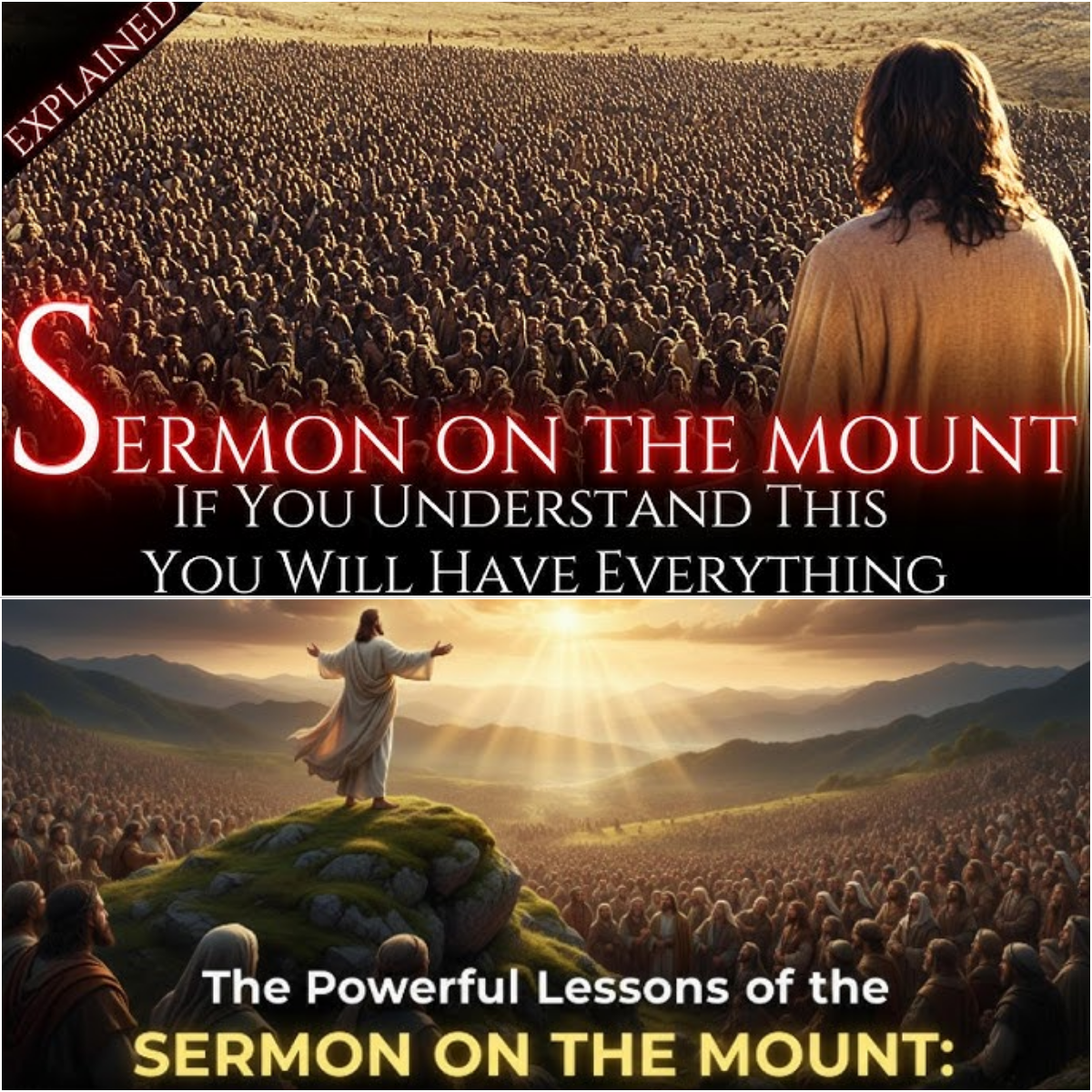
He opened his mouth, his voice carrying clearly over the natural amphitheater of the hillside, striking the ears of men who had spent their entire lives under the boots of imperial governors and corrupt high priests. He did not begin with a declaration of war or a legalistic indictment. He began with a word that sounded like a cracked bell in a dark room:
“Blessed…”
Silas, a stonecutter from Magdala who had dragged his crippled leg up the ridge in desperate hope of a physical healing, leaned forward against his crutch. His brow furrowed. In the vernacular of the Roman Empire, a “blessed” man was an aristocrat with a marble villa in Caesarea, a merchant with three grain ships in the Mediterranean, or a high priest who wore embroidered purple silk and commanded the temple treasury.
But the Nazarene was looking directly into the hollow eyes of the destitute.
“Blessed are the poor in spirit,” Jesus said, his gaze steady and unblinking, “for theirs is the kingdom of heaven.”
With that single sentence, the tectonic plates of the ancient social order buckled. He was not presenting a pleasant moral philosophy or a series of helpful hints for a successful life; he was launching a silent, catastrophic assault against human pride. He wasn’t praising material poverty itself, but pointing to the spiritually bankrupt—the broken individuals who came to the presence of God with absolutely nothing to show for themselves, no trophies of religious perfection, no wealth, no pedigree, just empty, trembling hands.
“Blessed are those who mourn,” the voice continued, cutting through the heavy afternoon heat, “for they shall be comforted.”
Silas watched an elderly woman nearby—a widow whose two sons had been crucified by the Romans during a tax revolt three winters ago—cover her mouth as her shoulders began to shake with silent, convulsive weeping. This was no superficial, optimistic sentimentality; it wasn’t a patronizing command to keep one’s spirits up. It was a terrifyingly intimate invitation to feel the full, crushing weight of human sin, injustice, and sorrow, paired with the absolute divine promise that those tears were monitored, valued, and would be personally dried by the hand of the Almighty.
PART II: THE MEASURE OF POWER
As the sun climbed higher, casting sharp shadows across the limestone cracks, the language of the Nazarene grew even more dangerous.
“Blessed are the meek,” he declared, “for they shall inherit the earth.”
A low, sharp hiss of breath rippled through a cluster of Zealots standing near the crest of the hill. Their leader, a man named Joram whose brother was currently rotting in a Roman dungeon, tightened his grip on his cloak. To the ancient mind—and to the modern world—meekness was synonymous with cowardice. It was the posture of a slave who licked the hand of his master. In a world ruled by the iron gladius of the Caesar, the dominant inherited the earth; the aggressive, the loud, and the ruthless carved their names into history.
But as Silas watched the Nazarene, he realized the man was redefining the very physics of power. The Greek word he used didn’t imply a spineless surrender; it described a wild stallion that had been broken, its immense, bone-crushing strength brought under the total, absolute control of the bridle. It was the deliberate choice of a warrior who possessed the terrifying capability to strike, to incinerate, to destroy his enemies, but who instead chose to wrap his strength in mercy and use it to heal.
“Blessed are those who hunger and thirst for righteousness,” Jesus said, his voice dropping into a deep, resonant cadence, “for they shall be filled.”
The crowd understood hunger. It was a physical reality that gnawed at their stomachs every afternoon when the grain rations ran short. But the carpenter was pointing to a more agonizing starvation—a desperate, gasping hunger for holiness, a longing to see the fractured cosmos set right, beginning within the deep, dark laboratory of one’s own heart.
Then the teaching turned inward, peeling back the skin to expose the bone.
“Do not think that I have come to abolish the law or the prophets,” Jesus said, responding to the silent, suspicious glares of several Jerusalem scribes who had embedded themselves within the crowd. “I have not come to abolish them, but to fulfill them.”
The legal scholars adjusted their phylacteries, their eyes narrowing. The law of Moses was the absolute foundation of Jewish survival, a massive, intricate network of hundreds of individual commandments designed to keep the nation separate from the pagan filth of Rome. They expected him to either discard the ancient scrolls or double down on their external performance.
Instead, the carpenter bypassed their outward rituals entirely, driving his words deep into the human chest cavity like a surgeon’s scalpel.
“You have heard that it was said to those of old, ‘You shall not murder,'” Jesus said, his eyes scanning the angry, resentful faces of the young men in the crowd. “But I say to you that everyone who is angry with his brother shall be liable to judgment.”
Joram the Zealot stiffened. The anger inside him wasn’t just a mood; it was his identity. It was the fuel that kept him alive through the cold Galilean nights. He considered his hatred for the Roman tax collectors to be a holy, righteous virtue.
“It is not enough to keep your hands clean of blood,” Jesus was saying, his words striking like iron hammers. “If you harbor bitterness, if you stew in resentment, if you destroy a man’s dignity with a whispered insult in the dark, you have already committed the execution in your heart. The law was never meant to be mere behavior management. It was meant to protect love.”
He did not pause to let them recover before he turned the blade toward their secret desires.
“You have heard that it was said, ‘You shall not commit adultery,'” the carpenter continued, his gaze piercing the comfortable illusions of the religious hypocrites. “But I say to you that everyone who looks at a woman with lustful intent has already committed adultery with her in his heart.”
A heavy, suffocating silence fell over the hillside. He wasn’t adding new, more restrictive regulations to their lives; he was stripping away their armor, showing them that true holiness is not measured by the absence of an outward scandal, but by the absolute purity of the imagination when no one else is watching.
“Unless your righteousness exceeds that of the scribes and Pharisees,” Jesus dropped the phrase like a boulder into a glass house, “you will never enter the kingdom of heaven.”
Silas looked around at his neighbors. The Pharisees were considered the gold standard of spiritual achievement; they spent their entire lives analyzing the microscopic details of tithing mint and dill. If they couldn’t make it into the kingdom, then the gate wasn’t just narrow—it was completely invisible. Silas realized with a sickening jolt that the carpenter was intentionally driving them to a state of absolute spiritual bankruptcy, forcing them to realize that they could never achieve this standard on their own power.
PART III: THE EXTRAVAGANCE OF RESISTANCE
The sun had passed its zenith, throwing long, dramatic shadows across the valley of Gennesaret. The air had cooled slightly, but the moral tension on the mountain was reaching a breaking point.
“You have heard that it was said, ‘An eye for an eye and a tooth for a tooth,'” Jesus said, addressing the ancient code of tribal justice that had kept the desert human elements from destroying each other for millennia. “But I say to you, do not resist the one who is evil. If anyone slaps you on the right cheek, turn to him the other also.”
Silas felt his breath catch in his throat. A slap on the right cheek in Roman Judea wasn’t an assault; it was an institutional insult. It was delivered with the back of a Roman soldier’s hand, designed to remind a Jewish subject of his utter inferiority. To hit back meant immediate execution. To run away meant cowardice.
“He’s telling us to stand our ground,” Silas whispered to himself, his eyes widening as he caught the radical brilliance of the image. By turning the other cheek, a person refused to mirror the violence of the oppressor, stripping the soldier of his power by forcing him to look at his victim as an equal human being. It wasn’t passive weakness; it was a proactive, asymmetric spiritual warfare.
“You have heard that it was said, ‘Love your neighbor and hate your enemy,'” Jesus continued, his voice expanding to fill the entire hillside. “But I say to you, love your enemies and pray for those who persecute you.”
The crowd erupted into a collective, internal gasp. Joram’s hand shook violently against his cloak. Love the Romans? Pray for the centurions who had burned the crops in Sepphoris? Bless the tax collectors who had driven their families into debt slavery? It sounded like a betrayal of their ancestors. It felt like an injustice against the dead.
“Why?” Jesus asked, looking out over the sea of conflicted, angry faces. “So that you may be children of your Father who is in heaven. For he makes his sun rise on the evil and on the good, and sends rain on the just and on the unjust.”
He was pointing them to a cosmic reality that existed far above the petty political struggles of the province. The God of the universe wasn’t a reactive deity who adjusted his love based on human performance; his grace was wildly, shockingly indiscriminate. He gave breath to the very men who forged the nails for the crosses.
“If you only love those who love you, what reward do you have?” Jesus asked, a touch of sharp irony in his voice. “Do not even the corrupt tax collectors do the same? Anyone can practice a tribal affection. But enemy love—that is the signature of the divine. That is the proof that the kingdom has broken into your reality.”
PART IV: THE ANATOMY OF A BLIND SPOT
The carpenter shifted his position on the rock, his eyes sweeping across the outer edges of the crowd where people were already beginning to whisper, point fingers, and pass judgment on those who were reacting poorly to the sermon.
“Judge not, that you be not judged,” Jesus warned, his voice cutting through the rising chatter like a cold blade.
It was a phrase that would one day be scrawled on walls and quoted by millions who wished to avoid moral accountability, but as Jesus spoke it on that hillside, it carried a far more specific, devastating warning. He wasn’t telling them to abandon their capacity for moral discernment; he was targeting the venomous spirit of self-righteous hypocrisy.
“Why do you look at the speck of sawdust in your brother’s eye,” he asked, his arms moving in a sudden, dramatic gesture, “and pay no attention to the log that is in your own eye?”
A few sharp, nervous laughs broke out among the younger boys in the audience. The imagery was intentionally absurd, almost comical—a religious teacher walking through the streets of Jerusalem with a massive wooden ceiling beam jutting out of his eye socket, bumping into walls and knocking over tables, while simultaneously leaning over a beggar to carefully remove a microscopic grain of dust from the man’s iris.
“You hypocrite,” Jesus said, the humor vanishing instantly from his tone, replaced by a terrifying seriousness. “First take the log out of your own eye, and then you will see clearly to take the speck out of your brother’s eye.”
Silas felt a cold sweat break out on his neck. He thought of his neighbor, a man who had cheated him out of three silver shekels during the last harvest. Silas had spent months nursing that grievance, telling everyone in the village about the man’s dishonesty, using his neighbor’s sin to make himself feel morally superior, clean, and justified. He had been completely blind to the thick, rotting beam of malice, pride, and resentment that had been clouding his own spiritual vision for a year.
“Real correction,” the carpenter was saying, “only begins with your own repentance. If you want to handle someone else’s brokenness, you must first allow God to smash your own self-sufficiency.”
He stood up from the rock, his silhouette dark against the setting sun that was turning the waters of Galilee into a sheet of liquid fire. He gathered the entire moral weight of the law, the prophets, and the covenants, and compressed them into a single, elegant axiom that would guide human ethics for the rest of time:
“Therefore, whatever you wish that others would do to you, do also to them, for this is the Law and the Prophets.”
It was not a passive command to simply avoid doing harm; it was an aggressive, proactive obligation of mercy. It required an individual to actively step across the cultural boundaries of race, status, and prejudice, to enter the imagination of another human being, to figure out what they needed to survive, and to provide it without demanding anything in return.
PART V: THE TRAGEDY OF THE SHIFTING CHANNELS
As the twilight began to purple the edges of the sky, Jesus looked down at the thousands of faces that were frozen in a state of absolute, paralyzed awe. He knew the nature of human crowds; he knew that many would leave this hill inspired, emotionally moved, and entirely unchanged. They would repeat his sayings in the marketplaces, they would debate his theology in the taverns, but they would continue to live according to the old rules of survival, anxiety, and domination.
“Therefore, everyone who hears these words of mine and puts them into practice,” Jesus said, his voice dropping into a low, prophetic roar that seemed to reverberate through the very limestone beneath their feet, “is like a wise man who built his house on the rock.”
Silas, the stonecutter, listened with a professional’s focus. He knew the topography of the land better than anyone. In the dry summer months, the sandy bottoms of the wadis—the seasonal river valleys—looked like perfect, flat, effortless building sites. The sand was soft, easy to dig, and required no grueling, muscle-tearing labor with a pickaxe.
“The rain fell, the floods came, and the winds blew and beat on that house,” Jesus said, his hands tracing the trajectory of a storm, “but it did not fall, because it had been founded on the rock.”
The crowd remained silent, picturing the sudden, catastrophic winter flash floods that routinely swept down from the heights of the Golan Heights, turning the dry sandy valleys into raging torrents of muddy water and debris that erased everything in their path.
“And everyone who hears these words of mine and does not put them into practice,” the carpenter concluded, his gaze sweeping across the multitude one final time, “is like a foolish man who built his house on the sand. The rain fell, the floods came, and the winds blew and beat against that house, and it fell—and great was the fall of it.”
He stopped speaking. He did not offer a closing benediction; he did not ask for a show of hands or a token of approval. He simply turned and began to descend the mountain track toward the shoreline, his disciples following closely behind him.
The crowd did not move for several minutes. Matthew, the young scribe who had been frantically scratching notes onto a wax tablet at the base of the rock, noted that the people were completely astounded by his teaching. He didn’t speak like the local scribes who constantly relied on the authority of dead commentators. He spoke as if he owned the mountain. He spoke as if he had written the law himself.
Silas leaned heavily on his crutch, looking down at the ground beneath his boots. The dirt was hard, filled with sharp, unforgiving flint and solid dolomite bedrock. To dig into it would take days of agony, sweat, and broken tools. It would require him to give up his comfort, his pride, his rights to retaliation, and his anxieties about tomorrow.
The wind blew hard from the lake, cold and laden with the promise of winter storms. Silas looked down the path where the Nazarene’s shadow was disappearing into the twilight, then looked at his own crippled leg. He drew a deep breath, lifted his crutch, and took his first, deliberate step down the narrow road. The question was no longer whether he had heard the words, but whether he was willing to let them break him apart so that he could finally be rebuilt upon the rock.