The PATHETIC EXCUSES of Modern NBA Players
The PATHETIC EXCUSES of Modern NBA Players
BOSTON — For decades, the parquet floor of TD Garden has served as a cathedral of accountability. From the blue-collar grit of the 1980s to the “Ubuntu” spirit of 2008, the Boston Celtics built a legendary identity on a simple premise: great players win, and champions don’t complain.
But following a historic, gut-wrenching collapse in the first round of the NBA playoffs, that identity has been replaced by something far more fragile. After blowing a 3-1 series lead to the Philadelphia 76ers—culminating in a Game 7 flameout that left the Boston faithful in stunned silence—the Celtics didn’t just lose their shot at a title. They lost their composure.
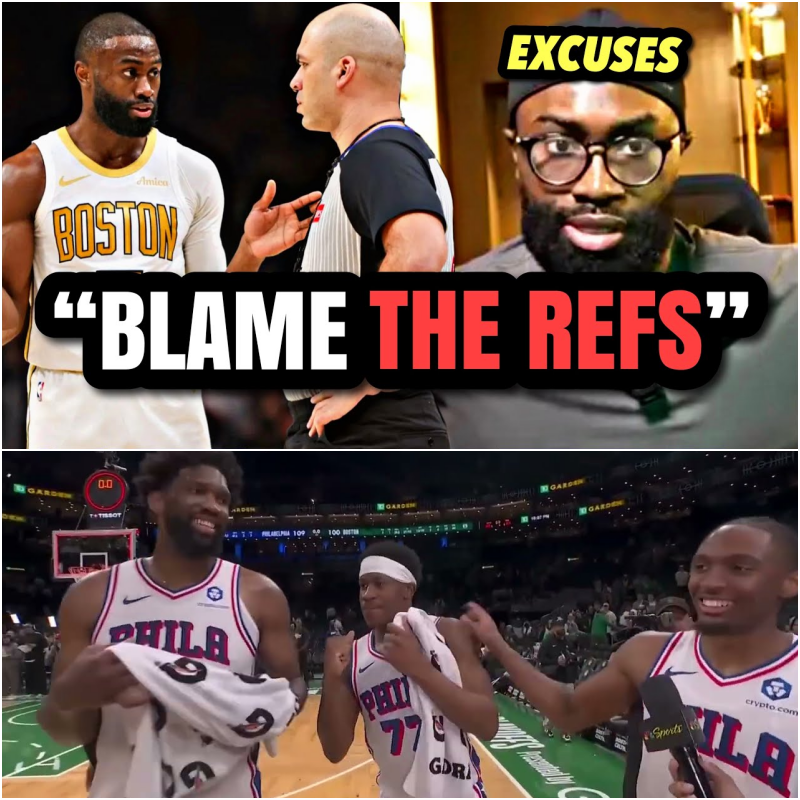
At the center of this identity crisis is Jaylen Brown. In the wake of what can only be described as a “historic choke job,” the All-NBA wing has embarked on a post-series press tour defined not by introspection, but by a sprawling, unsubstantiated conspiracy theory involving NBA officials, league-wide “agendas,” and a perceived vendetta against the green and white.
It is a performance that has been called “pathetic,” “delusional,” and “embarrassing” by analysts and fans alike. More importantly, it signals a disturbing trend in the modern NBA: the rise of the “unaccountable superstar.”
The Historic Melted Down
To understand the weight of Brown’s excuses, one must first understand the magnitude of the failure. Entering the series, the Celtics were not just favorites; they were the juggernaut. As the second seed with a roster boasting two All-NBA talents, they held a 32-0 franchise record when leading 3-1 in a playoff series.
That record is now 32-1.
The Celtics didn’t just lose; they “folded like a cheap suit,” as one commentator noted. They squandered a potential revenge series against the New York Knicks and a clear path to the Finals. But instead of addressing the tactical errors of the coaching staff or the shooting slump that plagued the roster, Brown chose a different target: the men in the grey pinstripes.
“You could clearly tell… I’ve actually spoke to some refs and they said it was an agenda going into each game,” Brown claimed following the Game 7 loss. “Philly took advantage of the officiating and it cost us to some degree.”
He didn’t stop there. Brown went on to suggest that the league has a specific directive to whistle his physical style of play differently than his peers, even hinting that certain officials “need to be investigated.”
The Myth of the “Agenda”
The word “agenda” is heavy. It implies a coordinated effort by the NBA front office and officiating crews to tip the scales of a multi-billion dollar entertainment product. It is a claim that requires extraordinary evidence. Brown, however, provided only anecdotes and frustration.
The irony of a Boston Celtic claiming a league-wide conspiracy against them is not lost on the American sporting public. If Adam Silver and the NBA league office have an “agenda,” history and economics suggest it would be to keep the Celtics—one of the league’s most profitable and storied brands—playing as long as possible. The idea that the NBA would rig a series to eliminate Boston in the first round in favor of a smaller-market narrative is, on its face, nonsensical.
When you peel back the layers of Brown’s “data,” the argument evaporates. Brown lamented that the Celtics finished “dead last” in getting calls. While technically true that Boston ranked at the bottom in fouls drawn (19.4 per game) during the first round, the difference between them and the 76ers was a negligible 0.5 fouls. In terms of free-throw attempts, Boston (20.0) actually sat ahead of Philadelphia (19.9).
In a vacuum, the officiating was remarkably balanced. If there was a conspiracy to dismantle the Celtics, the conspirators were surprisingly inefficient at it.
Mirror, Mirror: The Statistical Reality
The most damning indictment of Brown’s “excuse tour” isn’t found in the referee’s whistle, but in the box score. For a player who views himself as an MVP-caliber talent and a premier two-way force, Brown’s performance when the pressure reached its peak was nothing short of abysmal.
Over the final three games of the series—the three games Boston needed only one win to clinch—Brown’s impact disappeared. Look at the numbers:
Shooting Splits: 42% from the field, 35% from three, and a dismal 62% from the free-throw line.
The Plus-Minus: An “abysmal” -50 over the final four games.
The Turnovers: Three and a half per game, often coming at the most critical junctures of the transition game.
But the true “nail in the coffin” was Brown’s fourth-quarter play in Games 5 through 7. In the “winning time” of the season’s most important moments, Brown accounted for a total of nine points. He shot 3-of-15 from the floor and 0-of-5 from beyond the arc.
While Brown was busy pointing fingers at the officials, he was missing the very shots that would have made the officiating irrelevant. In Game 7, while Tyrese Maxey and Joel Embiid were aggressive, Brown was “a brick” from the perimeter and “up and down” in his decision-making. Even a hobbled Jayson Tatum, playing on what many described as “one leg,” managed to outproduce Brown in the series’ twilight.
The “Heisman Shove” and the Logic of Officiating
Brown’s specific gripe involves his signature “fend off” move—a forearm shove he uses to create space on drives. He claims the league has an “agenda” to call this against him specifically, while players like Paul George or Jalen Brunson get a pass.
“It’s a basketball play,” Brown argued. “Every player does it.”
But NBA officiating isn’t about what the move is; it’s about how it’s executed. Brown’s “Heisman shove” is frequently so egregious and so obvious that officials have little choice but to blow the whistle. In fact, video evidence from Game 7 shows the exact opposite of a conspiracy. At the 1:40 mark of the fourth quarter, with the season on the line, Brown drove on Maxey and blatantly shoved him into Embiid. It was a textbook offensive foul.
The result? No whistle. The refs let it go.
If the NBA truly had an agenda to see Jaylen Brown fail, that was the moment to execute it. Instead, they gave him the benefit of the doubt, and he still missed the shot. By ignoring these moments in his post-game grievances, Brown isn’t telling the truth; he is crafting a narrative to shield himself from the harsh reality of his own underperformance.
A Leadership Void in the North End
In the pantheon of American sports, we measure greatness by how a leader handles the “short end of the stick.”
When the 1980s Celtics lost, Larry Bird didn’t complain about the officiating; he complained that his teammates weren’t tough enough, or he took the blame himself. When the 2008 team struggled, they leaned into “Ubuntu”—the idea that “I am because we are.”
Jaylen Brown’s current rhetoric represents the antithesis of that culture. By blaming “least favorite refs” and “agendas,” he is giving his teammates—and himself—a psychological exit ramp. If the game is rigged, why bother perfecting the free throw? If the refs are against you, why bother passing the ball instead of forcing a contested fallback?
This “non-stop crying,” as some have labeled it, is more than just a sore loser’s rant. It is a signal to the rest of the league that the Celtics can be rattled. When a superstar player begins investigating the “referee board” instead of his own shooting mechanics, the “Celtic Mystique” officially dies.
The Path Forward: Accountability or Obscurity?
The Boston Celtics now face a long, cold offseason of reflection. They must decide if they are a championship-caliber core that had a bad week, or a fractured group led by a star who has lost touch with reality.
The solution for Jaylen Brown is simple, though not easy. It involves a mirror.
To win a Game 7, you don’t need a friendly officiating crew; you need to not shoot under 40% in the fourth quarter. You need to not miss 11 threes in the biggest quarter of the year. You need to be a “two-way player” who actually stops the opponent, rather than one who finishes with a -50 rating.
The American sports public is notoriously unforgiving of excuses, especially from those making hundreds of millions of dollars to put a ball in a hoop. We want our heroes to be stoic in defeat and humble in victory.
Jaylen Brown has a choice. He can continue to be the protagonist in a conspiracy thriller of his own making—a world where the league is out to get him and every whistle is a personal affront. Or, he can return to the gym, fix his handles, find his jumper, and realize that the only “agenda” that matters is the one he writes on the court.
Until then, the “pathetic excuses” will continue to ring louder than the championship bells Boston fans so desperately crave. And in the city of champions, excuses are the only thing that won’t be tolerated.