The mystery of Europe’s most famous bog bodies
The mystery of Europe’s most famous bog bodies
The iron blade of the spade sheared through a dense tangle of heather roots, releasing the sharp, acidic scent of decayed moss into the damp morning air. It was a Tuesday in early May, and the fog hung low over the peat cutters’ trenches in Tollund Fen, a sprawling, treacherous wetland on the Jutland peninsula of Denmark. The year was 1950, but within the perimeter of the dark, waterlogged bog, the modern calendar felt like an arbitrary construct.
Viggo and Emil Højgaard wiped the cold mist from their foreheads, their heavy woolen trousers stained black with the organic muck they had been harvesting since dawn. Peat was the lifeblood of the rural villages—the fuel that kept the ceramic stoves burning through the brutal northern winters. They dug systematically, cutting the dense, fibrous sods into uniform blocks and stacking them along the drainage bank to dry.
Then, at a depth of nearly nine feet beneath the living surface of the fen, Viggo’s spade struck something that didn’t yield like timber or crumble like stone.
He dropped to his knees, his hands parting the wet, chocolate-brown layers of sphagnum moss. A smooth, dark curvature emerged from the mire. At first, he thought it was the gnarled root of an ancient oak, but as he cleared away the loose silt, the undeniable contour of a human forehead came into view.
“Emil,” Viggo called out, his voice dropping to a harsh whisper that was instantly swallowed by the vast silence of the marshland. “Come down here.”
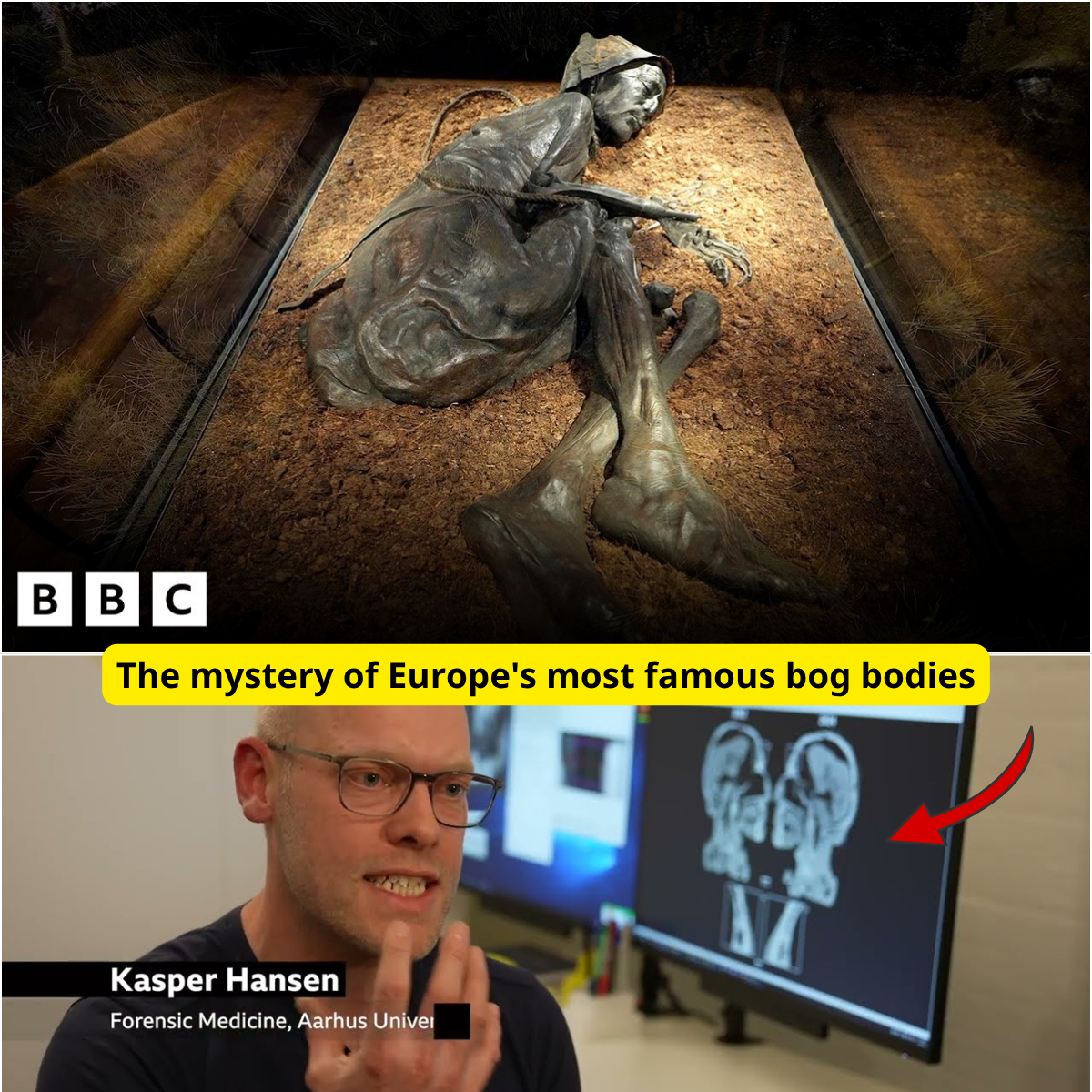
Together, using nothing but their bare fingers, the brothers peeled back the remaining layers of peat. What they uncovered froze the breath in their throats. Resting on his right side in a deliberate, peaceful fetal curve, lay a man. His skin was leathered and stained a deep, rich chestnut brown by the chemistry of the bog, but the preservation was so immaculate it defied the imagination.
The man’s eyes were closed so softly that the delicate lines of his eyelashes were completely intact. His lips were parted slightly, set in an expression of profound, unbothered tranquility—as if he had merely closed his eyes for a brief midday nap between the heather hillocks. He wore a pointed cap made of stitched sheepskin, secured beneath his chin by a thin hide thong, and a hide belt was fastened tightly around his waist. Otherwise, he was entirely naked.
The brothers looked at each other, their minds immediately jumping to a modern horror. Only a year prior, a local schoolboy had gone missing in the neighboring parish, and the memory of wartime disappearances still cast a long shadow over the countryside.
“It’s a murder,” Emil said, his hands trembling as he stood up. “We have to call the police in Silkeborg.”
Within hours, the local constable was standing at the edge of the trench, staring down into the black water at the serene face in the mud. But the officer was a pragmatist; he noted the immense depth of the peat layers above the body and the complete absence of modern clothing or boots. He didn’t see a case file for a missing local villager. He saw something that belonged to a different authority.
He picked up a field telephone and called the National Museum in Copenhagen. “We don’t need a detective out here,” the constable told the clerk on the other end. “Send us an archaeologist.”
The Dark Mirror
The man who arrived by train the following morning was Dr. Peter Glob, a towering figure in European prehistory with an obsessive fascination for the secrets hidden within the northern European lowlands. When he knelt beside the excavation trench in Tollund Fen, he knew he was looking at the apex of archaeological preservation.
“This is not a modern crime scene,” Glob murmured, his fingers gently tracing the edge of the leather cap without touching the skin itself. “And yet, it is the most intimate encounter with antiquity we have ever been granted. This face has no rival in the entire prehistoric world.”
Glob understood the unique, almost miraculous alchemy of the landscape. The fen was not merely dirt and water; it was a living, dying monoculture of Sphagnum moss. As the older layers of moss died and became compacted beneath the surface without oxygen, they released a specialized, complex organic compound known as sphagnan.
This sugary polymer reacted aggressively with the proteins and collagen inside human tissue. It tanned the skin into a durable, rot-resistant leather, locked the muscles and tendons into place, and dissolved the calcium within the bones—leaving the skeleton pliable but keeping the external envelope of the body perfectly intact. The highly acidic, anaerobic environment acted as a natural tomb, halting the process of decay and preserving the deceased for millennia.
But as Glob prepared the body for transport—encasing the entire block of peat in a massive timber crate to protect it from the drying effects of the open air—his eyes drifted down to the man’s neck.
Beneath the chin, partially hidden by the leather thong of the cap, was a thick, braided rope of animal hide. It was looped tightly around the throat, the knot drawn close behind the ear. The skin beneath the cord was deeply grooved, indicating immense pressure had been applied while the man was still alive.
This was indeed a murder, but it was an execution that had taken place twenty-four centuries ago, during the European Iron Age.
Two years later, in April 1952, the dark waters of the Danish bogs yielded another secret. Just a few miles away, in the peat bog of Grauballe, workers uncovered a second body. This individual, who would become known as Grauballe Man, lacked the serene demeanor of the Tollund specimen. His head was thrown back, his throat slit from ear to ear in a wide, horrific crescent that had severed his trachea and esophagus in a single, violent motion. His hair, turned a shocking, fiery orange-red by the chemistry of the bog, stood out wildly against the black muck.
The two bodies, discovered so close in space and time, presented a dark, systemic puzzle that shattered the conventional understanding of the European past.
The Limbo Landscape
To understand why these men were placed into the dark water, Dr. Glob had to reconstruct a world that existed between 500 BCE and the dawn of the common era. This was the early Iron Age—a period of intense socio-economic upheaval across the northwestern lowlands of Europe, spanning from Ireland across Great Britain and into Denmark and northern Germany.
Before this era, the communities of the North had lived in scattered, highly mobile family units. But as the climate shifted, becoming significantly colder and wetter, the survival strategies of the population had to change. People began to consolidate, pulling their resources together into permanent, tightly knit village communities. They cleared the primeval forests, established communal grazing fields, and built longhouses where families slept side by side with their livestock to conserve heat.
With this shift in human geography came a profound transformation in their spiritual universe.
“In the older Bronze Age, the dead were burned on great, public pyres,” Glob explained during a lecture to his colleagues in Copenhagen. “Their ashes were placed in clean ceramic urns and buried beneath high, sun-lit earthen mounds. It was a religion of the sky, of fire, and of visible monuments.”
“But the Iron Age people did something that was almost the exact opposite,” he continued, gesturing to a map of the regional peat deposits. “They turned their faces downward, away from the sun. They began to treat the wetlands not as waste spaces, but as the absolute center of their religious devotion.”
To the Iron Age villagers, the bog was a terrifying, magical landscape. It was a place of limbo—neither solid earth nor open water, a treacherous expanse where a single misstep meant drowning in the dark silt. The water’s surface acted as a mirror, reflecting the sky back at the viewer while concealing an unfathomable depth below. It was viewed as a portal, a thin, metaphysical seam where the human world directly intersected with the realm of the gods.
The archaeological record showed that the villages were engaged in a continuous, expensive dialogue with this portal.
Deep within the peat, excavators found vast hoards of wealth deliberately sunk into the mire. There were massive, intricately worked necklaces of solid bronze and silver; complete iron swords bent double to “kill” the weapon before offering it to the water; long strands of braided human hair; slaughtered horses; and magnificent, imported bronze cauldrons that could hold enough mead to feed an entire clan.
But the ultimate currency of this dialogue was human life.
Over three hundred and fifty bog bodies have been recovered from this specific geographic belt across Northern Europe. They were men, women, and occasionally children. And nearly all of them bore the unmistakable, violent marks of ritual execution. They had been hanged, garrotted, decapitated, or bludgeoned before being carefully pinned beneath the surface of the swamp with heavy wooden stakes or woven hurdles.
They stood completely outside the normal funerary traditions of their culture. While their neighbors and families were cremated and forgotten, these individuals were deliberately lowered into the preserving embrace of the sphagnum moss, destined to remain intact for eternity.
The Final Meal
The true breakthrough in understanding the daily lives of these sacrificial victims came from an unexpected source: the contents of their digestive tracts. Because the bog chemistry preserved internal organs as effectively as the skin, the stomachs and intestines of both Tollund Man and Grauballe Man remained completely intact, providing a pristine forensic snapshot of the final twenty-four hours of their lives.
In a secure laboratory room at the University of Copenhagen, analysts carefully extracted the sedimented material from Grauballe Man’s stomach. Under the microscope, the dark brown slurry resolved into thousands of tiny, microscopic structures.
There were no traces of fresh meat, summer fruits, or green vegetables. Instead, the meal consisted entirely of a dense, highly specialized porridge or gruel made from over sixty different varieties of seeds and grains. The dominant component was cultivated barley and rye, but it was heavily supplemented with the seeds of wild, uncultivated weeds—pale smartweed, corn spurry, wild mustard, and gold-of-pleasure.
“The composition of this meal is highly anomalous,” the lead paleobotanist noted, showing Marcus the seed counts. “This isn’t the robust, varied diet of an elite chieftain or a prosperous farmer during a time of plenty. This is a collection of winter storage sweeps and wild chaff. Many of these weeds would have been incredibly bitter, even toxic in large quantities.”
Furthermore, the analysis revealed a substantial concentration of ergot—a parasitic fungus that grows on rye grain during particularly wet, cold seasons. Ergot contains powerful psychoactive alkaloids that cause severe hallucinations, muscle spasms, and a deep, burning sensation in the limbs known in medieval times as St. Anthony’s Fire.
The evidence pointed toward a specific, recurring context: a winter or early spring crisis.
When the harvest failed, when the storage bins ran dry in the dark days of February, and when the livestock began to die of starvation in the longhouses, the village community found themselves on the brink of extinction. The cold climate and regional conflicts threatened to tear the fragile village structures apart.
In their desperation, the community turned to the portal in the mire. They did not choose a victim at random; they prepared an individual to carry the collective anxiety of the village down into the water.
Tollund Man had been meticulously prepared for his transformation. On the morning of his death, his face had been carefully shaved, his hair trimmed, and he was fed a final, symbolic meal of seed gruel—a representation of the earth’s dormant reproductive power. He was not beaten or mutilated. The rope was placed around his neck with a strange, clinical precision, and when the air was cut off, his eyes and mouth were gently closed by someone who cared for his transition. He was laid into the peat trench in the posture of a sleeping child, an emissary sent to the underworld to beg the gods of fertility to return the sun and restore life to the fields.
Grauballe Man, however, had met a far more violent fate. His throat had been cut from behind, his shins broken by a heavy blow from a wooden club before he was cast face-down into the cold, black pool. Whether he was a criminal sacrificed to cleanse the village of guilt, or a hostage offered during a time of inter-tribal warfare, his body carried the raw, unpolished trauma of a society fighting for its survival.
The Sixty-Micron Gaze
As the decades passed, the preservation of Tollund Man’s head remained a marvel of the museum world, but the limitations of twentieth-century science left many questions unanswered. Scholars debated whether the rope around his neck had actually been used for hanging, or if he had been strangled or suffocated in a different manner that left the internal structures of his throat intact.
In the winter of 2024, a team of clinical radiologists and forensic anthropologists at the Silkeborg Museum decided to subject the world’s most famous prehistoric face to the highest level of modern digital analysis available.
They transported the preserved head to an advanced industrial CT scanner, a machine capable of imaging organic material at a resolution of sixty microns—a dimension thinner than a single strand of human hair. This technology was over a thousand times more precise than the standard medical scanners utilized in modern hospitals.
Inside the dark scanning bay, the machine rotated around the ancient leather visage, capturing millions of cross-sectional data points and converting them into a three-dimensional digital matrix.
“Look at the screen,” the lead radiologist said, zooming in on the deep internal structures of the skull. “The level of detail is completely unprecedented. The clinical scanners used to show just a blurred, dark void where the brain used to be.”
On the monitor, the digital reconstruction sliced cleanly through the side of the head. The researchers stood back in stunned silence. There, suspended in the digital space, was an almost perfectly intact human eye.
The spherical shape of the globe was completely preserved, along with the delicate optic nerve that extended from the back of the retina through the bony canal and into the shrunken remnants of the brain tissue. The fine bones of the middle ear—the malleus, incus, and stapes—which usually dissolve or shatter within weeks of death, were perfectly aligned, cast in their proper anatomical positions.
The scanner then moved downward, mapping the delicate cervical vertebrae of the neck and the soft tissues surrounding the larynx.
“The data resolves the hanging debate permanently,” the anthropologist said, pointing to the structural deformation of the second and third cervical vertebrae. “Notice the specific, asymmetrical compression of the soft tissue and the slight separation of the upper spinal column. This isn’t the signature of manual strangulation or smothering. He was dropped from a height or suspended using his own body weight. The force was enough to cause instant unconsciousness before the water ever touched his skin.”
The sixty-micron scan did not reveal a monster or a primitive savage. It revealed a man between thirty and forty years of age, whose dental health was remarkably good for the Iron Age, and whose facial muscles had relaxed completely at the moment of death, locking that calm, enigmatic expression into the leathery skin forever.
The Restless Slumber
Today, the timber crate that Viggo and Emil Højgaard hauled out of Tollund Fen rests in a quiet, darkened exhibition room at the Silkeborg Museum. Millions of visitors from across the globe have walked past the low glass case, leaning in to look at the dark, serene face that has become the definitive symbol of Europe’s prehistoric soul.
The mystery landscape of the fen has been largely drained and transformed into modern agricultural fields, the ancient portals filled in by centuries of industrial progress. But the bodies remain, stubborn survivors of a world that attempted to erase its tracks in the dark water.
“When you stand before him,” Dr. Glob had written near the end of his life, “the twenty-four centuries that separate us seem to vanish like the morning mist over the marsh. You are not looking at a skeleton or a artifact; you are looking at a person. You are looking at a face that was known, loved, and feared by a community that vanished long before Rome ever dreamed of empire.”
The science will continue to progress. Future geneticists may eventually find a way to extract the deeply degraded DNA from the tanned skin, identifying his lineage, his eye color, and his susceptibility to disease. Future scanners will map his tissues at even smaller fractions of a millimeter, searching for the microscopic traces of the last dust he inhaled before the rope was pulled tight.
But the true essence of Tollund Man remains beyond the reach of the sixty-micron gaze. He lies in his glass case, his knees drawn up, his hands folded against his chest, holding his serene silence like a shield against the curiosity of the modern world. He was a man who went into the water to save his village, and who emerged two thousand years later to remind the living that the boundary between our world and the darkness below has always been terrifyingly thin.