The Miracle of Corpus Christi That Changed Church History (The Proof Still Exists)
The Miracle of Corpus Christi That Changed Church History (The Proof Still Exists)
The flicker of beeswax candles did little to warm the subterranean chill of the crypt beneath the Church of Saint Christina. It was the summer of 1263, in the small Italian town of Bolsena, but inside the dark catacombs, time felt suspended. Father Peter of Prague stood before the stone altar, his hands trembling slightly as he smoothed the white linen corporal cloth.
Outside, the volcanic waters of Lake Bolsena lapped gently against the shore, and the Roman sun beat down on the ancient Via Cassia. But inside Peter’s chest, a violent, suffocating storm was raging.
Peter was not an ignorant man. He was highly cultured, respected across Bohemia, and deeply devoted to the structure of the Church. Yet, he carried a terrible secret that was eating away his soul—a secret that, for a thirteenth-century priest, was the equivalent of eternal damnation.
Peter was losing his faith.
He did not doubt the existence of a grand Creator. He did not doubt the majesty of the heavens. What his rigorous, rational intellect could no longer accept was the profound, impossible mystery of Transubstantiation. Every single morning, he stood before a congregation, elevated a simple wafer of unleavened bread made of flour and water, and pronounced the words of consecration. And every single morning, a voice inside his head screamed that he was a hypocrite.
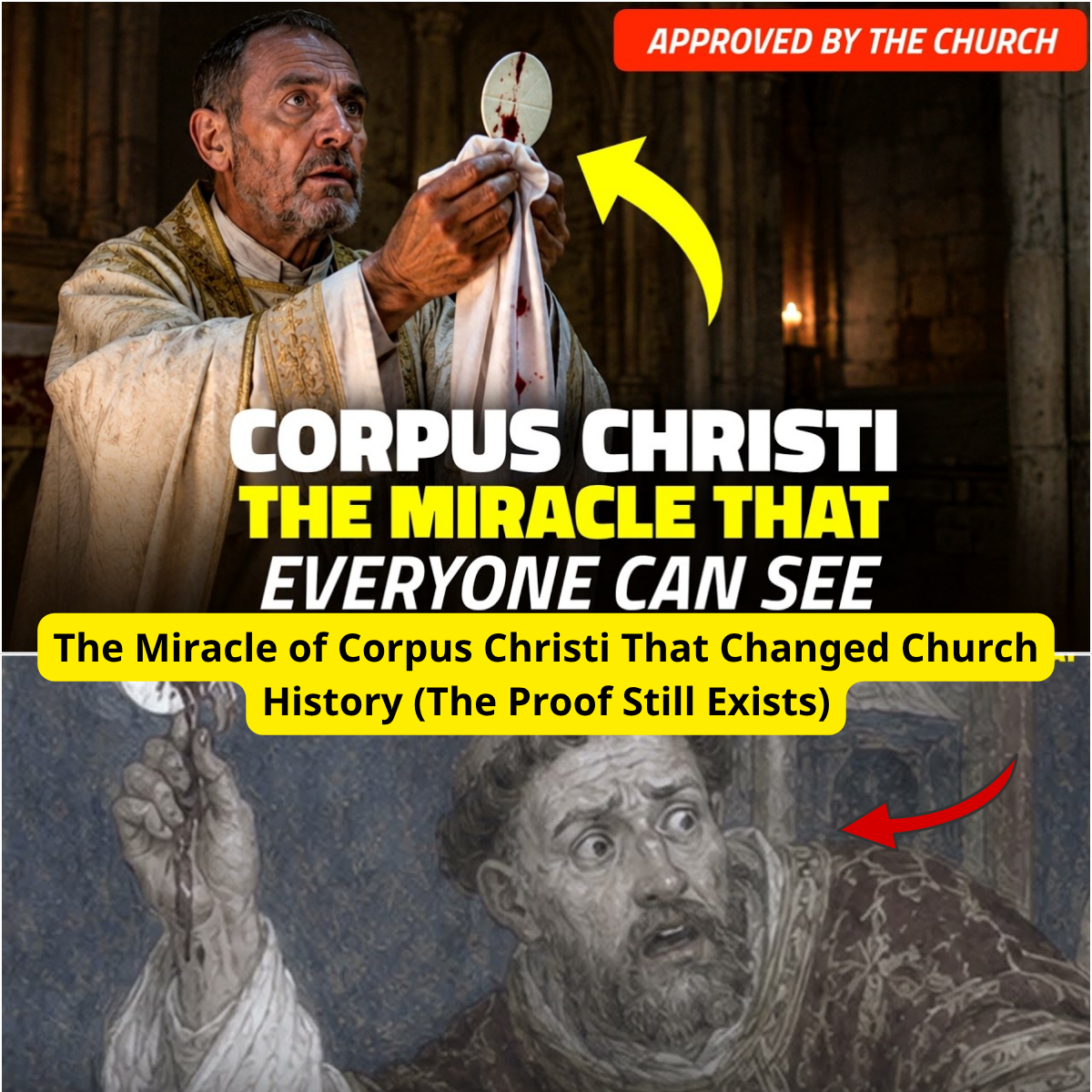
How? his mind demanded. How can the physical substance of bread literally, truly, and substantially transform into the living flesh of Jesus Christ while still looking and tasting like ordinary bread?
The relentless doubt was driving him to the brink of madness. In a desperate, final bid to save his soul, Peter had undertaken the most extreme spiritual gesture of his era: a grueling, months-long pilgrimage to Rome on foot. He had walked over eight hundred miles, trading the comforts of Prague for dusty roads, blisters, and starvation. He had thrown himself onto the hard marble floor above the tomb of Saint Peter, begging the Prince of the Apostles to intercede, to grant him a single spark of certainty.
But Rome had remained silent. The heavens had offered no lightning bolts, no booming voices, no sudden internal peace. Now, on his long journey back northward toward Bohemia, his soul remained shrouded in absolute, suffocating darkness.
Exhausted and spiritually broken, Peter had stopped in Bolsena to rest. It was not a random choice. Bolsena held the sacred remains of Saint Christina, a young martyr from the early centuries of the Church who had endured unimaginable tortures rather than deny her faith. Peter, a grown man paralyzed by his own cowardice and skepticism, sought out her dark, subterranean tomb, hoping that the young girl’s legendary courage might somehow infect his dying spirit.
He requested permission to celebrate the early morning Mass in the crypt.
Now, the moment of truth had arrived. The extractor of his breath felt tight in his throat as he navigated the ancient Latin liturgy. He reached the heart of the service. He took the white, dry, fragile host into his fingers. He bowed his head, closed his eyes against the mocking whispers in his mind, and pronounced the ancient, heavy words of Christ:
“Hoc est enim Corpus Meum.” For this is My Body.
And at that exact, micro-second of eternity, reality tore wide open.
Peter lifted the host high above his head, forcing his eyes to look at it, trying for the ten-thousandth time to simply force his intellect to believe.
But between his fingertips, the impossible manifested with brutal, physical violence.
The white, dry wafer did not remain bread. The center of the host suddenly softened, turning dark and crimson. Before Peter’s widening, terrified eyes, the fabric of the bread literally transformed into living, breathing human flesh.
Then came the blood.
It did not appear as a small, neat stain. A bright, warm, and copious flood of living human blood began to gush from the center of the host. It was so abundant, so relentless, that it immediately soaked through Peter’s fingers, pouring down his wrists and splashing onto his heavy vestments.
The psychological terror that gripped Peter in that moment was absolute. The very thing he had doubted, the very mystery he had dismissed as a philosophical abstraction, was literally exploding in his hands. The heat of the blood was real. The metallic smell of it filled the damp air of the crypt, overpowering the scent of frankincense and melting wax.
Peter went into complete, paralyzing shock. His immediate human instinct was not to turn around and shout the news of a miracle to the few locals praying in the dim pews. It was to hide it. The human brain naturally recoils and struggles to accept the supernatural when it manifests with such raw, gory physicality.
Desperate and trembling so violently he could barely stand, Peter lowered the bleeding host and tried to fold it tightly inside the white linen corporal cloth. He hoped to contain the liquid, to conceal his stain, and to flee back into the shadows of the highway.
But the living blood was completely unstoppable.
It quickly saturated the heavy linen corporal, seeping through the layers of the fabric, soaking into the broader altar cloths. In a state of total, blind panic, Peter grabbed the blood-drenched linens, abandoned the altar mid-Mass, and fled toward the sacristy.
But as he stumbled away in horror, his foot caught on his vestments. He gasped, his hands shaking, and as he lost his balance for a split second, several heavy drops of living blood fell from the linen to the ground.
They did not fall onto ordinary dirt. They fell directly onto the polished white marble steps of the altar.
The dark red fluid did not pool on top of the stone; it practically penetrated the porous grain of the ancient marble, leaving behind deep, dark, indelible stains.
Peter collapsed into the sacristy, his hands stained crimson, his chest heaving as tears of absolute terror and profound rebirth finally broke through his defenses. He realized, with a crushing weight, that he could not hide this. He was ruined, his intellectual pride completely shattered, but at the very same moment, he was fundamentally reborn. The doubt was gone, burned away by the terrifying warmth of the blood on his skin.
There was only one man in the entire world who could handle an event of this terrifying magnitude: the Vicar of Christ himself.
By an extraordinary, almost miraculous twist of fate, the leader of the Catholic Church was only a few miles away. Pope Urban IV was not in Rome that summer; due to political unrest in the capital, he was residing in the heavily fortified papal city of Orvietto, a mere twenty kilometers north of Bolsena.
Peter did not even wash his hands. He did not change his stained vestments. He threw himself onto a horse and rode like a madman along the rugged Italian trails toward Orvietto. He arrived at the papal palace drenched in sweat, covered in dust, distraught, and threw himself prostrate at the feet of the Pontiff.
Weeping openly, Peter confessed everything: his tremendous doubt, his months of silent hypocrisy, his cynical journey to Rome, and the terrifying explosion of living blood he had just witnessed in the crypt of Saint Christina.
Pope Urban IV was a deeply prudent, legally minded leader. He did not immediately jump to his feet or celebrate the distraught priest’s testimony. The Church, then as it does now, understood the danger of mass hysteria and psychological delusion. It always investigates thoroughly before proclaiming the hand of God.
Urban IV immediately ordered a secret, rigorous investigation. He dispatched the Bishop of Orvietto, accompanied by a select team of the most cynical, highly trained theologians of the papal court, to ride down to Bolsena to verify the facts, interrogate the witnesses, and retrieve the physical evidence.
When the Pope’s emissaries entered the dark crypt of Saint Christina, any intellectual skepticism they possessed instantly vanished. The evidence was undeniable. They carefully took the blood-soaked linen corporal cloth, secured it, and organized a grand, heavily guarded solemn procession to bring the relics back to the Pope.
Learning of their approach, Urban IV decided he could not simply wait in his palace. Accompanied by an immense, whispering crowd of citizens, Swiss guards, and the entire college of cardinals, the Pope walked out beyond the massive stone walls of Orvietto. The two groups met on the Rio Chiaro Bridge.
There, under the open sky, the Bishop knelt and unfolded the linen corporal before the Pontiff.
When Urban IV saw the deep, dark stains of blood—stains that, according to witnesses of the era, had arranged themselves on the fabric to form the faint outline of a human figure—the leader of the Western Church fell straight to his knees on the dirt road, weeping in sheer adoration.
This very linen, the famous Corporal of Orvietto, remains intact today. It is preserved inside a breathtaking, massive reliquary of gold and translucent enamel crafted in the fourteenth century, housed securely within the spectacular Cathedral of Orvietto.
Nearly eight hundred years have passed since that faithful summer morning in 1263. From a historical and material perspective, this longevity is one of the most staggering elements of the mystery. No medieval fake made with animal blood, organic dyes, or primitive paint could have survived eight centuries inside a stone cathedral without turning to gray dust, fading completely into the fabric, or rotting away into obscurity. Yet, the structural layout of the stains remains perfectly visible, an unequivocal, physical artifact of an event that broke straight through the natural laws of physics.
And what of the drops that fell onto the steps?
If you travel to the town of Bolsena today, you can descend into that very same ancient crypt. There, protected by iron grates and glass, are the exact marble stones stained by Father Peter’s panicked retreat. For generations, millions of pilgrims, skeptics, and historians have stood in that subterranean chill, looking with their own eyes at the dark, deep crimson spots deeply embedded inside solid stone.
Pope Urban IV understood that this terrifying grace could not remain a localized secret confined to the hills of Umbria. The miracle of Bolsena was God’s direct, undeniable response not just to the silent intellectual agonizing of Peter of Prague, but to the deep, lingering doubts of all humanity across every single continent and age.
The idea of establishing a universal feast dedicated entirely to the reality of the Eucharist had been floating through Europe for decades. Years prior, a mystic nun in Belgium named Juliana of Cornillon had experienced vivid, recurring visions of a full moon with a dark fraction missing—a sign she interpreted as the Church lacking a specific liturgical celebration for the Blessed Sacrament. A local celebration had been established in the Diocese of Liège in 1246, but it remained a fragile, isolated custom that the broader hierarchy resisted implementing globally.
It lacked a definitive spark. It lacked the undeniable weight of physical evidence.
The spark in Bolsena was made of living blood.
On August 11, 1264, just one year after Peter of Prague rode sweaty and terrified into Orvietto, Pope Urban IV issued the papal bull Transiturus de hoc mundo. With that single, historic decree, he instituted the grand feast of Corpus Christi—the Body of Christ—ordering the entire global Church to celebrate the Real Presence with grand processions and deep adoration every single year.
A brand-new, universal feast of such immense theological magnitude required an unprecedented liturgy. It needed hymns and prayers that could translate a terrifying supernatural mystery into words that ordinary human beings could sing.
To accomplish this monumental task, the Pope summoned the most brilliant, formidable mind of the thirteenth century to his court in Orvietto: a Dominican friar named Thomas Aquinas.
Thomas was the ultimate intellectual—a man of rigid logic, immense philosophical training, and a mind that viewed the world through the cold, structured lens of Aristotelian reason. Yet, when the brilliant philosopher was brought into the presence of the blood-stained corporal cloth of Orvietto, his immense intellect completely melted into profound, mystical adoration.
Standing before the physical evidence of the flesh of God, Thomas Aquinas dipped his quill into ink. From his hand came immortal, breathtaking masterpieces of human literature that are still sung in thousands of languages in churches across the United States and the world today: the Pange Lingua, the Tantum Ergo, and the Panis Angelicus.
These hymns were not written as abstract, poetic metaphors. They were composed as raw, eyewitness testimonies to a physical reality of flesh and blood that had occurred just a few miles away from where Thomas sat writing.
Modern secular minds might easily look at this narrative and dismiss it as a beautiful, dramatic fable from the dark corners of the Middle Ages—a clever piece of religious propaganda designed to scare illiterate medieval peasants into submission.
But the truest grandeur of Eucharistic miracles is that they actually speak to our modern, hyper-rational era of advanced medical science far more profoundly than they ever spoke to the people of the 1200s.
In the 13th century, humanity possessed no understanding of hematology, DNA, or cellular biology. They could only look at blood and see its color. But in recent decades, several highly documented Eucharistic miracles that occurred in the modern era have been subjected to rigorous, blind scientific testing under high-powered microscopes by top-tier, secular medical specialists.
Consider the famous, ancient miracle of Lanciano, Italy, or the highly scrutinized modern miracles in Buenos Aires, Argentina, and Legnica, Poland. When world-renowned forensic pathologists analyzed the physical tissues that inexplicably manifested from consecrated hosts, the scientific data returned identical, shocking results across the board:
Metric
Scientific Forensic Findings
Tissue Type
Authentic human myocardium (the thick muscular tissue of the heart wall).
Blood Type
AB positive, the rarest blood type on earth, matching the stains on the Shroud of Turin.
Cellular State
Presence of living white blood cells deep within the muscle tissue.
To any biologist, the presence of intact, living white blood cells is a medical impossibility. White blood cells disintegrate within minutes after a tissue is separated from a living body or after death occurs. Their presence in these analyzed samples indicated that the heart tissue was not only human, but that it was alive and in a state of profound, agonizing trauma—the exact muscular state of a heart belonging to a human being undergoing severe physical torture or asphyxiation.
Father Peter of Prague did not possess the laboratory equipment to discover these cellular secrets in 1263. But what happened between his trembling fingers was the visual, historical explosion of that exact same terrifying reality. It was a physical reminder to a skeptical world that when a priest steps up to an altar, a theatrical play is not taking place. A mere historical reenactment or symbolic gesture does not occur.
Instead, a profound collapse of space, time, and the natural order takes place, wherein the historical sacrifice of Calvary and the beating, suffering heart of Christ become physically present inside a small, circular fragment of bread. And when the veil of material substance occasionally falls away, what is left standing is the living flesh of God.
This Sunday, when the church bells ring across American towns and the golden monstrance is elevated during the grand processions of Corpus Christi, the ancient story demands to be remembered.
It asks the modern world to look past the stained glass, the heavy incense, and the formal pageantry, and to remember the terrified, sweating Bohemian priest fleeing up the highway to Orvietto. It asks us to remember the deep, dark stains embedded forever inside the marble steps of Bolsena.
The faithful are not merely looking at an ancient tradition or a historic piece of bread being paraded through the streets in a golden display case. They are looking at the exact same living heart. The exact same blood that gushed over the hands of a doubter. The exact same infinite God who love humanity so deeply that He chose to hide His blinding, terrifying light inside the smallest, most ordinary things on earth, gently waiting for our intellect to finally give way to faith.