The Hotel Owner Fired the Single Dad Baker — Then His Bread Changed Everything
The Hotel Owner Fired the Single Dad Baker — Then His Bread Changed Everything
Chapter I: The Dust of the Grand Alder
The aroma of fermenting yeast and caramelized sugar had always been the heartbeat of the Grand Alder Hotel. Long before the morning sun managed to slice through the dense, grey coastal fog of Portland, Oregon, the scent would slip beneath the heavy oak doors of the basement kitchen, rise through the service elevators, and settle into the velvet drapes of the lobby. It was a thick, old-fashioned smell—warm, yeast-heavy, and redolent of toasted grains—that made traveling businessmen pause at the front desk and smooth their rumpled ties, suddenly reminded of kitchens they hadn’t stepped into since 1994.
But on this crisp November morning, the air in the lobby felt remarkably thin.
Rowan Mercer stood by the service entrance, his calloused thumbs hooking into the knots of his stained canvas apron. At forty-two, Rowan looked like a man who had spent his entire adult life moving through the humid, white haze of a flour mill. There was permanent white dust caught in the deep, vertical lines between his eyebrows, and his knuckles were thick and slightly distorted from years of kneading cold, dense sourdough starters against marble slabs. His eyes, normally a gentle, quiet grey, were bloodshot from a lack of sleep that had nothing to do with the bakery’s 3:30 a.m. start time.
In his right hand, he held a brown paper grocery bag. Inside were six unsold loaves of country midth-rye and a small cluster of braided cinnamon rolls, their edges slightly over-browned where the sugar had kissed the pan.
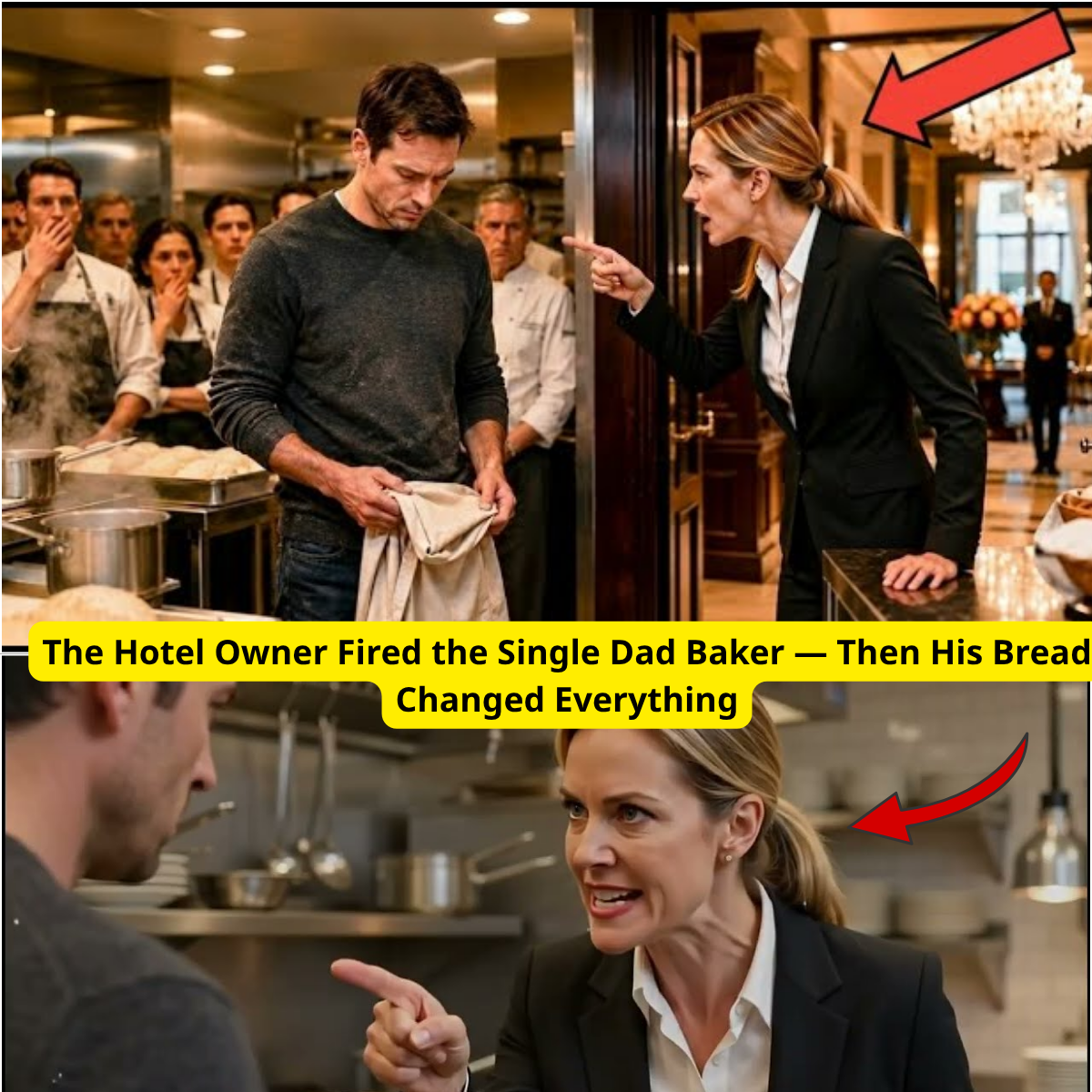
For seven years, Rowan had been the Grand Alder’s artisan baker. He worked in the windowless underbelly of the hotel, his arms moving in the same rhythmic, hypnotic arcs every single night, turning water, salt, flour, and wild yeast into something that felt like a sanctuary for the people sleeping upstairs. Since his wife, Sarah, had passed away three years ago after a sudden, aggressive battle with pneumonia, those midnight hours in the kitchen had been his only stability. The dough was predictable. It responded to the heat of his palms and the patience of his clock in a way that the terrifying, unpredictable outside world never did.
Everything he did was for Ivy.
His eight-year-old daughter was a small, extraordinarily quiet child who possessed her mother’s unnervingly large, dark eyes. Every afternoon when Rowan returned to their cramped, radiator-choked apartment on 14th Street, Ivy would be sitting on the linoleum floor by the window, her knees tucked into her oversized sweater, waiting. He would walk through the door smelling of toasted wheat, and he would pull out a few day-old pastries wrapped in white greaseproof paper. They called it their “baker’s tax.” It was their little afternoon ritual—a sweet, sticky bridge across the massive, silent void Sarah’s absence had left behind.
But the Grand Alder had recently fallen into the hands of Conrad Vale.
Vale was a twenty-nine-year-old venture capitalist from Seattle who looked at hospitality through the sharp, cold lens of a spreadsheet and a social media feed. He bought the historic hotel with a single, aggressive goal: to strip away what he called its “dated, grandmotherly sentimentality” and reinvent it as a minimalist luxury destination for wealthy tech executives and lifestyle influencers.
To Conrad, Rowan’s rustic, irregular sourdoughs with their blistered, dark crusts were an eyesore. They didn’t look uniform in photographs. They didn’t align with the glossy, clinical aesthetic he was cultivating. Within his first week, Conrad had contracted with an industrial pastry distributor out of Vancouver to fly in frozen, pre-formed desserts twice a week—glossy, multi-layered mousses, perfectly geometric tarts covered in clear glaze, and pale, pristine croissants that looked like they had been manufactured in a cleanroom rather than baked in an oven.
The confrontation happened on a Tuesday afternoon, just as the sunlight was hitting the flour dust in the basement kitchen, turning the air into a golden, shimmering fog.
Conrad walked in, his handmade leather shoes clicking with a sharp, militaristic cadence against the white subway tiles. He didn’t look at the massive, seventy-year-old cast-iron deck oven that Rowan had spent the last hour cleaning. He looked only at his tablet.
“Rowan,” Conrad said, his voice clipped, efficient, and entirely devoid of malice—which somehow made it worse. It was the tone of a man retiring a piece of software. “The guest demographics are shifting. We’re moving toward a curated, high-concept culinary experience. The rustic bread program doesn’t fit the brand identity we’re launching next month. People don’t want heavy carbs at breakfast anymore; they want aesthetic plating.”
He didn’t wait for Rowan to speak. He extended a thin white envelope containing two weeks of severance pay and a generic reference letter. “We appreciate the seven years, truly. But we won’t be needing you to punch in tomorrow. You can take whatever flour remains in your personal bin.”
The hardest part of that day wasn’t the cold, professional termination. It was eight hours later, when the radiator in the apartment began its rhythmic, metallic banging under the kitchen sink. Rowan sat at the small formica table, watching Ivy eat her dinner. He had told her he wasn’t hungry, claiming he had eaten a large sandwich at the hotel, but the little girl wasn’t fooled. She didn’t say anything, but she carefully divided her last slice of sourdough in half, sliding the smaller piece across the table toward his empty plate with a tiny, hesitant movement of her fingers.
Chapter II: The Cold Luxury
Over the next ten days, the apartment on 14th Street began to feel increasingly like a trap. The winter humidity crawled through the old window frames, leaving dark, damp rings on the wallpaper. Bills—gas, electricity, the past-due notice from Ivy’s after-school program—accumulated in a neat, terrifying stack next to the stained porcelain sink. The refrigerator hummed with a hollow, vibrating intensity, its shelves holding little more than a half-empty carton of generic milk and a jar of yellow mustard.
Rowan spent every morning pounding the pavement, his boots cracking against the frozen city sidewalks. He visited every boutique bakery, every high-volume supermarket, and every artisanal cafe from the Pearl District to the outer edges of SE Division.
The responses were identical, delivered by twenty-something managers with manicured beards and flashy digital portfolios. “Do you have a certificate from a culinary academy?” “Are you familiar with high-yield industrial laminators?” “We’re actually looking for someone who can manage our TikTok baking streams.” Rowan would stand there, his heavy, old-school baker’s hands hanging uselessly at his sides, realizing that the industry had moved into a digital space where the texture of a loaf mattered less than the lighting of the video clip showing it being cut in half.
Meanwhile, a mile away, the Grand Alder Hotel was slowly beginning to lose its skin.
The imported, glossy pastries looked magnificent under the newly installed halogen track lighting in the dining hall. Guests took thousands of photos, their camera flashes flickering against the geometric layers of raspberry gel and white chocolate foam. But after the initial photograph was taken, the plates were often left half-full. The croissants were dry—shipped across the border in refrigerated trucks, they lacked the elastic, buttery soul of a pastry that had been pulled from an oven less than an hour prior.
Online reviews, which Conrad watched with the obsessive focus of a day trader, began to drift into dangerous territory.
“The hotel looks beautiful, but the warmth is gone,” one regular corporate traveler wrote. “It feels like sleeping inside a high-end refrigerator. The breakfast used to smell like heaven. Now it just tastes like plastic.”
Families who had made the Grand Alder their traditional Thanksgiving base camp canceled their reservations, opting for smaller, less modern bed-and-breakfasts across the river. Business travelers checked out early, complaining that the breakfast hall felt eerie and cold. The bustling, high-volume morning rush that had defined the hotel’s main floor for decades slowly disintegrated into a quiet, sterile room where the only sound was the soft scraping of silver forks against porcelain and the distant, mechanical hum of the lobby’s espresso machine.
Conrad Vale ignored the warnings from his front-desk staff. He believed that luxury was a mathematical equation—if you spent enough money on Italian marble and minimalist furniture, the human element would eventually adjust itself to fill the gaps.
Then came the stormy Thursday that brought the city to a grinding halt.
Chapter III: The Gathering Storm
It began as a low, charcoal-colored wall of clouds moving in from the Pacific, but by noon, the storm had transformed into an atmospheric river that slammed into Portland with historic violence. The rain didn’t fall; it drove sideways, propelled by forty-mile-an-hour wind gusts that tore the yellow leaves from the maples and choked the city’s old storm drains within an hour.
By 2:00 p.m., the main interstate was a parking lot of stalled vehicles standing in eight inches of muddy water. Flights out of Portland International Airport were grounded indefinitely as the visibility dropped to zero.
Suddenly, the Grand Alder’s lobby was inundated. Dozens of exhausted, saturated travelers—families with screaming toddlers, international businessmen whose connecting flights had been terminated, and elderly couples wrapped in damp wool coats—poured through the revolving glass doors, desperate for shelter. Within ninety minutes, the hotel’s capacity soared to one hundred and twelve percent.
In the kitchen, the atmosphere was close to absolute panic.
The delivery truck from Vancouver, carrying the weekend’s supply of imported, high-end desserts and pre-baked breakfast parfaits, was trapped behind a jackknifed semi-truck on I-5, twenty miles north of the city. The kitchen’s backup inventory consisted of six boxes of frozen sausage patties and two industrial bags of instant oatmeal.
By 4:00 p.m., angry, wet, and deeply frustrated guests packed the dining hall and the lobby lounge, demanding food. The children were growing restless, their parents hounding the front-desk clerks with increasing hostility. Overhead, the thunder rattled the massive, floor-to-ceiling glass windows of the lobby, making the entire building feel like an island caught in a dark, violent sea.
For the first time since he had purchased the property, Conrad Vale looked genuinely terrified. He stood in the center of the kitchen, his silk tie loosened, his expensive leather shoes soaked from a leak near the dishwashing station, staring at an empty walk-in cooler.
“What do you mean we have nothing?” Conrad snapped at Matteo, the assistant kitchen manager. “We’re a four-star hotel! Figure it out!”
Matteo, a tired man in his late fifties who had worked alongside Rowan for five years, wiped his greasy face with a dish towel. He looked directly into his new employer’s eyes with a hard, defiant stare. “We don’t manufacture food here anymore, Conrad. We buy it from a truck. And the truck is stuck in a ditch. The only thing we have downstairs is forty pounds of unbleached flour that Rowan didn’t take with him.”
Vance choked on his own breath. “Can you bake something?”
“I’m a line cook,” Matteo said flatly. “I can fry an egg and I can sear a steak. I don’t know how to talk to the flour. Only one person does.”
Across town, in the small apartment on 14th Street, the air smelled entirely different.
The tiny kitchen was a sanctuary of thick, white heat. To keep his mind from spiraling into the dark math of his bank account, Rowan had spent the entire morning doing the only thing that made his hands feel useful. He had baked. He had revived his old sourdough culture from the jar in the back of the fridge, worked the dough until his forearms burned, and fired up the temperamental apartment oven to its absolute limit.
Dozens of fresh, golden-brown loaves were stacked across the laminate countertops, resting on wire racks. There were long, rustic batards with jagged, floured crusts, round boules that sounded hollow when tapped on the bottom, and a large tray of braided brioche rolls that were still radiating heat.
Ivy sat at the tiny table next to the oven, her small legs swinging under her chair, using two broken wax crayons to color a picture of a large, yellow sun on a piece of packing paper.
Suddenly, Rowan’s cell phone buzzed violently against the wood of the table. It was Matteo. His voice was frantic, barely audible over the sound of shouting guests and clattering pans in the background. He explained the disaster at the hotel—the stranded travelers, the missing delivery truck, the raw panic in Conrad Vale’s eyes.
“Rowan, please,” Matteo pleaded. “We’ve got eighty hungry people in the lobby right now and fifty more checking in. The boss is losing his mind. If you’ve got anything… if you can bring anything down here, I’ll pay you out of my own pocket.”
Rowan held the phone to his ear, his eyes drifting over the rows of beautiful, fragrant bread covering his counters. His first instinct was a sharp, cold spike of pride. Why should he help the man who had discarded him like an old piece of kitchen machinery? Why should he save a luxury hotel that had decided his soul wasn’t modern enough for its walls?
He looked down at Ivy.
The little girl had stopped coloring. She had been listening to the conversation, her large, dark eyes shifting from her father’s face to the warm loaves of bread. She reached out, her small hand touching the rough, floured sleeve of his shirt.
“Daddy,” she said softly, her voice carrying that strange, ancient wisdom that children of grief sometimes possess. “The people at the hotel didn’t fire you. The man did. But the people are hungry. You always said that if you can feed someone, you have to do it. Especially if they’re having a bad day.”
Rowan stared at his daughter. Her words landed with a soft, heavy impact that cleared away the bitter ash of his resentment. He reached down, kissed the top of her head, and pulled his old oiled-canvas coat off the peg behind the door.
“Help me find the big boxes, Ivy,” he said.
Chapter IV: The Rising Smell of Home
An hour later, the rear doors of an old, rusted station wagon slammed shut in the Grand Alder’s loading dock.
Rowan walked through the kitchen doors carrying two massive plastic catering trays balanced precariously on his forearms. He was drenched from the walk from the parking lot, his hair plastered to his forehead, his breath coming in short, heavy bursts. On the trays were thirty pounds of fresh bread—still warm, their crusts crackling slightly as they hit the cool air of the basement.
The scent hit the lobby before Rowan even reached the service stairs.
It was an immediate, overwhelming invasion of fragrance. The sharp, clean tang of natural sourdough fermentation, the deep, rich sweetness of honey-oat loaves, and the buttery, comforting embrace of the braided cinnamon rolls. The aroma drifted through the kitchen doors, crept down the marble corridors, and flooded the freezing, tense spaces of the lobby.
In the dining hall, a toddler who had been crying for forty-five minutes suddenly went silent, sniffing the air. An elderly woman sitting in a high-backed armchair closed her eyes, a tiny, involuntary smile touching the corners of her mouth. The sharp, aggressive murmur of complaints from the front desk died away within thirty seconds.
“What is that?” a man in a wet business suit asked, turning his head toward the kitchen entrance. “Is someone cooking?”
Matteo and Rowan didn’t ask for permission. They rolled out three large, rustic wooden chopping boards onto the main buffet tables. With long, rhythmic strokes of his bread knife, Rowan began slicing the loaves, the thick, golden crusts showering the wood with crisp, white flakes. He laid out the slices in giant, overlapping fans—white crumb holes glistening with moisture, still hot enough to melt the small tubs of local butter Matteo had unearthed from the back of the dairy fridge.
“Eat,” Rowan said to the crowd, his voice quiet but steady. “Please. There’s plenty.”
What happened over the next two hours was something the Grand Alder Hotel had not seen in a century.
The barriers of cold luxury collapsed entirely. Guests didn’t take photos of the food; they reached out with eager, trembling hands, tearing apart the warm rolls while standing right next to the buffet tables. Children laughed, their fingers sticky with cinnamon glaze, as they sat on the polished floorboards, their legs crossed, entirely content. Tired, stressed couples who had been arguing about flight delays five minutes earlier sat over bowls of hot potato soup and thick slices of sourdough, their shoulders dropping as they talked in low, relaxed tones.
The lobby ceased to be a transit station for wealthy strangers; it became a communal kitchen. People who would have ordinarily ignored one another began conversations, sharing stories of their travels across the bread boards. The soft afternoon light struggled through the dark storm clouds outside, casting a long, amber glow through the giant glass windows, illuminating the flour dust that had once again begun to float through the air.
Conrad Vale stood by the mezzanine railing, looking down at the scene below.
He held a half-eaten slice of Rowan’s country midth-rye in his hand. He had taken a bite out of sheer desperation, but now he was staring at the bread as if it were a foreign artifact. It was chewy, complex, and filled with a deep, satisfying warmth that made him feel incredibly small.
He looked at his hotel. For months, he had tried to manufacture luxury with millions of dollars in renovations and expensive imports, but the room had remained dead. Now, because of twenty dollars worth of flour, water, and salt brought in by a man he had dismissed, the building was alive. It had a soul again.
Chapter V: The Reward of the Heart
Late that evening, after the storm had finally passed, leaving the city streets quiet and wet under the streetlights, Rowan stood by the massive deck ovens in the basement kitchen. He was cleaning the marble counter with a metal bench scraper, his movements slow and peaceful.
A shadow fell across the doorway. Conrad Vale stood there, his expensive suit jacket removed, his white shirt sleeves rolled up to his elbows. He looked younger without his armor of corporate certainty, his shoulders slightly stooped, humbled by the truth of what he had witnessed upstairs.
He walked over to the counter, his steps quiet on the tile. He didn’t look at his tablet.
“Rowan,” Conrad said, his voice dropping into a sincere, quiet register that lacked any of its former efficiency. “I was wrong. I thought this place was just a building with rooms. I thought the food was just something you put in front of people to look at. I didn’t understand until tonight.”
He looked at the flour-dusted marble between them. “I want you to come back. Not just as our baker, but as the director of the entire culinary program for the hotel. You can throw out the Vancouver contracts. We’ll build a new bakery space on the main floor. I’ll double your previous salary, and provide full medical benefits from day one.”
Rowan stopped scraping. He looked out the small basement window at the wet sidewalk above. He thought about the past-due bills on his sink, and he thought about Ivy’s broken crayons. He knew what this money would mean for his family. It was the security he had prayed for every night since Sarah died.
But he didn’t say yes immediately. He looked back at Conrad, his jaw setting into a firm, unyielding line.
“I’ll come back under two conditions, Mr. Vale,” Rowan said, his voice vibrating with a quiet, paternal strength. “First, the Grand Alder will fund three full culinary scholarships every year specifically for single parents in the Portland area who are trying to rebuild their lives. Second, every Sunday morning, the breakfast hall will be open two hours early, and we will provide a free, high-quality breakfast program for any struggling family in this neighborhood who needs a warm meal. No questions asked. No cameras. No publicity.”
Conrad stared at the baker. He saw the white flour on the man’s sleeves and the deep, unwavering kindness in his grey eyes. He realized then that Rowan’s bread tasted the way it did because of who Rowan was. You couldn’t buy that kind of heart from a distributor.
“Agreed,” Conrad said, extending his hand.
Five months later, the Grand Alder Hotel had become famous across the Pacific Northwest, but not for its minimalist luxury or its expensive marble lobby. It was known simply as “The House with the Bread.”
People traveled across state lines just to sit in the sun-drenched breakfast room and taste the sourdough that had saved a hundred stranded travelers during the great winter storm.
Every afternoon after the elementary school bell rang, Ivy would walk through the front doors of the hotel, her backpack bouncing against her shoulders. She would take her seat at a custom-built oak counter near the new main-floor bakery windows, opening her homework books while the afternoon sun poured across her papers. The regular guests would wave at her as they walked past, and the kitchen staff would slide a fresh, warm cinnamon roll onto her plate with a wink. She didn’t just belong to the small apartment on 14th Street anymore; she belonged to the heart of the Grand Alder.
As the golden evening sun began its long, slow descent behind the hills, casting a brilliant orange light across the massive hotel windows, Rowan Mercer stood by his new ovens. The rich, yeasty aroma of fresh bread drifted out into the city streets once more, warm and heavy with second chances. He looked through the kitchen glass, watching Ivy laugh as Matteo showed her how to twist a piece of pastry dough into a heart, and he finally understood the long, painful road he had walked.
Sometimes the world breaks your life apart not to punish you, but to force you to discover the warmth inside you—the one gift you have that everyone else is quietly starving for.