The Forgotten Story of Saint Faustina Kowalska: The Nun Who Saw the Face of Divine Mercy
The Forgotten Story of Saint Faustina Kowalska: The Nun Who Saw the Face of Divine Mercy
The autumn wind of 1937 swept mercilessly across the dynamic, rising landscape of Kraków, rattling the heavy wooden window frames of the Convent of the Sisters of Our Lady of Mercy in Łagiewniki. Inside, the world was measured not by the sweeping geopolitics of a darkening Europe, but by the rhythmic, deliberate scrape of a wooden broom against flagstone floors and the quiet bubbling of large iron pots in the kitchen.
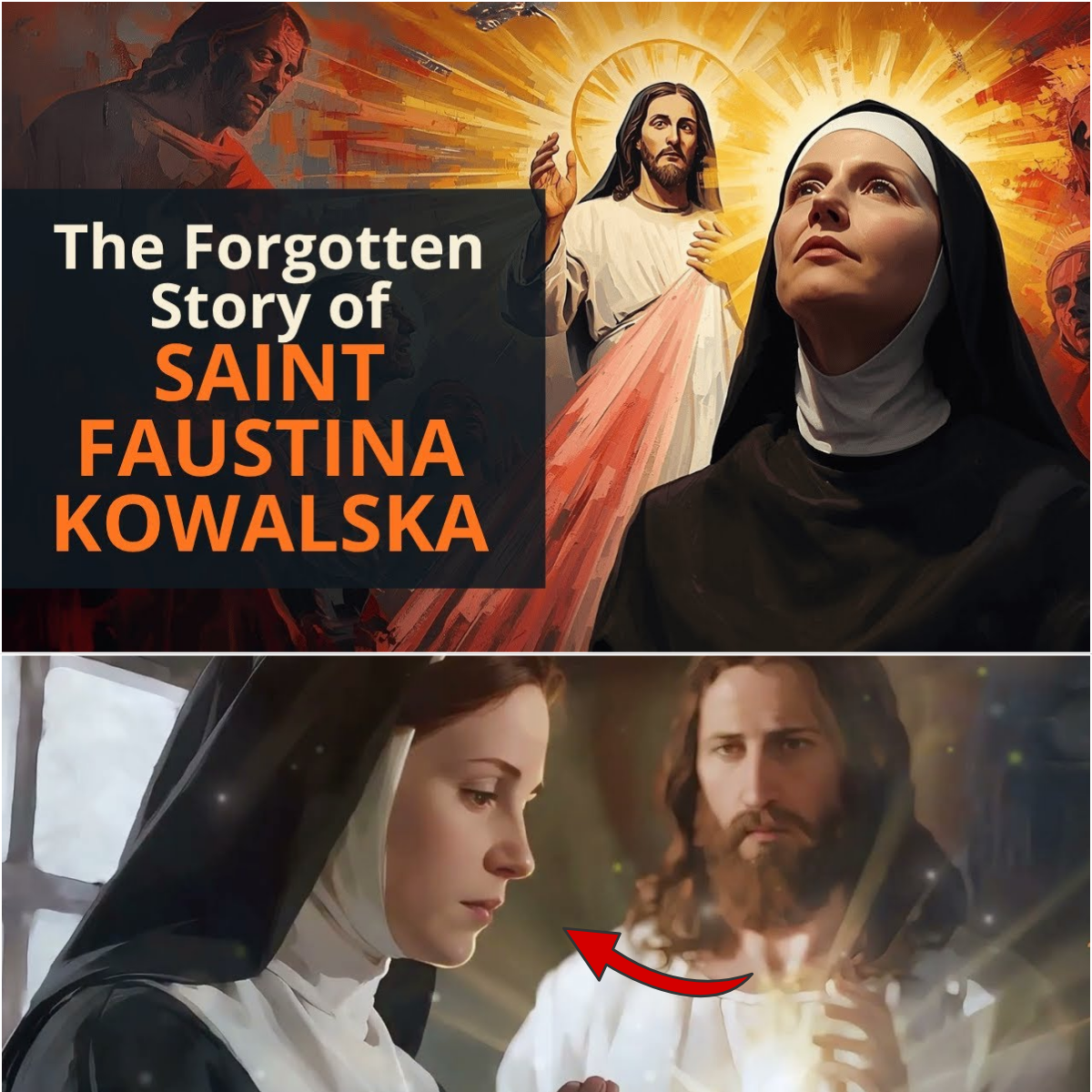
To the casual observer, Sister Maria Faustina of the Most Blessed Sacrament was entirely unremarkable. At thirty-two years old, her frame was slight, broken down by the early, quiet ravages of a respiratory illness she refused to complain about. Her hands were rough, calloused from years of peeling potatoes, tending the convent garden, and standing guard at the heavy wooden porter’s gate. She was a lay sister—a nun of the “second choir”—meaning her lack of formal education and poor peasant background relegated her to a life of manual labor. The sophisticated world of theological academia did not know her name. The local residents simply saw a quiet, intensely polite young woman in a plain black habit who occasionally gave loaves of fresh bread to the destitute at the convent door.
But beneath the simple wool of her veil lived a mind that was currently straddling two entirely different planes of existence.
At exactly 2:45 in the afternoon, Faustina walked down the narrow, dimly lit corridor leading toward the chapel. Every step felt like grinding broken glass into her lungs; the tuberculosis was now spreading from her respiratory tract down into her alimentary system, though she walked with a straight, unbothered posture. She carried a small, battered notebook hidden deep within the wide sleeve of her habit. It was one of six notebooks she had filled with a frantic, sprawling script—a meticulous recording of mystical encounters that her spiritual director, Father Michał Sopoćko, had commanded her to write down after a thorough psychiatric evaluation by Dr. Helena Maciejewska had declared her completely sane.
She slipped into the back row of the empty chapel. The air smelled faintly of beeswax, old incense, and cold stone. On the altar, the sanctuary lamp flickered, a solitary drop of crimson light in the vast, shadowed space.
Faustina looked up at the large canvas painting hanging on the side wall. It was the image she had personally supervised in Vilnius three years prior, painted by the artist Eugene Kazimierowski. It depicted Jesus dressed in a brilliant white garment, one hand raised in blessing, the other touching his chest, from which two massive rays—one a pale, translucent water, the other a deep, vibrant blood—poured forth into the darkness. She remembered weeping bitterly when she first saw the completed canvas, crying out to the Lord that the artist’s brush lines could never match the blinding, breathtaking beauty of the living person she had encountered in her cell.
“Not in the beauty of the color, nor of the brush lies the greatness of this image,” the voice had echoed in her soul, “but in my grace.”
Now, she watched the shadows of the autumn afternoon lengthen across the floorboards. She knew the time was approaching. The clock in the main hallway began its heavy, mechanical whir, preparing to strike.
Part I: The Cracking of the Clock
At precisely 3:00 p.m., the first iron chime reverberated through the quiet convent.
Faustina closed her eyes, her breathing shallow and deliberate. Instantly, the stone walls of the Polish chapel seemed to recede, replaced by a profound, heavy stillness that existed outside the boundaries of human time. It was a spiritual weight so immense it made her chest ache. In the theater of her soul, the brilliant white light of her usual visions gave way to something far more visceral, historic, and agonizing.
She was suddenly present at the base of a rocky, blood-slicked hill under a sky that had turned the color of bruised iron. She could hear the wet, ragged breathing of a dying man hanging from rough-hewn timber. It was the Ninth Hour—the exact moment of the great cosmic pivot, where Jewish tradition counted the hours from the dawn, marking the precise instant when the ancient temple veil in Jerusalem tore violently from top to bottom.
In the interior sanctuary of her heart, the familiar, resonant voice of Christ spoke to her, not with the triumph of a king, but with the raw, gasping vulnerability of a victim reaching the absolute end of his mortal endurance.
“At three o’clock,” the voice instructed, echoing clearly within her mind as she knelt on the hard floorboards of Kraków, “implore my mercy, especially for sinners; and, if only for a brief moment, immerse yourself in my passion, particularly in my abandonment at the moment of agony.”
Faustina’s fingers tightened around the fabric of her habit. She could feel a profound, mystical sorrow entering her own body—a spiritual stigmata that left no physical marks on her skin but burned with the intensity of an open flame.
“This is the hour of great mercy for the whole world,” the voice continued, expanding until it felt like an ocean breaking over the walls of the chapel. “I will allow you to enter into my mortal sorrow. In this hour, I will refuse nothing to the soul that makes a request of me in virtue of my passion.”
The words hung in the silence of her soul like stars. I will refuse nothing. It was an extraordinary, borderline terrifying promise made to a woman who possessed nothing but a third-grade education and a bucket of soapy water.
The voice spoke again, providing three distinct paths for those who would follow her in the decades to come: “Try your best to make the Stations of the Cross in this hour, provided that your duties permit; and if you are not able to make the Stations of the Cross, then at least step into the chapel for a moment and adore, in the Blessed Sacrament, my heart, which is full of mercy; and should you be unable to step into the chapel, immerse yourself in prayer there where you happen to be, if only for a very brief instant.”
Faustina opened eyes as the final echo of the 3:00 bell faded from the corridor. Her forehead was slick with sweat. She pulled out her pen and her notebook, her hand trembling violently as she recorded the words into what would become Paragraph 1320 of her diary. She knew, with a sudden, prophetic clarity, that she would not survive to see this message leave the borders of Poland. She was thirty-three years old—the exact historical age of the man on the cross—and her own clock was ticking down to its final hour.
Part II: The Iron Veil
On October 5, 1938, the room in the Łagiewniki sanatorium smelled of pine oil and death. Faustina lay beneath a thin white sheet, her breathing reduced to a wet, shallow rattle. The sisters gathered around her bed, their faces pale under their starch-white wimples.
“Today, Jesus is going to take me with him,” Faustina whispered, her eyes fixed on a small crucifix mounted to the wall.
Sister Felicia, an older nun who had often watched Faustina scrub the kitchen floors, leaned over her. “Are you afraid, sister? Are you afraid of the judgment?”
Faustina’s dry lips parted into a faint, serene smile. “Why should I be? All my sins and imperfections will be consumed like straw in the fire of the divine mercy.”
At 10:45 p.m., without drama or physical struggle, the young Polish nun closed her eyes for the last time. She was buried in the convent cemetery two days later, leaving behind six handwritten notebooks filled with a radical, challenging theology of grace that would soon run headfirst into the meat grinder of the twentieth century.
Less than a year after her death, Nazi panzers crossed the Polish border, and the city of Kraków was plunged into the horrors of the Second World War. The messages of divine mercy—copied onto small prayer cards by Father Sopoćko—began to circulate secretly among the terrified local population. For a people facing the systemic erasure of their culture and their lives, the 3:00 p.m. prayer became an act of spiritual resistance.
But the greatest threat to Faustina’s diary did not come from the gestapo or the subsequent Soviet occupation. It came from within the ancient, cautious walls of the Vatican itself.
By the late 1950s, the handwritten diaries had been transcribed and translated into French and Italian so that the Holy Office in Rome could evaluate them for doctrinal accuracy. However, the translations were an unmitigated disaster. Rushed by well-meaning but poorly skilled linguists, the translated texts contained massive theological errors, making it appear as though Faustina was promoting an arrogant, heretical form of self-salvation or a bizarre, un-Catholic emotionalism.
On March 6, 1959, the heavy hand of Rome came down. The Holy Office issued an official, binding notification signed by Cardinal Alfredo Ottaviani. The decree completely forbade the distribution of the Divine Mercy images, the chaplet, and any writings in the forms proposed by Sister Faustina.
For nearly twenty years, Faustina’s life’s work was locked away in the Vatican secret archives. To the world, she was a forgotten ghost, an eccentric peasant girl whose visions had been deemed unsafe for the global faithful. The devotion was dead, buried under a mountain of bureaucratic red tape and flawed translation files.
Part III: The Scrutiny of the Scholar
In the winter of 1965, a young, brilliant intellectual named Karol Wojtyła—the newly appointed Archbishop of Kraków—stood before Faustina’s unassuming grave in Łagiewniki. He was a man who had survived both the Nazi occupation and the heavy, crushing boots of the communist regime by relying on the power of the underground word. He had read Faustina’s original Polish notebooks before they were sent to Rome, and he knew, with the absolute certainty of a classical scholar, that the Vatican had made a monumental mistake.
Wojtyła knew that a direct, confrontational challenge to Rome would fail. Instead, he initiated a formal, highly academic “informative process” into Faustina’s life and virtues.
He approached Professor Ignacy Różycki, a fiercely conservative and notoriously rigorous theologian at the Pontifical Academy of Theology in Kraków. Różycki was a man who viewed mystical claims with a deep, intellectual skepticism.
“I want you to conduct an exhaustive, word-by-word theological analysis of Sister Faustina’s original Polish text,” Wojtyła told the professor, placing a photocopied stack of the original diaries onto his desk. “Do not look at the French translations. Look at the raw Polish. Tell me if she is a heretic, or if she is a saint.”
For years, Różycki pulled the text apart under a theological microscope. He spent months specifically analyzing the claims surrounding the 3:00 p.m. hour. He compared her words to the writings of Thomas Aquinas, Augustine, and the early Church Fathers.
One evening, after tracking down the specific translation errors that had alarmed the Vatican, Różycki walked into Wojtyła’s study. His face was pale with a profound, intellectual awe.
“The French translators missed the entire context of the Polish syntax, Your Eminence,” Różycki said, laying out his multi-volume analysis. “They translated her expressions of spiritual intimacy into declarations of theological pride. Her writings contain absolutely nothing contrary to Catholic dogma. In fact, her understanding of the relationship between divine justice and divine mercy is one of the most brilliant, organic synthesis of the Paschal Mystery I have ever encountered.”
Różycki explained that the 3:00 p.m. devotion fulfilled three highly specific theological conditions that kept it completely aligned with traditional Christian worship: it was addressed directly to Jesus as the mediator; it was anchored to a specific historical event—the crucifixion; and it appealed strictly to the merits of Christ’s sacrifice rather than any human work.
Armed with Różycki’s massive, bulletproof theological defense and a pristine, highly accurate new translation of the text, Archbishop Wojtyła formally submitted the dossier to the Congregation for the Doctrine of the Faith.
The defense was completely unassailable. On April 15, 1978, the Vatican issued a historic, sweeping retraction. The Congregation declared that after reviewing the original documents that had been entirely unknown to them in 1959, the prohibitions against Sister Faustina’s writings were officially lifted.
Exactly six months later, on October 16, 1978, smoke billowed from the chimney of the Sistine Chapel. Karol Wojtyła stepped onto the central balcony of St. Peter’s Basilica as Pope John Paul II.
Part IV: The Global Echo
On April 30, 2000, a crowd of over two hundred thousand people packed into St. Peter’s Square under a brilliant, cloudless Italian sky. Millions more watched via international satellite broadcasts across forty-five different countries.
Pope John Paul II, now aged and his hands trembling with the early signs of Parkinson’s disease, stood at the high altar. Behind him hung a massive, multi-story reproduction of the Divine Mercy painting—the exact image that a poor Polish housemaid had struggled to have painted in a small room in Vilnius seventy years prior.
“It is important that we accept the whole message that comes to us from the word of God on this Second Sunday of Easter, which from now on throughout the Church will be called ‘Divine Mercy Sunday,'” the Pope’s voice boomed across the square, his words carrying the weight of a lifetime spent fighting totalitarian regimes.
With those words, he officially canonized Sister Maria Faustina Kowalska, making her the very first saint of the new millennium. He had taken a woman who was once turned away from convents with the mocking phrase, “We do not accept maids here,” and raised her to the highest altars of global history.
“By providing this focus,” the Pope said, looking out over the sea of humanity, “Jesus told Sister Faustina that humanity will not find peace until it turns trustfully to divine mercy.”
Five years later, on April 2, 2005, John Paul II lay dying in his papal apartments overlooking St. Peter’s Square. The square below was packed with thousands of young people, their voices rising in low, rhythmic prayer through the dark night. It was the absolute vigil of Divine Mercy Sunday—the exact feast day he had instituted for the universal Church. He had completed the mission he had started in the dark corridors of occupied Kraków; he had vindicated the memory of the young nun who had died at thirty-three.
Part V: The Ninth Hour
Today, the legacy of that quiet Polish nun does not exist merely in historical textbooks or the marble niches of Rome. It exists in the daily, rhythmic lives of millions of people across the globe who participate in one of the largest grassroots spiritual movements in modern history.
In the Berkshire Mountains of Stockbridge, Massachusetts, the National Shrine of the Divine Mercy spans 375 acres of quiet, mist-covered hills. Every single afternoon, as the clock approaches 2:59 p.m., a profound, anticipatory silence falls over the grounds. Pilgrims who have traveled from the concrete expanses of New York, Boston, and Baltimore begin to file quietly into the stained-glass sanctuary or kneel on the grassy lawns outside.
At precisely 3:00 p.m., the heavy bronze bells of the shrine begin to ring out across the valley, their deep, resonant tones echoing through the pine trees.
Inside the chapel, a first-class relic of Saint Faustina—a small fragment of bone preserved in an ornate silver reliquary—rests beneath the image of the white-robed Christ. A priest steps up to the microphone, his voice cutting through the stillness.
“You expired, Jesus,” the voices of hundreds of pilgrims join him in a low, powerful unison, reciting the exact prayer Faustina had scribbled in her notebook while suffering from terminal tuberculosis in Kraków. “But the source of life gushed forth for souls, and the ocean of mercy opened up for the whole world. O Fountain of Life, unfathomable Divine Mercy, envelop the whole world and empty yourself out upon us.”
At that exact same moment, thousands of miles away in the bustling, neon-lit heart of Manila, a massive corporate office building experiences a sudden, bizarre pause. In the middle of high-stakes financial meetings and chaotic customer service calls, an automated tone chimes over the public address system. For sixty seconds, executives in tailored suits and young workers at call-center desks pause their keyboards, bow their heads, and participate in the exact same moment of recollection.
And deep within the quiet, historic interior of the Divine Mercy Shrine in Vilnius, Lithuania—the only shrine housing the original painting that Faustina’s eyes actually looked upon—a lone woman kneels in the back row. She does not have an engineering degree, she does not have political power, and she does not have credentials that the world considers valuable.
She simply looks at the downward gaze of the man in the white garment—the gaze that Faustina’s diary notes was designed to resemble the look from the cross—and whispers her requests into the 3:00 silence, relying entirely on a promise written in a schoolchild’s notebook by a forgotten maid after midnight.