The Forgotten Marian Apparition Behind a Powerful Devotion
The Forgotten Marian Apparition Behind a Powerful Devotion
The snow over Pellevoisin fell with a heavy, deadening weight, blanketing the flat wheat fields and dormant vineyards of central France until the earth looked as featureless as a shroud.
Inside the small cottage near the parish church, the only sound was the wet, rattling gasp of a thirty-two-year-old woman drowning in her own lungs. It was February 10, 1876.
Dr. Bernard stood by the window, adjusting his heavy wool coat. He had traveled through the biting cold from the nearby town of Buzançais to examine Estelle Faget, and his face carried the grim, clinical certainty of a nineteenth-century physician who had run out of tools. He looked at Estelle’s parents, whose faces were hollowed out by months of sleepless misery, and shook his head.
“There is nothing more anyone can do,” Bernard said, his voice dropping to a low, somber register. “The pulmonary tuberculosis has consumed the upper lobes. The acute peritonitis has turned tubercular, and the abdominal tumor on her left side is now the size of a large orange. Her stomach rejects even a spoonful of broth. I give her four, perhaps five hours. Prepare yourselves.”
But Estelle did not die in five hours. She did not even die that night.
To the doctors, her survival was a medical anomaly; to Estelle, it was a agonizing delay. For ten years, she had been the sole financial pillar of her family, working as a nursery maid and seamstress for the aristocratic Rochefoucauld family. Her father had never found steady work; her younger sister required constant care. When Estelle’s older sister had died years earlier, the weight of the entire household fell onto Estelle’s shoulders.
Now, she lay isolated in a rented room, banished from the chateau because the countess feared the white plague would spread to the rest of the household. Estelle was not afraid of the graveyard that sat just beyond her window, but she was terrified of what would happen to her aging parents once she was gone.
Six months earlier, in a desperate fit of love and grief, she had taken a pen and written a letter directly to the Virgin Mary.
“Oh my good mother,” she had written in her elegant, slanting cursive, “here I am once again prostrate at your feet… You know that I am my parents’ sole support. If, because of my sins, a complete cure cannot be granted, obtain for me at least a little strength to be able to support them. You see, my good mother, they are on the point of being obliged to beg for their bread.”
She had given the letter to a sympathetic tutor at the estate, who hid it at the feet of a statue of Our Lady of Lourdes in the family’s private garden grotto.
For months, heaven had remained entirely silent. The winter deepened. Her right arm became completely paralyzed, turning stiff and useless against her side. By February 14, she was so weak she could no longer swallow water.
Just after midnight, the room grew unseasonably cold. The candle on the bedside table flickered, its golden flame turning an unnatural, sickly green.
Estelle forced her heavy eyelids open. The shadows in the corner of the room were shifting, pooling together at the foot of her bed. Out of the darkness emerged a figure.
It was tall, gaunt, and shifting, its face a distorted, grimacing mask of raw malice. Its eyes were not human; they were twin pits of ancient, burning hatred, fixed entirely on her. Estelle froze, a primal terror seizing her chest. She tried to cry out for her parents sleeping in the next room, but her vocal cords were dry, locked tight by the grip of the plague. She could only stare back at the horror, understanding with absolute certainty what it was.
The devil had come to claim her despair.
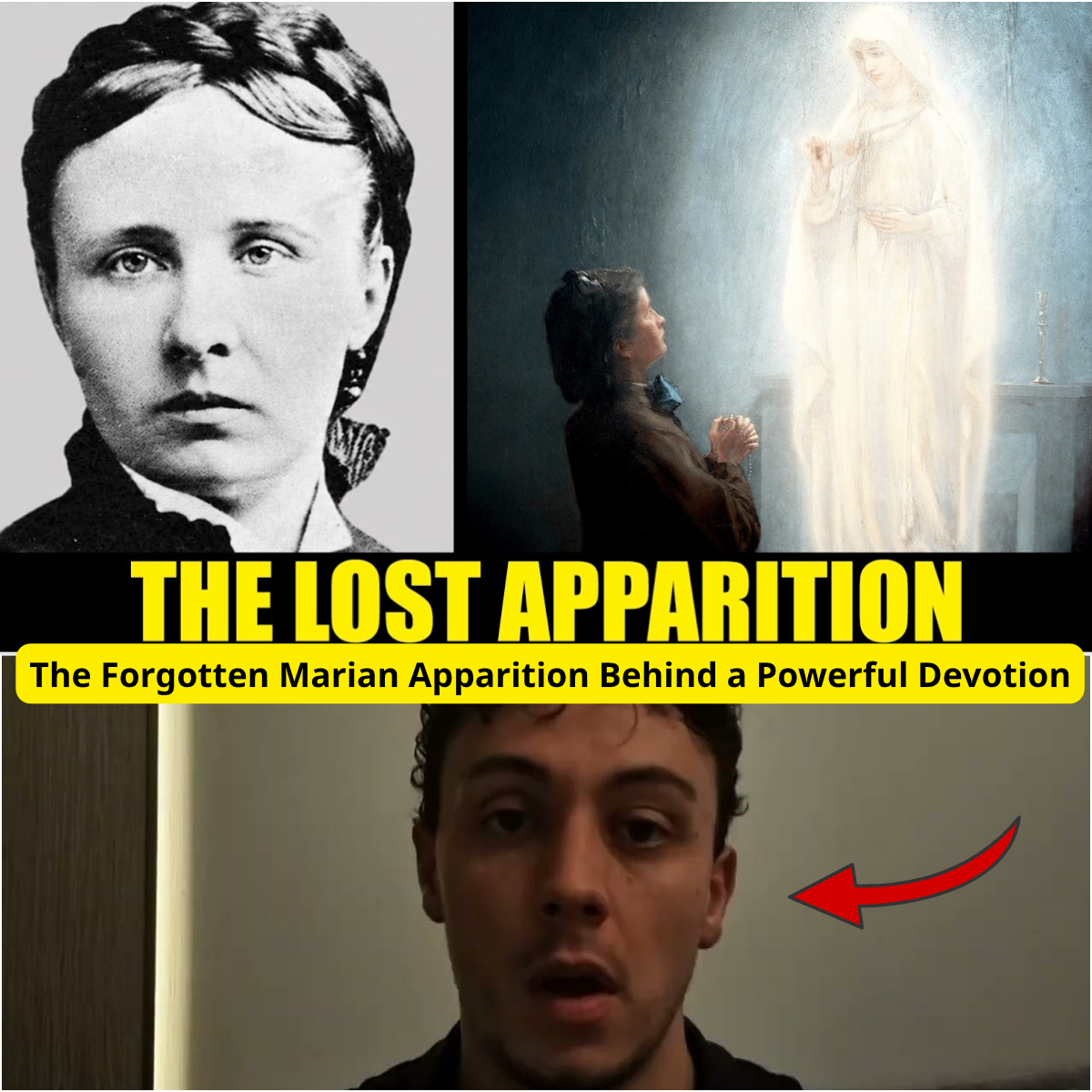
But before the shadow could move toward her pillow, a soft, blinding luminescence fractured the dark from the right side of the bed. Estelle turned her head slightly. Standing within the light was a woman dressed in flowing garments of brilliant white.
The woman in white did not look at Estelle first. She looked directly at the grimacing monster at the foot of the bed. Her voice, when she spoke, was not the sweet whisper of a holy card; it was sharp, commanding, and filled with the terrifying authority of an army in battle formation.
“What are you doing here?” the woman in white demanded, her words cutting through the damp chill of the room. “Don’t you see that she wears my livery and that of my son?”
Estelle’s mind raced. My livery. At fourteen, she had been enrolled as a Child of Mary, and around her neck—even now, tangled in the lace of her nightgown—lay a worn Miraculous Medal, the same design given to Catherine Labouré in Paris decades earlier. It was her uniform. Her sign of ownership.
The devil took one look at the woman in white, his terrible face twisting in frustration, and vanished into the floorboards, fading like smoke in a gale.
The woman turned toward Estelle. The sharpness instantly vanished from her expression, replaced by a tenderness so profound that Estelle felt her racing heart begin to slow.
“Fear nothing,” the woman said, her voice softer than silk. “You know well that you are my daughter. Take courage. Be patient. My son will let himself be moved. You will suffer five more days in honor of the five wounds of my son. On Saturday, you will be dead or healed. If my son gives you back your life, I want you to publish my glory.”
The Terms of Saturday
Before Estelle could speak, a large, flat object materialized in the air between them. It was a white marble plaque, identical to the ex-voto devotional tablets Estelle had seen plastering the walls of churches in Paris—public monuments of gratitude for answered prayers.
“Where should it go?” Estelle whispered, her voice returning. “In Paris? At the church of Notre-Dame des Victoires?”
The woman in white smiled, but shook her head before Estelle could finish the word. “At Notre-Dame des Victoires, they have plenty of marks of my power,” she said simply. “Whereas at Pellevoisin, there is nothing. They need stimulation.”
With those words, she receded into the light, leaving the room dark once more.
The next morning, Estelle sent for the parish priest, Abbé Salmon. He was a sensible, quiet man who had prepared many villagers for the cemetery, and when he heard the dying woman’s wild story about devils and marble plaques, his face clouded with worry. He told her to remain quiet, to pray, and to prepare for the end. He did not know that he would spend the next forty-six years of his life defending every syllable she had spoken.
On Tuesday night, February 15, the darkness returned, and with it, the grimacing face at the foot of the bed. But this time, the devil didn’t even have time to settle. The woman in white appeared almost instantly, casting him out with a single glance.
She looked down at Estelle. “Don’t be afraid. I am here. This time, my son has let himself be moved. He gives you back your life. You will be healed on Saturday.”
Estelle felt a surge of joy, but the woman’s expression turned solemn. “By giving you back your life, do not think you will be free from sufferings. You will suffer, and you will not be free from pains. That is what makes life worthwhile. Now, let us look at the past.”
In that instant, the walls of the cottage seemed to dissolve. The woman in white showed Estelle her own life as if it were a panoramic tapestry—every hidden sin, every moment of impatience, every sharp word spoken in the laundry houses of Paris, and every failure of charity. Estelle wept bitterly, the raw truth of her own unworthiness crashing down upon her. When the review was over, the woman vanished, leaving Estelle alone with the crushing weight of her faults.
By Wednesday night, Estelle was convinced she had disappointed her heavenly visitor. But when the light returned, the woman’s voice was even gentler than before.
“Come now, take courage, my child,” she said. “All this is in the past. By your resignation, you have made up for these faults.”
The woman then reached into the air and produced the small, crinkled letter Estelle had written six months prior. She quoted Estelle’s own words back to her: “See the pain of my parents… they are about to beg for their bread.”
“I showed this letter to my son,” the woman said, her eyes shining with a maternal light. “Your parents need you in the future. I am all-merciful, and mistress of my son. Try to be faithful. Do not lose the graces given to you, and publish my glory.”
The Sign of the Cross
Friday night arrived, and the atmosphere in the cottage was electric with tension. Saturday began at midnight, just hours away. Estelle’s parents had finally fallen into a heavy sleep in the adjoining room, exhausted by the weeklong vigil.
Exactly at midnight, the room filled with the familiar, brilliant illumination. The woman in white stepped through the curtains of the bed, closer than she had ever been before. Her face carried a deep, celestial sorrow.
“What afflicts me most,” she said, looking down at Estelle, “is the lack of respect people have for my son in Holy Communion, and the attitude of prayer they take when the mind is occupied with other things. I say this to people who claim to be pious.”
She paused, letting the warning hang in the quiet air of the room. Then, the white marble plaque appeared once more, hovering between them. But it had changed. In each of its four corners, a golden rosebud was carved into the stone. At the top, a flaming heart of gold blazed brightly, crowned with a wreath of roses and pierced through with a sacrificial sword.
Engraved across the center of the marble in gleaming gold letters were the words:
I INVOKED MARY AT THE HEIGHT OF MY MISERY. SHE OBTAINED FOR ME FROM HER SON MY COMPLETE HEALING.
“Can I tell people what has happened?” Estelle asked, her voice trembling.
“Yes,” the woman replied. “But before speaking of it, you will wait for the opinion of your confessor and director. You will face pitfalls. You will be called a visionary, mad, a fraud. Pay no attention to all of this. Be faithful to me, and I will help you. If you want to serve me, be simple, and let your actions match your words. One can be saved in any state of life.”
The light flickered, and she was gone.
It was 12:30 in the morning. Suddenly, Estelle felt a sensation like a rushing wave of heat move through her chest, breaking the icy congestion in her lungs. The agonizing pressure in her abdomen simply evaporated. For months, her body had felt like a broken machine; now, a vibrant, terrifying energy poured into her muscles.
She looked down at her right arm—the limb that had been completely paralyzed for weeks. It was still stiff. The woman had said the healing would be completed at Communion.
At six o’clock in the morning, Abbé Salmon entered the room, carrying the Eucharist. He looked at Estelle, expecting to see a corpse or a woman in the final throes of death. Instead, she was sitting upright, her eyes bright.
The priest advanced, raised the white host, and pronounced the words. As Estelle received the sacrament, a sharp tingle traveled down her right shoulder. With a smooth, effortless motion, her paralyzed right hand lifted from the sheet, rose to her forehead, and made a perfect, deliberate sign of the cross.
By noon, the village of Pellevoisin was in an uproar. Dr. Bernard was summoned back to the cottage, his leather bag shaking in his hand as he entered the room. He placed his stethoscope against Estelle’s chest, his face turning from skepticism to a pale, stunned mask of disbelief.
The lungs were entirely clear. The orange-sized tumor on her left side had completely vanished, leaving the abdominal wall smooth and healthy. There was no fever, no infection, no trace of the triple-headed monster that had been consuming her forty-eight hours prior.
“This cannot be explained by natural laws,” another consulting physician, Dr. Hubert, would later write in the official medical record. “She is a woman who should be in a cemetery, yet she is eating bread and walking.”
The Small Piece of Cloth
Estelle returned to her work in the nursery within days, her body completely restored. But the story of Pellevoisin was only half-finished.
Over the course of 1876, the woman in white returned ten more times, appearing in small groups during July, September, November, and finally on December 8—the Feast of the Immaculate Conception. During these later encounters, the tone shifted from a personal rescue to a universal mission.
Every time she appeared, Estelle noticed a specific, puzzling detail: over her chest, the woman wore a small, square piece of white cloth.
On September 9, Estelle had been weeping in her room because she had expected an apparition on the great feast of August 15, but heaven had remained empty. When the light finally returned in September, the woman looked at her with an amused, surprisingly human expression.
“You have the character of a Frenchman,” she said, a gentle rebuke in her voice. “Wanting to understand everything immediately, and wanting answers before learning patience.”
Then, she raised her hands and lifted the small white cloth from her blouse. Beneath it, resting over her heart, was a vibrant red emblem.
“I love this devotion,” the woman said, her voice echoing with an immense gravity. “It is here that I will be honored.”
Estelle looked closer. It was the Scapular of the Sacred Heart—a small devotional garment made of two squares of white wool connected by cords, meant to be worn over the chest and back beneath one’s clothing, bearing the image of Christ’s wounded heart. Devotion to the Sacred Heart was already known throughout France, but this specific garment was entirely new.
By November, Estelle had purchased pieces of white wool and had begun sewing the first copies of the scapular by hand in her small room, her fingers moving quickly through the fabric. On November 11, the woman appeared, looked at the piles of cloth on Estelle’s lap, and smiled.
“You have been working for me,” she said.
The final apparition came on December 8, 1876. The bedroom was packed with sixteen people, including two parish priests, who sat in the dark, watching Estelle’s eyes track an invisible light. They could see nothing, but they could hear Estelle’s breath catch as the woman in white appeared, surrounded by a magnificent garland of winter roses.
“My daughter, remember my words,” the woman said, and in that instant, every phrase spoken over the past ten months was burned into Estelle’s memory with absolute clarity. “Repeat them often. May they strengthen you and console you in your trials. You will not see me again.”
“What will I become without you, my good mother?” Estelle cried out into the quiet room.
“I will not leave you,” the lady replied, stretching her hands outward. “I will be invisibly close to you.”
As she spoke, translucent drops began to fall from her fingertips like rain. Estelle looked closely and saw that within each drop, words were written in letters of light: Piety, Salvation, Trust, Conversion, Health.
“These graces are from my son,” the woman said as she began to fade into the winter night. “I take them from his heart. He cannot refuse me.”
The Remnant of the Storm
The light went out, and the fifty-three-year aftermath began.
The woman had warned Estelle that she would face pitfalls, and the world did not disappoint. The Countess de la Rochefoucauld, furious that the supernatural glory had occurred in a rented cottage rather than inside her own aristocratic estate, grew deeply jealous. She demanded control of the narrative, wanting Estelle to sign over her journals and step aside.
When Estelle refused, the countess used her vast political and financial connections to pressure a local bishop who was already deeply hostile to mystical claims. Together, they launched a smear campaign. A dark, vicious rumor was circulated through the province, claiming that Estelle’s mysterious “tumor” and sudden “healing” had actually been a hidden pregnancy and a secret birth.
The local archives, the explicit testimonies of Dr. Bernard, and the detailed medical records from the Paris Faculty of Medicine easily proved the slander false, but the damage was done. The official sanctuary was shuttered by ecclesiastical decree, and for years, the pilgrimage was kept alive only by poor peasants who gathered secretly in the public park outside the chateau.
Through it all, Estelle kept her promise. She never defended her reputation, never lashed out at her accusers, and never retracted a single word. She lived quietly as a seamstress, growing old in the shadow of the church where her hand had first been restored.
The Vatican, however, was watching from a distance. In 1877, Pope Pius IX approved the local Confraternity of Our Lady of Pellevoisin. In 1896, Pope Leo XIII elevated it further.
In January of 1900, an elderly, silver-haired woman walked through the grand marble corridors of the Vatican. Estelle Faget was fifty-six years old, her face lined by years of hard labor and public mockery, but her eyes were still the bright, clear eyes of the girl who had looked at the light in 1876.
She was ushered into the private apartments of Pope Leo XIII. The aging Pontiff looked down at the simple French woman, took the white woolen scapular from her hands, and blessed it with a solemn sign of the cross. Later that year, the Vatican issued an official decree, granting full approval to the Scapular of the Sacred Heart, ordering that millions of these small cloths be distributed to the faithful across the globe.
Estelle returned to Pellevoisin, her task completed. She lived for another twenty-nine years, surviving the horrors of the First World War and watching the small village become a global beacon of hope.
When she finally closed her eyes for the last time in 1929 at the age of eighty-six, the doctors who examined her body remarked that her lungs were as clear as a child’s, showing only the ancient, healed scars of a battle won five decades prior.
They buried her in the village cemetery, beneath a simple limestone marker. Carved into the weathered stone, beneath her name, were the final words the woman in white had left her in the dark of that long-ago winter—a rule of life for the small remnant left behind:
BE SIMPLE.