The CEO Fired a Single Dad for Bringing His Son to Work — Then the Boy Solved Her Biggest Problem
The CEO Fired a Single Dad for Bringing His Son to Work — Then the Boy Solved Her Biggest Problem
The glass doors of the executive floor slid open with a whisper that felt entirely too loud.
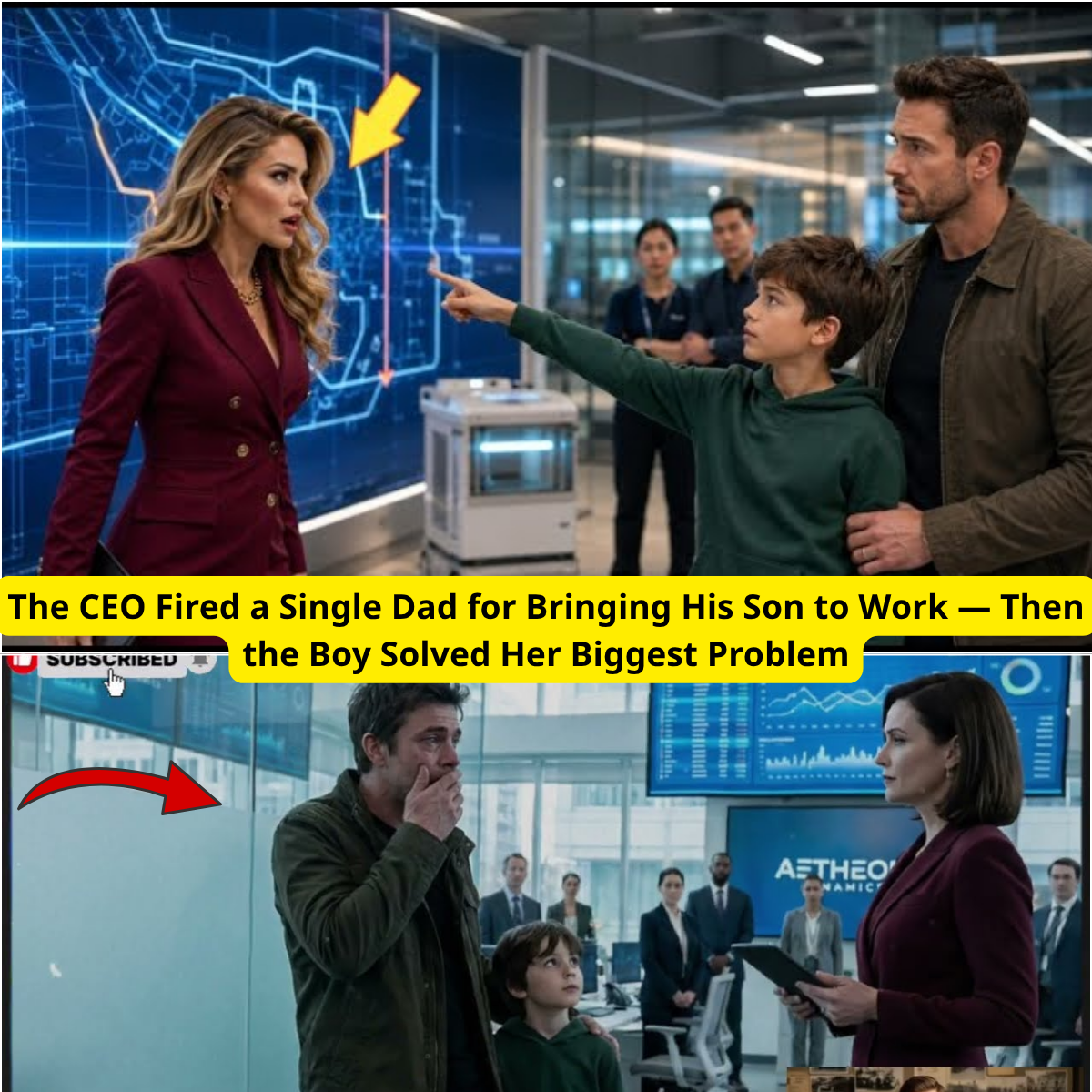
Eight-year-old Micah Carter stepped onto the polished white marble, his small hand buried completely in his father’s palm. He wore a slightly oversized gray sweater, his sneakers leaving faint, damp prints from the morning dew outside. Every executive seated around the massive mahogany conference table turned to look. It wasn’t a glance of curiosity; it was a collective gaze of corporate judgment, the kind that treated a human complication like a virus in a clean room.
At the far end of the room, framed by towering windows that looked out over the sunlit Chicago skyline, stood Vivian Hail.
At thirty-nine, Vivian was a titan of the cybersecurity industry, a woman who had spent her entire adult life converting vulnerability into armor. She was wearing a tailored charcoal suit that looked sharp enough to cut glass. Standing beside a massive digital wall flashing with aggressive red warning indicators and scrolling lines of compromised system data, she slowly removed her reading glasses. Her eyes locked onto Ethan Carter.
Ethan felt the temperature in the room drop. He was thirty-five, a senior systems architect, but under Vivian’s glare, he felt the heavy, suffocating weight of an amateur caught in a professional trap. His tie was slightly crooked, a casualty of a chaotic 5:00 a.m. morning routine that involved making pancakes, packing a lunchbox, and frantically calling four different babysitters who all checked out at the last second.
Two years ago, when his wife Clare died after a brutal, brief battle with a sudden illness, Ethan’s world had shrunk to a fragile, daily balancing act. Today, that balance had shattered. Hail Dynamics was in the middle of a catastrophic cyberattack—a breach threatening to tank a highly publicized billion-dollar merger. Every engineer had been summoned via an emergency pager at 3:00 a.m. With no childcare, no family in the city, and an empty safety net, Ethan had made the desperate calculation that he could tuck Micah into a quiet corner cubicle with an iPad and a coloring book.
He had calculated wrong. Vivian Hail noticed everything.
“Ethan,” Vivian said. Her voice didn’t carry anger; it carried something far more damaging—absolute, frozen disappointment. “Tell me I am not looking at a child in the middle of a Level One security containment protocol.”
“Vivian, I apologize,” Ethan said, his voice cracking slightly from exhaustion. He didn’t let go of Micah’s hand. “My childcare fell through at 4:00 a.m. The neighbor is out of town. I couldn’t leave him alone, and the system logs showed a cascading firewall failure. I thought I could contribute while keeping him out of the way.”
“This is a war room, Ethan, not a daycare,” Vivian replied, her heels clicking with metronomic precision as she walked toward him. The other board members shifted uncomfortably, looking down at their tablets. “We are losing millions of dollars by the hour. Our proprietary encryption keys are bleeding into the dark web. I don’t need distracted parents. I need total alignment.”
“He won’t make a sound, I promise—”
“You’re right, he won’t,” Vivian interrupted, stopping exactly three feet away. “Because you are both leaving. Your remote access is being revoked as we speak. Hand your badge to security on the way out. You’re done, Ethan.”
The finality of the word hung in the air like a guillotine. Ethan stood motionless for a five-second eternity. He looked at his son, whose wide, dark eyes were darting between his father and the terrifying woman in the suit. Micah didn’t cry, but he squeezed Ethan’s hand harder, pulling himself against his father’s leg.
Ethan didn’t beg. The grief of the last two years had stripped him of many things, but it had left his core integrity intact. He looked Vivian straight in the eye, gave a single, tight nod, and said, “Good luck with the recovery.”
As they turned toward the elevators, Micah stopped for a brief moment. His eyes fixed on the massive command screen on the wall—a chaotic tapestry of blinking red alerts, system loops, and hexadecimal code strings. For an eight-year-old, he stared at it with an eerie, hyper-focused intensity, his mind cataloging the shapes of the failure before the elevator doors slid shut, cutting off the corporate world entirely.
Chapter II: The Architecture of Failure
By 1:00 p.m., the atmosphere inside the operations center of Hail Dynamics had shifted from controlled panic to absolute desolation.
The attackers weren’t just stealing data; they were systematic executioners. Every time the senior network team built a new firewall, it collapsed within seven minutes. The company’s primary backup servers were being encrypted in real-time. Millions of dollars were dissolving into the ether, and the press was already running blind items about the imminent collapse of the merger.
Vivian stood over her chief technology officer, her face pale, her coffee cold and untouched. “How are they bypassing the air-gapped recovery protocols?” she demanded, her knuckles white against the back of his chair. “We rebuilt the entire authorization architecture from scratch three times!”
“I don’t know, Vivian,” the CTO whispered, his shirt stained with sweat. “It’s like the system is actively betraying us. Every time we lock the front door, an invisible hand opens the back window from the inside. We can’t find the origin point of the loop.”
Meanwhile, four blocks away, tucked into the vinyl booth of a fading, greasy-spoon diner, Ethan and Micah sat under the hum of a flickering fluorescent light. A single plate of french fries sat between them. Ethan wasn’t eating. He was staring at the cracked screen of his smartphone, looking at a digital banking app that informed him he had exactly two months of rent and insurance premiums left before his life fell into the red.
“Dad?” Micah asked softly, dipping a fry into a puddle of ketchup.
“Yeah, buddy?” Ethan forced a smile, his eyes blinking back the dry burn of sleeplessness.
“The lady with the glasses. She was really mad at the screen, wasn’t she?”
“She was mad at the situation, Micah. And she was right. I shouldn’t have brought you into a place like that. It wasn’t safe for our future, and it wasn’t professional.”
Micah picked up a paper napkin, smoothed it out against the laminate table, and reached into his backpack for a stubby blue pencil. He didn’t draw a robot or a cartoon character. Instead, he began drawing a sequence of squares connected by arrows—a primitive flow chart.
“Dad, remember when you showed me how the computer talks to itself when it thinks it’s broken?” Micah asked, his voice entirely devoid of the anxiety that filled the adults around him. “The training game you let me watch on your laptop last month?”
Ethan frowned, leaning in. “The recursive sandbox simulation? Yeah, I remember.”
“The big red screen at your office,” Micah said, pointing his pencil at a specific junction in his napkin drawing. “It was doing the loop. The one where the computer answers its own question before the question finishes changing.”
Ethan stopped breathing. He grabbed the napkin, pulling it closer into the greasy light of the diner.
   +-------------------+
   |  Recovery System  | <==============+
   +-------------------+                ||
             |                          || (Secret Internal Token)
             v                          ||
   +-------------------+                ||
   | Rebuild Firewall  | ---------------+
   +-------------------+
Micah had drawn a textbook representation of a recursive authentication loop. But he hadn’t just copied a concept from his dad’s old sandbox; he had mapped the exact rhythm of the data string that had been flashing on Vivian Hail’s wall.
Ethan’s engineering brain, dormant under the weight of his firing, suddenly woke up with a violent jolt. The attackers hadn’t broken the firewalls from the outside. They had planted a corrupted token inside the emergency recovery system itself. Every time Hail Dynamics initiated a system restore, the recovery protocol generated a hidden automated token that unlocked the backdoor to give the attackers access right through the internal network. The company was literally hacking itself every time it tried to fix the problem.
“Micah,” Ethan said, his voice a low, urgent rumble. “Are you sure you saw this specific sequence on the main board?”
“The numbers in the corner were counting backwards by fours, Dad. Just like the broken loop in your game.”
Ethan didn’t hesitate. He stood up, grabbed his laptop from his backpack, and stepped out onto the sidewalk, setting the machine on the warm hood of his parked sedan. He used his smartphone as a hotspot and accessed the public-facing emergency logs of Hail Dynamics—a secondary channel that his credentials could still view for a few more hours before the system completely processed his termination.
He ran the diagnostic script against the recovery architecture. The screen flashed green, then amber, then settled into a deep, looping crimson.
Micah was right. An eight-year-old boy, sitting in a room for less than ten minutes, had diagnosed a multi-million-dollar structural vulnerability that thirty veteran engineers had completely overlooked.
Chapter III: The Internal Mirror
Inside the operations center, Vivian Hail was staring at her own reflection in a dark monitor. The merger was hours away from cancellation. She was looking at the ruin of her life’s work, a kingdom built on the sacrifice of every personal relationship she had ever possessed.
Then her assistant ran into the room, her eyes wide, holding a corporate phone against her chest. “Vivian. It’s Ethan Carter on line four. He says he’s on the street, and he has the structural bypass code.”
The room went completely quiet. The CTO looked up, his expression a mix of jealousy and desperate hope.
Vivian felt a bitter spike of pride catch in her throat. She had fired this man five hours ago. She had humiliated him in front of the board. But as she looked at the red warning signs threatening to swallow her company whole, she realized she didn’t have the luxury of arrogance anymore.
“Put him through,” she commanded.
Ten minutes later, the elevator doors opened again. This time, the executives didn’t stare with judgment. They watched with the frantic intensity of drowning men looking at a lifeboat as Ethan entered, his laptop open under one arm, Micah walking quietly by his side.
Ethan walked straight to the main console, ignoring the corporate hierarchy completely. He plugged his machine into the central interface. “Your network team is chasing ghosts on the perimeter,” Ethan announced to the room. “The breach isn’t external anymore. It’s living in your emergency recovery layer.”
“That’s impossible,” the lead security engineer argued. “The recovery tier is completely sandboxed.”
“It’s not,” Micah spoke up, his voice small but perfectly clear in the cavernous room. He walked up to the edge of the glass floor, pointing his small finger at a specific module of hexadecimal code on the wall. “The code right there keeps repeating the letter ‘F’ four times. It thinks it’s resetting, but it’s just telling the bad guy to come back in.”
The security engineer leaned forward, his fingers flying across his keyboard as he isolated the script Micah was pointing at. He stopped, his mouth falling open. “Oh… oh no. He’s right. It’s a recursive authorization exploit hidden inside the automated patch script.”
“Isolate the recovery layer,” Vivian ordered, her voice cutting through the rising murmurs. “Kill the internal tokens and force a manual rebuild from the hard backups. Now!”
For forty minutes, the room was a symphony of mechanical clacking. Ethan directed the network realignment from his terminal, while Micah sat quietly on a nearby swivel chair, contentedly eating a small bag of crackers he’d found in the break room.
Slowly, the red light on the digital wall began to recede. One by one, the compromised servers reported green status indicators. The data flow stabilized. The unauthorized encryption stopped dead in its tracks, and the outbound leaks dried up completely.
The company was saved. The merger was back on.
A ragged cheer went up from the back rows of the engineering team, but Vivian Hail didn’t celebrate. She stood completely still, watching the small boy in the oversized gray sweater spin slowly in his chair.
As she looked at Micah, a sudden, unwanted memory hit her with the force of a physical blow. She remembered being nine years old, sitting on a leather suitcase in the lobby of a high-end Chicago hotel, waiting for her father to finish an acquisition meeting that had already run four hours late. She remembered the cold, sterile smells of success, and the realization that she was a secondary priority to a balance sheet. She had spent the next thirty years building a life where emotions were treated as systemic risks, assuming that compassion was a luxury only the weak could afford.
She looked at Ethan, who was carefully packing his laptop away, his arm wrapped defensively around his son’s shoulders. She had become the exact person who had made her feel invisible thirty years ago.
Chapter IV: Rebuilding the Heart
The sun was setting over the lake, casting long, amber shadows across the executive lounge when Vivian finally asked Ethan to step into her private office. Micah came along, sitting on the plush leather sofa near the window, using a corporate legal pad to sketch a detailed diagram of a cyber-security robot with laser eyes.
Vivian didn’t sit behind her massive desk. Instead, she took a seat on the lower coffee table directly across from Ethan, her posture still elegant but entirely stripped of its corporate armor.
“Ethan,” she began, her voice dropping its professional resonance, revealing a raw, human gravel underneath. “I don’t expect you to forgive me for this morning. What I did wasn’t leadership. It was cruelty masked as discipline.”
Ethan looked out the window at the gold light bouncing off the skyscrapers. “The industry doesn’t leave much room for single parents, Vivian. I’m used to it.”
“It shouldn’t be that way,” Vivian said, and for the first time, Ethan saw a genuine flicker of pain in her eyes. “I forgot that people carry entire worlds into this office every morning. Worlds that are heavy, and broken, and worth protecting. Your son didn’t just save our network today, Ethan. He reminded me of exactly who I used to be before I let this building swallow me whole.”
She reached into her jacket and placed a newly printed corporate security badge on the table between them. It had Ethan’s name on it, along with a new title: Director of Infrastructure Architecture.
“The position comes with a forty percent increase in base salary, full remote flexibility two days a week, and an explicit mandate to rebuild our internal team culture,” Vivian said. “And I’ve already cleared a space on the third floor to construct an on-site, fully staffed childcare center for every employee in this building. No one will ever have to choose between their child and their paycheck in this company again.”
Ethan looked at the badge, then looked back at Micah, who was currently making a soft humming noise as his pencil flew across the paper. The pride that had made Ethan walk away this morning wanted him to refuse, to protect his ego. But as he looked at his son’s peaceful face, he knew that the ghost of his wife Clare wouldn’t want him to fight a war of pride. She would want security for their boy.
“Two days remote,” Ethan specified, his voice soft but firm. “And if my son needs to sit in my office on a Friday afternoon, nobody says a word.”
Vivian offered a small, sincere smile—the first one Ethan had ever seen on her face. “If your son wants to sit in my chair on a Friday afternoon, he’s more than welcome. He clearly has a better grasp on our architecture than I do.”
They shook hands, a quiet contract signed not in blood or corporate ink, but in shared human understanding.
Chapter V: The Boy Who Saved Us
One year later, the grand ballroom of the Chicago Hilton was packed with over two thousand tech innovators, investors, and journalists for the annual Hail Dynamics Innovation Summit. The stage was backed by a massive screen displaying a vibrant blue interface—a symbol of the company’s new, unbroken security standard.
Vivian Hail stood at the center podium, her presence as commanding as ever, but her style had changed. Her sharp, severe lines had softened; her speeches no longer revolved around terms like dominance and sacrifice, but around resilience and human-centric design.
“Twelve months ago, this company almost ceased to exist,” Vivian told the silent crowd, her voice echoing clearly through the hall. “We were hit by an unprecedented attack that defeated our best minds and our most expensive systems. And in my arrogance, I had just terminated one of our finest architects because he had no choice but to bring his son to work during the crisis.”
A murmur ran through the audience.
“I was wrong,” Vivian continued openly, looking toward the side of the stage. “I looked at a family in a moment of struggle and I saw a liability. But the universe has a wonderful way of correcting our blindness. Because it wasn’t an executive, a consultant, or a machine that saved Hail Dynamics. It was an eight-year-old boy who looked at a screen and saw a pattern the rest of us were too busy to notice.”
Vivian turned toward the wings. “Please join me in welcoming our Director of Infrastructure Architecture, Ethan Carter, and the recipient of this year’s Humanitarian Innovation Award… Master Micah Carter.”
The applause started as a polite rumble and grew into a roaring standing ovation as Ethan stepped onto the stage. Beside him was Micah, now nine, wearing a sharp little navy blue suit with a red bow tie. His hair was neatly combed, but his sneakers were still the same comfortable, everyday shoes.
Vivian knelt down to be at eye level with Micah, handing him a heavy, beautiful glass trophy shaped like an unbroken shield, engraved with five simple words: The Boy Who Saved Us.
Micah held the heavy glass against his chest, looking up at the sea of clapping adults with wide, bright eyes. He didn’t look afraid anymore. He looked toward the side of the stage where his father stood, tears finally spilling over Ethan’s eyelashes as he smiled down at his son.
In that crowded room, under the flash of a hundred cameras and the weight of a multi-billion-dollar industry, the loudest sound was the quiet realization that success without humanity is nothing more than a well-decorated cage. Ethan reached down, lifting Micah into his arms as the applause reached its peak. The small world they had built together in the wake of loss wasn’t just surviving anymore. It was whole. And for the first time in two long years, the future looked completely wide open.