The Billionaire visited his Maid’s house… and what he saw there made him cry.
The Billionaire visited his Maid’s house… and what he saw there made him cry.
Act I: The Edge of the Grid
The midnight-blue Maybach rolled to a halt where the asphalt dissolved into cracked gravel and red clay. Outside the tinted bulletproof glass, the neon pulse of Atlanta’s skyline was a distant, mocking constellation. Here, on the forgotten fringes of the city’s industrial underbelly, the only illumination came from a single flickering streetlamp that hissed like a dying radiator.
Arthur Vance stepped out of the climate-controlled cabin. The heavy door clicked shut behind him with the muted, expensive thud of absolute German engineering. His bespoke leather Oxfords—shoes that had never touched anything less pristine than Italian marble or corporate plush—pressed into the damp, uneven earth. The air was thick with the scent of stagnant drainage, wet pine, and the unmistakable, sharp odor of systemic neglect.
He looked at the structure standing twenty feet away. Calling it a house felt like an insult to architecture. It was a low, lopsided shotgun shack squeezed between two abandoned concrete warehouses. The exterior wood was grey and rotting, split by decades of southern humidity. The corrugated tin roof sagged in the center like an old horse’s back, patched with rusted road signs and blue plastic tarps held down by bald tires. The front door was a warped slab of plywood, hanging by a single mismatched hinge.
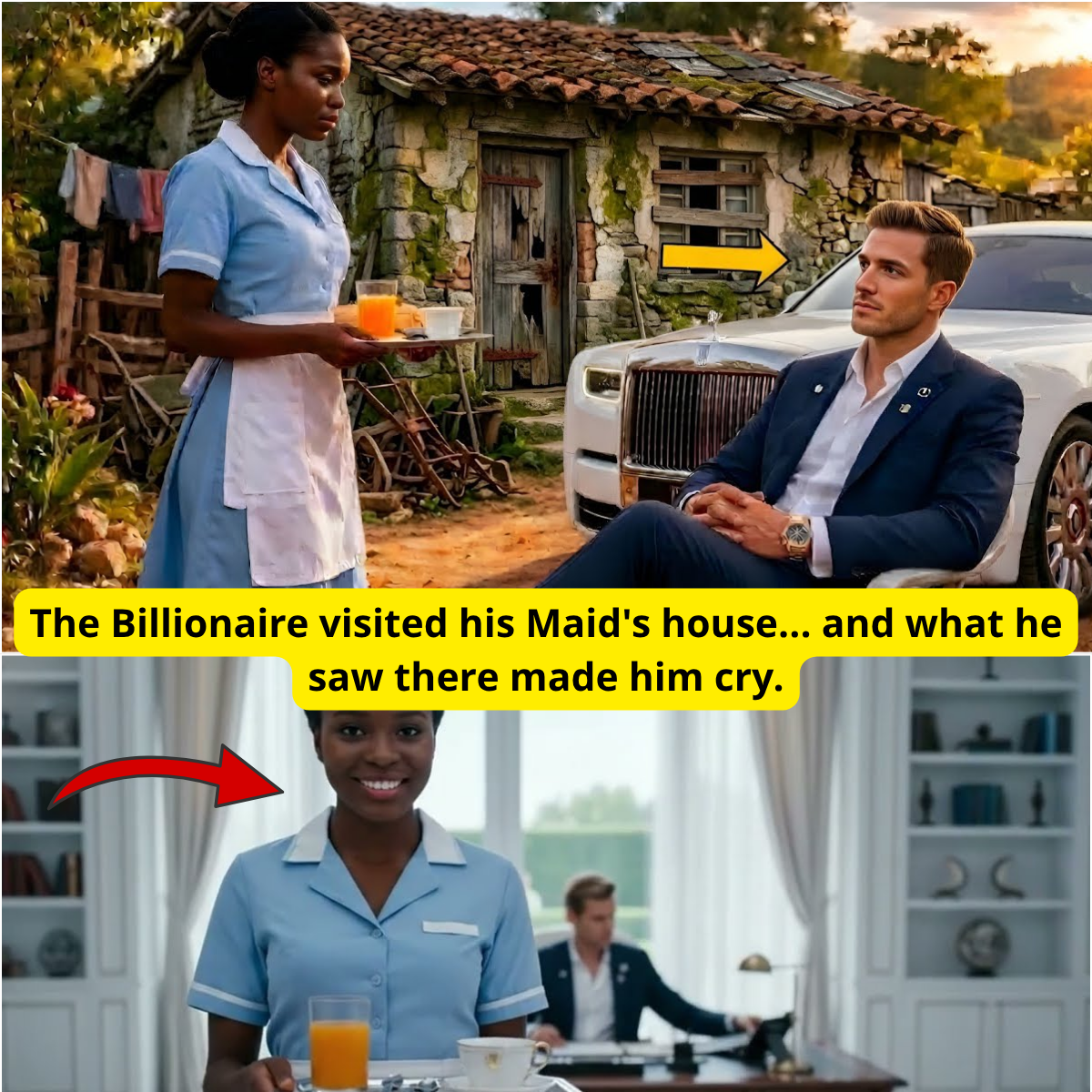
Arthur had seen poverty before—on television screens during charity galas, through the windows of helicopters flying over overseas manufacturing hubs, and in the abstract columns of financial spreadsheets under “philanthropic tax deductions.” But this was different.
This was the home of Amara.
Amara was the woman who arrived at his Buckhead penthouse every morning at precisely 6:00 AM. She was the invisible force that ensured his silk shirts were pressed without a single wrinkle, his rare-earth crystal decanters were never dusty, and his organic espresso was served at precisely 145°F. For seven years, she had been a flawless, quiet fixture of his high-powered life—an elegant ghost who moved through his five-million-dollar property leaving nothing behind but the scent of lavender and perfection.
Amara stood a few paces behind him now, her slight frame nearly swallowed by a faded denim jacket. Her fingers were tightly interlaced, her knuckles white. She didn’t look at the house, and she didn’t look at Arthur. Her gaze was locked onto the dusty ground near his shoes, her jaw set in a rigid line that balanced perfectly on the edge of profound shame and fierce defiance.
“Is this it?” Arthur asked. His voice, usually a booming instrument that commanded boardrooms, sounded thin and brittle in the damp night air.
“Yes, Mr. Vance,” she whispered. Her voice didn’t shake, but it possessed a flatness that was far more terrifying than tears. “This is where I live.”
Arthur took a slow step forward. The gravel crunched loudly beneath his feet—a sound that felt like an intrusion. He had driven her home tonight only because her old sedan had finally dropped its transmission in his driveway, and the local rideshare apps had flagged this specific ZIP code as too dangerous for a midnight pickup. He had expected a modest apartment complex or a working-class suburb. He had not expected a ruins.
As he reached the warped plywood door, Amara moved ahead of him with a sudden, protective swiftness. She didn’t want him to touch the handle. She didn’t want him to dirty his hands on her reality. With a gentle push, the door groaned inward, revealing the interior of her world.
Act II: The Inventory of Absence
Inside, the silence was absolute, heavy with the realization of a truth Arthur had spent a lifetime ignoring.
The single-room dwelling contained almost nothing. The walls were bare plaster, cracked in spiderweb patterns that exposed the rough wooden laths beneath. In the corner sat a narrow twin bed, its mattress so thin that the rusted iron springs showed through a faded, meticulously clean floral sheet. A single wooden chair with a fractured rung stood near a small laminate table. In the opposite corner, a two-burner electric hotplate sat atop a milk crate, its single cord snaking into a cracked wall outlet.
Arthur stopped in the center of the room. The air inside was freezing, barely a degree warmer than the gravel yard outside. He watched his own breath bloom into a faint cloud of white vapor.
His mind, an advanced computer trained to calculate profit margins and operational efficiency, suddenly went offline. He looked from the primitive hotplate to Amara, who was quietly placing her keys on the laminate table.
Every morning, she stood in his professional-grade kitchen, surrounded by sub-zero refrigeration units and French lacquer cabinetry, preparing meals that cost more than the monthly rent on this entire lot. She handled his imported truffles, his dry-aged wagyu, and his single-origin coffees with the practiced ease of an expert. And at night, she returned here—to a space where a simple pot of water would take twenty minutes to boil on a cracked ceramic coil.
The silence between them grew thick, vibrating with the unspoken history of their inequality. Guilt, a sensation Arthur had successfully insulated himself against through decades of corporate success, began to creep into his mind like a cold draft under a door.
He didn’t feel like the king of a venture capital firm anymore. He didn’t feel like a man who could buy and sell entire city blocks with a signature. Standing in the middle of this room, surrounded by the stark evidence of a survival that owed nothing to his system, he felt incredibly small.
He turned his head slowly, looking at her face under the harsh, unshaded bulb hanging from the ceiling. For seven years, he had seen only her smile—a polite, professional curve of the lips that signaled compliance and efficiency. But now, with the stage lights of his penthouse removed, he noticed the deep, permanent shadows beneath her eyes. He saw the faint, tight lines of physical exhaustion etched around her mouth, and a profound, ancient pain in her eyes that had been hidden behind her daily mask of cheerful deference.
Without asking, Arthur walked over to the broken wooden chair. His movements lacked their usual athletic confidence. He lowered himself onto the unstable seat, his heavy wool coat bunching around his knees. The wood groaned under his weight, but he didn’t care. The pride that had defined his entire adult life seemed to have stayed outside in the Maybach.
Amara remained standing near the door, her back flat against the plaster wall. She folded her arms tightly across her chest, her posture shifting into the defensive stance of someone who had learned long ago that when the powerful look at the poor, nothing good ever follows.
Act III: The Broken Scale
Arthur looked around the room again, his eyes focusing on the small details he would have dismissed as irrelevant noise just an hour ago.
He saw a torn wool blanket neatly folded at the foot of the bed. He saw a single ceramic cup on the table, its handle held together by a crude wrap of electrical tape. He saw an old metal canister beside the hotplate, its lid open to reveal a few remaining tablespoons of generic white rice.
This wasn’t a temporary setback; this was a landscape of permanent war against destitution. And Amara had been fighting it alone, five days a week, while maintaining an unblemished record of punctuality and grace in his home.
His fingers tightened against his knees as the memory of his own behavior began to play out before him like an interrogation. He remembered a Tuesday three months ago when he had raised his voice because his morning macchiato had been served at 130 degrees instead of 145. He had spoken to her with a cold, clipped arrogance, demanding she pay more attention to the details of his comfort. She had stood there quietly, her head slightly bowed, offering a soft apology before replacing the drink.
What had she eaten that morning? Arthur thought, a cold sweat breaking out on the back of his neck. Had she eaten anything at all?
A deep breath escaped his chest—a heavy, ragged sigh that sounded loud in the small room. Regret was a new flavor in his mouth, bitter and unrefined. He tried to speak, to offer some standard platitude of executive comfort, but his tongue felt thick and useless. For the first time in his memory, he didn’t know the correct corporate response to a crisis.
Amara moved from the door with a quiet, practiced fluidness. She picked up an old metal kettle, filled it from a single spigot behind the partition wall, and set it on the electric burner. She didn’t look at him as she worked. Her movements were calm, filled with the same steady dignity she displayed in his penthouse.
When the water finally steamed, she poured it over a simple tea bag into the cup with the taped handle. She placed it on a small lacquer tray—a discarded item she had likely saved from his trash years ago—and set it on the laminate table beside his chair.
“It is only black tea, Mr. Vance,” she said softly. It was the first time she had broken the silence since they entered. “I’m sorry I don’t have the milk you prefer.”
The simple act of hospitality hit him with the force of a physical blow. Even here, surrounded by the wreckage of her personal life, exposed to the man who held absolute financial power over her, she chose to offer him service. She chose to maintain her dignity through hospitality rather than breaking down into a plea for charity.
Arthur picked up the cup slowly. His hands, usually rock-steady during multi-million-dollar negotiations, were visibly trembling. The heat of the ceramic soaked into his palms, but it couldn’t reach the deep, cold ache that had settled into his chest.
He took a sip. The tea was bitter and cheap, but he held it in his mouth like a sacrament. He realized that this single tea bag might represent a measurable percentage of her remaining weekly budget.
His mind flashed back to his dinner the previous night—a three-hundred-dollar tasting menu at a Michelin-starred restaurant where he had left half of an Wagyu steak on the plate because he “wasn’t feeling the texture.” He had thrown away enough food in the last calendar year to sustain this neighborhood for a decade. The realization wasn’t dramatic; it didn’t come with tears or a theatrical outcry. It settled into his lungs like ash, making each breath feel tight, uneasy, and thoroughly unearned.
Act IV: The Invisible Story
Amara stood by the window, her back turned to him now as she looked out into the gravel yard. The unshaded bulb cast her long, sharp shadow across the cracked floorboards.
“For seven years,” Arthur said, his voice dropping an octave, losing its professional polish. “For seven years, you’ve come to my house every morning. You’ve never missed a day. You’ve never been late.”
“The buses are reliable if you catch the 4:15 AM line, sir,” she said, her voice entirely flat.
“Why didn’t you say anything?” Arthur’s eyes moved to her hands, which were now resting on the window frame. He looked at them closely for the first time. Really looked. The skin was rough, split by the cheap dish soap used in commercial cleaning agents, with small, faded scars near the knuckles from years of silent, unceasing labor. “Why didn’t you ask for an advance? A adjustment?”
Amara turned her head slightly, her profile silhouetted against the dark window. “Because in your world, Mr. Vance, workers who have problems are replaced by workers who do not. I needed the job. I could not afford to become a story.”
The words were spoken without anger, which made them infinitely more devastating. She had understood the rules of his world better than he did. To him, she had been an invisible component of his luxury—a human utility that functioned perfectly without a backstory. He had created the distance through his own deliberate blindness, treating his financial success as a shield that exempted him from noticing the human cost of his convenience.
He placed the cup down on the table, unable to finish it. The cheap tea felt like fire in his stomach.
Amara turned back toward him, her face calm, but her eyes held a ancient, steady tiredness that no amount of sleep could ever fix. She noticed his discomfort and stepped back toward the corner, her movements instinctively shrinking her presence to give him space. She had spent her entire life making herself smaller so that people like him could feel larger.
“I am fine, Mr. Vance,” she said quietly, her lips forming that familiar, defensive line. “You don’t need to stay. My brother will have the car parts tomorrow. I will be at the house by six.”
Arthur shook his head slowly, not in contradiction to her words, but in absolute rejection of the man he had been until tonight. “Don’t say you’re fine, Amara. Please. Don’t use that word with me anymore.”
He leaned forward, resting his elbows on his knees, his head dropping into his hands as he stared at the dusty floorboards. The luxury of his life felt like a ridiculous suit of armor that had pinned him to the ground, preventing him from moving, preventing him from seeing. He had failed the most basic test of a human being—the simple capacity to notice the survival of another person right beside him.
Act V: The Calculation of Justice
A soft acceptance filled the room—a quiet that was no longer empty, but heavy with an unspoken understanding. Amara didn’t ask for his pity, and she didn’t demand his money. She stood with her chin up, her worn denim jacket held around her like an imperial robe. Her self-respect was an absolute quantity that owed nothing to his bank accounts.
Arthur slowly stood up. The old wooden chair gave a final creak of relief as his weight left it. He looked around the single room one last time, his eyes no longer scanning like a curious tourist, but recording every detail with the heavy, unyielding weight of responsibility.
He looked at the empty corner where no proper food was stored. He looked at the cracked window where the November wind was beginning to whistle through the tape.
This wasn’t an unfortunate act of fate. This was the logical conclusion of an economic engine that he ran every single day—a system that paid the minimum allowable currency while extracting the maximum possible life. He clenched his jaw, his fingers tightening into fists within his coat pockets. He could have changed this seven years ago with a single keystroke on his payroll system. If only he had cared enough to see past the edge of his own desk.
He took a slow step toward her, maintaining a respectful distance that acknowledged her boundaries. The arrogance that had carried him through thirty years of corporate warfare had completely vanished, leaving behind only the raw, unpolished framework of a man trying to stand on equal ground.
Amara looked up, her amber eyes widening slightly as she detected the shift in his posture. The cold authority she had trained herself to navigate had evaporated, replaced by a sincerity that was rare in her experience of powerful men.
“Amara,” Arthur said, his voice low, steady, and entirely free of the performative kindness of corporate charity. “What I saw in this room tonight will not be ignored. The silence between us is over.”
She stood frozen, her fingers twitching against her jacket. “Mr. Vance, I don’t want your pity. I don’t need a handout.”
“This isn’t pity,” Arthur said, stepping closer, his face hardening with a quiet, executive resolve that was now directed at something larger than a profit margin. “And it isn’t a favor. It is a debt. I have lived off your perfection for seven years while ignoring your struggle. That is an error in my accounts, and I am going to correct it.”
He didn’t take out his phone to call an assistant. He didn’t offer a temporary check or a hollow promise of a bonus. He looked her directly in the eyes—really looked, matching her gaze with a vulnerability that cost him his entire image.
“This house will be repaired by a commercial crew starting tomorrow morning,” he said, his words falling like heavy, rhythmic stones. “Your salary will be adjusted to reflect your actual value to my life, not the minimum market rate. And you will never have to catch the 4:15 AM bus again. Not because I am being kind, Amara. But because dignity is not optional in my world anymore.”
Amara listened in silence. For a long moment, her face remained a mask of controlled disbelief. Promises were common in her world; promises that were kept were non-existent. But as she searched his face, looking for the familiar signs of upper-class condescension or temporary emotional guilt, she found nothing but a hard, clear purpose.
Slowly, the rigid line of her jaw began to tremble. A single, heavy tear gathered in the corner of her right eye, but she didn’t blink it away with her usual defensive quickness. She let it fall, a small silver line tracing the exhaustion on her cheek—not a sign of weakness, but the first crack in a dam that had held back a lifetime of silent survival.
Arthur nodded once, a brief, respectful gesture that demanded no gratitude and offered no self-congratulation. He turned toward the plywood door, his hand reaching out to push it open. But as his fingers touched the wood, he paused, looking out into the cold Atlanta night where his Maybach waited like a blue shadow.
He didn’t feel powerful as he stepped back into the gravel yard. He felt cold, tired, and thoroughly shaken. But as he opened the car door, he knew that a part of his mind—the part that had been asleep since he made his first million—had remained behind in that freezing, single-room home, sitting on a broken wooden chair, finally learning how to see.