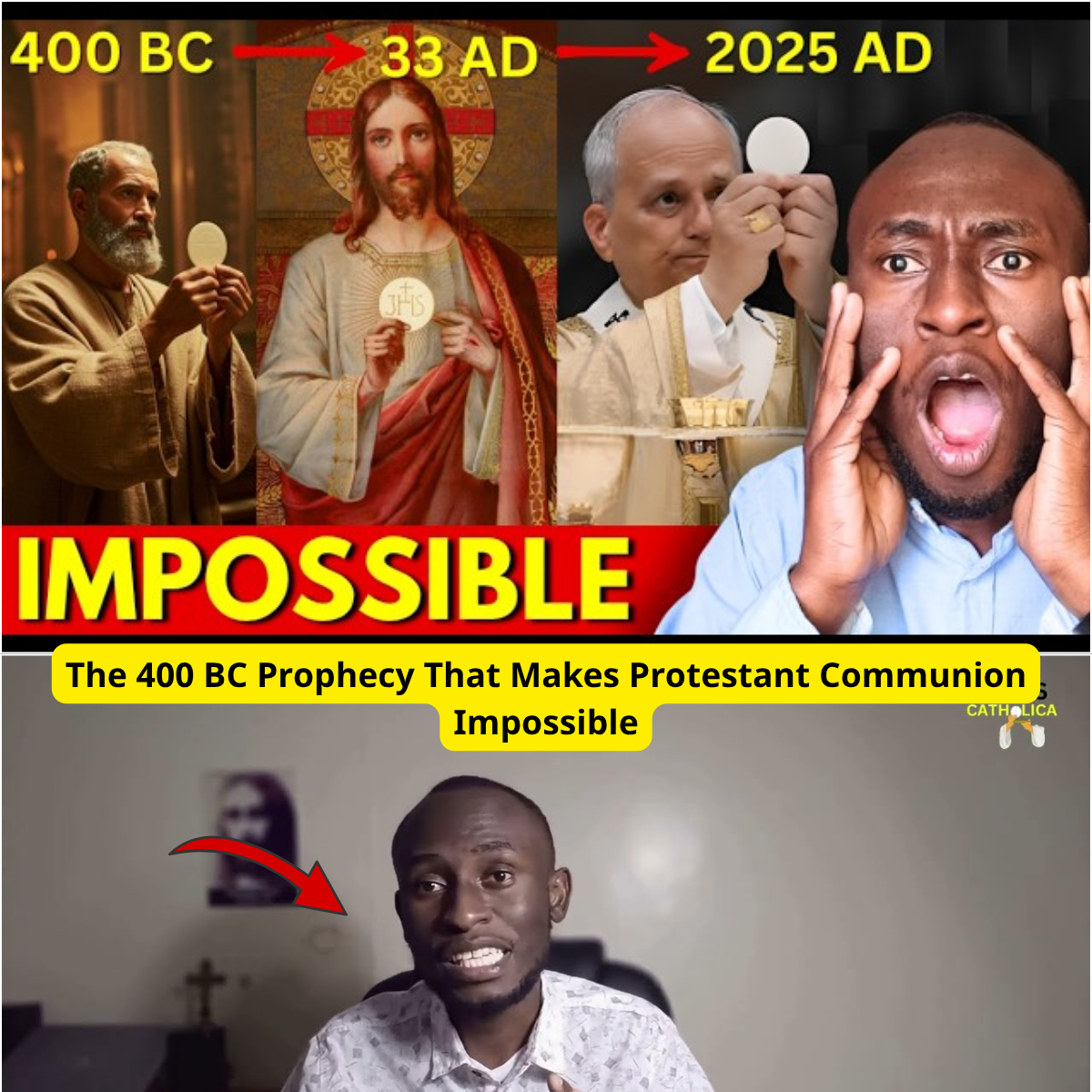
The 400 BC Prophecy That Makes Protestant Communion Impossible
The 400 BC Prophecy That Makes Protestant Communion Impossible
The cold air inside Grace Fellowship Church smelled faintly of damp carpets, premium dark roast coffee, and the lingering traces of lemon wood polish. It was a Tuesday evening in late autumn, and the suburban Chicago mega-church was quiet, its polished stadium seating stretching out like an empty concrete amphitheater under structural steel beams.
Thomas sat in the third row of the balcony, his laptop glowing open on his knees. He was twenty-nine, a youth pastor with an unblemished resume from a prominent Midwestern seminary. His faith was neat, logical, and built entirely on the rock of textual analysis. For Thomas, the Christian life was a series of propositions to be mastered, unpacked, and communicated through well-designed slideshow presentations. He was a man of the Word, and to him, the word was a sharp instrument used to clear away centuries of human tradition.
Lately, though, his cross-references had begun to feel tangled.
On his screen was a split-window display. On the left was his outline for an upcoming sermon series on the book of Hebrews. On the right was an open digitized text of the Early Church Fathers. He had been digging into the second century to find ammunition against a couple of college kids in his youth group who were drifting toward liturgical high-church traditions, looking for historic proof that the earliest Christians viewed communion as a simple, uncomplicated memorial service.
Instead, he had tripped over a ghost.
A specific verse from the very end of the Old Testament kept appearing in the footnotes of the oldest Christian documents he could find. It wasn’t a verse he had ever memorized for a scripture memory challenge. It wasn’t on any ministry posters. It was a line from Malachi—a text written four centuries before the first Roman nail was driven into wood.
The heavy glass doors of the auditorium swung open below. The soft, rhythmic scuff of running shoes broke the silence of the empty hall.
Thomas closed his laptop halfway, watching a tall, broad-shouldered man walk down the center aisle toward the stage. It was Marcus, the senior pastor and Thomas’s long-time ministry mentor. Marcus was a veteran of the church planting movements of the early 2000s—a pragmatic, deeply sincere man whose preaching style was conversational, warm, and explicitly focused on the functional application of scripture.
“Still up here chasing commas, Tommy?” Marcus called out, his voice bouncing cleanly off the acoustic paneling of the back wall.
Thomas stood up, his laptop tucked under his arm, and made his way down the concrete stairs to the main floor. “Hey, Marcus. Yeah. Just trying to iron out some theological wrinkles for the high school winter retreat. I got stuck in a rabbit hole.”
“The Hebrews series?” Marcus asked, leaning against the edge of the stage, his hands stuffed into the pockets of his fleece vest. “Don’t overcomplicate it. Just hit the main line: Christ died once for all, the old sacrificial system is obsolete, and we don’t need priests or altars because we have an open door straight to the Father. Keep it practical.”
“Right,” Thomas murmured, stopping a few feet away. He opened his laptop again, the screen illuminating his face in the dim house lights. “That’s exactly what I’m looking at. But Marcus, I ran into something weird in the early commentaries. Have you ever looked closely at Malachi chapter one?”
Marcus smiled, a familiar, encouraging look that he used for young interns. “Sure. The tithing passage is in chapter three—’bring the full tithe into the storehouse.’ Standard stewardship stuff.”
“No, not that part,” Thomas said, his finger scrolling down the digital page. “Chapter one, verses ten and eleven. It’s God speaking to the corrupt levitical priests in Jerusalem. He says: ‘Oh that there were one among you who would shut the doors, that you might not kindle fire on my altar in vain! I have no pleasure in you, says the Lord of hosts, and I will not accept an offering from your hand. For from the rising of the sun to its setting my name will be great among the nations, and in every place incense will be offered to my name, and a pure offering. For my name will be great among the nations, says the Lord of hosts.’“
Marcus shrugged slightly. “It’s a classic prophecy about the rejection of Israel and the inclusion of the Gentiles. The ‘pure offering’ is our spiritual worship—our prayers, our songs, our lives offered as a living sacrifice. Romans twelve stuff. What’s the issue?”
“The issue is the word he uses for ‘offering,'” Thomas said, his voice dropping into a tense, focused register. “In the Hebrew, it’s minchah. Everywhere else in the Old Testament, a minchah is a specific, physical, unbloody grain offering. It’s a literal sacrifice brought to an altar. And Malachi says that in the future, the Gentiles—non-Jews all over the globe, from east to west—will be offering this specific, tangible, unbloody sacrifice in every single place continually.”
Thomas looked up from the screen, his eyes troubled. “Marcus, when Malachi wrote that in 400 BC, the temple in Jerusalem was the only valid spot on earth for a sacrifice. The Gentiles were totally outside the covenant. For a Jewish prophet to say that Gentiles would be performing a globally synchronized, pure, unbloody sacrificial offering everywhere at once… it’s a radical, bizarre prediction. And it doesn’t fit our view of communion.”
The Witness of the Second Century
Marcus walked over to the front row of seats and sat down, his expression shifting from casual interest to a subtle, protective vigilance. “Tommy, you’re looking at ancient poetry. The New Testament spiritualizes those concepts. Our communion service isn’t a sacrifice; it’s a memorial. It’s a sermon in object form. We eat the bread and drink the juice to mentally recall what happened two thousand years ago. If you start calling it a sacrifice, you’re drifting into old Roman Catholic territory. You’re undoing the Reformation.”
“That’s what I thought too,” Thomas said, sitting down two chairs away. “I thought the sacrificial view of the Eucharist was a medieval invention—something the church cooked up centuries later when it got corrupted by power and ritualism. But I started reading the people who actually learned from the apostles. I went to the second century.”
Thomas pulled up a document on his screen, his finger highlighting a passage from Saint Justin Martyr, written around the year 155 AD.
“Listen to how Justin reads Malachi,” Thomas said, reading the translated text aloud: ‘God has therefore announced in advance that all the sacrifices which we offer him in every place are well-pleasing to him—and these are the sacrifices of the new covenant, namely, the bread and the cup of the Eucharist.’ That’s from his First Apology.”
He scrolled further down. “And here’s Saint Irenaeus, writing against heresies around 180 AD. He talks about Jesus taking bread, giving thanks, and saying ‘This is my body.’ Then Irenaeus explicitly states that Jesus taught the new sacrifice of the new covenant, which the church received from the apostles and offers to God throughout the whole world—the very thing Malachi foretold when he said a pure offering would be made among the nations.”
The stadium lights above them hummed a low, steady pitch. The vast, empty stage behind Marcus felt suddenly like an ideological border.
“These aren’t fringe medieval theologians, Marcus,” Thomas argued softly. “These are the guys who fought the Gnostics. They died for the faith in Roman arenas. And they didn’t read Malachi as a metaphor for singing songs or giving money. They read it as a literal description of the bread and the cup. They saw the Eucharist not as a symbol of a past event, but as the actual, real presence of Christ made present as a pure sacrifice across the earth.”
Marcus rubbed his temple, his voice remaining level, seasoned by years of pastoral debates. “Thomas, you’re missing the structural core of the New Testament. Look at Hebrews ten. ‘For by a single offering he has perfected for all time those who are sanctified.’ If Christ died once for all, any theology that treats communion as a sacrifice is an insult to the sufficiency of the cross. It implies that Calvary wasn’t enough, that we have to keep killing Jesus every Sunday to satisfy God. That’s why the Reformers rejected it.”
The Architecture of the Representation
“But that’s a caricature of what the historic church actually teaches,” Thomas countered, his fingers flying across his keyboard as he opened a copy of the Catholic Catechism he had downloaded earlier that afternoon. “I looked up the actual dogmatic definitions from the Council of Trent and the current Catechism. They explicitly state that Christ is not re-sacrificed. The mass doesn’t repeat Calvary; it doesn’t add anything to it.”
He pointed to paragraph 1365: ‘Because it is the memorial of Christ’s Passover, the Eucharist is also a sacrifice… not a separate one, not a repetition, but the same sacrifice of Calvary made present sacramentally.’
“Think about the imagery, Marcus,” Thomas continued, his theological training working in reverse to build a defense for the ancient view. “It’s like standing at the foot of the cross across time. We aren’t traveling backward through history, and we aren’t dragging Christ down to suffer again. God is bringing that one, eternal, infinite sacrifice forward into our present moment. It’s like the ancient Israelites celebrating the Passover. When they ate the lamb every year, they knew they weren’t repeating the Exodus. They weren’t killing a new firstborn in Egypt. But by participating in that ritual meal, they were entering into the active grace of that original saving event. It became present to them.”
Marcus leaned back, his eyes narrowing slightly as he evaluated his young colleague. “And you think our communion service doesn’t do that?”
“How can a symbol carry the weight of a covenant sacrifice?” Thomas asked. “If it’s just a reminder—just a visual aid to help our minds focus—then it’s entirely dependent on our own psychological effort. If I have a bad day or my mind wanders, the communion loses its efficacy. But Jesus didn’t say ‘This is a symbol of my body.’ In Luke twenty-two, He says, ‘This is my body which is given for you. Do this in remembrance of me.’ The Greek word there for remembrance is anamnesis. In the Old Testament Septuagint, anamnesis isn’t a word for mental recall. It’s a liturgical term. It means a representation—an action that causes a past spiritual reality to be actively present in the here and now.”
Thomas leaned forward, his voice rising with a mix of academic excitement and deep interior anxiety. “And look at how Paul treats it in First Corinthians ten. He asks, ‘The cup of blessing which we bless, is it not a participation—a koinonia, a real communion—in the blood of Christ?’ He doesn’t say it’s a sign of participation. He says it is a participation. If it’s only bread and juice, then we’ve reduced a cosmic, prophetic sacrifice down to a corporate slogan.”
Dismantling the Metaphor
“Thomas,” Marcus said, his voice dropping into a deeper, paternal tone. “Jesus used metaphorical language all the time. He said ‘I am the vine,’ ‘I am the door,’ ‘I am the good shepherd.’ We don’t look for wooden hinges on Jesus because He called Himself a door. Why do you insist on taking Him literally only when He talks about bread and wine?”
“Because of how His audience reacted,” Thomas shot back instantly, turning his laptop to display John chapter six. “When Jesus said ‘I am the door,’ nobody walked away. Nobody called Him a cannibal. They understood it was a parables-style metaphor. But in John six, when He says, ‘My flesh is true food, and my blood is true drink… he who eats my flesh and drinks my blood abides in me,’ look at what happens. The text says that many of his disciples turned back and no longer walked with Him.”
Thomas pointed aggressively at the screen. “They didn’t leave because they misunderstood Him, Marcus. They left because they understood Him too well. They were Jews; the idea of consuming blood was an abomination to the law. If He was just speaking metaphorically—if He just meant ‘accept my teachings’—all He had to do was call them back and clear up the misunderstanding. He was an expert teacher; He always corrected people when they took His parables too literally. But He didn’t correct them here. He turned to the twelve apostles and asked them, ‘Do you want to go away as well?’ He let the crowd walk away over a literal interpretation.”
Marcus was silent for a long moment. He looked at the high, empty stage, then out at the thousands of empty seats where every weekend, thousands of modern suburbanites gathered to sing contemporary worship songs and listen to life-application strategies.
“If you go down this road, Tommy,” Marcus said quietly, “you lose your job here. You know that, right? Our bylaws, our statement of faith—everything we built this church on—is predicated on the belief that the sacraments are strictly symbolic ordinances.”
“I know,” Thomas whispered, a sudden, cold wave of reality hitting his chest. He looked at his laptop, at the names of Justin and Irenaeus, at the ancient words of Malachi that had survived empires, Reformations, and the slow, numbing creep of modern materialism. “But I can’t unread it, Marcus. I can’t pretend that Malachi one-eleven isn’t there. It’s a precise, global prophecy of a pure, physical offering among the nations that cannot be fulfilled by a monthly communion service using plastic cups and crackers. It requires an altar. It requires a real sacrifice. It requires a presence that doesn’t depend on my imagination.”
Four Pillars of a New Reality
Thomas stood up, closing his laptop completely. The data had done its work; the structural integrity of his old worldview had collapsed under the weight of its own historical contradictions. As he looked around the auditorium, the four key takeaways of his months of hidden research crystallized in his mind like four unshakeable pillars:
The Precision of the Prophecy: Malachi $1:11$ was not a vague poetic expression of general devotion. It was a highly technical, specific blueprint for a new, unbloody, universal sacrificial offering (minchah) to be performed by non-Jews across every time zone on earth.
The Apostolic Continuity: The very first generations of Christian thinkers—the men who inherited the faith directly from the apostolic circle—unanimously identified this pure offering as the literal bread and cup of the Eucharist. They lived in an era before the church had any political power, yet their liturgical language was completely sacrificial.
The Sacramental Resolution: The ancient theology of the mass does not violate the book of Hebrews. It honors the “once for all” nature of Christ’s death by making that single, cosmic victory eternally contemporary to every generation through sacramental signs, bridging the gap between history and the present.
The Cost of the Metaphor: Reducing the Eucharist to a mere symbol strips the New Covenant of its prophetic fulfillment. It transforms the central act of early Christian worship from an objective encounter with the living God into a subjective psychological exercise.
“Where are you going?” Marcus asked, standing up as Thomas began to pack his notes into his backpack.
“I need to go sit somewhere quiet,” Thomas said, his voice steady despite the tremor in his hands. “I spent my whole life studying the text to find the truth, Marcus. I just didn’t expect the truth to look so much like an altar.”
The Step Toward the Promise
An hour later, Thomas was driving through the quiet streets of the city. The neon signs of strip malls and fast-food restaurants flashed past his window—the modern temples of Baal, the monuments to a culture consumed by the immediate, the tangible, and the commercial.
He parked his car in the lot of a small, traditional stone church on the old side of town. Above the door, a small red light gleamed through a stained-glass window. It was a Catholic parish, its doors left unlocked for evening prayer.
Thomas walked inside. The air was cold, smelling of beeswax and old wood. There were no video screens, no drum kits, no stadium seats. In the front of the sanctuary, inside a golden container illuminated by a single candle, was the host.
He didn’t kneel immediately. He sat in the back row, his hands resting on his knees, his mind racing through the cross-references one last time—Malachi chapter one, Luke chapter twenty-two, First Corinthians chapter ten. The texts lined up perfectly, pointing like an arrow toward the golden tabernacle at the front of the room.
He realized then that truth was not a presentation to be delivered or an argument to be won. It was a presence to be encountered. He stood up, walked down the aisle, and for the first time in his life, he let his knees hit the hard wooden kneeler, closing his eyes as the ancient prophecy and the living presence finally met in the silence of his heart.