Single Dad Used His Military Training to Save a CEO from Kidnappers —She Changed His Future
Single Dad Used His Military Training to Save a CEO from Kidnappers —She Changed His Future
The winter wind off the Front Range didn’t just blow through the streets of Denver; it scoured them. It carried the scent of frozen pine and high-altitude exhaust, rattling the loose corrugated metal on the warehouse roofs near the railway yards.
At thirty-four, Ethan Miller looked like a man who had been built to withstand that kind of weather, even if his coat couldn’t. He stood six-foot-two, with broad shoulders that habitually slouched to minimize his presence, and a face that seemed permanently set against a headwind. His eyes were the faded, watchful gray of the North Atlantic, surrounded by fine lines that hadn’t come from laughing.
It was 5:45 AM on a Tuesday in January. Ethan sat on an overturned milk crate in the loading bay of a shipping facility on the industrial edge of the city, his hands wrapped around a paper cup of black coffee that had already gone lukewarm. He had just finished a twelve-hour shift as a night security guard at a nearby railyard, and in four hours, he was scheduled to start an eight-hour route delivering bulk packages for a logistics subcontractor.
This was the math that governed his life: eighty-four hours a week divided between two corporate entities that didn’t know his middle name, all to preserve a drafty two-bedroom apartment where his eight-year-old daughter, Lily, was currently sleeping under three layers of quilts.
Three years ago, the math had been different. Three years ago, there had been Sarah. Sarah had been the one who kept the budget in a blue ledger, who knew how to turn a single supermarket chicken into four separate meals, and who looked at Ethan with the kind of absolute, unblinking certainty that made his ten years in the United States Marine Corps feel like a prelude to something grand. Then came the dry cough, the sudden breathlessness, the sterile, fluorescent reality of an oncology ward, and the devastating speed of an aggressive pulmonary fibrosis. In ninety days, Ethan had gone from a husband and a sergeant to a ghost navigating a life he didn’t recognize.
He stood up from the crate, his knees popping with a sound like dry kindling. He pulled his faded collar up against the frost and began the three-mile walk toward downtown, where his truck route began.
Most people in Denver saw Ethan as just another silent man in a dark blue canvas jacket, the kind of guy who moves boxes or checks padlocks without making eye contact. They didn’t see the faded Marine Corps Scout Sniper tattoo beneath his left sleeve—the skull and crosshairs wrapped in old olive drab ink. They didn’t see the phantom weight he still carried on his hip where his Beretta M9 used to sit during three tours in Helmand Province. He had traded the desert for the night shift, but the habit of looking for anomalies—for the one thing in a landscape that didn’t fit—had never left his blood.
The Intersection
The coffee shop on 17th Street was called The Foundry, a high-ceilinged room filled with the smell of roasted espresso beans and the click-clack of laptop keys. Ethan liked it because the heavy glass windows faced the street at an angle that allowed him to see three separate pedestrian crossings without turning his head. He had exactly four dollars left in his pocket until his Friday direct deposit cleared, enough for a large drip coffee with two sugars.
He stood near the pickup counter, his security guard uniform shirt—creased but clean—tucked tightly into his work pants. His boots were salt-stained from the slush on the sidewalks.
Outside, the gray morning light was finally hitting the glass of the high-rises. A black Lincoln Navigator—heavy, armored, with blacked-out commercial plates—pulled smoothly to the curb directly opposite the shop’s entrance. It wasn’t an unusual sight for the financial district, but Ethan’s eyes lingered on it because of the way it parked. It didn’t pull into the hotel loading zone fifty feet away; it stopped directly over a crosswalk, its hazard lights remaining dark.
Two men stepped out of the front doors. They were wearing dark, heavy Carhartt jackets and insulated gloves, but they weren’t utility workers. One of them walked to the rear bumper and knelt down, pretending to inspect a tire, but his head remained up, his eyes scanning the glass facade of the office building across the street. The second man stayed near the driver’s side door, his hands deep in his pockets, his weight shifted backward onto his heels—the classic stance of a man preparing to move quickly.
Too smooth, Ethan thought, his mind instantly dropping into the low, cold register of situational awareness he hadn’t used since the valley outside Marjah. Too practiced.
The heavy brass doors of the Hartman Building across the street swung open. A woman stepped out onto the granite plaza.
Claire Hartman didn’t look like someone who needed protection. At forty-two, she was the chief executive of Hartman Infrastructure, a multi-billion-dollar civil engineering firm that had spent the last decade rewriting the light-rail and water-management systems across the Western states. She was wearing a navy blue wool coat that looked like it had been tailored by an architect, her silver-streaked hair pulled back into a sharp, efficient knot. She was looking down at her tablet, her thumb flying across the screen as she walked toward the curb where her personal driver usually waited.
She didn’t see the two men from the Navigator move.
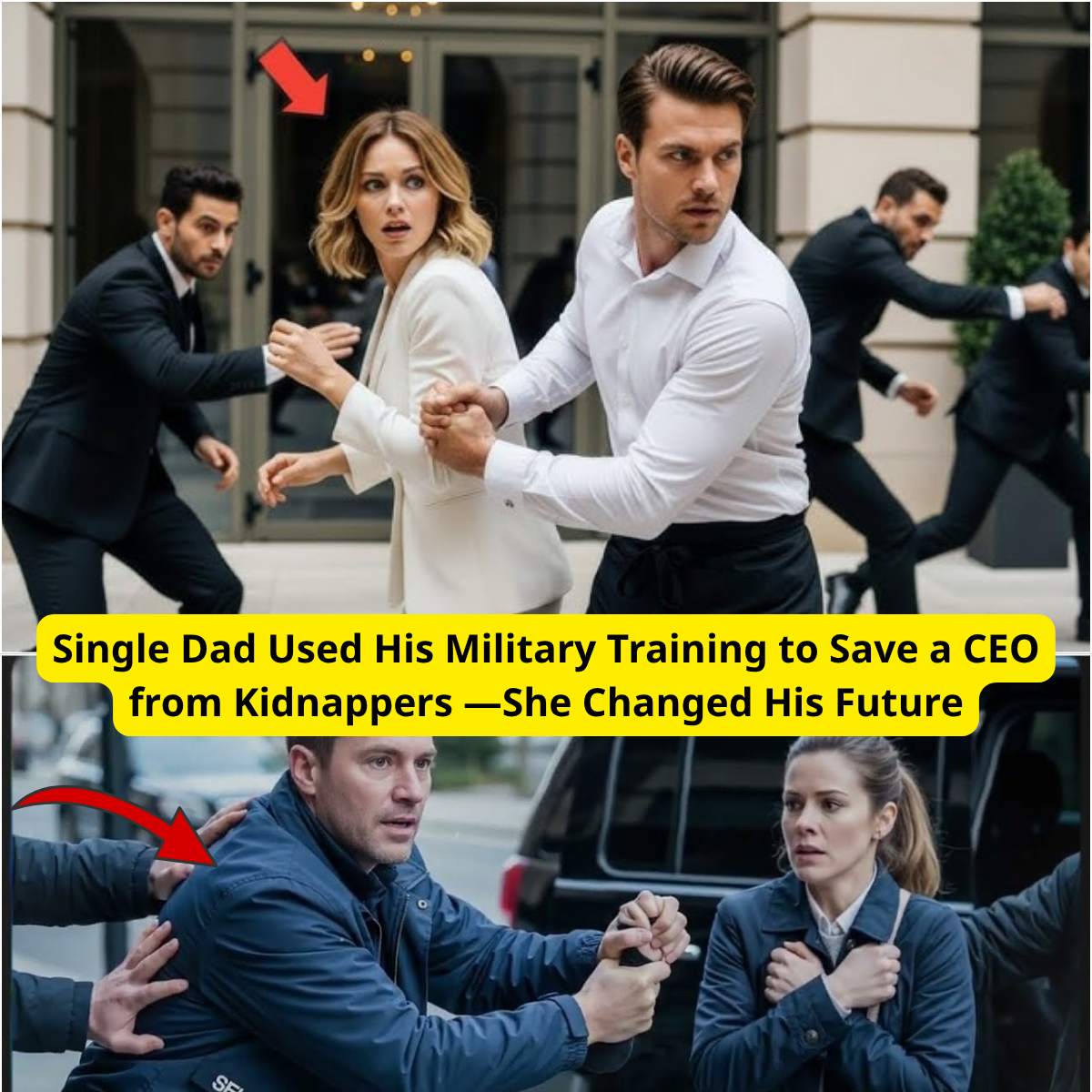
They didn’t call out. They didn’t hesitate. The man near the rear bumper rose in a single, fluid motion, his right hand coming out of his jacket carrying a heavy, black nylon zip-tie. The second man cut across the plaza at a dead sprint, aiming directly for Claire’s blind spot behind her right shoulder.
It took Ethan precisely two seconds to analyze the geometry of the street. It wasn’t a robbery; it was a snatch. A professional extraction in broad daylight.
His coffee cup hadn’t even touched the counter before his boots hit the pavement outside.
Two Seconds of Violence
The transition from a civilian delivery driver to a Marine sergeant is not a gradual process; it is a toggle switch. The cold Denver air hit Ethan’s face as he crossed the three lanes of traffic, his stride long and low, his center of gravity dropped to maintain traction on the black ice.
“Hey!” the man near the rear bumper called out, his eyes finally locking onto Ethan’s approaching silhouette. He reached into his coat, his fingers closing on something metallic.
Ethan didn’t answer. He didn’t warn them.
The first attacker had already closed his left hand around Claire’s forearm, his fingers digging into the wool of her coat as he began to drag her toward the open rear door of the SUV. Claire let out a sharp, choked gasp, her tablet shattering on the frozen granite as her heels lost their grip on the ice.
“Get in the—” the attacker began.
He never finished the word. Ethan arrived like a descending block of concrete. He didn’t use a fist; he drove his entire forearm into the side of the first man’s neck, utilizing his full running momentum. The impact sounded like a wet sack of flour hitting a deck. The man’s grip broke instantly, and he flew backward into the side of the Navigator, his head bouncing off the reinforced glass of the rear window with a dull thunk.
The second attacker, younger and leaner, reacted instantly. He dropped low and swung a heavy, lead-weighted sap toward Ethan’s temple.
Ethan didn’t try to dodge. He stepped into the strike, shortening the arc of the weapon. The leather sap caught him along the ridge of his left shoulder blade, a dull, blinding burst of pain that he chose to ignore. He caught the man’s right wrist with both hands, twisted the radius bone clockwise until the joint screamed, and drove his knee straight into the attacker’s common peroneal nerve on the outside of the thigh.
The man’s leg collapsed beneath him like a broken tripod. He hit the ice, groaning, his fingers opening as the sap skated away into the gutter.
“Inside! Get inside!” the driver of the Navigator shouted from within the cab. He had a heavy black pistol resting against the window sill, but he couldn’t fire without hitting his own men.
Ethan grabbed Claire by the collar of her coat and threw her behind him, using his own broad torso to completely block the driver’s line of sight. He didn’t look at her; his eyes were fixed on the driver’s hand. He reached down, grabbed the heavy iron door of the Navigator, and slammed it shut with a violent, two-handed heave that caught the driver’s extended arm against the frame.
A sharp yelp of pain echoed from the interior.
Then came the sound that ends every street fight: the rising, high-frequency wail of a Denver Police Department cruiser turning the corner from 16th Street, its red and blue lights painting the gray buildings in rhythmic strokes.
The young attacker on the ice scrambled up on one good leg, hauling his semi-conscious partner into the back seat of the Navigator. The SUV’s tires screamed against the asphalt, throwing a shower of black slush into the air as it tore away from the curb, leaving a thirty-foot strip of burnt rubber behind.
The plaza went dead quiet again, save for the hum of the city and the sound of Ethan’s ragged breath.
He turned slowly. Claire Hartman was leaning against the granite pillar of her own building, her hand pressed against her throat, her chest heaving under her navy coat. Her face was the color of skim milk.
She looked at Ethan—at his faded canvas coat, his salt-stained boots, and the dark drop of blood beginning to ooze from the corner of his mouth where a stray elbow had caught him.
“You,” she whispered, her voice trembling but controlled by an immense effort of will. “Who are you?”
Ethan wiped his mouth with the back of his hand, his eyes already scanning the street to ensure no secondary team was waiting. “Just a dad who needs a coffee, ma’am,” he said, his voice dropping back into its quiet, flat routine. “The police are here. You should sit down.”
The Statement
The interior of the Downtown Precinct smelled of old radiator steam and wet wool. Ethan sat at a metal desk for three hours, his left shoulder throbbing with a dull, rhythmic ache where the sap had struck him. He had missed his delivery shift orientation. That meant fifty dollars gone from his weekly calculation, a late fee he would have to explain to the landlord by Friday.
Claire sat across the room in a private office, surrounded by two corporate lawyers and a deputy chief of police. Every time Ethan looked up through the glass partition, he found her staring at him. Not with the polite gratitude of a wealthy woman who had been handled well, but with the sharp, analytical gaze of an engineer examining a structural component that had held under unexpected stress.
When the detective finally closed his folder and thanked him, Ethan stood up, his joints stiff. He walked out into the gray afternoon light of the precinct lobby, his mind already shifting to the logistics of picking Lily up from her after-school program at 3:30 PM.
“Mr. Miller.”
Claire Hartman was waiting near the glass exit doors. She had changed into a fresh coat, but she looked smaller now, the corporate armor slightly cracked around the edges.
“Ms. Hartman,” Ethan said, stopping a respectful three feet away. “The police said they found the vehicle in an abandoned lot near Five Points. They think it was a corporate extortion attempt. You should have an escort home.”
“I have four private guards outside right now,” she said softly, looking down at his hands. His knuckles were raw, the skin split across the middle finger of his right hand. “But none of them were there at seven this morning. You knew they had weapons, Ethan. I saw the driver lift the gun. Why did you step between us?”
Ethan looked past her at the snow beginning to fall again over the city. “Because you were on the ground, ma’am. In my world, you don’t leave people on the ground.”
Her eyes drifted down to his forearm, where the canvas sleeve of his jacket had ridden up, revealing the faded green crosshairs of his Marine Corps tattoo.
“How long were you in?” she asked.
“Ten years,” he said. “First Battalion, Eighth Marines.”
“And now you’re checking padlocks at a railyard for fifteen dollars an hour.” Her voice wasn’t condescending; it had the flat, hard edge of a woman who hated inefficiency. “That’s a waste of a structural asset, Mr. Miller.”
She reached into her coat and pulled out a heavy, textured business card with a minimalist silver logo. “Come to my office tomorrow at nine. Don’t go to the loading dock. Take the private elevator to the top floor.”
Ethan looked at the card. The silver ink caught the fluorescent light of the station. “Ms. Hartman, with all respect, I’m a restoration guy and a grunt. I don’t know anything about logistics or corporate strategy.”
“I don’t need a strategist, Ethan,” she said, her eyes locking onto his with the same weight as the iron doors across the street. “I need someone who looks at an asset and sees a person. I need a head of personal security who doesn’t check his contract before he takes a hit for me. Come tomorrow. Let’s talk about what you’re actually worth.”
The Hero’s Metric
That night, the apartment was warm. Ethan had turned the radiator valves with a pipe wrench until they stopped banging, and the smell of toasted cheese sandwiches filled the small kitchen.
Eight-year-old sophie—Lily—sat at the Formica table, her legs swinging six inches above the floor. She was drawing with a purple crayon on the back of an old delivery manifesto Ethan had brought home weeks ago.
“Daddy?” she asked without looking up.
“Yeah, bug.”
“Your shoulder looks funny when you move it.”
Ethan stopped scraping the crumbs off the counter. He reached back, his thumb tracing the large, purple bruise that had formed across his shoulder blade. “Just a little bump at work, Lily. Nothing to worry about.”
She turned the paper over. She had drawn a figure in a dark blue coat with an enormous, jagged yellow star on its chest. Beside it was a smaller figure with a purple ponytail.
“The teacher said heroes wear capes,” Lily said, her thumb tracing the crayon lines. “But I told her you wear boots because capes get caught in the truck doors.”
Ethan walked over, his big hand resting gently on her small shoulder. He looked at the business card sitting on the microwave—the silver logo clean against the greasy white plastic.
He had spent three years believing that his only job was to minimize the damage, to keep the water out of the basement and the hunger out of Lily’s stomach until she was old enough to leave this apartment behind. He had thought survival was a solitary business, measured in hours worked and dollars saved.
But looking at the purple star on the paper, he realized that survival wasn’t the metric. Lily didn’t need a father who was simply alive; she needed a father who believed the world was worth saving.
“Hey, Lily,” he said softly.
“Yeah?”
“Tomorrow morning, we’re going to take the bus downtown before school. I have to go to a meeting in a big glass building.”
She looked up, her eyes wide. “Are they going to give you a new truck?”
Ethan smiled, a real, slow movement that felt unfamiliar to the muscles in his cheeks. “No, bug. I think they’re going to let me fix the foundation.”
The Capital Structure
The fifty-fourth floor of the Hartman Building felt like the interior of a cloud. The walls were thick slabs of low-iron glass that looked out over the snow-capped peak of Mount Blue Sky, and the carpet was so thick Ethan felt like he was walking through a dry marsh.
Claire Hartman was sitting behind an acre of polished walnut wood, her tablet replaced by three neat stacks of legal documents. She didn’t look up until Ethan reached the edge of the desk. He was wearing his only good shirt—a faded blue Oxford he had bought for Sarah’s funeral—and his boots had been polished with black wax until the salt stains disappeared.
“Your military file came through the veteran liaison office at eight this morning, Sergeant Miller,” Claire said, closing the top folder with a crisp snap. “Two Navy Commendation Medals with a Combat ‘V’. An honorable discharge. And a letter from your company commander stating that you routinely managed security logistics for forty-man outposts in high-threat sectors.”
Ethan stood at attention, his hands clasped loosely behind his back. “The terrain was different, ma’am.”
“The risk profile isn’t,” she countered. She stood up, walking to the window that looked out over the entire northern grid of the city. “The men who tried to take me yesterday were hired by a subcontractor whose logistics license I revoked last November. It’s going to take six months for the federal court to process the indictments. During that time, I have to run a company that employs four thousand people across three states.”
She turned to face him. “The salary is ninety-five thousand a year. Full medical through the corporate plan, including dental and pediatric specialist care for your daughter. The schedule is tied to my movement ledger, which means when I’m in the office, you’re on-site; when I’m home, you’re off-duty. You’ll have a vehicle allowance, and your hours will be structured so you can drop Lily off at 8:00 AM and be home by her dinner.”
Ethan’s throat went dry. The numbers she was throwing out didn’t fit into his blue ledger. They didn’t just pay the rent; they wiped out the debt, the late fees, and the small, terrifying knot of panic that sat in his stomach every time Lily sneezed.
“Ms. Hartman,” he said, his voice dropping into a rough whisper. “That’s… that’s too much for a guy who just used a door to hit a driver.”
Claire walked around the desk until she was standing directly in front of him. She didn’t look like an executive now; she looked like the person who had been on her knees on the cold stone of the plaza, looking up at a man who had put his ribs between her and a bullet.
“You didn’t check my balance sheet before you jumped across that street, Ethan,” she said, her voice dropping its professional veneer, revealing a deep, emotional resonance. “You didn’t ask if I was a billionaire or a clerk. You saw a person who was about to be broken, and you used your own body to reinforce the structure. Let me do the same for you. Let me help you build something that doesn’t feel like it’s going to collapse every time the rent is due.”
Ethan looked down at his own split knuckles. For three years, he had been waiting for the other shoe to drop, for the winter that would finally be too cold for his coat to handle. He had forgotten that sometimes, the world doesn’t just take; sometimes, it offers a hand that is just as hard and real as the pavement.
“When do I start?” he asked.
“Right now,” she said, handing him a small, silver security badge with his name engraved across the bottom. “The car is downstairs. We have a water treatment plant to inspect in Fort Collins, and my driver tells me you know the route.”
The Meadow
Six months later, the snow had melted from the valleys, leaving the foothills around Golden covered in a thick, vibrant carpet of green sweetgrass and wild blue flax.
The afternoon sun was warm, the sky that deep, brilliant Colorado blue that looks like it has been stained by an artist. In the center of the park near the clear water of Clear Creek, Lily was running through the grass, her purple ponytail bouncing behind her as she chased a red plastic frisbee.
Claire Hartman was sitting on the edge of a timber picnic table, her high heels replaced by a pair of old running shoes, her navy coat traded for a simple white linen shirt. She was watching Lily with a small, quiet smile that Ethan had come to recognize over the hundred long drives they had shared across the state.
“She’s getting taller,” Claire said, nodding toward the grass where Lily had just successfully caught the disc on the short hop. “She looks like you when she runs. Same tilt to the shoulders.”
Ethan stood next to the table, his dark blue corporate suit clean, his hands clasped behind his back from old habit, though his posture had lost the defensive hunch of the railyard days. His shoulder didn’t hurt when the rain came anymore; the corporate physical therapy plan had fixed that within forty days.
“She likes the park,” Ethan said, his voice steady. “She likes that we don’t have to leave before the sun goes down.”
Claire looked up at him, her eyes catching the light from the creek. “Are you still looking for the exit doors, Ethan? Every time we walk into a restaurant, you spend the first five minutes checking the fire paths.”
“Old habits, ma’am,” he said, though he didn’t call her ma’am with the same distance he used to. It had become a joke between them—the Marine sergeant and the infrastructure boss.
“You saved my life, Ethan,” she said, her voice turning serious as she looked across the meadow at the child in the dinosaur shirt. “I don’t think I’ve ever properly told you what that means. My family spent forty years teaching me that every relationship is a transaction, that everyone wants a piece of the foundation. When you crossed that street in the snow, you broke the ledger. You showed me that some things are just true.”
Ethan turned, his gray eyes softening as he looked down at her. “I didn’t save a CEO, Claire. I just saved a woman who was on the ice. The rest of it… the job, the apartment, the medical plan… that was just you showing me that the concrete had cured.”
Lily came running back across the grass, her face red from the heat, her small fingers catching Claire’s hand as she pulled her toward the swings. “Auntie Claire! Come on! You promised you’d show me how to do the big jump!”
Claire laughed—that real, deep sound that had first broken through the service hallway at the precinct—and let herself be pulled away into the sunlight.
Ethan stood by the timber table, his arms crossed over his chest, the warmth of the Colorado summer setting into his shoulders. The math of his life had changed completely. It was no longer about hours worked or dollars left over; it was about the simple, unshakeable weight of a life that had been reinforced from the bottom up. One act of courage, one moment of kindness on a cold morning, and the structure had held. The winter was over, and the house was stable at last.