Single Dad Billionaire Was Left Waiting at His Office—Six Minutes Later, He Fired the Executives”””
Single Dad Billionaire Was Left Waiting at His Office—Six Minutes Later, He Fired the Executives”””
The rain did not fall in drops; it smeared against the triple-paned glass of the 42nd floor like grease.
At 5:54 a.m., Manhattan was a smudge of charcoal and wet slate. Below, the city slept behind blackout curtains, nestled in the quiet luxury of unfinished dreams and central heating. But inside the corner office of Cole Holdings, the overhead fluorescents were dead. The only illumination came from the harsh, blue glare of a laptop screen and a single desk lamp that cast long, skeletal shadows across the polished mahogany.
Ethan Cole sat motionless. His fingers were loosely tented beneath his chin, his eyes fixed not on the pre-market tickers blinking across his secondary monitor, but on a cheap, scratched silver picture frame.
In the photograph, an eight-year-old girl smiled with a fierce, unselfconscious joy, showcasing a missing front tooth and two aggressively crooked ponytails. Her name was Maya. She was twenty-four now, a residency student in Chicago, but to Ethan, this artifact was the anchor. The financial news networks currently valued his company at $4.2 billion, a number that felt entirely abstract. The photograph, however, felt heavy. It felt real.
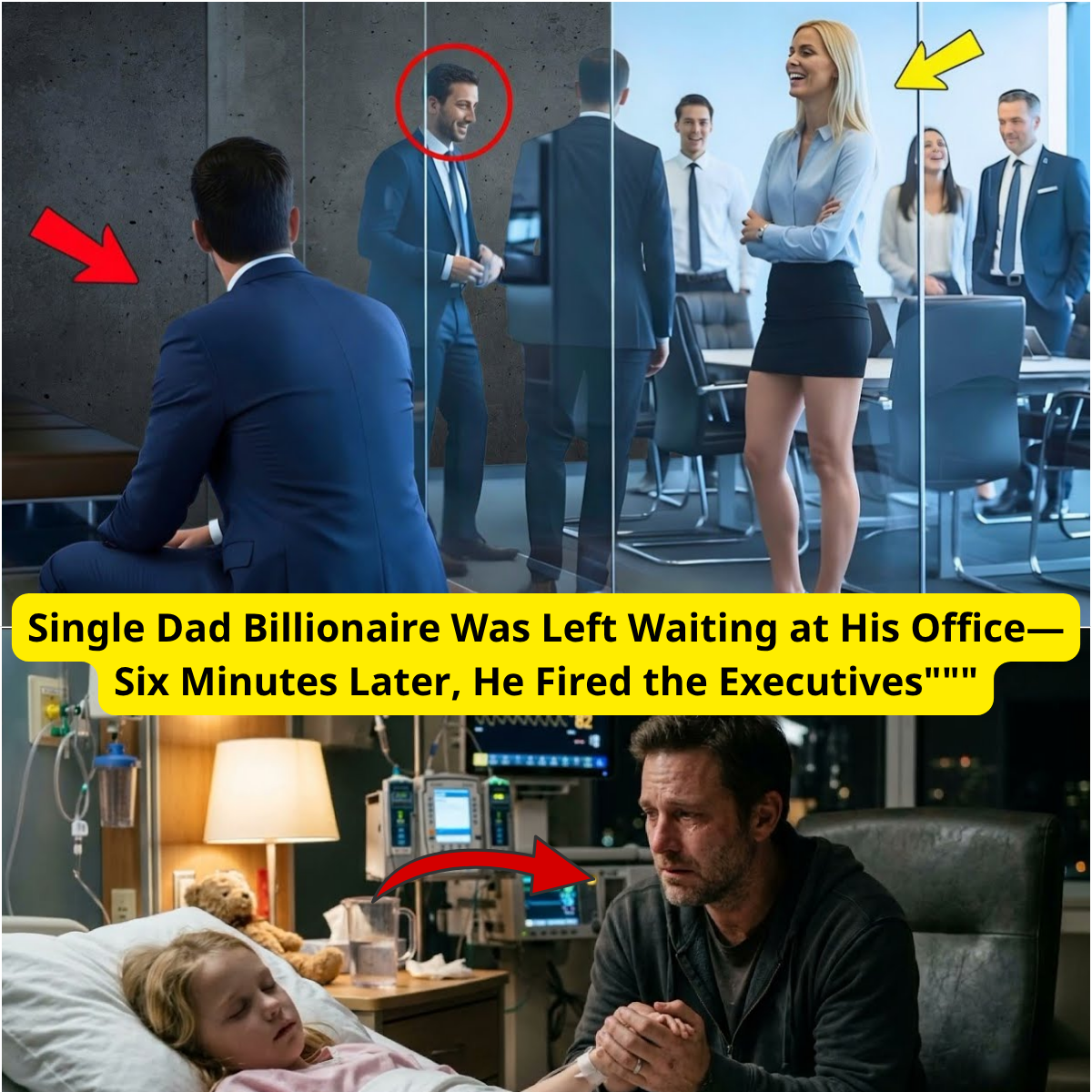
To the financial press, Ethan was “The Ghost of Wall Street”—a ruthless, tight-lipped savant who dismantled underperforming acquisitions with surgical precision. To his competitors, he was an apex predator who didn’t sleep. But nobody saw the quiet architecture of his real life. Nobody saw the midnight containers of cold, leftover pasta eaten over a sink, or the decades spent balancing investor calls on a Bluetooth earpiece while helping Maya carry a papier-mâché volcano into a public school. Nobody remembered him sitting on the linoleum floor of a municipal hospital ER, his back against the wall, counting the seconds between his daughter’s ragged, asthmatic wheezes.
He had built Cole Holdings from a windowless storage unit in Queens, working on a secondhand Dell computer that groaned whenever he ran a spreadsheet. Back then, shivering in a winter jacket because the landlord turned off the building’s radiator at 8:00 p.m., Ethan had made a pact with himself. It was a secular vow, carved into his knuckles through hard work: If I ever earn the right to lead, I will never forget what the bottom feels like.
That promise was the sole reason he tolerated failure far better than he tolerated arrogance. Failure was a calculation gone wrong; arrogance was a rot of the soul.
At exactly 6:00 a.m., Ethan had scheduled a mandatory leadership meeting. The invitees were his inner circle—six senior executives who commanded the company’s core divisions. The calendar invite hadn’t included an agenda, but the executives assumed it was about the Q3 expansion strategy.
It wasn’t. It was about an execution.
The previous Thursday, during a closed-door strategy session, Martin Reeves—the Chief Financial Officer, a man whose tailored Tom Ford suits always looked as though they had been painted onto him—had presented a “fiscal optimization initiative.” The slideshow was a masterpiece of corporate euphemism. It spoke of “headcount rationalization” and “operational streamlining.” Stripped of its vocabulary, the proposal was simple: terminate four hundred entry-level and mid-tier employees across the logistics and administrative sectors. The resulting savings would perfectly insulate the senior executive bonus pool from the year’s market dip.
Ethan had sat through the two-hour presentation without uttering a single word. He hadn’t frowned; he hadn’t nodded. He had simply watched. He watched Martin’s smooth, practiced hand gestures. He watched Sarah Jenkins, the VP of Human Resources, nod in passive agreement. He watched Julian Vance, the Head of Operations, stare at his lap, avoiding eye contact but remaining silent.
They thought his silence was compliance. They thought the machine was calculating the dividend yield.
The digital clock on the media console shifted.
5:59 a.m.
Ethan did not move. His coffee had gone completely cold, a thin skin forming over the dark liquid. Outside, the storm picked up, the wind howling as it whipped through the concrete canyons of the Financial District.
6:00 a.m.
The heavy oak doors of the boardroom remained closed. The silence in the executive suite was absolute, save for the hum of the HVAC system. Ethan checked his Breitling—not out of impatience, but with the cold, diagnostic precision of a scientist recording data.
6:02 a.m.
Still, nothing. The hallway outside was a vacuum.
At 6:04 a.m., the door to Ethan’s private office clicked open. His executive assistant, David, walked in quietly. David looked anxious, holding a tablet to his chest like a shield. He had been with Ethan for seven years and knew how to read the atmospheric pressure in the room. Right now, the barometer was dropping rapidly.
“Sir,” David said, his voice dropping an octave instinctively. “I just heard from Martin’s assistant. And Julian’s. They’re downstairs in the lobby or just pulling into the garage. They… they mentioned the call time was unusually early for a non-trading framework. They’re on their way up.”
Ethan didn’t turn his head. He kept his eyes on the rain-streaked skyline. “Too early,” he murmured.
“Yes, sir.”
“Thank you, David. Leave the doors open.”
The words too early hung in the air like carbon monoxide—invisible, but suffocating. Ethan leaned back in his leather chair. A memory, sharp and uninvited, cut through his thoughts. Three years after founding the firm, during the tech mini-crash, he had slept in the back of a rusted Honda Civic for four months. He had sold his apartment to pay for Maya’s specialized medical treatments and to keep his two junior developers on payroll. He remembered using a public restroom at a gas station to shave before presenting to venture capitalists.
In Ethan’s vocabulary, too early was a phrase reserved for the dead. It was a luxury that people living on the edge of survival could never afford. If you were poor, you were early, or you were replaced.
At 6:06 a.m., the silence was broken by the sound of muffled laughter and the squeak of leather-soled shoes on the polished travertine hallway.
The six executives entered the boardroom adjacent to Ethan’s office, carrying artisanal lattes and insulated tumblers from the boutique cafe down the street. They were chatting about a golf handicap, their voices bright and casual, completely oblivious to the heavy, stagnant air of the suite.
Martin Reeves led the pack, his coat damp from the run between his town car and the building elevator. He looked into Ethan’s office and smiled smoothly, checking his own watch with an easy air of familiarity.
“Morning, Ethan,” Martin said, leaning against the doorframe. “Traffic on the FDR was an absolute parking lot. Total disaster.”
Julian Vance stepped in behind him, taking a sip from his cup. “You’re here before sunrise again, boss? Honestly, I don’t know how you do it. Some of us need at least a few hours of REM sleep.”
None of them noticed that Ethan hadn’t returned their smiles. None of them realized that the meeting they had spent the last week preparing for had already concluded before they reached the 42nd floor.
Ethan slowly stood up. He picked up a thick, manila folder from his desk, closed his laptop with a soft, deliberate click, and walked into the boardroom.
The laughter died instantly. It wasn’t because Ethan looked angry; it was because he looked entirely vacant. His presence possessed a gravity that pulled the oxygen out of the room. The executives hurriedly took their respective seats around the massive glass conference table, setting their coffee cups down with small, nervous clicks.
Ethan didn’t sit. He walked to the head of the table, looked directly into every face present, and spoke. His voice was low, devoid of theatricality, but it carried the weight of an anvil.
“I asked all of you to be here at six o’clock because I wanted to discuss responsibility,” he said. He didn’t raise his voice, which made it infinitely more terrifying. “Instead, you demonstrated exactly why this company is starting to lose its soul.”
The executives exchanged uneasy, swift glances. Martin Reeves, accustomed to being the translator between Ethan and the rest of the board, cleared his throat and adjusted his tie.
“Ethan, with all due respect, we’re only six minutes late,” Martin said, forcing a self-deprecating chuckle. “The storm caught everyone off guard. It’s a minor scheduling friction.”
“Six minutes,” Ethan repeated. The words were soft, almost academic.
He turned away from them, walking toward the floor-to-ceiling glass windows that overlooked the waking city. The gray dawn was finally breaking, casting a pale, washed-out light over the boardroom.
“When Maya was seven, she had a severe acute asthma attack in the middle of the night,” Ethan said, his back still to the room. “Her airways closed. She stopped breathing. I called 911. I did CPR on my living room floor until my shins were bruised from kneeling.”
The room went dead silent. Julian Vance froze with his pen hovering over his notepad.
“The ambulance arrived six minutes late,” Ethan continued, his voice steady, his eyes locked on the distant, blurry lights of the harbor. “The paramedics were professional. They apologized. They said the rain had caused an accident on the expressway. Six minutes. I spent three hundred and sixty seconds watching my daughter’s lips turn blue, wondering if I was going to bury her before the sun came up.”
He turned back around. His face was a mask of cold stone, but his eyes were burning.
“Six minutes can feel meaningless to a man who spends his weekends in the Hamptons,” Ethan said, leaning his palms flat against the glass table, tilting his body toward Martin. “But to someone waiting for a lifeline, six minutes is an eternity. You think this is about punctuality, Martin? You think I brought you here at dawn to play a schoolmaster checking an attendance sheet?”
Martin opened his mouth, but no sound came out.
“It’s about standards,” Ethan said, his voice dropping lower, vibrating with an intensity that made the glass table seem to hum. “It’s about who you are when you think nobody is holding you accountable. It’s about respect for the entity that feeds your families.”
He walked down the length of the table, his eyes locked onto Sarah Jenkins, who shrank back slightly into her ergonomic chair.
“Last week, you sat in this exact room and proposed cutting four hundred and twelve jobs from our logistics division,” Ethan said. “You threw out metrics. You talked about ‘slimming the fat.’ You did it because you wanted to ensure that your annual performance bonuses remained entirely unaffected by the macro-downturn.”
His jaw tightened, a small muscle twitching near his ear.
“Those four hundred people don’t have town cars, Martin. They don’t have drivers. They take the subway from the outer boroughs at 4:30 a.m. They work two jobs. They show up early every single day of their lives—not because they want a promotion, but because they are terrified of what happens if they lose their health insurance for even a single weekend. They cannot afford the luxury of being six minutes late.”
Martin swallowed hard, trying to claw back his composure. “Ethan, we have a fiduciary duty to our shareholders. The market expects a certain margin expansion. We were simply thinking about capital efficiency and expectations—”
“No,” Ethan interrupted, his voice cutting through Martin’s defense like a blade. “You were thinking about comfort. You were thinking about your mortgages, your country clubs, and your insulation from the real world.”
The silence that followed was suffocating. For years, these executives had viewed Ethan Cole as a highly efficient corporate machine. They thought his impossible discipline, his 18-hour workdays, and his relentless focus were the natural byproducts of a billionaire’s ambition. They had never understood the architecture of his mind. They had never understood that his discipline wasn’t built on greed; it was built on fear.
The fear of being helpless again. The fear of failing the people who depended on him. The fear of becoming like the very men who now sat around his table—bloated, comfortable, and blind to the suffering of ordinary people.
Ethan walked back to the head of the table. He took the manila folder he had brought in and opened it. Inside were six individual blue documents, each stamped with the seal of the corporate legal department.
With a smooth, practiced motion, he slid the folders across the polished surface. They drifted down the glass table, coming to a stop in front of each executive.
“I spent the night reviewing the executive compensation structures,” Ethan said, crossing his arms. “Effective at 6:00 a.m. today—six minutes ago—all senior leadership bonuses for the fiscal year are suspended indefinitely.”
Julian Vance gasped, his hand dropping his pen. “Ethan, you can’t be serious. Our contracts—”
“Your contracts contain a discretionary performance clause tied to corporate culture and board approval, which I control,” Ethan said coldly. “Furthermore, the layoff proposal is dead. It has been permanently deleted from the agenda. The capital saved from freezing your bonuses, along with a fifteen percent reduction in all executive base salaries, will be reallocated. It will fund a permanent retention pool and an enhanced healthcare subsidy for our hourly staff.”
Sarah Jenkins looked down at her folder, her face pale. “Ethan… this is a radical restructuring. The board will want a consultation. The volatility—”
“If anyone in this room feels that this environment is too volatile, or too demanding,” Ethan said, looking directly into Sarah’s eyes, “your resignations will be accepted by noon today. No severance. No non-compete waivers.”
He leaned in close, his voice barely a whisper, yet filled with an absolute, terrifying certainty.
“I built this company from a rented storage room with people who showed up on time, stayed loyal, and treated each other with dignity. If the leadership of this firm can no longer meet that baseline, then the leadership changes. It’s that simple.”
The executives stared at the blue folders in front of them. Nobody moved to open them. Nobody looked up. The casual, confident energy that had filled the hallway six minutes prior had been completely eradicated.
Outside, the rain grew heavier, drumming a frantic, relentless rhythm against the glass windows of the skyscraper. The city below was beginning to wake up, the headlights of thousands of commuter cars forming a crawling river of yellow and red light through the gray morning.
For the first time in their careers, the six figures sitting around that table understood the true nature of the man they worked for. The billionaire they feared wasn’t angry because they had missed a deadline or compromised a margin.
He was disappointed because they had forgotten what it felt like to be ordinary. And in Ethan Cole’s world, that was the only unpardonable sin.









